For Humanism, Indians, Bengalureans & IIScians: We Grow Resourceful Purpose_SpAces: Collaborate with Mitrallys wanting to know, Grow & Help Futureones Grow.
We are fans of Progress may not be of Congress, We are fans of GDP maynot be of BJP, We are fans of Akal may not be Akali Dal, We are fans of Aaj not AAP, We are fans of A.I. in politics not AIMIM, We are fans of JP yes not JDS, We are fans of Gyan-hi not any Gandhi or Modi, We are fans of Public eye not CPI, We are fans of MSP not BSP, We are fans of DeMoKrats not DMK, We are fans of Unity not SP, We are fans of Truth not TMC, We are fans of Justice not JD(U), We are fans of Equality not NCP, We are fans of Freedom not Shiv Sena, We are fans of Wisdom not RJD, We are fans of Harmony not BJD, We are fans of Clarity not CPM,
We are fans of Republic not RPI, We are fans of Citizens Empowerment not Elites Entitlement, We are fans of Constitution not any institution,
We are fans of Satyameva Jayathe not mera party hi satyahai,
We are fans of Citizens_Participation not Parties_Domination,
We are fans of Democracy not Partycracy,
We are here for W.E (WiseNlight Electors) not to Gaslight Citizens.
“Arrogance” Blinds both eyes of Intelligence(IQ) & Tolerance(EQ) & leads to Ignorance. more “Citizens’ Awaraness-Arrogance” in Nation.
While Rational Acceptance increases Tolerance+Intelligence leading to Benevolence. Constitutional Awareness-Activism in Nation.
Social Solutions to bring more Equity & Tolerance (Reduce Inequality & Intolerance) is Equal Equitable Education & Healthcare for all Citizens.
Tolerance
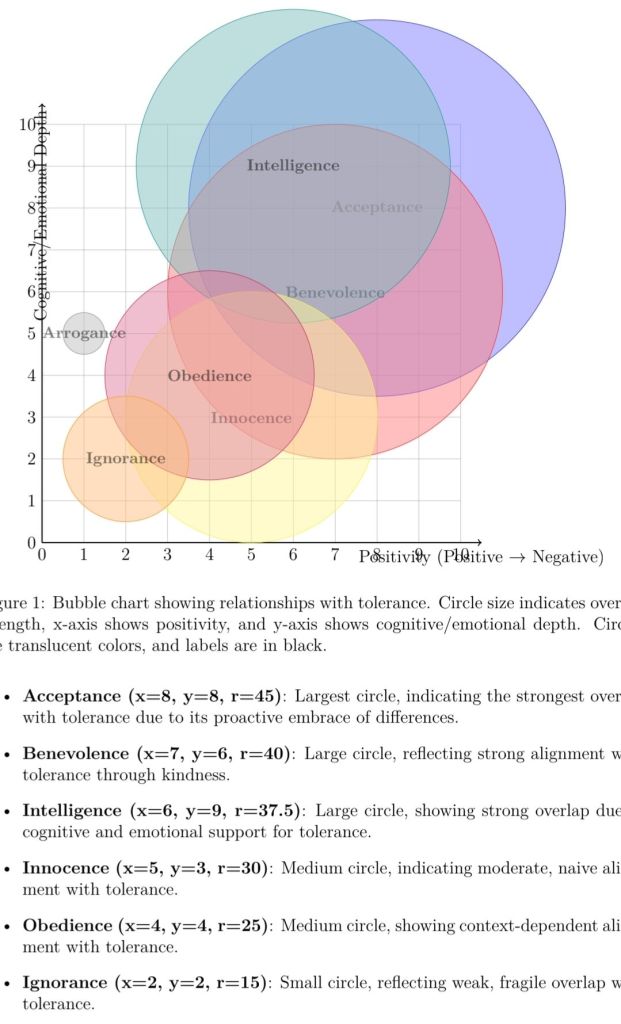
To extend the analysis of tolerance by including acceptance and intelligence as additional factors, I’ll incorporate these into the radar chart visualization, updating the set theory framework to account for their relationships with tolerance and the previously discussed concepts (innocence, ignorance, arrogance, benevolence, obedience). The goal is to visualize the strength of overlap between tolerance and all these factors, maintaining the same methodology as before.
Step 1: Defining the New Factors as Sets
Acceptance (C): The set of attitudes and behaviors involving embracing or approving of differences in beliefs, identities, or behaviors without judgment. Acceptance is closely related to tolerance but often implies a deeper, more positive endorsement rather than mere endurance.
Intelligence (N): The set of cognitive abilities involving reasoning, problem-solving, and understanding complex ideas. In this context, intelligence includes emotional and social intelligence, which influence how one processes and responds to differences.
These are added to the existing sets: Tolerance (T), Innocence (I), Ignorance (G), Arrogance (A), Benevolence (B), and Obedience (O), within the universal set U (all possible human attitudes, behaviors, or states of mind).
Step 2: Set Theory Analysis for New Factors
1. Tolerance and Acceptance (T ∩ C):
Intersection: Acceptance and tolerance have a significant overlap, as both involve positive engagement with differences. Acceptance is often seen as a stronger form of tolerance, implying not just enduring but embracing diversity. For example, accepting someone’s cultural practices goes beyond tolerating them.
Difference: Tolerance without acceptance (T − C) includes grudging or pragmatic tolerance (e.g., enduring differences due to social pressure). Acceptance without tolerance (C − T) is rare but might occur in performative acceptance without genuine endurance of discomfort.
Complement: The complement of acceptance (C’, rejection or indifference) is largely incompatible with tolerance, as rejection often fuels intolerance.
2. Tolerance and Intelligence (T ∩ N):
Intersection: Intelligence supports tolerance by enabling understanding of diverse perspectives and critical reflection on biases. Emotional intelligence, in particular, fosters empathy, which aligns with tolerance. For example, an intelligent person might tolerate differing opinions by reasoning through their validity.
Difference: Tolerance without intelligence (T − N) can occur in simplistic or instinctive forms (e.g., tolerance due to social norms rather than understanding). Intelligence without tolerance (N − T) might manifest as intellectual arrogance, where knowledge leads to dismissal of others’ views.
Complement: The complement of intelligence (N’, lack of reasoning or understanding) overlaps with ignorance but can still coexist with tolerance if driven by other factors like benevolence or innocence.
3. Interactions with Other Concepts:
Acceptance and Benevolence (C ∩ B): Strong overlap, as both involve positive, goodwill-driven engagement with others.
Intelligence and Ignorance (N ∩ G): Mutually exclusive, as intelligence implies knowledge, while ignorance is its absence. However, intelligence can coexist with arrogance if knowledge fosters superiority (N ∩ A).
Acceptance and Innocence (C ∩ I): Similar to tolerance, acceptance can stem from innocent, non-judgmental attitudes but may lack depth without experience.
Intelligence and Obedience (N ∩ O): Intelligence can inform obedience (e.g., following rules after reasoning) but may also lead to questioning authority, reducing blind obedience.
Step 3: Updated Radar Chart
The radar chart now includes acceptance and intelligence alongside the original factors. The values (0–100) represent the estimated strength of overlap with tolerance, based on the set theory analysis:
Acceptance (C): Very high overlap (90), as acceptance is a deeper form of tolerance.
Intelligence (N): High overlap (75), as cognitive and emotional intelligence support tolerance through understanding and empathy.
Benevolence (B): High overlap (80), as before, due to shared kindness.
Acceptance has the strongest overlap with tolerance, reflecting its role as a proactive, positive form of tolerance.
Intelligence and benevolence are close seconds, highlighting their roles in fostering informed and kind tolerance.
Innocence and obedience remain moderately aligned, context-dependent as before.
Ignorance and arrogance show minimal overlap, as they often undermine true tolerance.
The chart visually emphasizes that tolerance is most strongly supported by acceptance, intelligence, and benevolence, while ignorance and arrogance are least aligned.
If you’d like to:
Explore specific intersections (e.g., T ∩ C ∩ N)?
Add more factors to the analysis?
Use a different visualization (e.g., bar chart)?
Incorporate real-world examples via external data? Please let me know your preference!
Being Blindly Tolerant or Tyrant to citizens both are Issues..
As a nation we need to find the Balance to be Tolerant to Citizens & Indian Constitutionalists and Tyrants to the *Anti-Constitutionalists.* eg.. Taslima Nasreen and Sheikh Haseena is a Tolerant Bangladeshi, who India has provided shelter.. Even Dalai Lama and Tibetan are Tolerant Refugees.. there needs to be system of testing Constituonism.
Indian Constitution as a Religious_Philosophy for Better life of Citizens. (Constitutionism).
Opposite of SwarthVidanis or Method of Selfs_ish (NOT Nation-ish)
Becoming a Samvidhani (Constitutionalist), a practitioner of Samvidana Dharma (I.e Constitutionalism) , involves embracing a syncretic spiritual and philosophical path that integrates India’s diverse historical, cultural, and religious evolution into a modern constitutional framework. Samvidana Dharma, as described, is a culmination of India’s multifaceted heritage—from prehistoric times through various religious and cultural periods to the present constitutional era. Below is a guide on how to become a Samvidhani, outlining the principles, practices, and mindset required to embody this unique path.
How to Become a Samvidhani
“Samvidana Dharma” represents the synthesis of India’s rich historical and spiritual evolution, encompassing prehistoric traditions, the Indus Valley Civilization (IVC), Vedic Sanatana Dharma, Buddhist influences under Ashoka, Greek interactions, Mughal Islamic culture, British Christian influences, communistic ideologies, and the modern constitutional framework. Becoming a Samvidhani involves embracing this pluralistic heritage while aligning with the values of India’s Constitution. Below is a step-by-step guide to embody this path.
1. Understand the Historical and Philosophical Foundations
Study India’s Diverse Heritage: Familiarize yourself with the key periods of India’s evolution:
Prehistoric AdiDharma and Adivasi Traditions: Learn about the spiritual practices of India’s indigenous communities and their connection to nature and animism.
Keezhadi and IVC Dharma: Explore the urban sophistication and egalitarian principles of the Indus Valley Civilization and Keezhadi excavations.
Sanatana Vedic Period: Understand the philosophical depth of the Vedas, Upanishads, and concepts like Dharma, Karma, and Moksha.
Ashokan Buddhist Period: Study the principles of non-violence (Ahimsa), compassion, and social equity promoted by Emperor Ashoka.
Greek, Mughal, and British Influences: Recognize the cultural exchanges, including Greek philosophy, Islamic Sufism, and Christian ethics, that shaped India’s pluralistic identity.
Communistic Ideals: Reflect on the emphasis on equality and collective welfare from India’s brief communistic influences.
Modern Constitutional Period: Embrace the values of justice, liberty, equality, and fraternity enshrined in the Indian Constitution.
Action: Read texts like the Rigveda, Buddhist Suttas, Sufi poetry, and the Indian Constitution. Visit museums or archaeological sites like Keezhadi or Dholavira to connect with this heritage.
2. Embrace Syncretism and Pluralism
Integrate Diverse Beliefs: Samvidana Dharma is inherently inclusive. Practice openness to ideas from all traditions, recognizing their contributions to India’s spiritual and cultural mosaic.
Reject Exclusivism: Move beyond rigid religious or ideological boundaries. A Samvidhani sees truth as multifaceted, drawing wisdom from all periods of India’s history.
Action: Participate in interfaith dialogues, attend cultural festivals (e.g., Diwali, Eid, Christmas), and reflect on shared values like compassion and justice.
3. Align with Constitutional Values
Core Principles: The Indian Constitution is the cornerstone of Samvidana Dharma’s modern phase. Internalize its values:
Justice: Advocate for social, economic, and political fairness.
Liberty: Uphold freedom of thought, expression, and belief.
Equality: Promote equal opportunities regardless of caste, creed, or gender.
Fraternity: Foster unity and brotherhood among diverse communities.
Action: Study the Preamble and key articles of the Indian Constitution. Engage in civic activities like voting, community service, or promoting social justice.
4. Practice Mindfulness and Ethical Living
Incorporate Meditation and Reflection: Draw from Vedic, Buddhist, and Sufi practices to cultivate mindfulness. Meditate daily to connect with your inner self and the universal principles of Dharma.
Ethical Conduct: Live by Ahimsa (non-violence), Satya (truth), and Karuna (compassion). These principles bridge India’s ancient traditions with modern constitutional ethics.
Action: Practice daily meditation or yoga. Volunteer for causes that align with equality and non-violence, such as environmental conservation or social welfare.
5. Contribute to Society
Community Engagement: A Samvidhani is an active participant in society. Work towards uplifting marginalized communities, inspired by Ashoka’s welfare policies and the Constitution’s emphasis on justice.
Cultural Preservation: Celebrate and preserve India’s diverse heritage through art, literature, or storytelling, reflecting the syncretic spirit of Samvidana Dharma.
Action: Join or start initiatives that promote education, environmental sustainability, or cultural heritage. Share stories of India’s pluralistic past through blogs or community events.
6. Develop a Personal Practice
Create a Daily Ritual: Blend practices from various traditions, such as chanting Vedic mantras, practicing Buddhist mindfulness, or reflecting on constitutional values.
Journaling: Maintain a journal to reflect on how you integrate Samvidana Dharma’s principles into your life.
Action: Design a morning routine that includes meditation, reading a constitutional article, and setting an intention for ethical action.
7. Educate and Inspire Others
Share Knowledge: Spread awareness about Samvidana Dharma’s inclusive philosophy. Educate others about India’s syncretic heritage and constitutional values.
Lead by Example: Demonstrate tolerance, compassion, and civic responsibility in your actions to inspire others to follow this path.
Action: Organize workshops or discussions on India’s cultural evolution or write articles to promote the ideals of “Samvidana Dharma 1950-2025+..”
Conclusion
Becoming a Samvidhani or Constitutionalist is a journey of embracing India’s diverse spiritual and cultural heritage while living by the principles of the Indian Constitution. It requires continuous learning, ethical living, and active contribution to society. By integrating the wisdom of India’s past with the values of its present, a Samvidhani becomes a beacon of unity, rights, justice, and compassion in a diverse and dynamic world.
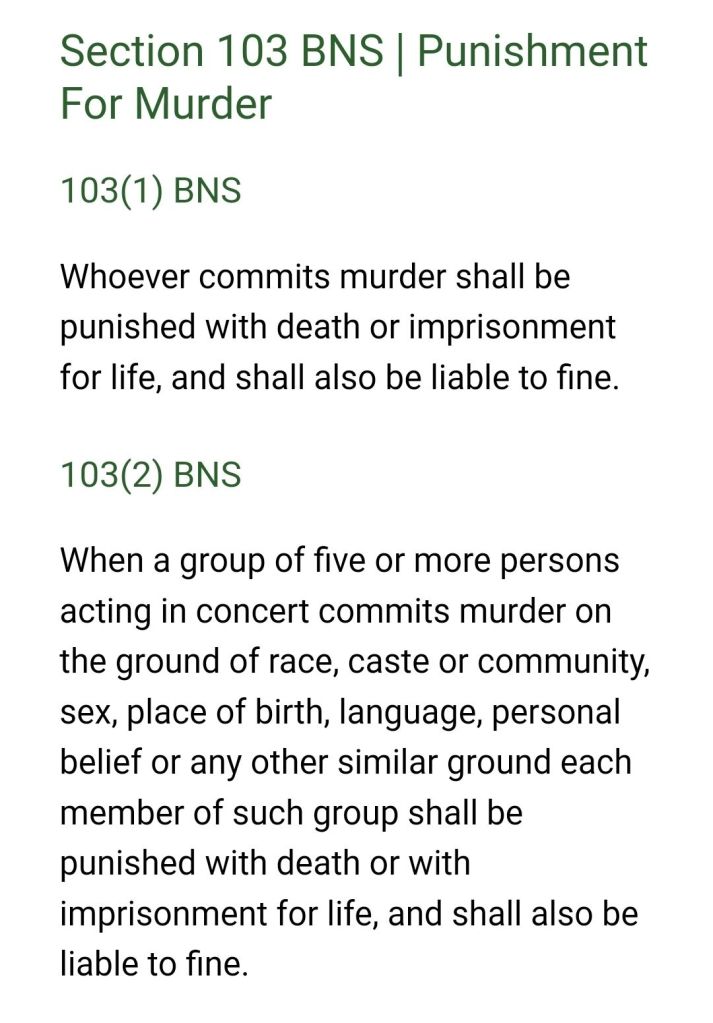
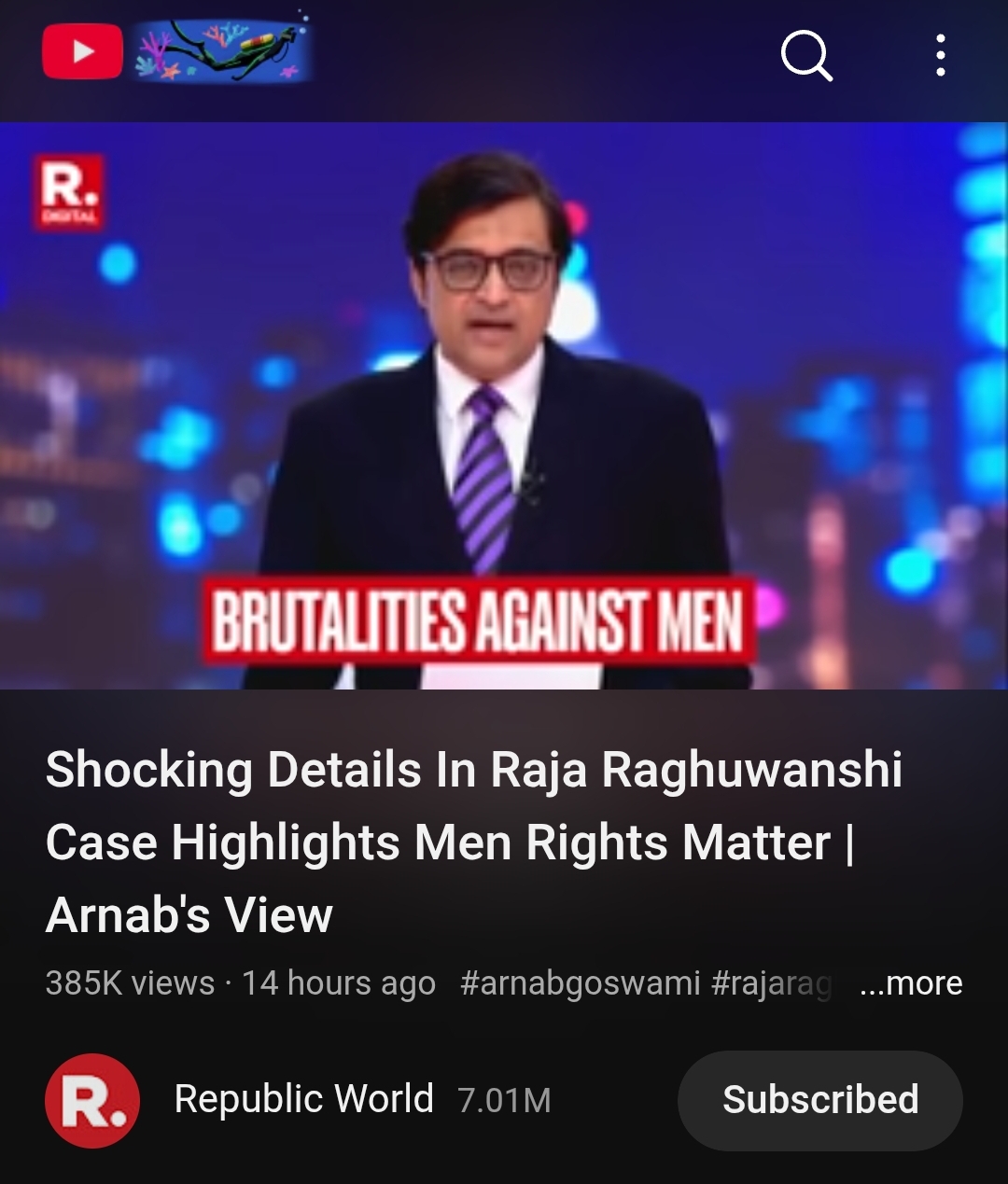
BNS.103 will just maximum give Death or life imprisonment or 14+years of Imprisonment with fine and after it, the system may release the murderers depending on Court proceedings (bail..eg Kannada Actor Darshan Murder case)..
The murderers will be dead, In prison or out and the cycle (of Cheat, Marry & Kill, Jail or Bail) in society continues?… Most suffering like in this case is by the Men & their families..
How can complete justice be done so the Husband’s family is compensated from the murderer Wife’s Assets of her ancestral wealth (fined fully). also the muderers need mental correction for Narc-Criminality & Victim+Society needs family counselling for grief & Narc Abuse/CPTSD Social Support which is lacking in Indian Society.
Below is an updated and comprehensive analysis that incorporates familicide (the death & killing of family members, often including a spouse, children, or other relatives) alongside mariticide (killing of a husband by a wife) and spousicide (killing of a spouse, encompassing both Suicide, mariticide and uxoricide). The analysis builds on the Raja Raghuvanshi case and extends to broader strategies for preventing deaths, abuse, and crimes within families in India, focusing on psychological, social, cultural, and systemic interventions.
Given the cultural and socioeconomic context of India in 2025, the recommendations are tailored to address unique challenges such as Love or arranged Fraud_marriages, patri-Matriarchal norms, and resource constraints.
Preventing Familicide, Mariticide, Spousicide, and Family Abuse in India: Strategies for 2025
Introduction
Familicide, mariticide, suicide, spousicide, elopicide and family Narc abuse represent severe forms of intra-family violence, with devastating consequences for individuals and communities. Familicide involves the killing of multiple family members, often a spouse, children, or extended relatives, typically by a family member driven by motives such as control, despair, or revenge. Mariticide (killing of a husband by a wife) and spousicide (killing of a spouse, including mariticide and uxoricide, the killing of a wife by a husband) are subsets of family violence, often linked to infidelity, financial disputes, or domestic abuse. In India, these crimes are shaped by cultural factors like fraud arranged marriages, misandry, Matri-patriarchal norms, and social stigma, as exemplified by the Raja Raghuvanshi murder case (2025), where Sonam Raghuvanshi allegedly orchestrated her husband’s killing during their honeymoon.
This analysis outlines comprehensive strategies to prevent deaths, abuse, and crimes within Indian Innocent or fraud families, addressing root causes and leveraging systemic reforms.
The Raja Raghuvanshi Case: A Contextual Anchor
Case Summary
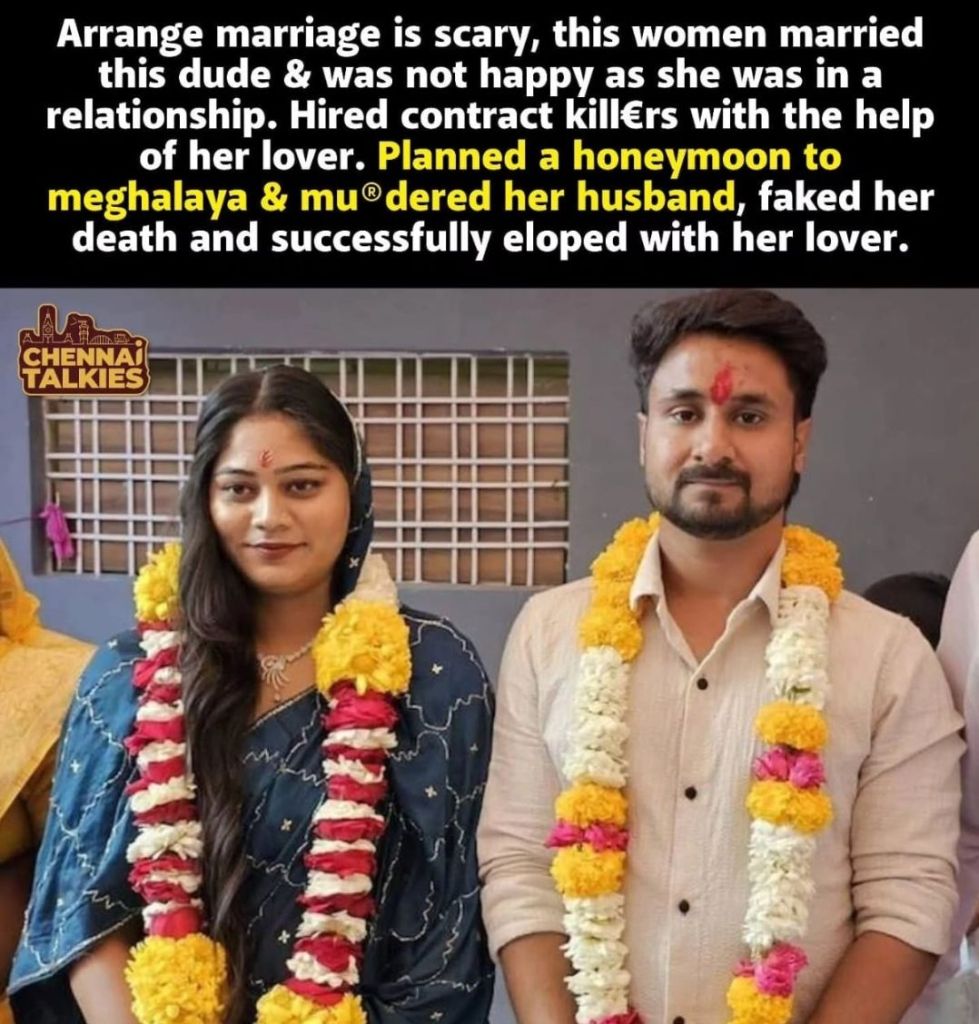
Raja Raghuvanshi, a 29-year-old businessman from Indore, was murdered around May 23, 2025, in Meghalaya during his honeymoon. His wife, Sonam Rags_Kia_Vanshki (24), allegedly (Police & People Evidences) conspired with her lover, Raj Kushwaha(21), and three hired accomplices (Akash Rajput, Vishal Singh Chauhan, and Anand Kurmi/Patel) to kill him. Raja’s body was found on June 2 in a gorge near Weisawdong Falls, with a bloodstained machete as a key clue. Sonam surrendered on June 9 in Ghazipur, Uttar Pradesh, and the accomplices were arrested in Madhya Pradesh and Uttar Pradesh. The case highlights motives of infidelity (Sonam’s affair with Kushwaha) and financial gain (control over family wealth), rooted in the pressures of an arranged marriage.
Relevance to Familicide
While the Raghuvanshi case is a mariticide, it reflects dynamics that could escalate to familicide, such as betrayal, sexual, financial motives, and disregard for family life, honor or bonds. Had the conspiracy extended to other family members (e.g., Raja’s relatives over inheritance disputes), it could have qualified as familocide. The case underscores the need for early intervention by MedicoLegal Maritologists to prevent inter & intra-family violences from escalating.
Understanding Familicide, Mariticide, Spousicide, and Family Abuse
Definitions and Patterns
Familicide: The killing of multiple family members, often by a male head of household, driven by motives like financial ruin, perceived betrayal, or mental health crises. Examples include cases where a parent kills their spouse and children before committing suicide, often due to shame or control (e.g., John List, 1971, USA, who killed his wife, mother, and three children).
Mariticide: The killing of a husband by a wife, as in the Raghuvanshi case, often linked to infidelity, financial gain, or escaping an unwanted marriage. Motives may overlap with familicide when extended to other relatives.
Spousicide: Encompasses mariticide and uxoricide, with uxoricide being more common in India due to dowry disputes and patriarchal violence. The National Crime Records Bureau (NCRB) reported in 2019 that love affairs and extramarital relationships were significant murder motives in India.
Family Abuse: Includes physical, emotional, financial, or sexual abuse within families, often a precursor to homicide. In India, domestic violence is prevalent, with 32% of women reporting abuse in the 2019–21 National Family Health Survey (NFHS-5).
Common Risk Factors in India
Cultural Pressures: Arranged marriages, as in the Raghuvanshi case, can lead to emotional disconnect or resentment, especially when personal desires (e.g., Sonam’s affair) conflict with familial expectations.
Patriarchal Norms: Rigid gender roles often empower men to exert control through abuse or uxoricide, while women may resort to mariticide to escape oppressive marriages.
Economic Stress: Financial disputes, as seen with the alleged Rs 9 lakh transfer in the Raghuvanshi case, can escalate tensions, particularly in affluent families or those facing economic distress.
Mental Health Issues: Untreated conditions like depression, personality disorders, or substance abuse increase the risk of violence. Sonam’s calculated behavior suggests possible antisocial traits.
Social Stigma: Divorce and separation are stigmatized, pushing individuals toward extreme measures like murder to resolve marital conflicts.
Strategies to Prevent Familicide, Mariticide, Spousicide, and Family Abuse in India
1. Strengthening Family Relationships
Pre-Marital and Family Counseling
Objective: Identify and resolve conflicts before marriage and within families to prevent escalation to violence.
Actions:
Mandatory Counseling for Arranged Marriages: Require pre-marital counseling to assess compatibility, discuss prior relationships, and set expectations. In the Raghuvanshi case, counseling could have revealed Sonam’s disinterest or affair, potentially halting the marriage.
Family Mediation: Offer counseling for extended families to address tensions, such as inheritance disputes or in-law conflicts, which can lead to familicide.
Parenting Support: Provide programs to teach non-violent discipline and stress management, reducing risks of abuse or familicide involving children.
Implementation: Partner with NGOs, religious institutions, and community health workers to deliver counseling in urban and rural areas. Leverage India’s ASHA workers to reach remote communities.
Education on Healthy Family Dynamics
Objective: Promote mutual respect, communication, and non-violence within families.
Actions:
School Curricula: Integrate modules on healthy relationships, conflict resolution, and gender equality in schools to shape attitudes early.
Community Workshops: Conduct sessions on family communication, focusing on managing financial stress and emotional conflicts, which are common precursors to violence.
Media Campaigns: Use platforms like X, television, and radio to share stories of healthy families and destigmatize seeking help for marital or family issues.
Implementation: Collaborate with the Ministry of Education and media outlets. Engage influencers to amplify messages on social media.
2. Addressing Cultural and Social Barriers
Normalizing Divorce and Family Dispute Resolution
Objective: Provide socially acceptable alternatives to violence for resolving family conflicts.
Actions:
Legal Reforms: Simplify divorce and separation processes, reducing legal barriers. Fast-track divorce for irreconcilable differences could have given Sonam an alternative to murder.
Destigmatization Campaigns: Promote acceptance of divorce and single-parent households through media and community leaders, reducing pressure to stay in toxic relationships.
Mediation Centers: Establish family dispute resolution centers to handle conflicts over inheritance, dowry, or custody non-violently.
Implementation: Expand initiatives like the Ministry of Women and Child Development’s One Stop Centres and collaborate with legal aid organizations to support families.
Challenging Patriarchal Norms
Objective: Dismantle gender roles that perpetuate control, abuse, and violence.
Actions:
Gender Equality Education: Promote equal partnership in families, challenging male dominance and female subservience that fuel uxoricide and abuse.
Women’s Empowerment: Enhance access to education, employment, and financial independence for women, reducing dependency on abusive or unwanted marriages.
Engaging Men: Educate men on healthy masculinity, discouraging controlling behaviors that may provoke retaliation or escalate to familicide.
Implementation: Leverage programs like Beti Bachao Beti Padhao and engage men’s groups to foster gender equity.
3. Enhancing Mental Health Support
Accessible Mental Health Services
Objective: Address psychological issues that contribute to family violence and homicide.
Actions:
Expand Infrastructure: Increase funding for mental health services under the National Mental Health Programme, focusing on rural access. Train community health workers to identify risks like depression or personality disorders.
Screening Programs: Integrate mental health screenings into pre-marital counseling, family planning clinics, and routine health check-ups to detect issues early, as Sonam’s manipulative behavior might have been flagged.
Crisis Hotlines: Establish 24/7 helplines for family members experiencing distress, offering immediate counseling to de-escalate conflicts.
Implementation: Partner with NGOs and private healthcare providers to scale services. Use telehealth platforms to reach remote areas.
Support for Abuse Victims
Objective: Protect victims and prevent abuse from escalating to homicide.
Actions:
Safe Shelters: Expand shelters for victims of domestic violence, ensuring safety for women, children, and extended family members at risk of familicide.
Legal Protections: Strengthen enforcement of the Protection of Women from Domestic Violence Act, 2005, with swift restraining orders and penalties for abusers.
Awareness Campaigns: Educate families about recognizing and reporting abuse, using platforms like X to share resources like India’s 181 Women Helpline.
Implementation: Collaborate with police, NGOs, and community leaders to create a robust support network.
4. Strengthening Law Enforcement and Community Vigilance
Proactive Policing
Objective: Enhance prevention and detection of family-related crimes.
Actions:
Specialized Training: Train police to recognize warning signs of familicide, mariticide, and spousicide, such as sudden financial transactions or reports of infidelity, as in the Raghuvanshi case.
Digital Forensics: Prioritize real-time analysis of call records, financial transactions, and social media for early intervention. Sonam’s communication with Kushwaha was a key clue.
Community Policing: Deploy officers to engage with communities, particularly in high-risk areas, to monitor family disputes and prevent escalation.
Implementation: Strengthen State Crime Records Bureaus and cybercrime units. Allocate budgets for advanced forensic tools.
Community Engagement
Objective: Leverage community networks to prevent and report family violence.
Actions:
Vigilance Networks: Encourage neighbors, relatives, and community leaders to report signs of abuse or distress, as the guide Albert Pde did in the Raghuvanshi case.
Family Mediation Boards: Establish local boards to resolve disputes over marriage, inheritance, or dowry, preventing escalation to violence.
Tourist Safety Protocols: In tourist areas like Meghalaya, train guides and locals to monitor for suspicious behavior, such as strangers accompanying families.
Implementation: Partner with Gram Panchayats and tourism boards to foster vigilance. Train community leaders as first responders.
5. Financial and Digital Oversight
Monitoring Financial Transactions
Objective: Detect financial motives behind family crimes.
Actions:
Bank Alerts: Implement systems to flag large or unusual transactions, like the alleged Rs 9 lakh transfer in the Raghuvanshi case, especially in new marriages or family disputes.
Family Oversight: Encourage families to monitor financial dealings, particularly in arranged marriages with significant wealth.
Forensic Accounting: Train investigators to trace money trails in homicide or abuse cases, identifying payments to accomplices.
Implementation: Collaborate with the Reserve Bank of India and financial institutions to establish monitoring protocols.
Digital Surveillance
Objective: Identify planning or coordination of family crimes.
Actions:
Communication Tracking: Enhance police access to call and message records in suspected cases, respecting privacy laws. Sonam’s call logs were critical in her arrest.
Social Media Monitoring: Analyze public X posts or other platforms for signs of distress or threats, ensuring legal compliance.
Cyber Education: Educate families on securing devices to prevent manipulation or tracking by abusive relatives.
Implementation: Work with telecom providers and the CyberCrime Portal to streamline investigations.
6. Legal and Policy Reforms
Stricter Penalties for Family Crimes
Objective: Deter familicide, spousicide, and abuse through robust legal consequences.
Actions:
Legislative Changes: Increase penalties for conspiracy, contract killings, and family violence, emphasizing premeditation as in the Raghuvanshi case.
Fast-Track Courts: Establish specialized courts for family-related crimes to ensure swift justice, deterring potential offenders.
Witness Protection: Protect informants, such as family members or accomplices, to encourage cooperation in dismantling criminal networks.
Implementation: Advocate for amendments to the Indian Penal Code and expand fast-track courts.
Transparency in Family Arrangements
Objective: Reduce fraud or hidden motives in marriages and family dynamics.
Actions:
Mandatory Disclosures: Require disclosure of prior relationships, financial debts, or mental health issues during matchmaking to prevent conflicts, as in Sonam’s undisclosed affair.
Prenuptial Agreements: Encourage agreements to clarify asset distribution, reducing financial motives for familicide or spousicide.
Community Oversight: Involve elders or mediators in verifying marriage and family arrangements to ensure transparency.
Implementation: Integrate disclosures into community matchmaking traditions and legal frameworks.
7. Research and Data Collection
Understanding Family Violence Trends
Objective: Build evidence to inform prevention strategies.
Actions:
National Registry: Enhance the NCRB to track familicide, spousicide, and abuse cases with detailed motives, demographics, and outcomes for 2025.
Criminological Studies: Fund research on risk factors like arranged marriages, dowry disputes, or mental health issues, using cases like Raghuvanshi’s as reference.
Global Collaboration: Share data with international bodies like the UN to adopt best practices for family violence prevention.
Implementation: Partner with the National Institute of Criminology and Forensic Science and academic institutions for robust data collection.
India-Specific Considerations
Cultural Context: India’s diverse traditions, particularly arranged marriages and joint family systems, require culturally sensitive interventions. Engaging community leaders ensures acceptance of reforms like counseling or divorce normalization.
Resource Constraints: Limited mental health and policing resources necessitate cost-effective solutions, such as training ASHA workers or leveraging community networks.
Urban-Rural Divide: Urban areas may adopt modern interventions like telehealth, while rural areas need grassroots programs through Panchayats and NGOs.
Gender Dynamics: While uxoricide is more prevalent due to patriarchy, mariticide and familicide cases like Raghuvanshi’s highlight the need for gender-neutral approaches to address all perpetrators and victims.
Critical Reflections from the Raghuvanshi Case
Missed Opportunities: Sonam’s family knew of her affair but dismissed it, and Raja’s mother noted her disinterest. Pre-marital counseling and family mediation could have prevented the marriage or addressed conflicts.
Cultural Pressures: The stigma of divorce and arranged marriage pressures likely pushed Sonam toward murder. Normalizing separation could have offered an alternative.
Community Role: The guide’s testimony was pivotal, underscoring the importance of community vigilance in preventingソーシャルメディア detecting suspicious behavior in remote areas.
Economic Factors: The financial motive (Rs 9 lakh) highlights the need for oversight in high-stake family arrangements to prevent exploitation.
Conclusion
Preventing familicide, mariticide, spousicide, and family abuse in India requires a holistic approach that addresses psychological, cultural, and systemic factors. By strengthening family relationships through counseling and education, normalizing divorce, enhancing mental health and legal support, improving policing and community vigilance, and promoting transparency, India can reduce intra-family violence. The Raghuvanshi case illustrates the tragic consequences of unaddressed conflicts in arranged marriages, emphasizing the urgency of these reforms. With coordinated efforts from government, communities, and individuals, India can foster safer families, preventing the escalation of disputes into deadly outcomes in 2025 and beyond.
Marry Safer or Later Suffer? Emotional Choice Vs Rational Choice.
Below is a detailed psycho-forensic dissection of the Raja Raghuvanshi murder case, focusing on the psychological and criminological aspects of the crime, the perpetrators, and potential factors that could have prevented the tragedy. The analysis is based on the provided source and additional web results, critically examining the case to understand the motivations, behaviors, and circumstances surrounding the crime.
Psycho-Forensic Dissection of the Raja Raghuvanshi Murder Case
Case Overview
The Raja Raghuvanshi murder case is a chilling example of a premeditated spousal murder that unfolded during a honeymoon trip in Meghalaya, India. Raja Raghuvanshi, a 29-year-old businessman from Indore, was found dead on June 2, 2025, in a gorge near Weisawdong Falls in Sohra, with a bloodstained machete nearby serving as a critical clue. His wife, Sonam Raghuvanshi, aged 24, was arrested on June 9, 2025, in Ghazipur, Uttar Pradesh, accused of orchestrating the murder with her alleged lover, Raj Kushwaha, and three hired accomplices: Akash Rajput, Vishal Singh Chauhan, and Anand Kurmi (or Patel, as referred to in some sources). The case, dubbed “Operation Honeymoon” by the Meghalaya Police, revealed a complex conspiracy rooted in infidelity, greed, and meticulous planning.
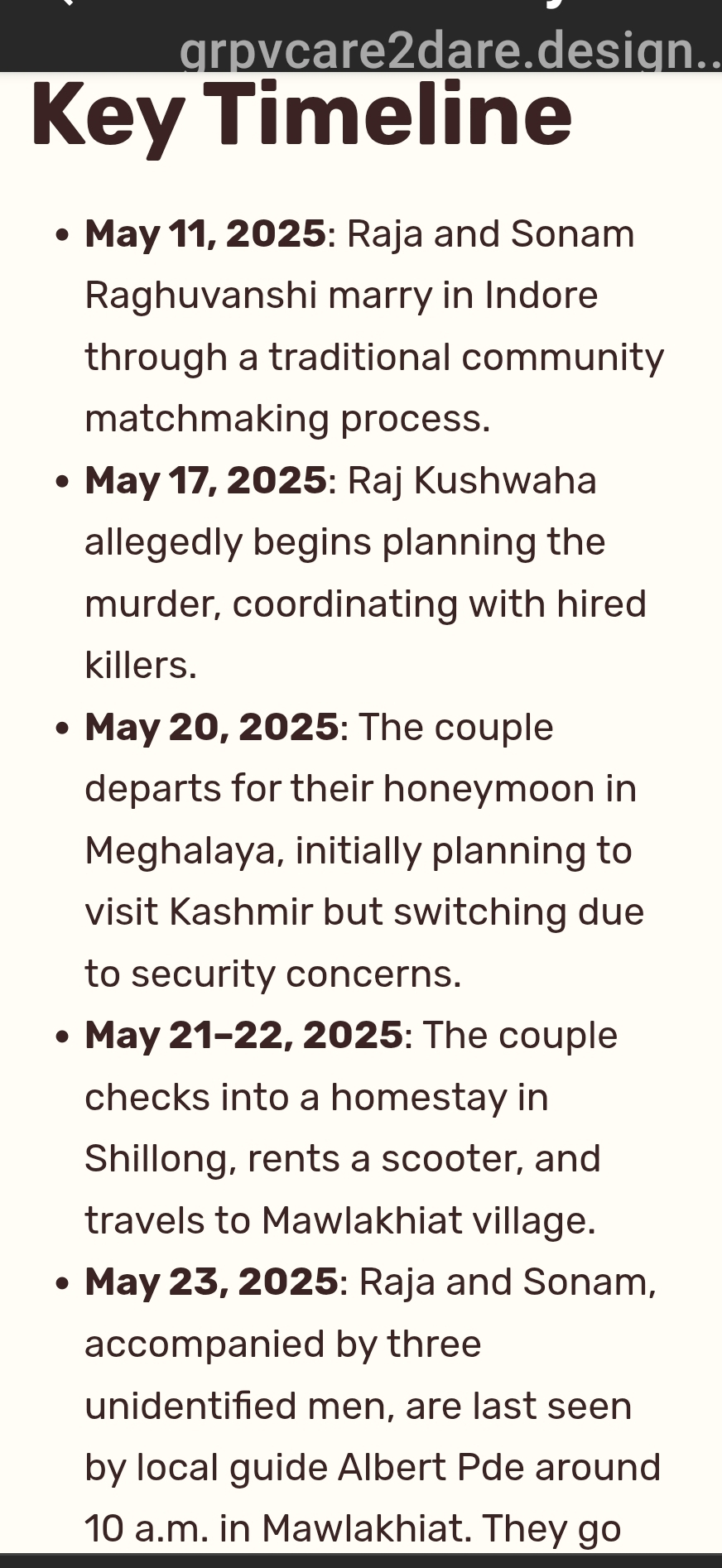
Key Timeline
May 11, 2025: Raja and Sonam Raghuvanshi marry in Indore through a traditional community matchmaking process.
May 17, 2025: Raj Kushwaha allegedly begins planning the murder, coordinating with hired killers.
May 20, 2025: The couple departs for their honeymoon in Meghalaya, initially planning to visit Kashmir but switching due to security concerns.
May 21–22, 2025: The couple checks into a homestay in Shillong, rents a scooter, and travels to Mawlakhiat village.
May 23, 2025: Raja and Sonam, accompanied by three unidentified men, are last seen by local guide Albert Pde around 10 a.m. in Mawlakhiat. They go missing later that day.
May 24, 2025: Their rented scooter is found abandoned near a cafe on the Shillong-Sohra road.
June 2, 2025: Raja’s body is discovered in a gorge, identified by a tattoo. A bloodstained machete is found nearby.
June 3, 2025: Police suspect Sonam’s involvement based on early evidence.
June 4, 2025: A bloodstained raincoat, possibly linked to the couple, is found in Mawkma village.
June 7, 2025: Albert Pde’s testimony about seeing the couple with three men shifts the investigation toward a conspiracy.
June 9, 2025: Sonam surrenders in Ghazipur, Uttar Pradesh. Three accomplices (Akash Rajput, Vishal Singh Chauhan, and Raj Kushwaha) are arrested in Madhya Pradesh, with Anand Patel detained later.
Psycho-Forensic Analysis of the Perpetrators
Sonam Raghuvanshi (Primary Accused)
Psychological Profile:
Motivation: Sonam’s alleged motive appears to be a combination of romantic entanglement and financial gain. Her two-year relationship with Raj Kushwaha, an employee in her family’s plywood business, suggests emotional attachment and possible dissatisfaction with her arranged marriage to Raja. Reports indicate she planned to live as a widow temporarily before marrying Kushwaha, pointing to a long-term strategy to maintain social and familial acceptance while pursuing her relationship.
Personality Traits: Sonam’s actions suggest manipulative and calculating tendencies, characteristic of individuals with high levels of Machiavellianism, a trait associated with deceit and strategic planning for personal gain. Her ability to orchestrate a murder within days of her wedding, while maintaining the facade of a honeymoon, indicates a lack of empathy and possible narcissistic traits, prioritizing her desires over Raja’s life. Her claim of being abducted and abandoned in Ghazipur could reflect a defensive strategy to deflect guilt, a common tactic among offenders with antisocial tendencies.
Behavioral Indicators: Sonam’s choice of a remote trail (Mawlingkhiyiat) over a popular tourist route suggests premeditation and knowledge of the terrain’s isolation, facilitating the crime. Her call records showing contact with Kushwaha and sharing her location further indicate active coordination. Her surrender in Ghazipur, after allegedly fleeing to Indore and then Uttar Pradesh, may suggest a mix of guilt, fear of capture, or an attempt to control the narrative.
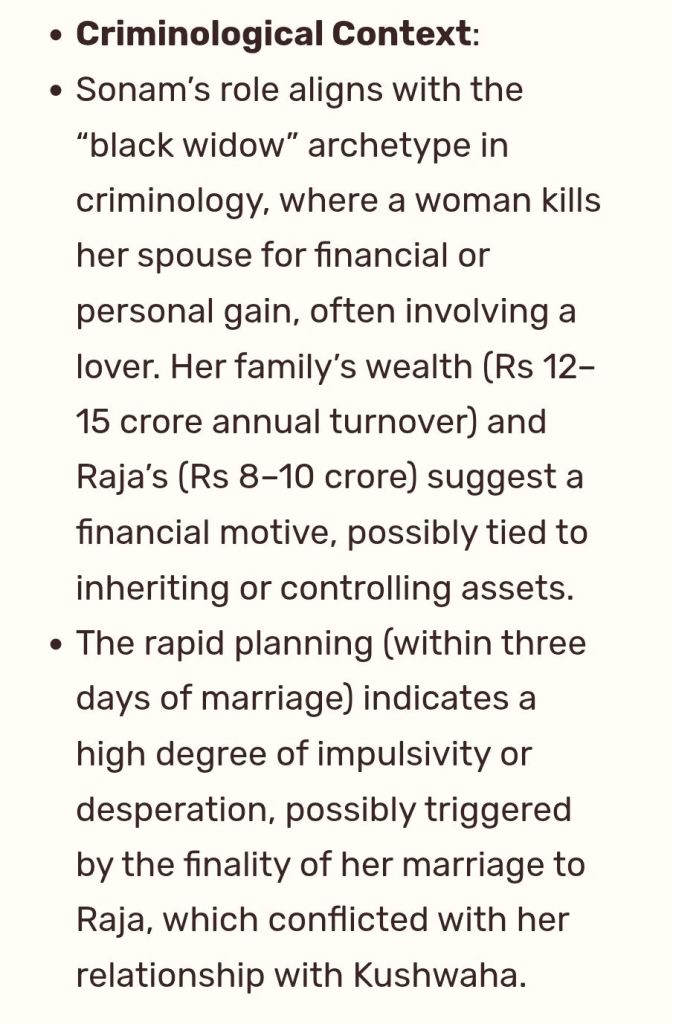
Criminological Context:
Sonam’s role aligns with the “black widow” archetype in criminology, where a woman kills her spouse for financial or personal gain, often involving a lover. Her family’s wealth (Rs 12–15 crore annual turnover) and Raja’s (Rs 8–10 crore) suggest a financial motive, possibly tied to inheriting or controlling assets.
The rapid planning (within three days of marriage) indicates a high degree of impulsivity or desperation, possibly triggered by the finality of her marriage to Raja, which conflicted with her relationship with Kushwaha.
Raj Kushwaha (Alleged Co-Conspirator)
Psychological Profile:
Motivation: As Sonam’s alleged lover, Kushwaha’s motive appears rooted in jealousy, possessiveness, and a desire to eliminate Raja as a rival. His role as the planner, staying in Indore to maintain an alibi, suggests strategic thinking and a willingness to manipulate others (the hired killers) to achieve his goals.
Personality Traits: Kushwaha’s behavior indicates traits of antisocial personality disorder, including disregard for societal norms and willingness to engage in violent crime. His presence at Raja’s funeral, as reported by an eyewitness, suggests a lack of remorse and a bold attempt to maintain appearances, possibly to monitor the investigation or feign innocence.
Behavioral Indicators: Kushwaha’s coordination with the hired killers, providing them with a phone and planning the murder from May 17, shows organizational skills and premeditation. His employment in Sonam’s family business and proximity to her suggests a power dynamic where he may have felt entitled to her, fueling his willingness to orchestrate the crime.
Criminological Context:
Kushwaha fits the profile of a conspiratorial accomplice in spousal murder cases, often driven by romantic obsession or financial incentives. His decision to remain in Indore while others executed the murder aligns with a “mastermind” role, minimizing his direct exposure to risk.
His prior relationship with Sonam, known to her family but rejected, suggests a motive rooted in resentment toward the arranged marriage system, which may have exacerbated his willingness to resort to extreme measures.
Motivation: The three accomplices, aged 19–22, were likely motivated by financial gain or loyalty to Kushwaha. Their willingness to travel from Madhya Pradesh to Meghalaya and execute a violent murder suggests a lack of moral inhibition, possibly influenced by socioeconomic factors or group dynamics.
Personality Traits: Young, impressionable individuals involved in contract killings often exhibit low empathy, thrill-seeking behavior, or susceptibility to manipulation by a dominant figure (in this case, Kushwaha). Their confession that Sonam instructed them to kill Raja in her presence indicates a hierarchical dynamic where they followed orders, possibly under coercion or promise of reward.
Behavioral Indicators: The use of a non-local machete, purchased in Guwahati, and the brutal nature of the attack (two head injuries) suggest a lack of sophistication in execution but a high level of violence. Leaving evidence like a bloodstained shirt and machete indicates inexperience or carelessness, common among young offenders.
Criminological Context:
The accomplices fit the profile of hired killers in organized crime, often young men from lower socioeconomic backgrounds who are easily recruited for violent tasks. Their arrests in Madhya Pradesh and Uttar Pradesh suggest a network of connections, possibly through Kushwaha’s influence in Indore.
The group’s decision to follow the couple from Guwahati to Shillong and execute the murder in a remote location indicates planning but poor operational security, as evidenced by the trail of physical evidence.
Forensic Evidence and Investigation
Physical Evidence:
Machete: The bloodstained machete, identified as non-local and brand new, was pivotal in shifting suspicion toward external perpetrators. Its purchase in Guwahati by the accomplices suggests premeditation and logistical planning.
Autopsy Findings: Raja sustained two head injuries, one to the front and one to the back, indicating a brutal, targeted attack. The absence of his gold ring and chain suggests a possible attempt to stage the murder as a robbery.
Additional Items: A bloodstained raincoat, a woman’s white shirt, a strip of tablets, a smartwatch, and part of a phone screen were recovered, linking the crime scene to the couple and accomplices. The raincoat’s location in Mawkma village, halfway between the gorge and Sohrarim, suggests an attempt to dispose of evidence.
Scooter: The abandoned rented scooter on May 24 provided an early clue, prompting a search and rescue operation.
Witness Testimony:
Albert Pde’s observation of Raja and Sonam with three Hindi-speaking men on May 23 was critical, expanding the investigation to include accomplices. His lack of interaction with the group due to language barriers highlights the perpetrators’ attempt to blend in as tourists.
Digital Evidence:
Sonam’s call records revealed communication with Kushwaha and one of the hired killers, with her sharing her last location before the murder. This digital trail was instrumental in linking her to the conspiracy.
Psychological and Social Factors Contributing to the Crime
Arranged Marriage Dynamics:
The marriage between Raja and Sonam, arranged through a community matchmaking tradition, appears to have been a source of tension. Raja’s mother reported that Sonam showed little interest in him post-marriage, suggesting emotional detachment or resentment. Sonam’s prior relationship with Kushwaha, known to her family but rejected, likely created a conflict between personal desires and societal expectations.
Arranged marriages can lead to psychological strain when one partner feels coerced or unfulfilled, potentially fostering resentment or desperation, as seen in Sonam’s actions.
Infidelity and Emotional Betrayal:
Sonam’s two-year affair with Kushwaha, an employee in her family’s business, indicates a deep emotional bond that conflicted with her marriage. This relationship likely fueled her willingness to eliminate Raja to pursue her preferred partner.
Kushwaha’s role as a subordinate in Sonam’s family business may have intensified his desire to “prove” himself or secure her, leading to extreme measures.
Financial Motives:
Both families were affluent, with Raja’s transport business and Sonam’s family’s plywood business generating significant revenue. Allegations that Sonam took Rs 9 lakh from Raja for honeymoon expenses and possibly paid the killers suggest a financial incentive, possibly to control assets or fund her future with Kushwaha.
The missing jewelry (gold ring and chain) supports the theory of a staged robbery, potentially to obscure the true motive.
Cultural and Social Pressures:
The Raghuvanshi community’s matchmaking tradition and the pressure to conform to familial expectations may have trapped Sonam in a marriage she did not want, pushing her toward drastic action.
The stigma of divorce in Indian society may have made murder seem a more viable option to Sonam than ending the marriage legally, especially given her family’s rejection of her relationship with Kushwaha.
Factors That Could Have Saved Raja Raghuvanshi
Open Communication and Family Intervention:
Pre-Marital Counseling: Had Raja and Sonam undergone pre-marital counseling, underlying issues like Sonam’s lack of interest or her relationship with Kushwaha might have surfaced, potentially leading to the marriage being reconsidered. Open discussions about compatibility could have prevented the union.
Family Awareness: Sonam’s family was aware of her relationship with Kushwaha but dismissed it. Proactive intervention, such as addressing her emotional needs or mediating with Raja’s family, could have resolved the conflict before marriage.
Raja’s Awareness: Raja’s mother noted his concerns about Sonam’s disinterest. Encouraging Raja to confront these issues directly or seek mediation might have led to a separation rather than a honeymoon trip.
Social Acceptance of Divorce:
Greater societal acceptance of divorce or relationship dissolution could have allowed Sonam to end the marriage without resorting to violence. Cultural stigma often pressures individuals to remain in unhappy marriages, leading to extreme outcomes. Providing Sonam with a socially acceptable exit strategy might have prevented the crime.
Psychological Support:
Mental Health Resources: Sonam’s manipulative and calculating behavior suggests underlying psychological issues, possibly exacerbated by the pressure of an unwanted marriage. Access to therapy or counseling could have helped her process her emotions and make healthier choices.
Conflict Resolution: Psychological support for both Sonam and Kushwaha could have addressed their resentment and obsession, potentially deterring the murder plot.
Vigilance During the Honeymoon:
Travel Safety Measures: Raja’s decision to travel to a remote area with strangers (the three men) was a critical vulnerability. Greater awareness of personal safety, such as avoiding isolated locations or verifying companions, could have reduced the opportunity for the crime.
Local Authorities: Enhanced monitoring by local police or tourist guides in high-risk areas like Sohra could have deterred the perpetrators or led to earlier intervention. Albert Pde’s testimony was crucial, but proactive engagement with tourists might have raised red flags sooner.
Digital and Financial Oversight:
Call Record Monitoring: Earlier access to Sonam’s call records could have alerted authorities to her communication with Kushwaha and the killers, potentially preventing the murder.
Financial Transparency: Raja’s family alleged Sonam took Rs 9 lakh for honeymoon expenses. Closer scrutiny of large financial transactions within the family could have raised suspicions about her intentions.
Community and Legal Support:
Community Mediation: The Raghuvanshi community’s matchmaking tradition could incorporate follow-up mechanisms to check on newlyweds’ well-being, identifying issues like Sonam’s disinterest early on.
Legal Protections: Stronger legal mechanisms to protect individuals in arranged marriages, such as mandatory disclosures of prior relationships or financial agreements, could have flagged Sonam’s intentions.
Critical Reflections
Police Efficiency: The Meghalaya Police’s swift response, forming an SIT and arresting suspects within seven days, highlights effective investigative work. However, the initial search-and-rescue operation was hampered by heavy rain, suggesting a need for better resources in remote areas.
Sonam’s Defense: Sonam’s claim of abduction and abandonment lacks corroboration and contradicts the evidence of her coordination with the killers. This defense may reflect a calculated attempt to evade responsibility, a common tactic in spousal murder cases.
Societal Implications: The case underscores the dangers of unresolved emotional conflicts in arranged marriages and the need for cultural shifts toward open communication and mental health support. It also highlights the risks of hiring contract killers, a growing trend in spousal crimes in India.
Conclusion
The Raja Raghuvanshi murder case reveals a tragic interplay of infidelity, societal pressures, and premeditated violence. Sonam Raghuvanshi’s alleged orchestration, driven by her affair with Raj Kushwaha and possible financial motives, reflects deep psychological and social dysfunction. The hired accomplices’ actions underscore the accessibility of contract killers in certain networks. Preventive measures, including open communication, psychological support, and enhanced safety protocols, could have saved Raja’s life. The case serves as a stark reminder of the need for societal reform to address the root causes of such crimes, particularly in the context of arranged marriages and cultural expectations.
How Democratic are We, you, our families, our city and country?
Democrity: The Capacity and Capability of Democracy Across Scales
Introduction
The concept of “Democrity” can be understood as the level of capability and capacity for democratic engagement and practice at various scales of human organization—from the individual citizen to the couple, family, clan, street, neighborhood, city, state, and country or region. Democrity encapsulates the ability of individuals and collectives to actively participate in, uphold, and sustain democratic principles such as equality, freedom, representation, and mutual respect. This essay explores how Democrity manifests across these scales, examining the unique challenges and opportunities at each level.
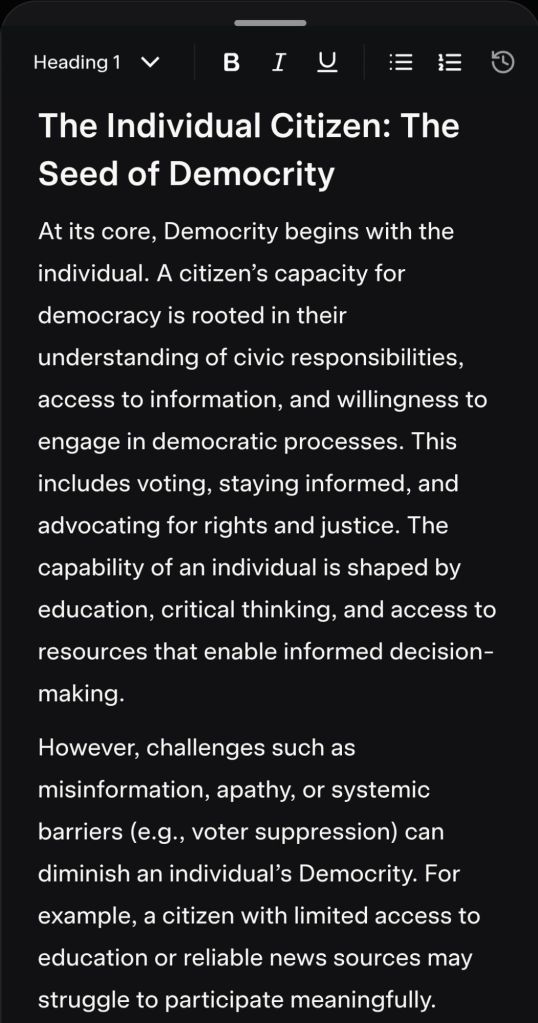
The Individual Citizen: The Seed of Democrity
At its core, Democrity begins with the individual. A citizen’s capacity for democracy is rooted in their understanding of civic responsibilities, access to information, and willingness to engage in democratic processes. This includes voting, staying informed, and advocating for rights and justice. The capability of an individual is shaped by education, critical thinking, and access to resources that enable informed decision-making.
However, challenges such as misinformation, apathy, or systemic barriers (e.g., voter suppression) can diminish an individual’s Democrity. For example, a citizen with limited access to education or reliable news sources may struggle to participate meaningfully. Conversely, an empowered citizen, equipped with knowledge and agency, can amplify democratic values through activism and dialogue.
The Couple: Intimate Foundations of Democracy
At the level of a couple, Democrity manifests in mutual respect, shared decision-making, and equitable communication. A democratic relationship requires both partners to have equal voices, negotiate differences, and resolve conflicts through dialogue rather than domination. The capacity for Democrity in a couple depends on their ability to practice empathy and fairness in their daily interactions.
Challenges at this level include power imbalances due to cultural norms, economic disparities, or differing levels of awareness about democratic principles. A couple that models Democrity fosters a microcosm of democratic values, setting a foundation for larger social units like families.
The Family: Nurturing Democratic Values
In a family, Democrity is reflected in how members share responsibilities, make collective decisions, and respect individual autonomy. Parents or guardians play a critical role in modeling democratic behavior by encouraging open dialogue, teaching fairness, and resolving conflicts collaboratively. The capacity for Democrity in a family grows when children are taught to value diverse perspectives and participate in decision-making processes, such as household rules or budget planning.
However, authoritarian parenting styles or rigid hierarchies can stifle Democrity, creating environments where certain voices are marginalized. A family with high Democrity serves as a training ground for future citizens who carry these values into larger communities.
The Clan: Cultural and Kinship Dynamics
At the clan level, Democrity involves balancing tradition with inclusivity. Clans, often bound by shared heritage or extended kinship, may have established norms that guide decision-making. Democratic capacity here depends on the clan’s ability to adapt to diverse viewpoints, incorporate younger generations’ ideas, and avoid rigid adherence to outdated practices.
Challenges include entrenched hierarchies or exclusionary practices that prioritize certain members over others. A clan with strong Democrity embraces collective decision-making while respecting individual rights, serving as a bridge between familial and broader societal democratic practices.
The Street and Neighborhood: Community-Level Democrity
At the street and neighborhood levels, Democrity is expressed through community engagement, local governance, and collective problem-solving. Neighbors who organize to address shared concerns—such as safety, infrastructure, or community events—demonstrate high democratic capacity. Tools like neighborhood associations, town halls, or informal gatherings enhance this capability.
Barriers to Democrity at this level include social fragmentation, economic disparities, or lack of access to local decision-making processes. A neighborhood with robust Democrity fosters trust, mutual support, and active participation, creating a sense of belonging and shared purpose.
The City: Scaling Democratic Systems
Cities represent a more complex scale of Democrity, where formal governance structures like city councils, public forums, and civic organizations come into play. A city’s democratic capacity depends on transparent governance, equitable resource distribution, and opportunities for citizen participation. Effective city-level Democrity requires mechanisms like participatory budgeting, public consultations, and accessible voting systems.
Challenges include corruption, bureaucratic inefficiencies, or exclusion of marginalized groups. Cities with high Democrity empower residents to shape their urban environment, fostering innovation and inclusivity.
The State: Balancing Diversity and Unity
At the state level, Democrity involves managing diverse populations, balancing regional interests, and ensuring equitable representation. States with strong democratic capacity have robust institutions, fair electoral systems, and policies that protect minority rights while addressing majority needs. Citizen engagement through advocacy, voting, and public discourse is critical.
Challenges include polarization, gerrymandering, or suppression of dissent. A state with high Democrity promotes accountability, transparency, and inclusivity, serving as a model for smaller and larger scales.
The Country or Region: The Apex of Democrity
At the national or regional level, Democrity reaches its broadest scope, encompassing complex systems of governance, international relations, and diverse cultural identities. A country’s democratic capacity is measured by its ability to uphold constitutional principles, protect human rights, and ensure fair representation across diverse populations. Regional Democrity also involves cooperation between nations to address global challenges like climate change or human rights.
Challenges at this level include authoritarianism, systemic inequalities, or external pressures like economic instability. A country or region with strong Democrity fosters global citizenship, encourages civic participation, and upholds democratic institutions as a beacon for others.
Interconnections Across Scales
Democrity is not isolated at any one level; it is interconnected. An individual’s democratic capacity influences their family, which shapes the neighborhood, and so on. Conversely, a country’s democratic health impacts its states, cities, and citizens. For example, national policies that promote education enhance individual Democrity, while community initiatives can influence state-level reforms. Strengthening Democrity at any scale requires addressing barriers like inequality, misinformation, and exclusion while fostering education, dialogue, and participation.
Conclusion
Democrity is a dynamic measure of democratic capability and capacity that evolves across scales, from the individual to the global. Each level presents unique opportunities to practice and strengthen democratic principles, but also faces distinct challenges that require tailored solutions. By nurturing Democrity at every scale—through education, inclusivity, and active engagement—societies can build a resilient democratic culture that empowers individuals and collectives to shape a just and equitable world.
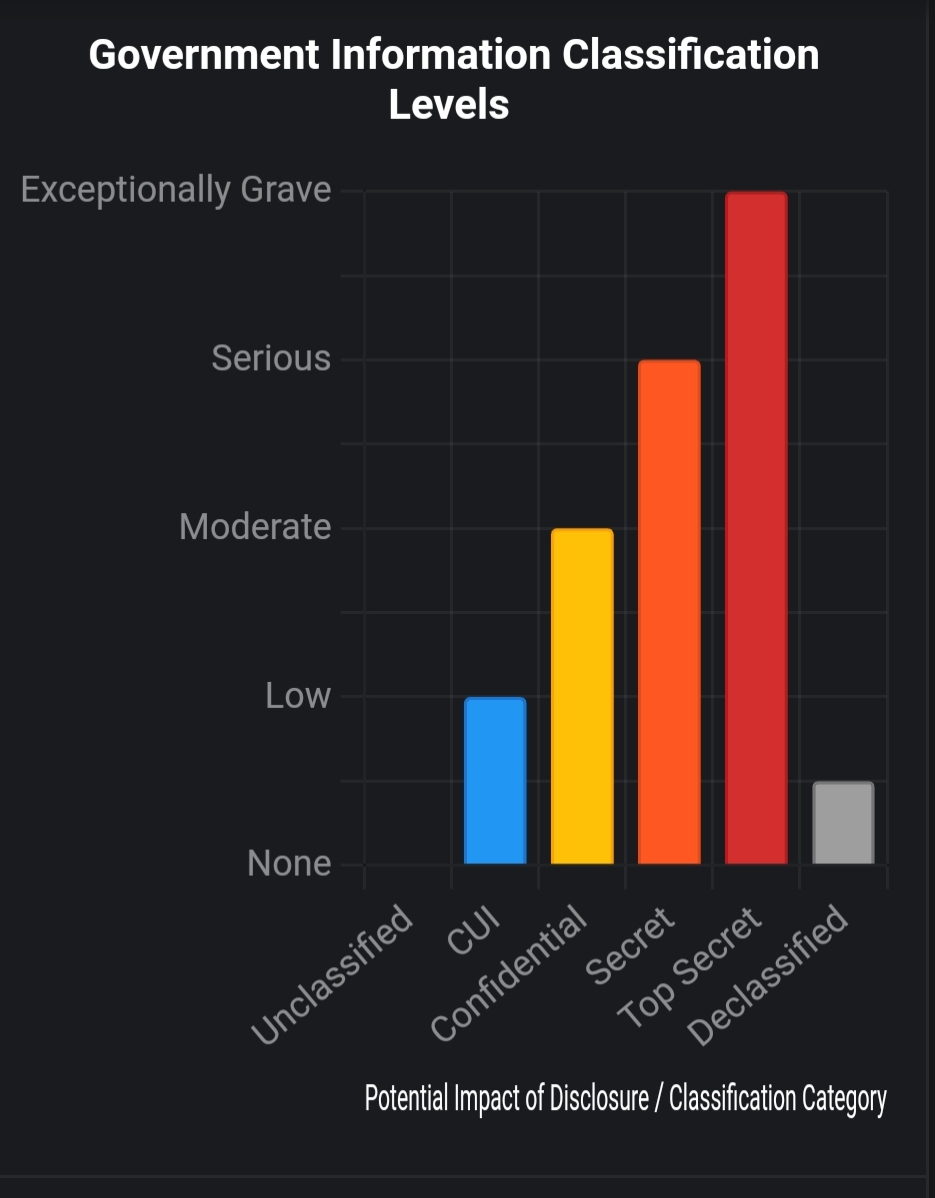
The classification of government information varies by country, but most systems categorize information based on the level of sensitivity and the potential impact of unauthorized disclosure. Below is an overview of common categories, from open public information to highly sensitive classified information, including declassification, based primarily on U.S. standards (as they are widely referenced) and general principles applicable globally. I’ll keep it concise yet comprehensive, as you’ve requested a detailed but clear explanation.
Types of Government Information Categories
Unclassified/Open Public Information
Definition: Information that is not sensitive and is intended or suitable for public release.
Characteristics:
No restrictions on access or dissemination.
Includes press releases, public laws, government websites, reports, and data like census statistics.
Freely available to citizens, media, or anyone via platforms like government websites or FOIA (Freedom of Information Act) requests in the U.S.
Example: Budget reports, public health guidelines, or declassified historical records.
Controlled Unclassified Information (CUI) (U.S.-specific term, but similar concepts exist elsewhere)
Definition: Information that is not classified but requires safeguarding or restricted dissemination due to sensitivity.
Characteristics:
Not classified under national security but still sensitive (e.g., personal data, proprietary information).
Subject to specific handling rules to prevent unauthorized access.
Example: Personally identifiable information (PII), law enforcement data, or export-controlled technical data.
Classified Information Classified information is restricted due to its potential to harm national security if disclosed. In the U.S., it’s divided into three main levels, with increasing sensitivity and access restrictions: a. Confidential
Definition: The lowest level of classified information, where unauthorized disclosure could cause damage to national security.
Characteristics:
Access limited to individuals with appropriate security clearance and a “need to know.”
Examples include operational plans, low-level intelligence reports.
Example: Routine military logistics data or diplomatic correspondence.
b. Secret
Definition: Information where unauthorized disclosure could cause serious damage to national security.
Characteristics:
Stricter access controls and higher clearance requirements than Confidential.
Often involves more sensitive intelligence or operational details.
Example: Intelligence reports on foreign military capabilities or sensitive diplomatic negotiations.
c. Top Secret
Definition: The highest classification level, where unauthorized disclosure could cause exceptionally grave damage to national security.
Characteristics:
Extremely limited access, requiring Top Secret clearance and specific authorization.
Often involves critical intelligence, nuclear secrets, or high-level strategic plans.
Special Access Programs (SAPs) and Sensitive Compartmented Information (SCI)
Definition: Subcategories of classified information (often Top Secret) with additional restrictions.
Characteristics:
SAPs: Highly sensitive programs (e.g., covert operations or advanced technology) with access limited to a small group.
SCI: Intelligence-related information requiring special handling within secure facilities (e.g., SCIFs).
Both require additional clearances beyond standard Top Secret.
Example: Details of black ops missions or advanced cyber warfare capabilities.
Declassified Information
Definition: Previously classified information that has been officially released for public access.
Characteristics:
Declassification occurs after a review determines the information no longer poses a risk to national security.
May be partially redacted to protect specific details.
Often released under mandatory declassification reviews, FOIA requests, or after a set time (e.g., 25 years in the U.S. under Executive Order 13526).
Example: Historical documents like Cold War-era CIA reports or declassified JFK assassination files.
Additional Notes on Classification Systems
Global Variations: Different countries use similar but distinct systems. For example:
UK: Official, Secret, Top Secret.
Canada: Protected (A, B, C), Confidential, Secret, Top Secret.
NATO: Cosmic Top Secret, NATO Secret, NATO Confidential, NATO Restricted.
Markings and Handling: Classified documents are marked with their level (e.g., “TOP SECRET//NOFORN” for no foreign dissemination) and require secure storage, transmission, and access protocols.
Declassification Process: Involves review by authorized agencies (e.g., National Archives in the U.S.). Some information is automatically declassified after a period unless exempted for ongoing sensitivity.
Unauthorized Disclosure: Leaking classified information can lead to legal consequences (e.g., Espionage Act in the U.S.).
Sources and Tools
I relied on general knowledge of government classification systems, primarily U.S.-based (e.g., Executive Order 13526), as it’s a standard framework. No specific web or X searches were needed, as this is well-established information. If you want details on a specific country’s system or recent examples from X posts (e.g., leaks or declassification events), I can search for real-time data.
If you’d like a visual representation (e.g., a chart of classification levels and their impact), please confirm, and I can generate one. Let me know if you want deeper details on any category or process!
Calculating a “democratic index” for religious texts is a novel and complex task, as religious texts are not inherently designed to govern political systems but rather to provide spiritual, ethical, or cultural guidance. However, we can assess the democratic alignment of major religious texts by analyzing their content for principles that align with democratic values, such as participation, equality, pluralism, accountability, and freedom. Below, I outline a methodology to evaluate the democratic index of the most important texts from major world religions, provide assessments for each, and assign scores based on a consistent framework.
Methodology for Calculating a Democratic Index
To create a democratic index for religious texts, we define key democratic principles and evaluate how each text reflects or supports them. The following indicators are used, tailored to the context of religious texts:
Participation (20%): Does the text encourage collective decision-making, consultation, or community involvement in governance or ethical matters? (e.g., references to communal councils or shared responsibility).
Equality (25%): Does the text promote equal treatment of individuals regardless of status, gender, or background? (e.g., universal rights or fairness).
Pluralism (20%): Does the text allow for diverse beliefs or coexistence with other perspectives? (e.g., tolerance of other faiths or viewpoints).
Accountability (20%): Does the text advocate mechanisms to hold leaders or individuals accountable to ethical or communal standards? (e.g., checks on authority).
Freedom (15%): Does the text support individual autonomy, free will, or freedoms like speech and choice? (e.g., emphasis on personal responsibility or liberty).
Scoring Process:
Each indicator is scored on a scale of 0–10 based on textual analysis.
Scores are weighted according to the percentages above to calculate a final index (0–100).
Analysis is based on primary texts, scholarly interpretations, and contextual understanding, drawing on available sources (e.g., web results, academic insights).
Limitations: Texts are interpreted variably; translations may affect meaning; and democratic concepts are modern, so historical context is considered to avoid anachronism.
Religions and Texts: The most important texts for major world religions, based on their centrality to doctrine and widespread recognition, are:
Christianity: The Bible (Old and New Testaments).
Islam: The Qur’an.
Hinduism: The Bhagavad Gita (most accessible and widely revered, though the Vedas are foundational).
Buddhism: The Pali Canon (specifically the Dhammapada for its concise teachings).
Judaism: The Tanakh (Hebrew Bible, especially the Torah).
Sikhism: The Guru Granth Sahib.
Baha’i Faith: The Kitáb-i-Aqdas (Most Holy Book).
Zoroastrianism: The Avesta (specifically the Gathas, attributed to Zoroaster).
Taoism: The Tao Te Ching (Daodejing).
Confucianism: The Analects (most representative of Confucian thought).
Democratic Index for Each Religious Text
1. Christianity: The Bible
Overview: The Bible combines the Old Testament (Hebrew scriptures) and New Testament (Christian teachings). It includes diverse genres, from law (e.g., Ten Commandments) to teachings of Jesus emphasizing love and equality.
Analysis:
Participation (6/10): The Old Testament describes communal roles (e.g., judges, prophets) but emphasizes divine authority over human governance. The New Testament encourages community involvement (e.g., Acts 2:44–47 on shared resources) but lacks explicit democratic mechanisms.
Equality (7/10): Galatians 3:28 (“neither Jew nor Gentile, neither slave nor free”) promotes universal equality, but some passages (e.g., on gender roles, 1 Timothy 2:12) reflect hierarchical norms of the time.
Pluralism (5/10): The Bible acknowledges other faiths but often condemns idolatry (e.g., Exodus 20:3). Jesus’ teachings on love (e.g., Luke 10:25–37, Good Samaritan) suggest tolerance, but exclusivity claims (John 14:6) limit pluralism.
Accountability (6/10): Leaders like kings are judged by divine standards (e.g., 1 Samuel 8), and New Testament teachings urge ethical accountability (e.g., Matthew 7:1–5), but human institutions for accountability are absent.
Freedom (6/10): Free will is central (e.g., Deuteronomy 30:19, choosing life), but obedience to God overrides individual autonomy in many contexts.
Comment: The Bible supports some democratic values like equality but reflects a theocentric worldview, not a democratic system.
2. Islam: The Qur’an
Overview: The Qur’an is the central text of Islam, believed to be divine revelation to Muhammad, emphasizing submission to God and ethical conduct.
Analysis:
Participation (7/10): Surah Ash-Shura (42:38) praises consultation (shura) in decision-making, a basis for communal governance in Islamic tradition, though not fully democratic.
Equality (7/10): The Qur’an emphasizes equality before God (e.g., 49:13, judging by piety, not status), but gender roles (e.g., 4:34) and historical context (e.g., slavery) limit universal equality.
Pluralism (6/10): It acknowledges “People of the Book” (Jews, Christians) with respect (e.g., 2:62), but other faiths face restrictions (e.g., 9:29). Tolerance varies by interpretation.
Accountability (7/10): Leaders are accountable to divine law (e.g., 4:59, obey those in authority under God), and justice is emphasized (e.g., 5:8), but human checks are less explicit.
Freedom (6/10): Free will is affirmed (e.g., 18:29, “let him who will, believe”), but submission to divine will is paramount.
Comment: The Qur’an’s emphasis on consultation and justice aligns with some democratic principles, but divine sovereignty limits secular democratic frameworks.
3. Hinduism: The Bhagavad Gita
Overview: Part of the Mahabharata, the Gita is a dialogue between Krishna and Arjuna, addressing duty, ethics, and spirituality.
Analysis:
Participation (5/10): The Gita focuses on individual duty (dharma) within a cosmic order, not collective governance. No clear endorsement of communal decision-making.
Equality (6/10): It emphasizes spiritual equality (e.g., 5:18, all beings equal before God), but the caste system (4:13) reflects hierarchical norms of its time.
Pluralism (7/10): The Gita promotes universal spiritual paths (e.g., 4:11, “all paths lead to me”), suggesting tolerance for diverse practices, though within a Hindu framework.
Accountability (5/10): Leaders are bound by dharma (e.g., Arjuna’s duty as a warrior), but accountability is to divine order, not human institutions.
Freedom (7/10): Free will is central (e.g., 18:63, Arjuna urged to choose), emphasizing personal responsibility.
Comment: The Gita’s universalism and free will align with democratic values, but its focus on dharma and hierarchy limits political democracy.
4. Buddhism: The Dhammapada
Overview: A collection of Buddha’s sayings in the Pali Canon, focusing on ethical conduct and mental discipline.
Analysis:
Participation (6/10): The Sangha (monastic community) involves collective decision-making (e.g., consensus in monastic rules), but this is limited to monks, not laypeople.
Equality (8/10): The Dhammapada emphasizes universal potential for enlightenment (e.g., verse 396, no caste in nirvana), challenging social hierarchies.
Pluralism (7/10): Buddhism tolerates other paths (e.g., focus on personal practice over dogma), but some texts critique rival philosophies.
Accountability (6/10): Ethical accountability is strong (e.g., verse 165, individuals responsible for their actions), but political accountability is absent.
Freedom (8/10): Emphasis on self-liberation and free will (e.g., verse 160, “self is the lord of self”) supports autonomy.
Comment: The Guru Granth Sahib’s emphasis on equality and community aligns strongly with democratic values, though political structures are not explicit.
7. Baha’i Faith: The Kitáb-i-Aqdas
Overview: Written by Baha’u’llah, it outlines laws, ethics, and principles for a global community, emphasizing unity.
Analysis:
Participation (8/10): Encourages consultation in governance (e.g., Houses of Justice), a democratic-like process for decision-making.
Equality (9/10): Strong focus on universal equality (e.g., gender equality, unity of humanity), with inclusive principles.
Pluralism (8/10): Promotes unity of religions (e.g., all prophets valid), highly tolerant of diverse beliefs.
Accountability (7/10): Leaders are accountable to divine and communal standards, with structured institutions like the Universal House of Justice.
Freedom (7/10): Emphasizes free will within ethical bounds (e.g., voluntary obedience to laws).
Comment: The Kitáb-i-Aqdas aligns closely with democratic values due to its focus on consultation, equality, and pluralism, though divine authority remains central.
8. Zoroastrianism: The Avesta (Gathas)
Overview: The Gathas, hymns of Zoroaster, form the core of the Avesta, emphasizing truth, righteousness, and divine order.
Analysis:
Participation (5/10): Limited focus on collective governance; emphasis is on individual and priestly roles in maintaining cosmic order.
Equality (6/10): Equality before Ahura Mazda is implied (e.g., all judged by deeds), but social roles (e.g., priests, warriors) suggest hierarchy.
Pluralism (5/10): Monotheistic focus limits tolerance for other faiths, though ethical universalism allows some coexistence.
Accountability (6/10): Ethical accountability to divine law (e.g., Asha, truth) is strong, but human governance is less clear.
Freedom (6/10): Free will is central (e.g., choice between good and evil), supporting autonomy.
Comment: The Analects’ focus on ethical governance supports some democratic principles, but hierarchy limits its democratic alignment.
Summary of Democratic Indices
ReligionTextDemocratic Index (0–100) Baha’i Faith Kitáb-i-Aqdas 79.0 Sikhism Guru Granth Sahib 75.0 Buddhism Dhammapada 70.0 Islam Qur’an 66.5 Taoism Tao Te Ching 61.5 Christianity Bible 60.5 Hinduism Bhagavad Gita 59.5 Confucianism Analects 58.5 Zoroastrianism Avesta (Gathas) 56.0 Judaism Tanakh (Torah) 52.5
Chart of Democratic Indices
If you’d like a visual representation, here is a chart comparing the democratic indices of these texts:{ "type": "bar", "data": { "labels": ["Baha’i", "Sikhism", "Buddhism", "Islam", "Taoism", "Christianity", "Hinduism", "Confucianism", "Zoroastrianism", "Judaism"], "datasets": [{ "label": "Democratic Index", "data": [79.0, 75.0, 70.0, 66.5, 61.5, 60.5, 59.5, 58.5, 56.0, 52.5], "backgroundColor": ["#1f77b4", "#ff7f0e", "#2ca02c", "#d62728", "#9467bd", "#8c564b", "#e377c2", "#7f7f7f", "#bcbd22", "#17becf"], "borderColor": ["#1f77b4", "#ff7f0e", "#2ca02c", "#d62728", "#9467bd", "#8c564b", "#e377c2", "#7f7f7f", "#bcbd22", "#17becf"], "borderWidth": 1 }] }, "options": { "scales": { "y": { "beginAtZero": true, "max": 100, "title": { "display": true, "text": "Democratic Index (0–100)" } }, "x": { "title": { "display": true, "text": "Religious Text" } } }, "plugins": { "legend": { "display": false }, "title": { "display": true, "text": "Democratic Index of Major Religious Texts" } } } }
Analysis and Insights
Highest Scores: The Kitáb-i-Aqdas (Baha’i) and Guru Granth Sahib (Sikhism) score highest due to their explicit emphasis on equality, consultation, and pluralism, reflecting modern and inclusive principles. The Baha’i Faith, in particular, integrates democratic-like governance (e.g., Houses of Justice).
Moderate Scores: Texts like the Dhammapada and Qur’an score well due to universalism and consultation, respectively, but divine authority limits full democratic alignment.
Lower Scores: The Tanakh and Avesta score lower due to their focus on divine law and limited pluralism, reflecting their ancient contexts.
Challenges: Religious texts are not political manifestos; applying modern democratic criteria risks anachronism. Interpretations vary, and cultural/historical contexts shape their application.
Web Insights: Sources like the Pew Research Center and Wikipedia highlight the diversity of religious texts and their varied influence on democratic values, supporting the need for nuanced analysis.
Limitations
Interpretative Bias: Different sects interpret texts variably (e.g., liberal vs. conservative readings of the Bible).
Historical Context: Texts predate modern democracy, so democratic alignment is inferred, not explicit.
Subjectivity: Scoring involves judgment, though grounded in textual evidence and scholarly sources.
Incomplete Data: Some texts (e.g., Avesta) have fragmented surviving content, limiting analysis.
If you want a deeper analysis of any specific text, alternative indicators, or additional religions (e.g., Jainism, Shinto), or if you’d like me to search X or the web for more data, let me know!
 GRP_VCare2Dare