S1279: Genders Sciences 101 & Family Arts 101.
G.I = Genders Intelligence..
*All Genders’ Wellness & Bros2 Healthify Life Group:*
https://chat.whatsapp.com/KecJokbFlP4F0azMaCyeyA
Course Syllabus: Genders & Family Sciences 101
Course Overview
Course Title: Genders & Family Sciences 101
Course Code: GFS 101
Credits: 3
Prerequisites: None
Instructor: Dr. [Your Name]
Contact: [Your Email]
Office Hours: [Specify Days/Times]
Course Format: Hybrid (In-person and Online)
This introductory course explores the interdisciplinary fields of gender studies and family sciences, examining the social, cultural, and historical dimensions of gender roles, family structures, and their intersections. Students will engage with key theories, empirical research, and contemporary issues—including modern feminists and meninists perspectives—to develop a foundational understanding of how gender and family dynamics shape individual and societal experiences.
Course Objectives
By the end of this course, students will be able to:
- Understand key concepts and theories in gender and family studies, including feminist, queer, and modern masculinist frameworks.
- Analyze the impact of social, cultural, and economic factors on gender roles and family structures.
- Evaluate historical and contemporary perspectives on gender and family dynamics, incorporating diverse viewpoints such as those from men’s studies.
- Apply interdisciplinary approaches to real-world issues related to gender and family.
- Develop critical thinking and communication skills through discussions and written assignments.
Course Outline
Week 1: Introduction to Gender and Family Sciences
- Topics: Overview of gender studies and family sciences, key terminology, interdisciplinary approaches
- Readings: Excerpts from Gender: Ideas, Interactions, Institutions by Lisa Wade & Myra Marx Ferree
- Assignment: Reflective journal entry on personal perceptions of gender and family (500 words)
Week 2: Theoretical Foundations
- Topics: Feminist theory, queer theory, family systems theory, and introduction to modern masculinist theories (e.g., concepts from “The Rational Male” on hypergamy and intersexual dynamics)
- Readings: Feminist Theory: A Reader by Wendy Kolmar (selected chapters); Excerpts from The Rational Male by Rollo Tomassi
- Assignment: Group discussion on theoretical applications, including critiques of masculinist vs. feminist lenses
Week 3: Historical Perspectives on Gender
- Topics: Evolution of gender roles across cultures and time periods
- Readings: The Second Sex by Simone de Beauvoir (excerpts)
- Assignment: Short essay on historical gender norms (750 words)
Week 4: Historical Perspectives on Family
- Topics: Family structures through history (nuclear, extended, chosen families)
- Readings: Families as They Really Are by Barbara J. Risman (selected chapters)
- Assignment: Case study analysis of a historical family structure
Week 5: Gender and Socialization
- Topics: How gender is learned and reinforced through family, media, and education
- Readings: Gendered Lives by Julia T. Wood (selected chapters)
- Assignment: Media analysis project (group presentation)
Week 6: Family Dynamics and Roles
- Topics: Division of labor, parenting roles, power dynamics in families, and relational theories (e.g., Gottman’s Four Horsemen of the Apocalypse in relationships)
- Readings: The Family: Diversity, Inequality, and Social Change by Philip N. Cohen; Excerpts from The Seven Principles for Making Marriage Work by John M. Gottman
- Assignment: Reflective essay on family roles, incorporating Gottman’s principles (1,000 words)
Week 7: Intersectionality in Gender and Family
- Topics: Race, class, sexuality, and their impact on gender and family experiences
- Readings: Intersectionality by Patricia Hill Collins & Sirma Bilge (excerpts)
- Assignment: Intersectionality case study (group project)
Week 8: Midterm Exam
- Format: Mixed (multiple-choice, short answer, essay)
- Covers: Weeks 1–7 materials
Week 9: Gender, Work, and Family Balance
- Topics: Work-life balance, caregiving responsibilities, and policy implications
- Readings: Unfinished Business by Anne-Marie Slaughter (selected chapters)
- Assignment: Policy brief on family leave policies (1,000 words)
Week 10: Contemporary Issues in Gender
- Topics: Gender identity, non-binary identities, transgender experiences, and modern meninist movements (e.g., critiques of feminism from men’s rights perspectives)
- Readings: Trans: A Memoir by Juliet Jacques (excerpts); Additional articles on meninism and men’s rights activism
- Assignment: Discussion board post on gender inclusivity and balanced perspectives
Week 11: Contemporary Issues in Family
- Topics: Divorce, blended families, single-parent households, and evidence-based relationship strategies (e.g., Gottman’s research on predicting marital success)
- Readings: The Marriage-Go-Round by Andrew J. Cherlin; More from Gottman’s works
- Assignment: Research paper outline on a contemporary family issue, optionally incorporating masculinist theories
Week 12: Global Perspectives on Gender and Family
- Topics: Cross-cultural comparisons of gender roles and family structures, including global masculinities
- Readings: Global Woman by Barbara Ehrenreich & Arlie Russell Hochschild (selected chapters)
- Assignment: Comparative analysis essay (1,500 words)
Week 13: Technology and Family Dynamics
- Topics: Impact of technology on relationships and family communication
- Readings: Alone Together by Sherry Turkle (excerpts)
- Assignment: Group presentation on technology’s role in families
Week 14: Policy and Advocacy
- Topics: Gender equality policies, family support systems, social change, and advocacy from diverse gender perspectives
- Readings: Half the Sky by Nicholas D. Kristof & Sheryl WuDunn (selected chapters)
- Assignment: Advocacy project proposal (group), considering balanced views on men’s and women’s issues
Week 15: Course Wrap-Up and Review
- Topics: Synthesis of key themes, including integration of modern meninist and relational theories, preparation for final project
- Assignment: Final project draft submission
Week 16: Final Project Presentations
- Format: Oral presentations and written report (2,000 words)
- Topic: Student-selected issue in gender or family sciences, encouraged to include diverse theories such as those from Tomassi or Gottman
Assessment and Grading
- Participation: 10%
- Weekly Assignments (journal entries, discussion posts): 20%
- Midterm Exam: 20%
- Group Projects (media analysis, intersectionality case study, advocacy project): 20%
- Final Project (presentation and report): 30%
Grading Scale:
- A: 90–100%
- B: 80–89%
- C: 70–79%
- D: 60–69%
- F: Below 60%
Course Policies
- Attendance: Expected for all in-person sessions; online participation required for hybrid components.
- Late Work: 10% deduction per day unless prior approval is granted.
- Academic Integrity: Plagiarism or cheating will result in a failing grade for the assignment and potential course failure.
- Inclusivity: Respectful dialogue is required; all perspectives, including controversial ones like meninist theories, must be expressed thoughtfully and critically.
Required Texts
- Wade, L., & Ferree, M. M. (2018). Gender: Ideas, Interactions, Institutions. W.W. Norton.
- Cohen, P. N. (2020). The Family: Diversity, Inequality, and Social Change. W.W. Norton.
- Tomassi, R. (2013). The Rational Male. CreateSpace Independent Publishing Platform.
- Gottman, J. M., & Silver, N. (1999). The Seven Principles for Making Marriage Work. Harmony Books.
- Additional readings will be provided via course portal or library reserves.
Additional Resources
- Library Databases: JSTOR, ProQuest, GenderWatch
- Support Services: University Writing Center, Counseling Services
- Online Platforms: Course materials and discussions hosted on [Insert LMS, e.g., Canvas]
Instructor’s Note
This course is designed to foster open dialogue and critical thinking, including exploration of diverse and sometimes contentious theories like those in modern meninism. I encourage you to bring your perspectives and experiences to our discussions while maintaining respect for others. Let’s create a learning environment where everyone feels valued and heard.
S1278: The Mens Pro-Dress to Anti-Dress Index. 2025.
Suit/Gown to Leaf G-String Index
The Suit/Gown to Leaf G-String Index (SGLG Index) is a conceptual framework to categorize dress codes for men based on the degree of skin exposure. It places attire on a spectrum from maximum coverage (minimal exposure) to minimal coverage (maximum exposure), reflecting cultural, social, or regional dressing norms. This index can be used to broadly characterize the predominant dress styles for men in a city or nation, acknowledging that individual choices vary widely. Note: “Suit_Gown” is interpreted as formal attire like suits or gown-like robes (e.g., dishdasha or kaftan) with high coverage.
Index Spectrum
The SGLG Index ranges from 1 (maximum coverage, minimal skin exposure) to 10 (minimal coverage, maximum skin exposure). Below is the spectrum with examples of attire, their approximate exposure levels, and descriptions.
- Suit/Gown (Level 1)
- Description: Full-body formal attire, such as a three-piece suit, tuxedo, or long robe/gown like a dishdasha or kaftan, often with a tie or head covering. Covers nearly the entire body.
- Skin Exposure: ~0-5% (face and hands exposed).
- Cultural Context: Common in professional or formal settings (e.g., business meetings in New York, traditional events in the Middle East).
- Overcoat or Sherwani (Level 2)
- Description: Layered formal wear like an overcoat over a suit or a sherwani (long coat-like garment) with trousers. Provides extensive coverage with minor exposures.
- Skin Exposure: ~5-10% (face, hands, possibly neck).
- Cultural Context: Seen in colder climates or Indian weddings (e.g., Delhi, London during winter).
- Kurta Pyjama or Button-Up Shirt with Pants (Level 3)
- Description: Traditional outfits like kurta pyjama or long-sleeved button-up shirts with full-length pants. Covers arms, torso, and legs.
- Skin Exposure: ~10-15% (face, hands, neck).
- Cultural Context: Prevalent in South Asian daily wear or office casual (e.g., Mumbai, Istanbul).
- Polo Shirt with Chinos (Level 4)
- Description: Semi-casual attire like polo shirts with short sleeves and chinos or jeans. Exposes forearms.
- Skin Exposure: ~15-25% (face, hands, neck, forearms).
- Cultural Context: Common in business casual environments (e.g., Silicon Valley, Sydney).
- T-Shirt with Jeans (Level 5)
- Description: Casual wear like short-sleeved T-shirts with full-length jeans or pants. Balanced exposure for everyday use.
- Skin Exposure: ~25-35% (face, hands, neck, arms).
- Cultural Context: Widespread in urban casual settings (e.g., Los Angeles, Berlin).
- Tank Top with Shorts (Level 6)
- Description: Sporty or casual outfits like tank tops and knee-length shorts. Exposes shoulders, arms, and lower legs.
- Skin Exposure: ~35-50% (arms, shoulders, lower legs).
- Cultural Context: Popular in warm climates or gyms (e.g., Miami, Rio de Janeiro).
- Swim Trunks or Lungi (Level 7)
- Description: Beachwear like swim trunks or traditional wrapped garments like lungi/dhoti (knee-length). Exposes upper body and legs.
- Skin Exposure: ~50-65% (torso, arms, legs).
- Cultural Context: Common in coastal or rural areas (e.g., Goa, Bali).
- Speedo or Loincloth (Level 8)
- Description: Minimal swimwear like Speedos or traditional loincloths. Covers essentials but exposes most of the body.
- Skin Exposure: ~65-80% (most of torso, arms, legs).
- Cultural Context: Seen in swimming or tribal settings (e.g., European beaches, African tribes).
- G-String or Minimal Tribal Wear (Level 9)
- Description: Very minimal coverage like G-strings or tribal penis sheaths (e.g., koteka in Papua New Guinea).
- Skin Exposure: ~80-90% (almost entire body).
- Cultural Context: Rare in urban areas; found in nudist beaches or uncontacted tribes (e.g., Amazonian indigenous groups).
- Leaf G-String (Level 10)
- Description: Improvised or traditional minimal covering, like a fig leaf or vine G-string, essentially near-nude.
- Skin Exposure: ~90-95% (virtually no coverage).
- Cultural Context: Hypothetical or in isolated, naturalist communities (e.g., solitary islanders like Sentinelese tribes).
Application to Cities/Nations
The SGLG Index can characterize predominant men’s dress codes based on norms, climate, and context. Examples:
- Level 1-3 (Suit/Gown to Kurta Pyjama): Cities like Tokyo (Japan) or Riyadh (Saudi Arabia), where formal or traditional full-coverage attire is common.
- Level 4-6 (Polo to Tank Top/Shorts): Urban areas like New York (USA) or Mumbai (India), blending casual and semi-formal styles.
- Level 7-8 (Swim Trunks to Speedo): Beach destinations like Sydney (Australia) or Goa (India).
- Level 9-10 (G-String to Leaf G-String): Remote or tribal regions like parts of Papua New Guinea or uncontacted Amazon tribes.
Notes
- Cultural Sensitivity: This is descriptive, not prescriptive. Exposure varies by context (e.g., work vs. leisure).
- Dynamic Nature: Norms change with fashion and globalization.
Official Uniformist (Soldier) to Naturalist (Solitary Islanders) Index
The Official Uniformist to Naturalist Index (OUN Index) is a conceptual framework for men’s wear, focusing on the spectrum from structured, official uniforms (e.g., soldier attire with full coverage) to naturalist or minimalist styles (e.g., solitary islanders with high exposure). It emphasizes lifestyle and contextual factors alongside skin exposure, from regimented to free-form dressing.
Index Spectrum
The OUN Index ranges from 1 (structured, maximum coverage in official contexts) to 10 (naturalist, minimal coverage in isolated or free lifestyles). Examples include attire, exposure levels, and contexts.
- Soldier Uniform (Level 1)
- Description: Military fatigues or dress uniforms with long sleeves, pants, boots, and possibly helmets. Full protection for duty.
- Skin Exposure: ~0-5% (face exposed).
- Cultural Context: Military or official settings (e.g., active duty soldiers in the US or India).
- Police or Security Uniform (Level 2)
- Description: Uniforms with shirts, trousers, and vests. Structured but slightly less militarized.
- Skin Exposure: ~5-10% (face, hands).
- Cultural Context: Law enforcement in cities like London or Delhi.
- Business Suit Uniform (Level 3)
- Description: Corporate suits as “uniforms” for professionals, with shirts and ties.
- Skin Exposure: ~10-15% (face, hands, neck).
- Cultural Context: Office environments in Tokyo or New York.
- Workwear Overalls (Level 4)
- Description: Functional uniforms like mechanic overalls or construction gear.
- Skin Exposure: ~15-20% (face, hands, sometimes arms).
- Cultural Context: Industrial areas (e.g., Detroit, Manchester).
- Casual Uniform (Level 5)
- Description: Standardized casual like branded polos and khakis (e.g., retail uniforms).
- Skin Exposure: ~20-30% (arms, neck).
- Cultural Context: Service industries in urban centers.
- Athletic Wear (Level 6)
- Description: Sports uniforms like jerseys and shorts, transitioning to less structured.
- Skin Exposure: ~30-50% (arms, legs).
- Cultural Context: Gyms or teams in Los Angeles or Sydney.
- Beach or Resort Wear (Level 7)
- Description: Swim shorts and tank tops, for relaxed lifestyles.
- Skin Exposure: ~50-65% (torso, legs).
- Cultural Context: Coastal communities (e.g., Hawaii, Goa).
- Tribal Attire (Level 8)
- Description: Traditional tribal clothing like loincloths or wraps in semi-naturalist settings.
- Skin Exposure: ~65-80% (most body).
- Cultural Context: Indigenous groups (e.g., African Maasai warriors).
- Minimalist Islander Wear (Level 9)
- Description: Sparse coverings like vine wraps or sheaths for solitary lifestyles.
- Skin Exposure: ~80-90% (near-nude).
- Cultural Context: Remote islands (e.g., Papua New Guinea tribes).
- Naturalist (Solitary Islanders) (Level 10)
- Description: Virtually no clothing, or improvised leaf/ natural coverings, embracing nudity or extreme minimalism.
- Skin Exposure: ~90-100% (full exposure).
- Cultural Context: Uncontacted or naturalist communities (e.g., Sentinelese islanders, nudist retreats).
Application to Cities/Nations
Examples of placements:
- Level 1-3 (Soldier to Business Uniform): Nations with strong military traditions like Israel or South Korea.
- Level 4-6 (Workwear to Athletic): Industrial or sporty cultures like Germany or Australia.
- Level 7-8 (Beach to Tribal): Tropical regions like Brazil or Kenya.
- Level 9-10 (Minimalist to Naturalist): Isolated areas like the Amazon or Andaman Islands.
Notes
- Contextual Focus: Emphasizes lifestyle from regimented (uniformist) to free (naturalist).
- Sensitivity: Respects cultural practices; exposure is not a value judgment.
S1277: Useful Games Arena. GRP..
S1276: Bikini-Burqa Index of Nations. Fashion Technovation 2025.
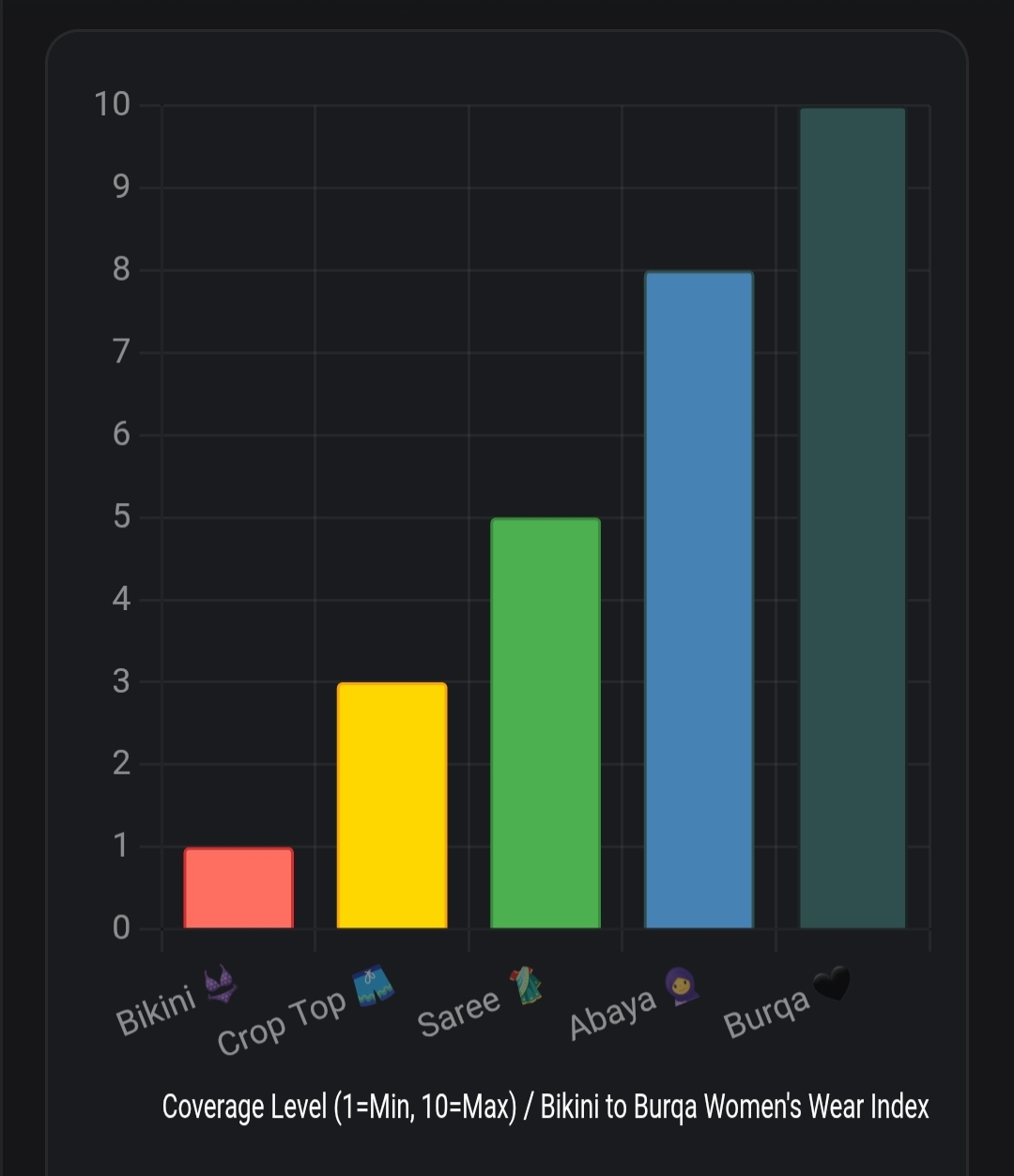
The Bikini to Burqa Womens Wear Index (B2BWW Index) is a conceptual framework to categorize dress codes for women based on the degree of skin and hair exposure. It places attire on a spectrum from minimal coverage to maximum coverage, reflecting cultural, social, or regional dressing norms. This index can be used to broadly characterize the predominant dress styles for women in a city or nation, acknowledging that individual choices vary widely.
On the left is 1. Extreme Radical Individual Liberalists or Naturists (Nudists-Tribalists) eg. Andaman and Rio Carnival Brazil & Indian Jain Monks (Naga Sadhus). Unevolved Genderity of Individualists.
on the Right Extreme Radical Collective Conservatives global_Religionists or Clothists (Nuns & Hijabbed nations like Iran). Toxic Genderity of Authoritarianism/Totalitarianism.
in Centre is Moderate Centerist Nations. that are Balanced Tonic Genderity Utilitarianism.
Index Spectrum
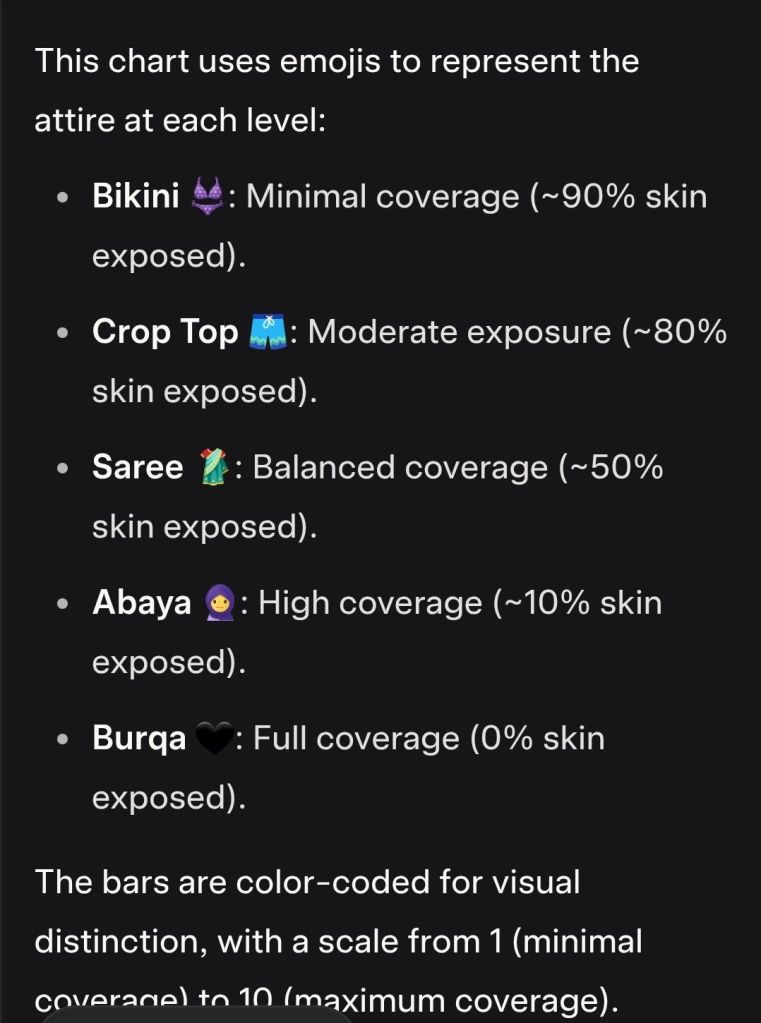
The BBSB Index ranges from 1 (minimal coverage, maximum exposure) to 10 (maximum coverage, minimal exposure). Below is the spectrum with examples of attire, their approximate coverage levels, and descriptions.
- Bikini (Level 1)
- Description: Minimal coverage, typically exposing most of the body, including torso, arms, legs, and hair. Common in beach or resort settings.
- Skin Exposure: ~90-95% (torso, arms, legs exposed).
- Hair Exposure: Fully exposed.
- Cultural Context: Often seen in liberal, warm-climate regions or tourist-heavy areas (e.g., Goa, India; Miami, USA).
- Crop Top and Shorts/Skirt (Level 2)
- Description: Exposes midriff, arms, and legs. Popular in urban, youth-centric settings.
- Skin Exposure: ~80-85% (midriff, arms, legs exposed).
- Hair Exposure: Fully exposed.
- Cultural Context: Common in metropolitan cities with liberal fashion norms (e.g., Mumbai, Los Angeles).
- Short Dress/Mini Skirt (Level 3)
- Description: Covers torso but exposes legs and arms. Often fashionable in urban settings.
- Skin Exposure: ~70-80% (arms, upper legs exposed).
- Hair Exposure: Fully exposed.
- Cultural Context: Seen in cosmopolitan areas (e.g., Delhi, London).
- Knee-Length Dress/Salwar Kameez (Level 4)
- Description: Covers torso and upper legs, may expose lower legs and arms. Includes modern dresses or traditional outfits like salwar kameez with short sleeves.
- Skin Exposure: ~50-60% (lower legs, arms exposed).
- Hair Exposure: Fully exposed.
- Cultural Context: Common in semi-conservative urban settings (e.g., Bangalore, Dubai).
- Bandhani-Saree/Lehenga (Level 5)
- Description: Traditional Indian attire like a saree or lehenga, often exposing midriff but covering most of the body. May include a dupatta for additional coverage.
- Skin Exposure: ~40-50% (midriff, sometimes arms exposed).
- Hair Exposure: Fully exposed or partially covered with dupatta.
- Cultural Context: Widespread in India, especially during cultural or festive events (e.g., Jaipur, Ahmedabad).
- Maxi Dress/Anarkali Suit (Level 6)
- Description: Covers torso, arms, and legs fully, but form-fitting or with minimal exposure (e.g., neckline). Includes floor-length Anarkali suits.
- Skin Exposure: ~20-30% (neck, hands exposed).
- Hair Exposure: Fully exposed or loosely covered.
- Cultural Context: Common in conservative urban areas (e.g., Lucknow, Istanbul).
- Churidar with Long Dupatta (Level 7)
- Description: Full-body coverage with long-sleeved kameez, churidar, and a dupatta covering hair or shoulders.
- Skin Exposure: ~10-20% (face, hands exposed).
- Hair Exposure: Partially or fully covered with dupatta.
- Cultural Context: Prevalent in traditional or semi-conservative regions (e.g., Punjab, parts of Pakistan).
- Abaya/Jilbab (Level 8)
- Description: Loose, full-body covering attire, often with a headscarf covering hair and neck. Face remains exposed.
- Skin Exposure: ~5-10% (face, hands exposed).
- Hair Exposure: Fully covered.
- Cultural Context: Common in conservative regions (e.g., Riyadh, Tehran).
- Hijab with Niqab (Level 9)
- Description: Covers entire body and hair, with only eyes visible. Includes niqab paired with abaya or similar attire.
- Skin Exposure: ~2-5% (eyes exposed).
- Hair Exposure: Fully covered.
- Cultural Context: Seen in highly conservative areas (e.g., parts of Saudi Arabia, Afghanistan).
- Burqa (Level 10)
- Description: Complete coverage, including a mesh over the eyes to allow vision. No skin or hair exposed.
- Skin Exposure: 0% (no skin visible).
- Hair Exposure: Fully covered.
- Cultural Context: Prevalent in extremely conservative regions (e.g., parts of Afghanistan, rural Yemen).
Application to Cities/Nations
The BBSB Index can be applied to characterize the predominant dress code for women in a city or nation based on cultural norms, climate, and social expectations. Below are examples of where certain cities might fall on the spectrum, based on general observations:
- Level 1-2 (Bikini to Crop Top/Shorts): Cities like Miami (USA), Rio de Janeiro (Brazil), or Goa (India during tourist season) where beachwear or casual, revealing clothing is common in specific contexts.
- Level 3-4 (Short Dress to Knee-Length Dress/Salwar): Urban centers like Mumbai (India), New York (USA), or London (UK), where modern and semi-traditional attire with moderate coverage is prevalent.
- Level 5-6 (Bandhani-Saree to Maxi Dress/Anarkali): Cities like Jaipur (India), Dhaka (Bangladesh), or Istanbul (Turkey), where traditional attire with moderate coverage dominates.
- Level 7-8 (Churidar to Abaya): Regions like Lahore (Pakistan), Dubai (UAE), or Cairo (Egypt), where conservative attire with headscarves is common.
- Level 9-10 (Hijab with Niqab to Burqa): Cities like Kabul (Afghanistan) or Riyadh (Saudi Arabia), where full-coverage attire is culturally or legally enforced.
Notes
- Cultural Sensitivity: The index is a descriptive tool and does not imply judgment on any dress style. Individual choices vary, and the index reflects general trends.
- Context Matters: Dress codes depend on context (e.g., urban vs. rural, festive vs. daily wear, climate). For example, a city like Mumbai may span Levels 2-6 depending on the setting.
- Dynamic Nature: Dress norms evolve with globalization, fashion trends, and socio-political changes, so a city’s position on the index may shift over time.
This index provides a framework to understand and compare dress codes globally, respecting the diversity of cultural expressions.
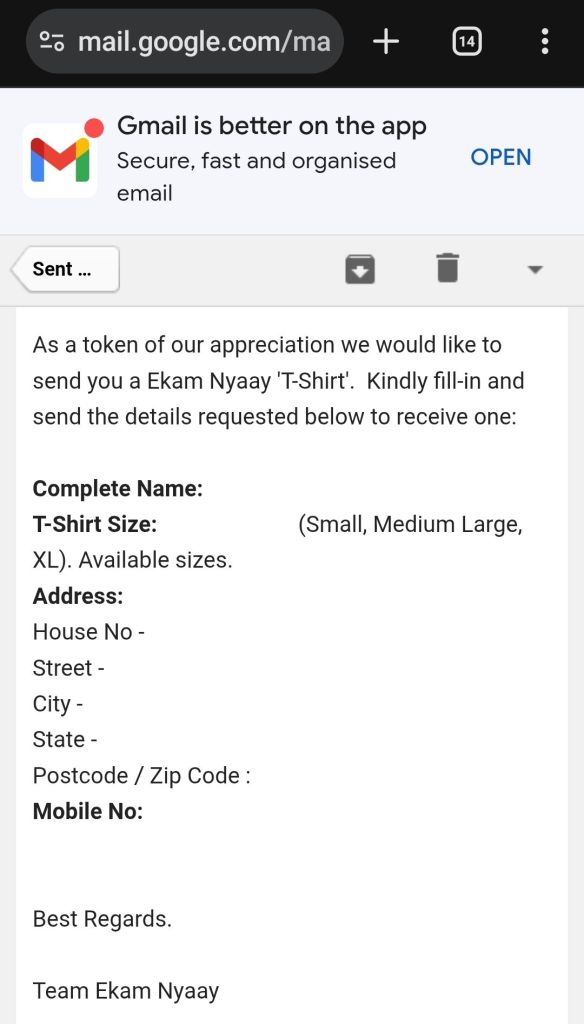
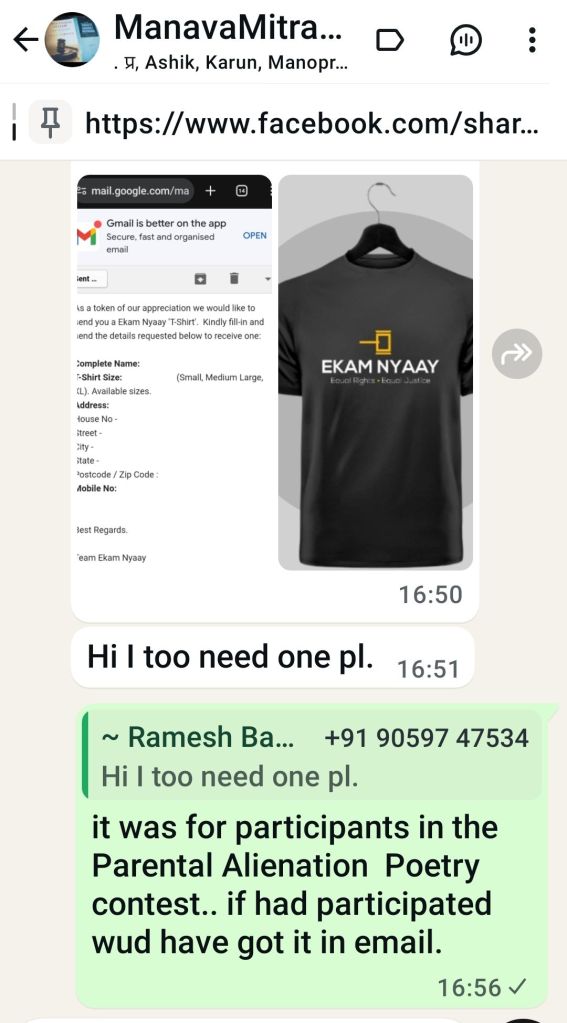
S1275: I Trusted & You Twisted. Anti’False Accusation Day Poem.
Poem Contest Submission for Ekam Nyaay Foundation.
I Trusted & U Twisted.
(A False Accusation Victims Voice.)
I trusted you, our words a shared tongue,
Though your village differed, your heart seemed young.
I sought friends, kin in spirit, not just name,
Dreaming of solidarity, a community’s flame.
I bypassed brighter paths to give you a chance,
Now I curse my choice, caught in this dance.
Your unfairness Within, was opposite of my hues,
Held no warning of the darkness you grew.
our homes hearts sparked bright, a radiant glow,
But yours, a shadow, I’d never know.
I saw your youth, thought innocence true,
Yet you wove lies that our lives now rue.
Your online profile screamed deceit, but to red flags I turned blind,
Believed in good, in a heart that’s kind.
Now trapped in this prison of your cruel creation,
My trust betrayed, my soul confined.
I hope and Trust the Divine or Human Justice will be served, & we all will get back in Life with efforts that which we Always deserved.
U Trusted Me but I Thrusted U..
(A Deviant’s Confessions..)
You trusted me, thought our roots aligned,
Shared language, shared hopes, our paths entwined.
I seemed a friend, a brother from afar,
But I hid a blade beneath my star.
You sought unity, a bond to forge,
While I planned a storm on your heart’s shore.
You passed up others, gave me your hand,
Unknowing I’d bury you in sinking sand.
My skin, my mother’s, dark as night,
You thought it harmless, saw only light.
But my heart was coal, my intent to sting,
A trap set tight with a liar’s spring.
You saw my youth, assumed a soul pure,
But I spun a web, your ruin my lure.
Your trust was soft, an easy mark to bruise,
I thrusted deep, with lies I’d choose.
Until I completed my SCAM of Seed, Corrupt, Abuse & Mess Life.
S1274: Pro-men & Proper-Justice Judgements & Citations.
1. Expecting Educated & Earning Wife To Contribute To Household Expenses Is Not Cruelty: Calcutta High Court https://www.livelaw.in/high-court/calcutta-high-court/expecting-educated-earning-wife-to-contribute-to-household-expenses-is-not-cruelty-calcutta-high-court-302881
S1273: Properties Matching in Marriages..
Your marriage not only depends 50% on the Marital_laws in the Nation & 50% on your in_laws in the Commotions & Out-laws in the Compilations.
The user’s query posits an insightful perspective on marital success: that it hinges not on material wealth or assets (“properties owned”) by the spouses or their parents, but rather on the character traits (“properties in character”) of the four key individuals involved—the bride, groom, and their respective parents. Below, I’ll examine this claim by drawing on empirical research to substantiate it, while also offering refinements to enhance its nuance and applicability.
Proving the Claim
Research on marital success consistently emphasizes interpersonal dynamics, personality compatibility, and relational skills over material factors. While financial stability can play a supportive role, studies show it’s often secondary to character-driven elements like communication, empathy, and conflict resolution. Similarly, the involvement of parents (or in-laws post-marriage) is highlighted as influential, particularly through their attitudes and behaviors toward the couple.
1. Character Traits of the Spouses as Primary Predictors
Numerous studies identify personality and behavioral traits as foundational to long-term marital satisfaction and stability. For instance:
- Couples with high conscientiousness (e.g., reliability, self-discipline) report greater marital satisfaction, while high neuroticism (e.g., emotional instability) correlates with lower satisfaction.
- Key traits like kindness, humility, resilience, and humor are linked to sustained relationships, with kindness emerging as the top predictor of stability in multiple analyses.
- Positive within-couple personality concordance—such as both partners exhibiting agreeableness or emotional stability—predicts higher marital quality, whereas mismatches in traits like openness or extraversion can lead to friction.
- Broader accounts from self-described happy couples highlight factors like commitment, communication, intimacy, and mutual respect as essential, all of which stem from character rather than external resources. These findings align with longitudinal models, such as those from John Gottman’s research, which predict marital outcomes with over 80% accuracy based on observable character-driven behaviors like “turning toward” one another during bids for attention and effective conflict management.
2. Role of Parents’ (or In-Laws’) Character
The character and involvement of parents significantly influence marital outcomes, often through ongoing support or conflict. Discord with in-laws is prospectively linked to declines in marital success over time, while positive relationships provide emotional buffering and reduce divorce risk. For example:
- Early positive bonds with mothers-in-law predict stronger in-law relationships later, fostering marital harmony.
- Couples who agree on handling in-law issues (e.g., boundaries, expectations) experience higher satisfaction and better therapy outcomes.
- Supportive in-laws contribute to a “kin network” that enhances stability, whereas intrusive or critical behaviors exacerbate stress. This supports the query’s inclusion of parents’ character, as their traits (e.g., respectfulness, adaptability) can either reinforce or undermine the couple’s bond.
3. Material Wealth as Secondary or Non-Determinative
Contrary to the query’s emphasis, wealth does correlate with marital stability in some contexts—higher income individuals are more likely to marry and stay married, and wealth shocks can boost marriage rates for men. However, this is not a direct causal dependency; instead, financial factors often interact with character:
- Financial stress negatively impacts satisfaction, but its effects are moderated by communication and relational skills—couples with strong character traits handle money issues better.
- Lower-income couples don’t inherently have less satisfying marriages; trajectories depend more on how they navigate stressors.
- Jointly managed wealth boosts life satisfaction, but only when aligned with shared values and behaviors. Overall, while wealth provides a buffer against external pressures, it’s not the core driver—character traits outperform it in predictive models.
Improving the Claim
The original statement is compelling but can be refined for greater precision and practicality:
- Add Nuance on Interdependence: Marital success depends on the compatibility and interplay of character traits among the four people, not just their individual qualities. For example, shared values (e.g., spirituality, commitment) amplify positive outcomes. A revised version: “Marital success is primarily dependent on the compatible character traits of the bride, groom, and their parents, rather than on material assets.”
- Incorporate Actionable Assessment: To evaluate these “properties,” premarital tools like the PREPARE inventory can predict success by assessing traits such as emotional health, adaptability, and family-of-origin influences.
- Acknowledge Cultural Contexts: In collectivist cultures, parents’ roles are amplified, so emphasize building kin networks early.
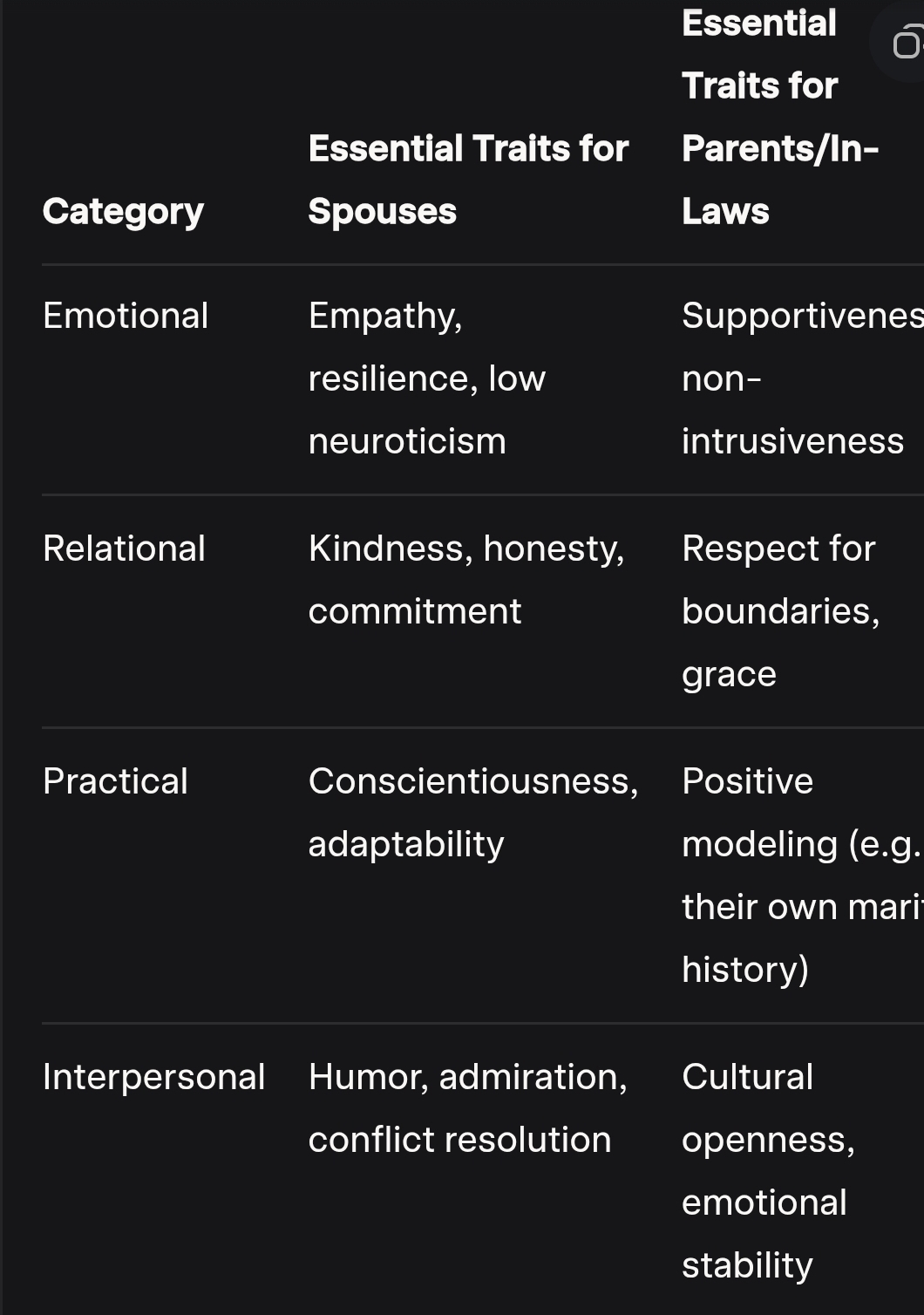
- Key Traits to Prioritize: Based on research, focus on these for the spouses and parents:
Category Essential Traits for Spouses Essential Traits for Parents/In-Laws Emotional Empathy, resilience, low neuroticism Supportiveness, non-intrusiveness Relational Kindness, honesty, commitment Respect for boundaries, grace Practical Conscientiousness, adaptability Positive modeling (e.g., their own marital history) Interpersonal Humor, admiration, conflict resolution Cultural openness, emotional stability
By prioritizing these, couples can foster resilience against challenges, including financial ones. If you’d like to dive deeper into specific studies or personal applications, let me know!
S1272: Types of DT..
Thank you for your request to write about the types of “DTs,” which, based on our prior conversation, refers to DT1 (Design Thinking), DT2 (Decision Theory), and DT3 (Democratic Thinking). Below, I’ll provide an overview of each type, describing their core principles, methodologies, and variations (or “types” within each), tailored to their relevance in contexts like global international geopolitics, as discussed previously. I’ll also address their application and non-application areas briefly, ensuring the response is clear, structured, and comprehensive without repeating the detailed geopolitical applications already covered. If you meant a different interpretation of “types of DTs” or want a specific focus (e.g., subtypes within one DT or a comparison chart), please clarify!
Types of DTs: Design Thinking, Decision Theory, and Democratic Thinking
DT1: Design Thinking
Definition: Design Thinking is a human-centered, iterative methodology for solving complex problems by focusing on empathy, creativity, and experimentation. It’s widely used to innovate in product design, policy, and social challenges, including geopolitics.
Core Principles:
- Empathy: Understand users’ needs through observation and engagement.
- Define: Clearly articulate the problem based on insights.
- Ideate: Generate diverse solutions through brainstorming.
- Prototype: Create tangible, low-fidelity models of ideas.
- Test: Implement and refine solutions based on feedback.
Types (Variations) of Design Thinking:
- Stanford d.school Model: The classic five-stage process (Empathize, Define, Ideate, Prototype, Test), emphasizing linear progression but flexible iteration. Used in education and product design.
- Double Diamond Model: Developed by the UK Design Council, it splits into Discover, Define, Develop, Deliver phases, focusing on divergent and convergent thinking. Common in service design and policy innovation.
- Lean Design Thinking: Integrates lean startup principles, prioritizing rapid prototyping and minimal viable products (MVPs). Used in tech and startups.
- Social Innovation Design Thinking: Tailored for social impact, emphasizing community engagement and systemic change (e.g., IDEO.org’s work on poverty alleviation).
- Military Design Thinking: Adapted for strategic contexts, like national security or geopolitics, blending DT with systems thinking to address complex threats.
Application Areas:
- Product and service design (e.g., user interfaces, healthcare services).
- Social impact (e.g., education reform, climate justice).
- Geopolitics (e.g., peace negotiations, urban policy).
- Business strategy (e.g., innovation workshops).
Non-Application Areas:
- Purely technical problems (e.g., algorithm optimization).
- Highly regulated or standardized processes (e.g., legal compliance).
- Routine tasks with no need for creativity (e.g., data entry).
Example in Geopolitics: Facilitating dialogue in Colombia’s peace process by empathizing with stakeholders and prototyping communication platforms.
DT2: Decision Theory
Definition: Decision Theory is a formal framework for making rational choices under uncertainty, using mathematical and logical models to evaluate options, probabilities, and outcomes. It’s widely applied in economics, policy, and strategic planning, including geopolitical decision-making.
Core Principles:
- Normative Approach: Prescribes optimal decisions based on maximizing expected utility.
- Descriptive Approach: Analyzes how people actually make decisions, accounting for biases.
- Probabilistic Reasoning: Incorporates uncertainty through probability assessments.
- Utility Evaluation: Assigns values to outcomes to guide choices.
Types (Variations) of Decision Theory:
- Normative Decision Theory: Focuses on ideal decision-making (e.g., Expected Utility Theory), assuming rational actors. Used in economic modeling and policy analysis.
- Descriptive Decision Theory: Studies real-world decision-making, incorporating psychological biases (e.g., Prospect Theory by Kahneman and Tversky). Relevant for understanding diplomatic behavior.
- Bayesian Decision Theory: Uses Bayes’ theorem to update probabilities with new evidence. Common in risk assessment and intelligence analysis.
- Game Theory: A subset modeling strategic interactions among multiple actors (e.g., Nash Equilibrium). Widely used in geopolitics for analyzing conflicts or alliances.
- Multi-Criteria Decision Analysis (MCDA): Evaluates decisions with multiple conflicting objectives (e.g., balancing economic and environmental goals in trade agreements).
Application Areas:
- Geopolitical strategy (e.g., modeling nuclear deterrence).
- Economics and finance (e.g., investment decisions).
- Policy analysis (e.g., trade negotiations).
- Risk management (e.g., disaster response planning).
Non-Application Areas:
- Highly subjective or creative tasks (e.g., art creation).
- Situations requiring rapid, intuitive action (e.g., emergency response).
- Contexts with insufficient data for modeling (e.g., unpredictable social movements).
Example in Geopolitics: Game Theory models in the Cold War analyzed U.S.-Soviet strategies, informing mutually assured destruction (MAD) policies to prevent escalation.
DT3: Democratic Thinking
Definition: Democratic Thinking is less formally defined but refers to approaches that prioritize participatory, inclusive, and deliberative processes to foster democratic values in decision-making. It emphasizes collective agency, equity, and citizen engagement, often applied to governance and social change, including geopolitical contexts like international democracy promotion.
Core Principles:
- Inclusivity: Engage diverse stakeholders in decision-making.
- Deliberation: Encourage open dialogue to reach consensus or informed decisions.
- Equity: Ensure marginalized voices are heard and empowered.
- Transparency: Promote accountability in governance processes.
Types (Variations) of Democratic Thinking:
- Deliberative Democracy: Uses structured forums (e.g., citizen assemblies) to discuss policy issues, like climate agreements or constitutional reforms.
- Participatory Democracy: Encourages direct citizen involvement, such as through referenda or community councils, to influence local or global policies.
- Collaborative Governance: Involves multi-stakeholder partnerships (e.g., governments, NGOs, citizens) to co-create solutions, often in international development.
- Digital Democratic Thinking: Leverages technology (e.g., online platforms like Pol.is) for scalable citizen input, used in global policy consultations.
- Civic Design Thinking: Blends Design Thinking with democratic principles, focusing on prototyping inclusive governance models (e.g., Global Classroom for Democracy Innovation).
Application Areas:
- Governance reform (e.g., constitutional design).
- Geopolitical collaboration (e.g., climate justice workshops).
- Community empowerment (e.g., local policy co-creation).
- Education for civic engagement (e.g., youth leadership programs like SEASAT).
Non-Application Areas:
- Authoritarian systems resistant to participation.
- Highly technical domains (e.g., engineering standards).
- Situations requiring immediate, unilateral decisions (e.g., crisis response).
Example in Geopolitics: The Global Classroom for Democracy Innovation used Democratic Thinking to engage students from Canada, South Africa, and Sweden in co-creating climate policy prototypes, fostering cross-border collaboration.
Summary of DTs and Their Relevance to Geopolitics
- Design Thinking (DT1): Best for human-centered geopolitical challenges (e.g., peacebuilding, refugee integration) where empathy and iteration uncover innovative solutions. Less suitable for purely technical or rigid systems.
- Decision Theory (DT2): Ideal for strategic, data-driven geopolitical decisions (e.g., trade negotiations, conflict modeling) where rational analysis is key. Less effective for subjective or data-scarce contexts.
- Democratic Thinking (DT3): Suited for inclusive geopolitical processes (e.g., global governance, citizen diplomacy) where participation and equity matter. Less applicable in authoritarian or urgent scenarios.
Clarifications and Next Steps
If you’d like a deeper exploration of specific types within one DT (e.g., Game Theory in Decision Theory), their geopolitical applications, or a comparison chart, let me know! I can also search X for real-time discussions on these DTs or analyze specific documents for further context. Alternatively, if you meant another interpretation of “DTs” or want to focus on a particular geopolitical issue, please provide more details.
Sources: This response draws on general knowledge up to September 2025, including case studies from Design Thinking (e.g., IDEO, Stanford d.school), Decision Theory (e.g., economic and game-theoretic literature), and Democratic Thinking (e.g., deliberative democracy initiatives). Specific citations include Colombia’s peace process , Team Rubicon’s global expansion , Global Classroom for Democracy , and SEASAT Youth Camp .
S1271: DT application & Non-application Areas. GRP+GROK.
Where Design Thinking Should be & Could Not Be Applied?
Design Thinking, a human-centered, iterative approach to problem-solving, is not subject to strict rules prohibiting its use in any domain, but recommendations exist based on its suitability and effectiveness. Experts suggest Design Thinking is most valuable in domains involving complex, human-related problems where empathy, ideation, and prototyping can drive innovation. It may be less effective or impractical in areas requiring rigid, standardized processes, purely technical solutions, or where human-centric insights offer little value. The decision to apply Design Thinking depends on the problem’s nature, stakeholder involvement, and the need for creative, user-focused solutions.
Design Thinking Application Areas
Design Thinking is widely applied in domains where understanding user needs, fostering creativity, and iterative problem-solving are beneficial. Here’s a list of key application areas:
- Product Design and Development:
- Creating user-friendly products by focusing on customer needs (e.g., consumer electronics, apps).
- Example: Apple’s iterative design process for user interfaces.
- Service Design:
- Improving customer experiences in industries like hospitality, banking, or retail.
- Example: Redesigning bank service processes to reduce customer wait times.
- Healthcare:
- Designing patient-centered solutions, such as better hospital workflows or medical devices.
- Example: IDEO’s work on patient experience improvements in healthcare settings.
- Education:
- Developing innovative curricula, teaching methods, or learning environments.
- Example: Redesigning classroom experiences to enhance student engagement.
- Business Strategy and Innovation:
- Creating new business models, improving organizational processes, or fostering innovation cultures.
- Example: IBM’s use of Design Thinking to streamline enterprise solutions.
- Social Impact and Nonprofits:
- Addressing social challenges like poverty, education access, or sustainability.
- Example: Design Thinking workshops to develop community-based solutions for clean water access.
- Urban Planning and Public Policy:
- Designing citizen-centered policies or urban spaces (e.g., public transportation systems).
- Example: Redesigning city services to improve accessibility for marginalized groups.
- Technology and Software Development:
- Creating intuitive user interfaces, apps, or customer-facing tech solutions.
- Example: Airbnb’s use of Design Thinking to enhance user experience on its platform.
Non-Application Areas
While Design Thinking is versatile, it may be less suitable or challenging to apply in certain domains due to practical, cultural, or structural constraints. Here’s a list of areas where Design Thinking is less likely to be applied effectively:
- Highly Technical or Algorithmic Domains:
- Areas like pure mathematics, cryptography, or low-level software engineering where problems are solved through logic or computation rather than human-centric insights.
- Reason: Design Thinking’s focus on empathy and ideation adds little value to purely technical challenges.
- Standardized or Regulated Processes:
- Domains with strict compliance requirements, such as legal procedures or safety-critical systems (e.g., nuclear power plant operations).
- Reason: Rigid protocols leave little room for iterative experimentation.
- Routine or Repetitive Tasks:
- Simple, operational tasks like data entry or assembly line work where creativity isn’t needed.
- Reason: These tasks don’t benefit from Design Thinking’s iterative, user-focused approach.
- Domains with Minimal Human Interaction:
- Systems like industrial automation or backend infrastructure where user experience isn’t a priority.
- Reason: Design Thinking thrives on understanding human needs, which is irrelevant here.
- Time- or Resource-Constrained Environments:
- Situations requiring immediate action (e.g., emergency response) or with limited budgets for iterative processes.
- Reason: Design Thinking’s iterative nature can be time- and resource-intensive.
- Highly Abstract or Philosophical Problems:
- Areas like theoretical philosophy or metaphysics where problems lack tangible, user-focused outcomes.
- Reason: Design Thinking requires actionable problems tied to human experiences.
Nuances and Considerations
- “Should/Could” Apply: Design Thinking is recommended in domains with complex, human-centered problems (e.g., healthcare, education, product design) where empathy and iteration can uncover innovative solutions. It’s also feasible in emerging areas like policy design or sustainability, where user-focused innovation is gaining traction.
- “Must Not” Apply: There’s no strict prohibition, but Design Thinking is impractical in domains with rigid processes, purely technical challenges, or where quick, standardized solutions are needed. For example, using Design Thinking to optimize a mathematical algorithm is overkill when computational methods suffice.
- Emerging Areas: Fields like agriculture or government services are starting to adopt Design Thinking (e.g., designing farmer-friendly tools or citizen-centric policies), but adoption may be limited by cultural resistance or resource constraints.
Clarification and Next Steps
If you have a specific context in mind (e.g., a particular industry, project, or framework for Design Thinking), or if you’d like examples from specific domains, please let me know! I can also search for real-time examples or discussions on X about Design Thinking applications or provide a chart comparing application areas if that’s helpful. Additionally, if you want guidance on applying Design Thinking to a specific problem, I can tailor suggestions.
Sources
This response is based on general knowledge of Design Thinking applications up to September 2025, drawing from industry practices and case studies (e.g., IDEO, Stanford d.school).
 GRP_VCare2Dare