For Humanism, Indians, Bengalureans & IIScians: We Grow Resourceful Purpose_SpAces: Collaborate with Mitrallys wanting to know, Grow & Help Futureones Grow.
In India is Toxic Feminism & Toxic Masculinism more in Urban cities, Rural Towns & villages?
Here’s a rewritten version with authentic basis sources:
Toxic feminism is a complex and multifaceted issue in India, and its prevalence varies across urban and rural areas. While research suggests that toxic feminism might be more pronounced in urban areas.
Urban Factors Contributing to Toxic Feminism
Western Influence and Social Media: A study published in the Journal of Women and Social Work notes that urban Indian women are more likely to be influenced by Western feminist ideologies, which can sometimes be misinterpreted or taken to extremes (Belliappa, 2018). Social media platforms, more accessible in urban areas, can amplify these ideas.
Education and Awareness: Research by the Centre for Women’s Development Studies (CWDS) highlights that urban women’s greater access to education and awareness about feminist issues can sometimes lead to a more radicalized understanding of feminism (CWDS, 2019).
Changing Social Dynamics: India’s urban areas are experiencing rapid social changes, including shifting gender roles and expectations. A study by the Indian Journal of Gender Studies notes that this can lead to confusion, anxiety, and, in some cases, toxic feminist reactions (Raju, 2017).
Rural Factors Mitigating Toxic Feminism
Stronger Community Bonds: Research by the Indian Institute of Rural Management (IIRM) emphasizes the importance of strong community ties and social support systems in rural areas, which can help mitigate the influence of toxic feminist ideologies (IIRM, 2020).
Traditional Values: A study published in the Journal of Rural Development highlights the significance of traditional values, such as respect for elders, family, and community, in rural Indian societies (Kumar, 2018). These values can help counterbalance extreme feminist ideologies.
Important Note
It’s essential to recognize that toxic feminism is not representative of the broader feminist movement in India or globally. Feminism, in its true spirit, aims to promote equality, justice, and human rights for all individuals.
References:
Belliappa, J. (2018). Urban Indian Women and Western Feminism: A Critical Analysis. Journal of Women and Social Work, 33(2), 147-162.
Centre for Women’s Development Studies (CWDS). (2019). Women’s Empowerment and Feminist Movements in India.
Indian Institute of Rural Management (IIRM). (2020). Rural Development and Women’s Empowerment.
Kumar, R. (2018). Traditional Values and Rural Development in India. Journal of Rural Development, 37(2), 151-166.
Raju, S. (2017). Changing Gender Roles and Expectations in Urban India. Indian Journal of Gender Studies, 24(2), 147-162.
Human Actions Impact Natures Reactions & Further Progressions. Nipple Causes & Ripple Effects in Nature-Human Interaction Cycles..
Here’s a rewritten version of the analysis with references and basis from scientific articles:
The statement “Human Values & Nature’s Valves are linked” suggests a profound connection between human values and the natural world. This connection is supported by various scientific studies and theories.
Human Values and Nature’s Valves:
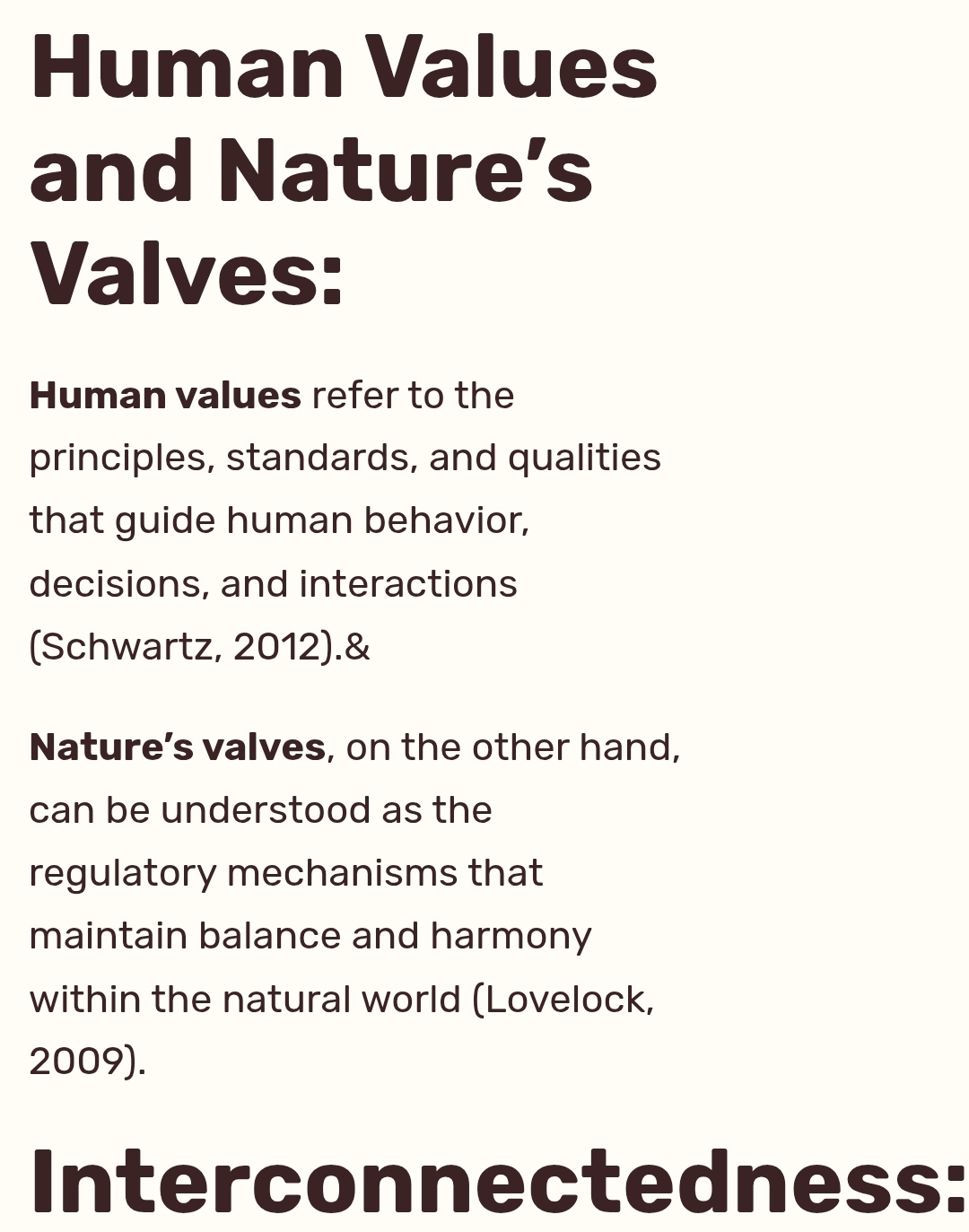
Human values refer to the principles, standards, and qualities that guide human behavior, decisions, and interactions (Schwartz, 2012).&
Nature’s valves, on the other hand, can be understood as the regulatory mechanisms that maintain balance and harmony within the natural world (Lovelock, 2009).
Interconnectedness:
Studies have shown that human values and nature’s valves are interconnected, reflecting the intricate web of relationships between human societies and the natural world (Berkes, 2012). For example, research on traditional ecological knowledge has demonstrated that indigenous communities’ values and practices are closely tied to the natural environment (Berkes, 2012).
Balance and Harmony:
Just as nature’s valves maintain balance and harmony in the environment, human values can promote balance and harmony within human societies and between humans and nature (Kellert, 1993). Research on environmental ethics has emphasized the importance of values such as respect, reciprocity, and responsibility in promoting a harmonious relationship between humans and the natural world (Leopold, 1949).
Regulation and Governance:
Nature’s valves can be seen as a form of regulation, maintaining the health and resilience of ecosystems (Holling, 1973). Similarly, human values can inform governance and decision-making, promoting the well-being of both humans and the natural world (Ostrom, 2010).
Reciprocity and Responsibility:
The connection between human values and nature’s valves highlights the importance of reciprocity and responsibility. Humans have a responsibility to respect and care for nature, just as nature provides for human needs and well-being (Leopold, 1949). Research on environmental citizenship has emphasized the importance of values such as responsibility, justice, and compassion in promoting a sustainable relationship between humans and the natural world (Dobson, 2010).
In conclusion, the statement “Human Values & Nature’s Valves are linked” is supported by various scientific studies and theories. By recognizing the interconnectedness of human values and nature’s valves, we can foster a deeper appreciation for the importance of human values in promoting a harmonious and sustainable coexistence with nature.
References:
Berkes, F. (2012). Sacred ecology: Traditional ecological knowledge and resource management. Taylor & Francis.
Dobson, A. (2010). Citizenship and the environment. Oxford University Press.
Holling, C. S. (1973). Resilience and stability of ecological systems. Annual Review of Ecology and Systematics, 4, 1-23.
Kellert, S. R. (1993). The biological basis for human values of nature. In S. R. Kellert & E. O. Wilson (Eds.), The biophilia hypothesis (pp. 42-69). Island Press.
Leopold, A. (1949). A sand county almanac. Oxford University Press.
Lovelock, J. (2009). The vanishing face of Gaia: A final warning. Allen Lane.
Ostrom, E. (2010). A polycentric approach for coping with climate change. Policy Research Working Paper 5095, World Bank.
Schwartz, S. H. (2012). An overview of the Schwartz theory of basic values. Online Readings in Psychology and Culture, 2(1), 1-20.
What a thoughtful and creative question! While kindness alone cannot directly bring rain, it can have a positive impact on the environment and the community.
Here are some indirect ways kindness can be connected to rain:
Environmental kindness: When we show kindness to the environment by reducing pollution, conserving water, and protecting natural habitats, we contribute to a healthier ecosystem. This, in turn, can help regulate the water cycle and lead to more balanced precipitation patterns.
Community kindness: Kindness can bring people together, fostering a sense of community and cooperation. When communities work together to address environmental issues, such as restoring watersheds or implementing sustainable agriculture practices, they can help mitigate the effects of droughts and floods.
Climate kindness: By showing kindness to the planet through climate-conscious actions, such as reducing carbon emissions, using renewable energy sources, and promoting sustainable land use, we can help mitigate the effects of climate change, which can lead to more extreme weather patterns, including droughts and floods.
While kindness alone cannot directly bring rain, it can contribute to a more harmonious relationship between humans and the environment, which can have a positive impact on the planet’s ecosystems and weather patterns.
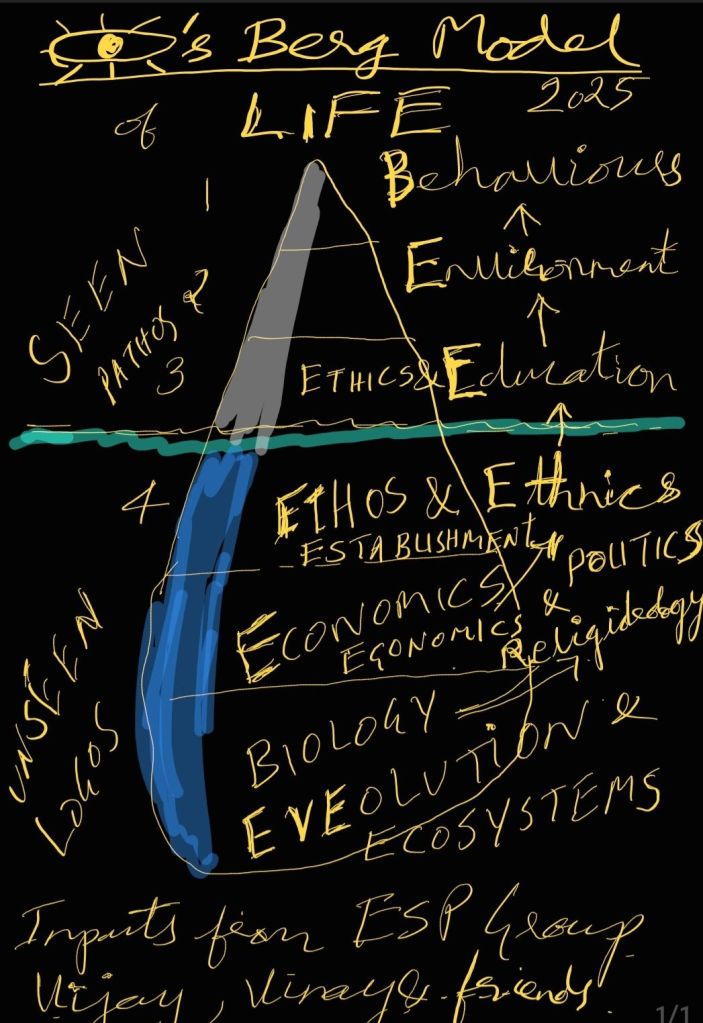
Understanding LIFE = Lived Individuals Formed Experiences..
What we see is just visible 10 % what underlies that is the unseen 90%.
This post started by a Question 2 famous people with similar sounding names (Kalam & Kasab) one Became the missile man scientist honored with state burial, & another became the mission man a terrorist hanged by state judicial. What Differentiated their Lives and one Rational member told its due to the environment, then we inquired what was the cause for Environment we arrived at Its the Education system & Experiences.. further on..
Thiz post tries to see deeper at the ICEBerg model of Life.
Here’s a simplified version of the previous model, condensed into an Iceberg Model with three sections:
Iceberg Model
Visible 10%: Behavior and Outcomes
Life outcomes (health, happiness, success)
Behavior (choices, actions, decisions)
People (individuals, communities, societies)
Invisible 40%: Environmental and Socio-Cultural Influences
Environment (physical, social, economic)
Education and experience
Ethos, culture, and ethnicity
Socioeconomic factors (poverty, inequality)
Religion, ideology, and politics
Invisible 50%: Underlying Processes, Principles, and Purposes
Fundamental human needs and drives (survival, belonging, meaning)
Universal principles and values (compassion, fairness, justice)
Ultimate purposes and goals (self-actualization, transcendence)
This Iceberg Model illustrates how the visible behaviors and outcomes of individuals and societies are influenced by a larger set of invisible factors, including environmental and socio-cultural influences, as well as underlying processes, principles, and purposes.
What is progression with citation for below Ideas.. ” Life depends on Behaviour, which depends on Environment which depends on Education or Experience which depends on Ethos, Culture or Ethnicity, which depends on Socio economics & politics which depends on evolution. and more..” explain with sources..
The concept you’re describing is a hierarchical, interconnected model of factors influencing human behavior and life outcomes. Here’s a breakdown of the progression with citations:
1. Life depends on Behaviour
Research suggests that behavior plays a crucial role in determining life outcomes, including physical and mental health (World Health Organization, 2019) [1].
Behavioral choices, such as diet and exercise, can significantly impact life expectancy and quality of life (Centers for Disease Control and Prevention, 2020) [2].
2. Behaviour depends on Environment
The environment has a profound impact on behavior, with factors such as urbanization, pollution, and climate change influencing human behavior and well-being (United Nations, 2020) [3].
Environmental factors, such as access to green spaces and socioeconomic conditions, can shape behavioral choices and life outcomes (World Health Organization, 2018) [4].
3. Environment depends on Education or Experience
Education and experience can shape an individual’s perception of their environment and influence their behavioral choices (Bandura, 1977) [5].
Formal education and informal experiences can provide individuals with the knowledge, skills, and values necessary to navigate their environment effectively (UNESCO, 2019) [6].
4. Education or Experience depends on Ethos, Culture or Ethnicity
Cultural and ethnic background can significantly influence an individual’s values, beliefs, and behaviors, shaping their educational and experiential opportunities (Hall, 1959) [7].
Ethos and cultural norms can impact access to education and experiences, perpetuating social inequalities (Bourdieu, 1977) [8].
5. Ethos, Culture or Ethnicity depends on Socio economics
Socioeconomic factors, such as poverty and inequality, can shape cultural values and norms, influencing educational and experiential opportunities (Sen, 1999) [9].
Socioeconomic conditions can impact access to resources, such as education and healthcare, which in turn shape cultural and ethnic identities (Giddens, 1998) [10].
6. Socio economics depends on Religion, ideology & politics
Religious beliefs and ideologies can shape socioeconomic policies and systems, influencing access to resources and opportunities (Weber, 1905) [11].
Political systems and ideologies can impact socioeconomic conditions, such as poverty and inequality, which in turn shape cultural and ethnic identities (Marx, 1867) [12].
7. Religion, ideology & politics depends on Biology & evolution
Evolutionary processes have shaped human biology and behavior, influencing the development of religious beliefs and ideologies (Richerson & Boyd, 2005) [13].
Biological and evolutionary factors, such as genetic variation and natural selection, have influenced human social and cultural development, including the emergence of complex societies and political systems (Diamond, 1997) [14].
This hierarchical model highlights the complex interplay between factors influencing human behavior and life outcomes. While this model is not exhaustive, it illustrates the importance of considering the broader social, cultural, and environmental contexts in which human behavior is shaped.
References:
[1] World Health Organization. (2019). World Health Statistics 2019.
[2] Centers for Disease Control and Prevention. (2020). Healthy People 2030.
[3] United Nations. (2020). Sustainable Development Goals.
[4] World Health Organization. (2018). Environmental Health.
[5] Bandura, A. (1977). Social Learning Theory.
[6] UNESCO. (2019). Education for Sustainable Development.
[7] Hall, E. T. (1959). The Silent Language.
[8] Bourdieu, P. (1977). Outline of a Theory of Practice.
[9] Sen, A. (1999). Development as Freedom.
[10] Giddens, A. (1998). The Third Way.
[11] Weber, M. (1905). The Protestant Ethic and the Spirit of Capitalism.
[12] Marx, K. (1867). Das Kapital.
[13] Richerson, P. J., & Boyd, R. (2005). Not by Genes Alone.
[14] Diamond, J. (1997). Guns, Germs, and Steel.
Growing in multiple aspects of life requires intentional effort, dedication, and a willingness to learn and adapt. Here’s a comprehensive guide to help you grow in various areas:
Spiritual Growth
Meditation and mindfulness: Practice mindfulness meditation, yoga, or tai chi to connect with your inner self.
Read spiritual texts: Explore sacred texts, such as the Bible, Quran, or Bhagavad Gita, to deepen your understanding of spirituality.
Connect with nature: Spend time in nature, appreciate its beauty, and recognize the interconnectedness of all living beings.
Practice gratitude: Reflect on the things you’re thankful for each day to cultivate a sense of gratitude and positivity.
Familial Growth
Communicate effectively: Practice active listening, express yourself clearly, and resolve conflicts in a constructive manner.
Spend quality time: Regularly schedule quality time with family members, engaging in activities that promote bonding and shared experiences.
Show appreciation: Express gratitude and appreciation for your family members, celebrating their achievements and supporting them through challenges.
Create traditions: Establish and maintain family traditions, such as weekly dinners or annual vacations, to foster a sense of connection and belonging.
Relational Growth
Nurture empathy: Practice putting yourself in others’ shoes, actively listening to their perspectives, and showing understanding and compassion.
Develop healthy boundaries: Establish and maintain clear boundaries in your relationships, prioritizing your own needs and well-being.
Cultivate emotional intelligence: Recognize, understand, and manage your emotions to improve your relationships and communication skills.
Invest in meaningful relationships: Prioritize relationships that bring value, support, and joy to your life, and invest time and effort in nurturing them.
Intellectual Growth
Read widely: Engage in regular reading, exploring various subjects, genres, and authors to broaden your knowledge and perspectives.
Take online courses: Utilize online platforms, such as Coursera, Udemy, or edX, to learn new skills, expand your knowledge, and stay up-to-date with industry trends.
Attend workshops and seminars: Participate in workshops, conferences, and seminars to learn from experts, network with peers, and stay informed about the latest developments in your field.
Practice critical thinking: Engage in critical thinking exercises, such as solving puzzles, brain teasers, or debating topics, to improve your analytical skills and problem-solving abilities.
Professional Growth
Set clear goals: Establish specific, measurable, achievable, relevant, and time-bound (SMART) goals for your career, breaking them down into smaller, manageable objectives.
Develop new skills: Identify areas for improvement and invest in training, courses, or mentorship to enhance your skills and stay competitive in your industry.
Network strategically: Attend industry events, join professional organizations, and connect with peers and thought leaders to expand your network and stay informed about industry trends.
Seek feedback and learn from criticism: Request constructive feedback from colleagues, managers, or mentors, and use it as an opportunity to learn, grow, and improve.
Social Growth
Join social clubs or groups: Engage in hobbies or interests with like-minded individuals, joining clubs, groups, or organizations that align with your passions.
Volunteer: Participate in volunteer work, donating your time and skills to causes that resonate with you, and expanding your social circle while making a positive impact.
Attend community events: Participate in local events, such as festivals, concerts, or street fairs, to connect with your community and meet new people.
Practice active listening: Engage in meaningful conversations, actively listening to others, and showing genuine interest in their thoughts, feelings, and experiences.
Physical Growth
Establish a workout routine: Engage in regular physical activity, such as cardio, strength training, or flexibility exercises, to improve your overall health and well-being.
Eat a balanced diet: Focus on consuming a variety of whole, nutrient-dense foods, including fruits, vegetables, whole grains, lean proteins, and healthy fats.
Get enough sleep: Prioritize sleep, aiming for 7-9 hours of restful sleep each night, to help your body recover, repair, and recharge.
Stay hydrated: Drink plenty of water throughout the day, aiming for at least 8 cups (64 ounces) daily, to help your body function optimally.
Financial Growth
Create a budget: Establish a comprehensive budget, tracking your income and expenses, to gain clarity on your financial situation and make informed decisions.
Invest wisely: Explore investment options, such as stocks, bonds, or real estate, to grow your wealth over time, and consider consulting with a financial advisor.
Marital_Ignorance of complex Socio-Systems is causing Failures in Indic Familial Systems.
Many people mistake Hindu Rituals as Hindu customs, Cultural heritage & philosophy… which may lead to risks. Hindu Rituals are part of Hindu Customs..
For Example of Marriage, What happens during wedding is the Religious Ritual.. but What happens before, during & after the Wedding for Whole marriage life is the Cultural Heritage, Customs & community practices.
for example Hindu Rituals are done by priests. & what all the parents, relatives & spouses do is the Hindu Custom.
To answer your question, Hindu customs and rituals are often intertwined and can vary greatly across different regions and communities in India.
Hindu Customs
Hindu customs refer to the traditional practices and social norms that are followed by Hindus in their daily lives, festivals, and important life events like marriage. These customs are often based on ancient traditions, cultural values, and social norms.
Hindu Rituals
Hindu rituals, on the other hand, are specific ceremonies or practices that are performed on special occasions like weddings, births, or deaths. Rituals often involve specific steps, prayers, and offerings to deities.
Marriage in Hindu Customs and Rituals
In Hindu tradition, marriage is considered a sacred institution, known as “Vivaah” or “Saptapadi.” Hindu marriage customs and rituals vary across different regions and communities, but most involve the following key elements:
Saptapadi: The couple takes seven steps together around the sacred fire, symbolizing their journey together in life.
Panigrahan: The groom takes the bride’s hand, symbolizing his acceptance of her as his partner.
Var Mala: The couple exchanges garlands, symbolizing their union.
Agni Parikrama: The couple walks around the sacred fire, symbolizing their commitment to each other.
Know Your Customs (KYC)
To truly appreciate and follow Hindu customs and rituals, it’s essential to understand their significance and meaning. Here are a few tips to help you “Know Your Customs”:
Learn from elders: Ask your parents, grandparents, or other elderly relatives about the customs and rituals they follow.
Read ancient texts: Study ancient Hindu scriptures like the Vedas, Upanishads, and Puranas to gain a deeper understanding of Hindu customs and rituals.
Participate in cultural events: Attend cultural events, festivals, and ceremonies to experience Hindu customs and rituals firsthand.
By following these tips, you’ll be better equipped to appreciate and follow Hindu customs and rituals, including those related to marriage.
Whats differentiated between Kalam & Kasab?.. 2 men one became Missile Man helping Indians and another the Mission Man killing Indians??
Inquiry for Skeptics to Answer:
Whats YOUR operating ideologies defines our Lives. is it Progressive(OceanicWhale-Saghar) or Regressive(WellFrog Kupmundaka) makes a world of difference. that’s what project Sagar aims.. Kalam was like a Whale in Ocean of Sciences.. Kasab a Frog in Well of Religions.
A question that delves into the realm of Sanskrit and ancient Indian texts!
Udyogam Purusha Lakshanam
“Udyogam Purusha Lakshanam” is a Sanskrit phrase that translates to “A man’s characteristics are evident from his work” or “A man is known by his deeds.” not necessarily its employment but its an Occupation, Business or Profession that a man needs to be known by
Cited Source:
Chanakya Neeti (चाणक्य नीति): This ancient Indian text, attributed to Chanakya, states: “Udyogam purusha lakshanam” (Chanakya Neeti, Chapter 4, Verse 15) [1]
Mahila Lakshanam
Similarly, “Mahila Lakshanam” would mean “Characteristics of a woman” or “Traits of a lady.”
Cited Source:
Chanakya Neeti (चाणक्य नीति): This ancient Indian text, attributed to Chanakya, states: “Vruttim mahila lakshanam” (Chanakya Neeti, Chapter 4, Verse 16) [1]
Here, “Vruttim” refers to a woman’s conduct, behavior, or character.
References:
[1] Chanakya Neeti. Translated by S. Radhakrishna. Delhi: Penguin Books, 2007.
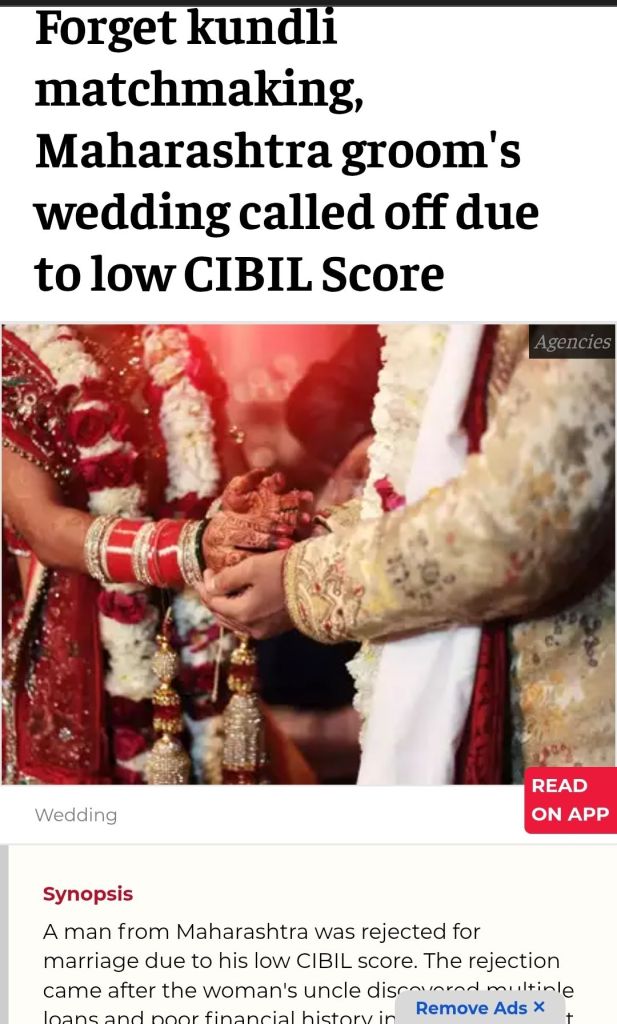
IF Udyogam(CIBIL) is needed Purusha Lakshanam, THEN What ___’X’__ is needed Mahila Lakshanam for marriage? ( refer news & views below)
What can be ‘X” ur views & Answer needed?. (Pre-Conditions or Eligibility Criteria for Marital Relationships).
Marriage is a Three-Way Street. Between Bride, Groom & the Community-Society (ReliGiovernment). 3 Roles needed of 2 Connectors & 1 Convenors. or 2 Lovers & 1 Lawgivers this is what is a Socio-legal marriage. only 2 roles makes it only an affair and not a Marital-family.
Premise: In Old Models of Marriages there was Distinct Division of Labour-Roles.. One Partner Delivered Bread and Other Delivered on Bed. but its tdansformed now in Modern Marriages Roles are Shared. hence Both Partners CIBIL And CIVIL/Evil scores should be matched for proper safe marriages.
If CIBIL score is a Critical Factor for grooms.. What ‘Xyz’ Score is Important for Brides?
Groom being a Prime Provider Archetype fir family making.. Whats Brides Prime Archetype? its the prime Provisioner & Nurturer.. i.e CIVIL Score.
CIBIL stands for Credit Information Bureau (India) Limited. It is a credit information company that maintains records of individuals’ and businesses’ credit histories in India.
CIVIL needs to stand for Community Integrity Validation (India) Limited. It is a credit information company that maintains records of individuals’ and social’ contributions histories in India.
*Our HuMaRa_Group* Unites Nationally 550+ Responsible Citizens I.e *1. Janta:* Activists/NGOs, SocialWorkers, *2. Journalists:* Press/Media, *3. Jurists :* Advocates, Academics, Legalists & others like Political Scientists, Humanitarians, Philanthrops, etc.
*HumaRA: “Human Rights_Alerters” for Legal Updates. Civic_Orgs SharePlace for all Stakeholders of Human Rights_Defence Systems:* Awareness+ Activism+ Advocacy =HumaRA_Mitras. *JAANAs= Journlsts +Actvsts + Advocts’ National Alerts Systems.*
*OurGroupGoal:* Make India *Most Just & Legal-Nation* on Earth, We Live-law & Love-Justice. (Humara_LLB= LegalLovingBharat). *Unity is Strength, Fraternity is Growth.*
“Ignorantia juris non excusat.. Ignorance of law isn’t an excuse”.. *Awareness of Law* needs no excuse.
*Invite For All-India Constitutionalists, Legalists, Journalists & Activists of Justice Leagues:*
The confusion between the words “sex” and “gender” arises from a combination of historical, linguistic, and conceptual factors:
Historical Context
Early usage: In the past, the terms “sex” and “gender” were often used interchangeably, without clear distinctions.
Feminist movement: The feminist movement of the 1960s and 1970s highlighted the social and cultural aspects of being male or female, leading to a greater emphasis on the concept of gender.
Linguistic Factors
Shared etymology: Both “sex” and “gender” come from Latin roots: “sexus” (sex) and “genus” (gender).
Limited vocabulary: Until recently, there wasn’t a distinct vocabulary to describe the complexities of human identity, leading to imprecise language.
Conceptual Factors
Biological vs. social: The distinction between biological sex (male, female, intersex) and social gender (masculine, feminine, non-binary) is not always clear-cut.
Cultural influence: Cultural norms, expectations, and stereotypes around sex and gender can blur the lines between the two concepts.
Sex as an act: The term “sex” is also used to describe intimate physical activity, which can lead to confusion when discussing sex as a biological or social concept.
Modern Clarification
To reduce confusion:
Biological sex: Refers to physical characteristics, such as chromosomes, hormone levels, and reproductive anatomy.
Gender: Encompasses the social, cultural, and psychological aspects of identity, including roles, expectations, and expressions.
& ‘Sex’ is to denote the Act of intercourse and not mixed with genders.
By acknowledging the historical, linguistic, and conceptual factors contributing to the confusion, we can work towards a clearer understanding and more precise usage of the terms “sex” and “gender”.
Content Management Protocols that induces Mindful Sharing & Reduces Mindless Spamming. For 3C Groups that are Contributive, Creative & Connective.
Is Your Group having Problem of low quality Message Flooding? You have Good group members sharing responsibly but out of 200 there would be 1 or 2 oversharing members who forward good messages but share about 8 to 10 messages during day, how to manage such situations?.
Comparing Quality Vs Quantity of Members, Messages & Movements, WE see Quality is primary, Quantity is secondary.
WHY & HOW are Primary, What & Who are Secondary. GRP2025.
Many Groups are flooded with Multiple Duplicated Irrelevant and divergent messages that negatively impact group members (Info Overload & Overwhelm) Group Experience.
It leads to Deviation from group purpose and exit of valuable positive members from group.
What do we do? how do we collectively arrive at Democratic Decisions that Improve Group messaging quality & Experience?
A Group Member Raises Question: Who decides ❓Is it not a kind of censorship ❓.
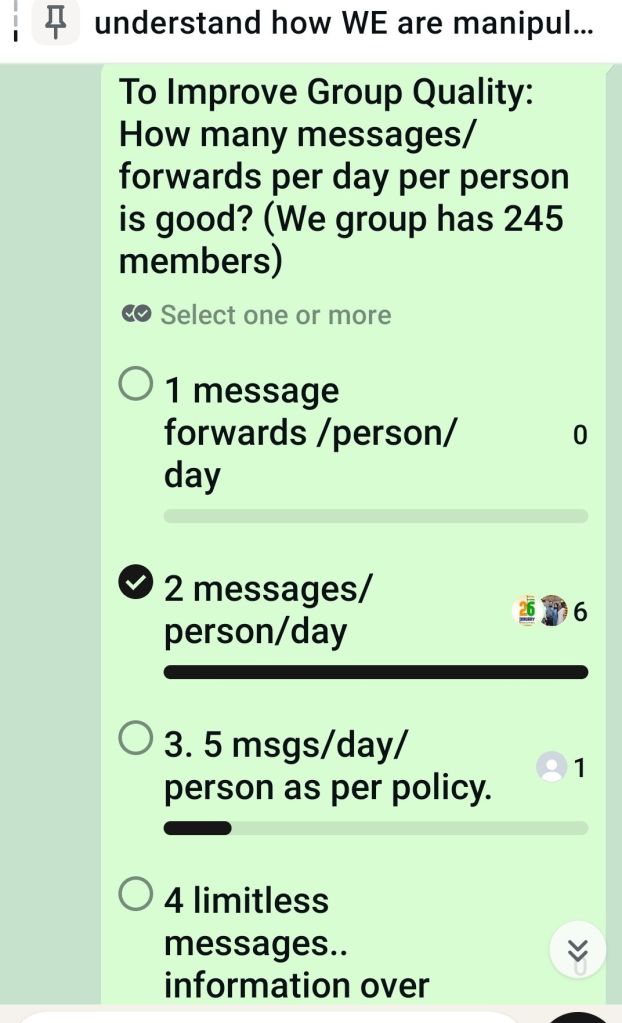
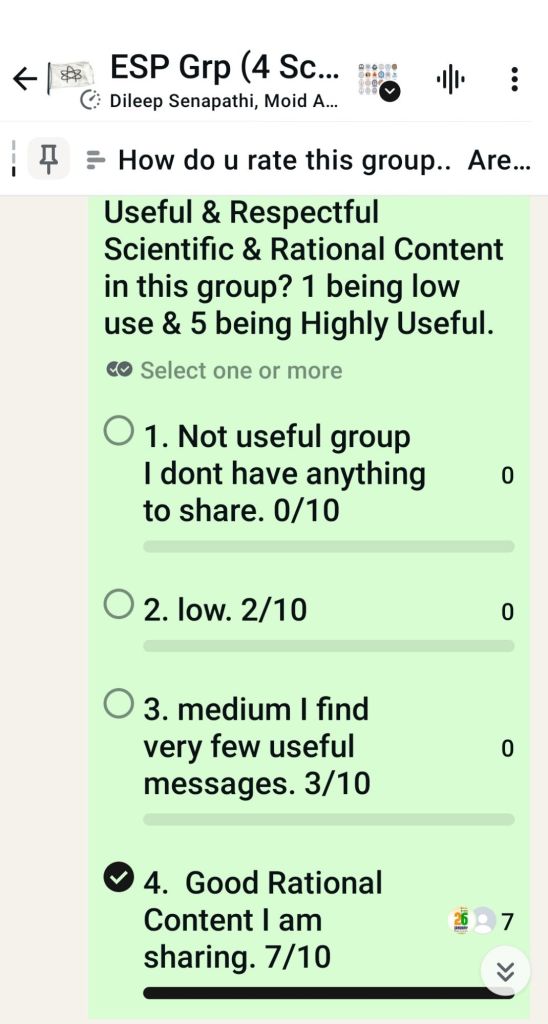
Presuming this message is regarding Limitation on Forwards in Group.. WHO decides is “WE ALL TOGETHER DECIDE in a democratic way”. HOW is more important in a Democracy…. WHO is Known.. How we Decided to limit 2 Forwards Per day Per person.. We collectively decided based on the open group poll results.
This Pinned Poll was Deciding Factor.. Max Voted Result.. do see Number of Forwards before and after this Poll. One can see Group Message Quality increases as Quantity Decreases.
CENSORSHIP is a Tool per se is not Bad or Good depends on How the Censoring is arrived at by Authoritarianism (I or we(admins) say that’s Why)
or is it by Authoritativism (We(ALL) collectively rationaly decided that’s why). eg.. Movie Censorship board keeps public morality and Interests in mind for film certification.. #Reasonable Restrictions Vs Arbitrary rules.
WE group is a Political Ideas practice group…we stand for democracy by practicing it in group..
CENSORSHIP is a Tool per se is not Bad or Good depends on How the Censoring is arrived at by Authoritarianism (I say that’s Why)..
or is it by Authoritativism (WE collectively rationaly decided that’s why). eg.. Movie Censorship board keeps public morality and Interests in mind for film certification.. #Reasonable Restrictions Vs Arbitrary rules.
References:
Politics is based on Laws and Laws are based on Democracy, Morals and Socially Negotiated Codes of Conduct.
WE group is a Political Ideas practice group…we stand for democracy by practicing it in group..
WE the Voters of India.. Unite4 *Voter-Mitras.* Voter-allys Love2Vote.
Motto: *Voters First Policy*
Welcome to *Wisen-Electors Group*: for Political Info_Sharing Group *WE_grp4Democracy* “Ai.VA= All-India Voters Association” 4Smart-Votering;
*Group Description:* EveryCitizen’sWelfare. *Observation_Deck* for Geo-Politics. WE Group Serves to make Able & improved Quality of Citizens/Voter-Patriots.
Join *VIN (Voters India Network)* for Rational Voters in a Better_India.
*Shared_Group-Vision: Democratic2030*
*GrpPurpose:* 2Empower_Citizenry, Rationality+ Responsiblty =Civility. Better Ethical_Politics. NyayaHitavad-Rajneethi. *Mission_Citizens’India2030*. WE-Grp Ddctd2 *Citizen-Mitras* & Patriots. Unbiased Political analysis and Synthesis Group.
[20/02, 10:05] Col. Mathew Thomas PBhushan client: Majority votes could be woefully wrong as we experience in elections in our country an elsewhere. If the purpose is to share information so that members become aware then we must welcome posts. If some don’t like posts which are contrary to their cherished opinions they could rebut them with sound arguments. [20/02, 10:14] G.R.P )=Grit, Reason, Peers) GR Prasahd Jayahe_SatyaBharatam!.: Sir.. Majority Votes in a closed system of manipulated unaware public without a feedback and correction mechanism can be wrong yes. Current system of Politics 4.0 is such.. But by an Aware and Informed Majority it can be less wrong and more right.. if open polling can be improved can suggest better methods of collective decision making apart from polls. [20/02, 10:18] G.R.P )=Grit, Reason, Peers) GR Prasahd Jayahe_SatyaBharatam!.: polls rely on this principle..it needs Improvement https://en.wikipedia.org/wiki/Wisdom_of_the_crowd [20/02, 10:20] G.R.P )=Grit, Reason, Peers) GR Prasahd Jayahe_SatyaBharatam!.: WE Welcome Right Quality posts in Right Quantity. Members like right Content in right Numbers. There is a word limit in twitter post.. similar community guidelines developed.

 GRP_VCare2Dare