1. Religions talk about spirituallife or afterlife (WorldsView),
2. Politics talks about this social life (HomelandView)
3. Civics converns with ur personal life(Homeview).. All are Very Closely Connected Impacts eachother.
- Religions talk about future spirituallife or afterlife (Worlds-View), eg. Entry Citizenship & Administration of Kingdom of Heaven. eg.. Pope, Caliph, Wahabis, Israeli Rabbis, Using Holy-scriptures, Making Holy-Laws & Controlling the Holy Land.
- Politics talks about this present socio-political life (Homeland-View).. Citizenship of Nation & states and City and politician party membership & Supporters. eg. Kings, Presidents, PMs, CMs…
- Civics concerns with ur Community, personal-Private life (Homely view).. Membership of Societies & Community Associations & circles, eg.. Cultural, community & Commercial Clan & Family leaders.. All 3 are Very Closely Connected and interdependent Impacts eachother at various levels.
To address your request, I’ll expand on the triad of religion, politics, and civics, incorporating African (Pharaoh-centric), Indo-Asian, and New Age religions and tracing their evolution and interplay from ancient to modern times. This will show how these domains have historically interacted and continue to shape each other across different cultural contexts.
1. Religion: Spiritual Life (Worlds-View)
Religion has always provided spiritual frameworks, moral codes, and visions of the afterlife or cosmic order. Its evolution reflects cultural, historical, and philosophical shifts.
Ancient Times
- African (Pharaoh-Centric): In ancient Egypt, religion centered on the divine kingship of the Pharaoh, seen as a god-king (e.g., Horus incarnate) mediating between the gods (e.g., Ra, Osiris) and humanity. The afterlife was central, with elaborate rituals (e.g., mummification) ensuring passage to the Field of Reeds. Priests and temples controlled religious life, often wielding significant political power.
- Indo-Asian: In ancient India, Vedic religion (predecessor to Hinduism) emphasized rituals (yajnas) and cosmic order (Rta), with texts like the Rigveda guiding spiritual life. In China, early Confucianism and Daoism focused on harmony with the cosmos (Tian) and ancestral veneration. The afterlife was less emphasized than living in alignment with divine or natural laws.
- Absence of New Age: New Age religions did not exist in ancient times but have roots in ancient mysticism (e.g., Gnosticism, Vedic spirituality).
Medieval to Early Modern
- African: As Egyptian religion waned, African traditional religions (ATRs) persisted across the continent, emphasizing ancestral spirits, animism, and community rituals. These systems often integrated with emerging political structures, such as the Mali Empire’s blend of Islam and local beliefs.
- Indo-Asian: Hinduism evolved with the rise of Bhakti and Advaita philosophies, emphasizing personal devotion and non-dualism. Buddhism spread across Asia, influencing governance (e.g., Ashoka’s Buddhist empire). In China, Neo-Confucianism merged spiritual and ethical governance, shaping imperial bureaucracies. Jainism and Sikhism emerged, blending spiritual liberation with social reform.
- New Age Precursors: Mystical traditions (e.g., Sufism, Kabbalah) laid groundwork for later New Age ideas, emphasizing personal spiritual experience over institutionalized dogma.
Modern Times
- African: ATRs continue to influence spiritual life, often syncretized with Christianity or Islam (e.g., Vodun in West Africa). The legacy of Pharaoh-centric divine kingship persists in symbolic forms, such as reverence for traditional rulers (e.g., Ashanti kings in Ghana).
- Indo-Asian: Hinduism, Buddhism, and Daoism remain influential, adapting to modernity (e.g., global yoga movements, Buddhist mindfulness). Secularism in India and China has reduced religious control over politics, but spiritual values still shape civic life (e.g., Gandhian principles).
- New Age: Emerging in the 20th century, New Age religions blend ancient mysticism, Eastern philosophies, and Western esotericism (e.g., Theosophy, Eckankar). They emphasize personal spirituality, holistic healing, and cosmic consciousness, often rejecting rigid dogma.
Religious Impact: Across time, religion has shaped political legitimacy (e.g., Pharaohs as gods, divine-right monarchs) and civic norms (e.g., community festivals, ethical codes).
2. Politics: Socio-Political Life (Homeland-View)
Politics organizes societies, balancing power, resources, and governance. Its evolution reflects the interplay with religious authority and civic needs.
Ancient Times
- African (Pharaoh-Centric): In ancient Egypt, the Pharaoh was both a political and divine ruler, centralizing power through a theocratic state. Temples and priests were key political players, managing resources and land. Political stability depended on religious rituals ensuring cosmic order (Ma’at).
- Indo-Asian: In India, Vedic kings (rajas) derived legitimacy from priests (Brahmins) performing rituals. In China, the Mandate of Heaven justified imperial rule, linking political authority to cosmic approval. Political systems were hierarchical, with rulers enforcing dharma (India) or li (China).
- New Age: Not applicable in ancient times.
Medieval to Early Modern
- African: Empires like Mali and Songhai integrated Islamic governance with traditional tribal structures. Political leaders (e.g., Mansa Musa) balanced religious piety with secular authority, using religion to unify diverse populations.
- Indo-Asian: In India, Mughal emperors blended Islamic and Hindu traditions to govern, while in China, the Confucian bureaucracy stabilized dynasties. Buddhist kings in Southeast Asia (e.g., Thailand) used religion to legitimize rule. Colonialism later disrupted these systems, introducing Western governance models.
- New Age: Still absent, but Enlightenment ideas in Europe began challenging divine-right politics, setting the stage for individual-centric ideologies.
Modern Times
- African: Post-colonial African states often adopted secular constitutions but retained traditional leaders’ influence (e.g., Nigerian emirs). Political instability in some regions reflects tensions between modern governance and religious/tribal loyalties.
- Indo-Asian: India’s secular democracy navigates religious diversity, with political parties often appealing to Hindu, Muslim, or Sikh identities. In China, the Communist Party subordinates religion to state control, yet traditional values (e.g., Confucianism) influence governance. Southeast Asian nations balance Buddhist and secular political systems.
- New Age: New Age movements rarely engage directly in politics but influence civic activism (e.g., environmentalism, holistic health policies). Their decentralized nature resists formal political structures.
Political Impact: Politics has historically drawn legitimacy from religion (e.g., Pharaohs, Mandate of Heaven) and shaped civic life through laws and resource allocation.
3. Civics: Community and Personal Life (Homely-View)
Civics focuses on community cohesion, cultural identity, and daily interactions, shaped by both religion and politics.
Ancient Times
- African (Pharaoh-Centric): Egyptian communities revolved around temple-based civic life, with festivals and rituals reinforcing loyalty to the Pharaoh. Local priests and nobles managed community welfare, linking civic duties to spiritual obligations.
- Indo-Asian: In India, caste and village systems structured civic life, with Brahmins and elders enforcing dharma-based norms. In China, clan-based communities followed Confucian ethics, emphasizing filial piety and social harmony.
- New Age: Not applicable.
Medieval to Early Modern
- African: ATRs fostered community cohesion through rituals (e.g., ancestor worship, initiation rites). In empires like Great Zimbabwe, civic life blended local traditions with trade-based urban networks.
- Indo-Asian: In India, Bhakti movements democratized spirituality, fostering inclusive community practices. In China, Confucian academies and clan networks strengthened civic ties. Buddhist monasteries in Southeast Asia served as civic hubs for education and charity.
- New Age Precursors: Mystical communities (e.g., Sufi orders) created civic spaces for spiritual and social bonding, emphasizing personal connection over hierarchy.
Modern Times
- African: Civic life blends traditional practices (e.g., community councils in Yoruba societies) with modern associations (e.g., trade unions). Syncretic religious practices (e.g., Candomblé in Brazil) sustain cultural identity.
- Indo-Asian: In India, civic organizations (e.g., NGOs, cultural groups) navigate religious diversity, while in China, state-controlled civic groups align with national goals. Buddhist and Hindu diaspora communities globally maintain cultural ties.
- New Age: New Age communities form around shared practices (e.g., meditation groups, eco-villages), emphasizing personal growth and global consciousness. These groups often influence civic trends like sustainability and wellness.
Civic Impact: Civic life translates religious values into community practices and responds to political structures, creating a feedback loop.
Evolution of the Triad
The interplay of religion, politics, and civics has evolved as follows:
- Ancient Times: The triad was tightly integrated, with religion dominating (e.g., Pharaohs as divine rulers, Vedic kings tied to Brahmin rituals). Civic life was subordinate to religious and political hierarchies.
- Medieval to Early Modern: The triad diversified as empires grew. African and Indo-Asian systems blended local traditions with universal religions (e.g., Islam, Buddhism), while civic life adapted to centralized political structures.
- Modern Times: Secularism and globalization have loosened religious control over politics in many regions, but spiritual values still influence civic life. New Age religions reflect a shift toward individualized spirituality, impacting civic trends but rarely formal politics.
Interdependence Across Time
- African (Pharaoh-Centric): The divine Pharaoh unified religion, politics, and civics in ancient Egypt. Modern African societies balance traditional spiritualities with democratic politics, with civic life bridging the two.
- Indo-Asian: Ancient Vedic and Confucian systems tied governance to cosmic order, with civic life reinforcing these norms. Today, secular politics coexist with religious diversity, and civic movements (e.g., environmentalism in India) draw on spiritual roots.
- New Age: Emerging from modern disillusionment with institutional religion, New Age movements prioritize personal spirituality, influencing civic life (e.g., wellness communities) but remaining peripheral to mainstream politics.
Artifact: Visualizing the Triad’s Evolution
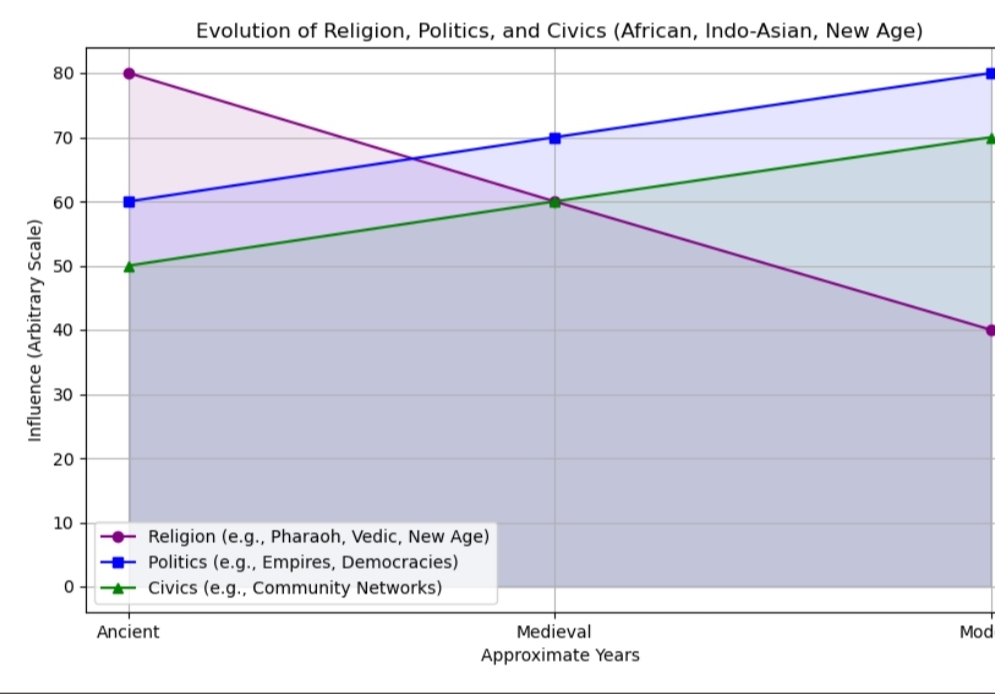
To illustrate the evolution and interdependence of religion, politics, and civics across African, Indo-Asian, and New Age contexts, I’ve created a timeline chart in Python using Matplotlib. This chart highlights key milestones in each domain and their interactions.
How to Interpret the Above Chart:
- Religion: High influence in ancient times (e.g., Pharaohs, Vedic rituals) declines with secularism but persists in modern civic life (e.g., New Age).
- Politics: Grows stronger with modern nation-states, reflecting centralized governance.
- Civics: Steadily increases as communities gain agency in modern times (e.g., NGOs, New Age groups).
- Shaded Areas: Represent overlapping influences, showing interdependence.
Conclusion
The triad of religion, politics, and civics has evolved significantly from ancient to modern times across African, Indo-Asian, and New Age contexts. In ancient Egypt, the Pharaoh unified all three domains; in Indo-Asian traditions, cosmic order shaped governance and community life; and New Age movements reflect modern individualism, impacting civics more than politics. Their interdependence remains evident, with each domain adapting to cultural and historical shifts while influencing the others.
If you’d like to explore a specific region, religion, or period further, or if you want to modify the chart (e.g., add specific events or data points), let me know!

 GRP_VCare2Dare