Sense, Sensitivity, and Sensibility: The Triad of Human Growth and Development
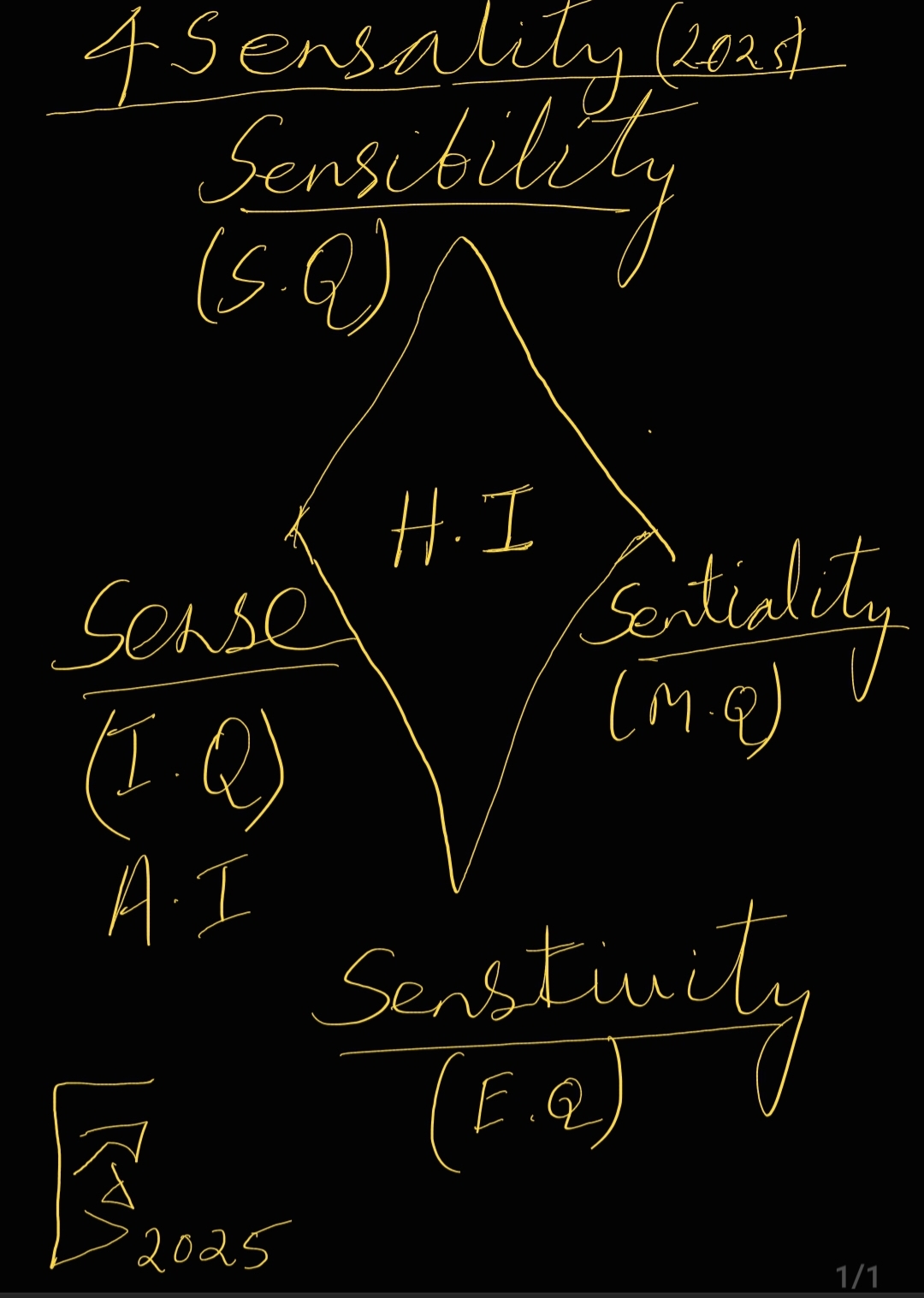
As humans, we strive for growth, development, and self-actualization. Our journey towards becoming the best version of ourselves requires a harmonious blend of three essential qualities: Sense, Sensitivity, and Sensibility. In this article, we’ll delve into the significance of each, exploring how they intersect and impact our common human growth and development.
Sense (IQ): The Foundation of Cognitive Abilities
Sense, often associated with Intelligence Quotient (IQ), encompasses our cognitive abilities, such as reasoning, problem-solving, and memory. A well-developed sense enables us to navigate the world effectively, making informed decisions and adapting to new situations.
Sensitivity (EQ): The Heart of Emotional Intelligence
Sensitivity, linked to Emotional Quotient (EQ), is the cornerstone of emotional intelligence. It allows us to recognize and understand emotions in ourselves and others, empathize, and build strong relationships. Sensitivity is the glue that holds our personal and professional connections together.
Sensibility (SQ): The Soul of Social Intelligence
Sensibility, tied to Social Quotient (SQ), represents our social intelligence. It enables us to communicate effectively, navigate complex social dynamics, and foster a sense of community. Sensibility helps us understand the intricacies of human behavior, facilitating cooperation and mutual understanding.
The Interplay Between Sense, Sensitivity, and Sensibility
These three qualities are interconnected and interdependent. A well-balanced individual possesses a harmonious blend of sense, sensitivity, and sensibility.
- Sense informs sensitivity: Cognitive abilities lay the groundwork for emotional intelligence. A strong sense enables us to better understand and manage our emotions.
- Sensitivity enriches sensibility: Emotional intelligence fosters deeper social connections and a greater sense of community. When we’re attuned to the emotions of others, we become more empathetic and effective communicators.
- Sensibility refines sense: Social intelligence can refine our cognitive abilities by providing a broader perspective and encouraging us to consider multiple viewpoints.
Cultivating Sense, Sensitivity, and Sensibility
To promote healthy growth and development, it’s essential to cultivate all three qualities:
- Develop your sense: Engage in lifelong learning, practice critical thinking, and challenge yourself with new experiences.
- Nurture your sensitivity: Practice empathy, self-reflection, and effective communication to deepen your emotional intelligence.
- Foster your sensibility: Engage in social activities, practice active listening, and seek to understand diverse perspectives to enhance your social intelligence.
Conclusion
Sense, sensitivity, and sensibility form the foundation of human growth and development. By acknowledging the interconnectedness of these qualities and actively cultivating each, we can become more well-rounded, empathetic, and effective individuals. As we strive for personal and collective growth, let us prioritize the development of sense, sensitivity, and sensibility, recognizing their transformative power in shaping our shared human experience.
Let’s expand the equation to incorporate Physical, Musical, Spatial, and Cultural Quotients:
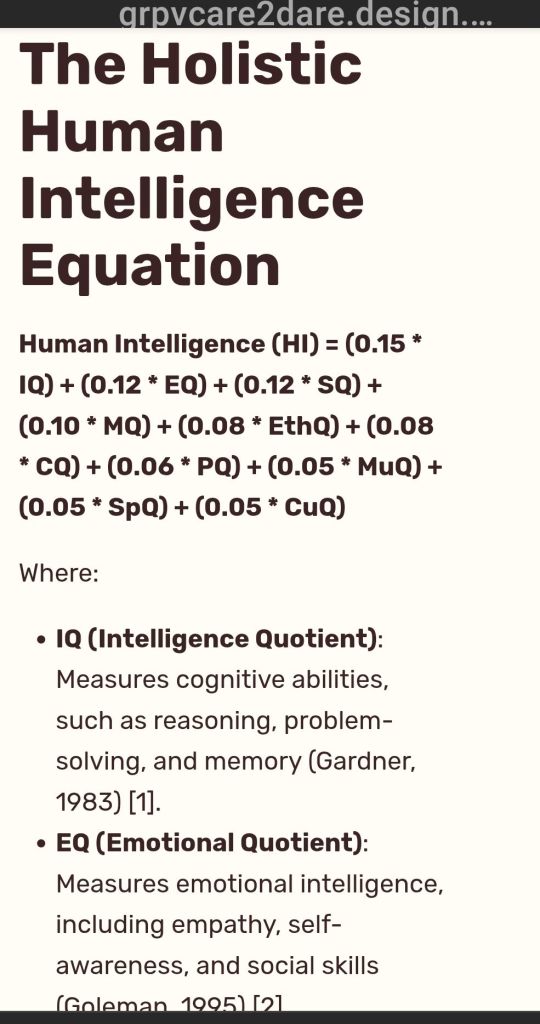
The Holistic Human Intelligence Equation
Human Intelligence (HI) = (0.15 * IQ) + (0.12 * EQ) + (0.12 * SQ) + (0.10 * MQ) + (0.08 * EthQ) + (0.08 * CQ) + (0.06 * PQ) + (0.05 * MuQ) + (0.05 * SpQ) + (0.05 * CuQ)
Where:
- IQ (Intelligence Quotient): Measures cognitive abilities, such as reasoning, problem-solving, and memory (Gardner, 1983) [1].
- EQ (Emotional Quotient): Measures emotional intelligence, including empathy, self-awareness, and social skills (Goleman, 1995) [2].
- SQ (Social Quotient): Measures social intelligence, encompassing communication, relationships, and community involvement (Goleman, 2006) [3].
- MQ (Moral Quotient): Measures moral intelligence, including values, principles, and ethical decision-making (Lennick & Kiel, 2005) [4].
- EthQ (Ethics Quotient): Measures ethical awareness, judgment, and behavior (Treviño & Nelson, 2011) [5].
- CQ (Creativity Quotient): Measures creative thinking, innovation, and problem-solving (Sternberg, 2006) [6].
- PQ (Physical Quotient): Measures physical intelligence, including coordination, balance, and overall physical well-being (Gardner, 1983) [1].
- MuQ (Musical Quotient): Measures musical intelligence, including pitch, rhythm, and musical expression (Gardner, 1983) [1].
- SpQ (Spatial Quotient): Measures spatial intelligence, including visual-spatial skills and mental imagery (Gardner, 1983) [1].
- CuQ (Cultural Quotient): Measures cultural intelligence, including cultural awareness, understanding, and competence (Earley & Ang, 2003) [7].
This expanded equation acknowledges the diversity of human intelligence and the importance of considering multiple aspects of human cognition, emotion, and behavior.
References:
[1] Gardner, H. (1983). Frames of mind: The theory of multiple intelligences. Basic Books.
[2] Goleman, D. (1995). Emotional intelligence: Why it can matter more than IQ. Bantam Books.
[3] Goleman, D. (2006). Social intelligence: The new science of human relationships. Bantam Books.
[4] Lennick, D., & Kiel, F. (2005). Moral intelligence: Enhancing business performance and leadership success. Wharton School Publishing.
[5] Treviño, L. K., & Nelson, K. A. (2011). Managing business ethics: Straight talk about how to do it right. John Wiley & Sons.
[6] Sternberg, R. J. (2006). The nature of creativity. Cambridge University Press.
[7] Earley, P. C., & Ang, S. (2003). Cultural intelligence: Individual interactions across cultures. Stanford University Press.
 GRP_VCare2Dare