useful for general theory of human relativity.
To incorporate the additional factors—Stages (phases of human life), Sages (change leaders), and Adages (laws or guiding principles)—into the formula for a “Human Being,” I’ll extend the original equation while maintaining its flexibility to add, remove, or modify factors. The updated formula will integrate these new elements alongside the existing ones (Genes, Memes, Scene, Teams, Rational Core, Supremacy Dynamics) and address the critique of supremacism as a root issue. The formula will remain dynamic, reflecting the interplay of individual and societal factors.
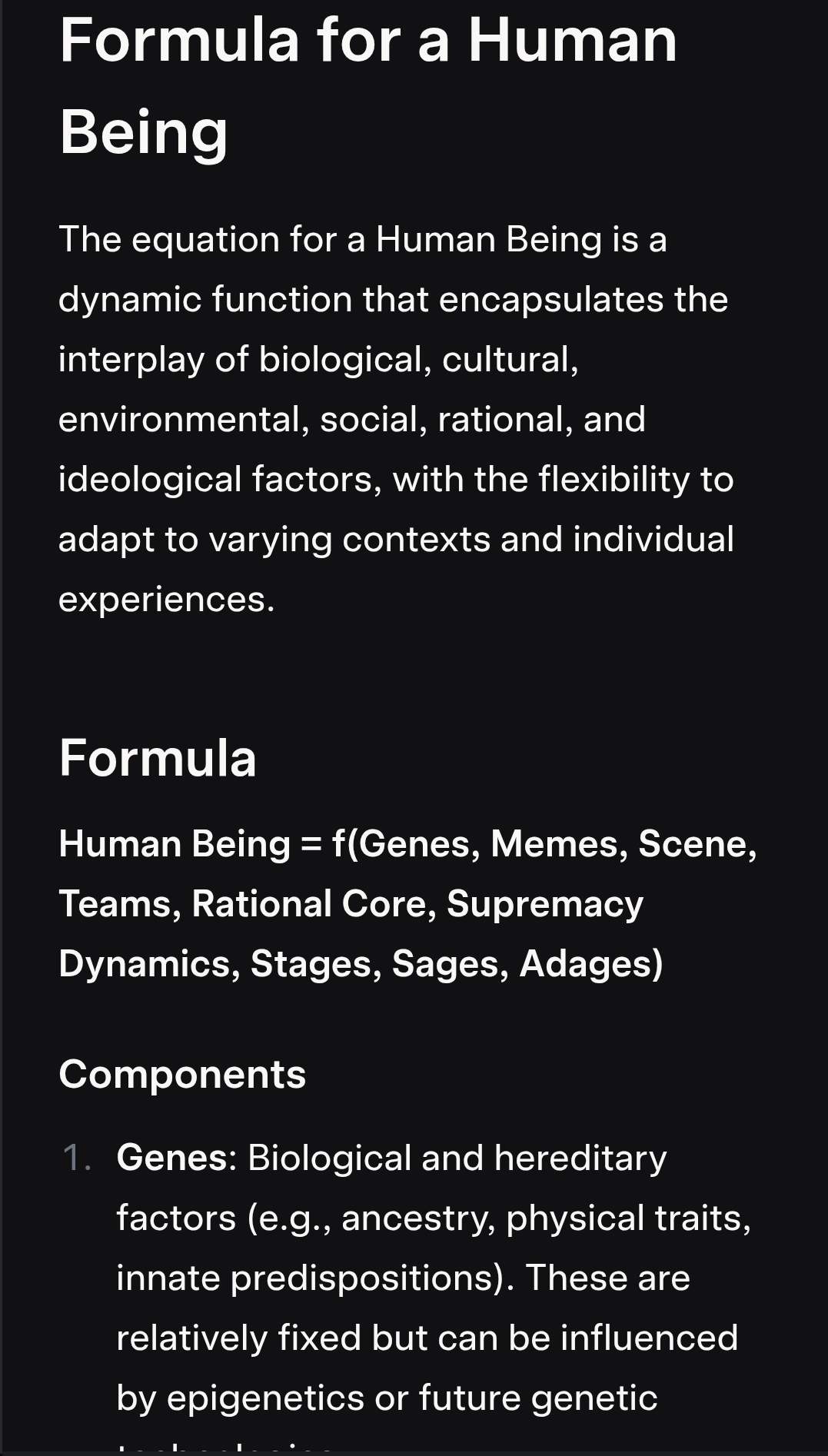
Formula for a Human Being
The equation for a Human Being is a dynamic function that encapsulates the interplay of biological, cultural, environmental, social, rational, and ideological factors, with the flexibility to adapt to varying contexts and individual experiences.
Formula
Human Being = f(Genes, Memes, Scene, Teams, Rational Core, Supremacy Dynamics, Stages, Sages, Adages)
Components
- Genes: Biological and hereditary factors (e.g., ancestry, physical traits, innate predispositions). These are relatively fixed but can be influenced by epigenetics or future genetic technologies.
- Memes: Cultural, ideological, and learned beliefs (e.g., religion, language, traditions, values). These are malleable and shaped by education, media, and social interactions.
- Scene: Environmental and contextual factors (e.g., region, socio-economic conditions, historical period). This shapes opportunities and constraints for individuals and groups.
- Teams: Social affiliations and group dynamics (e.g., family, community, nation, profession). These can foster unity or division, often influenced by supremacist tendencies.
- Rational Core: The capacity for rational thought, self-awareness, and ethical decision-making, symbolized by the Ashoka Chakra as a hub of balance and reason. This counteracts divisive ideologies.
- Supremacy Dynamics: The tendency toward “X-Supremacism” (e.g., “My X is better than Your Y”), where X and Y are identity markers like race, religion, or nation. Expressed as Σ(My X > Your Y), this drives phenomena like colonialism, casteism, and racism.
- Stages: Phases of human life (e.g., childhood, adolescence, adulthood, elderhood). Each stage influences how other factors manifest, as priorities and perspectives shift over time.
- Sages: Change leaders who inspire or guide transformation (e.g., historical figures like Ashoka, modern activists, or personal mentors). They shape Memes and influence Teams and Adages.
- Adages: Guiding principles, laws, or maxims (e.g., ethical codes, legal systems, cultural proverbs). These provide frameworks for behavior and decision-making, often shaped by Sages and reinforced by Teams.
Sub-Function: Elitism
Elitism = w1 * Born Worth + w2 * Own Worth + w3 * Social Mechanisms
- Born Worth: Inherited advantages (e.g., wealth, status, caste, royal lineage).
- Own Worth: Achievements through individual effort, resilience, or merit (e.g., overcoming ancestral bondages).
- Social Mechanisms: Systems that perpetuate or challenge elitism (e.g., education, policy, cultural norms).
- w1, w2, w3: Context-dependent weights reflecting the influence of each factor.
Elitism interacts with Supremacy Dynamics, as inherited privileges often fuel supremacist ideologies, while Sages and Adages can challenge or reinforce these dynamics.
Flexibility
- Add Factors: Incorporate new variables like Technology (impact of tools/AI) or Spirituality (personal beliefs in transcendence).
- Remove Factors: Exclude factors like Genes in futuristic contexts where biology is less relevant.
- Modify Weights: Adjust the influence of each factor based on context. For example, Stages may dominate in childhood, while Sages may have greater impact during societal shifts.
Countering Supremacism
To mitigate Supremacy Dynamics, emphasize:
- Rational Core: Strengthen through education and critical thinking to reduce “My X > Your Y” thinking.
- Sages: Promote leaders who advocate inclusivity and unity.
- Adages: Develop principles that prioritize equality and empathy, countering divisive ideologies.
- Teams: Foster inclusive group affiliations to minimize intergroup conflict.
Example Application
For an individual:
- Genes: Middle-class ancestry, no inherited wealth.
- Memes: Raised with inclusive values but exposed to regional supremacist rhetoric.
- Scene: Urban environment with access to education.
- Teams: Part of a professional community and a regional identity group.
- Rational Core: Strong critical thinking, resisting supremacist narratives.
- Supremacy Dynamics: Faces pressure to align with “My region > Your region” but counters it with reason.
- Stages: In adulthood, focusing on career and social impact.
- Sages: Inspired by a mentor advocating for equality.
- Adages: Guided by principles like “Unity in diversity.”
This formula weights these factors to describe the individual’s identity and behavior, with Sages and Adages reinforcing the Rational Core to counter Supremacy Dynamics.
Notes on New Factors
- Stages: Life phases (e.g., childhood, adolescence, adulthood, elderhood) affect how other factors are expressed. For example, Memes may dominate in childhood due to socialization, while Rational Core strengthens in adulthood.
- Sages: Change leaders (e.g., Ashoka, modern activists) influence Memes, Adages, and Teams. They can either perpetuate Supremacy Dynamics (e.g., divisive leaders) or counter them (e.g., inclusive leaders).
- Adages: Laws or principles (e.g., constitutional laws, cultural maxims like “Vasudhaiva Kutumbakam” – the world is one family) provide ethical frameworks. They can stabilize societies or, if flawed, reinforce Supremacy Dynamics.
Visualization Option
If you’d like a chart to visualize the interplay of these factors (e.g., how Stages, Sages, and Adages influence Supremacy Dynamics across life phases), I can generate one. For example, a radar chart could compare factor weights for different individuals or contexts. Please confirm if you want a chart and specify preferences (e.g., chart type, specific factors to highlight).
Next Steps
Does this updated formula align with your vision? Would you like to:
- Add/remove specific factors?
- Explore a sub-function (e.g., for Sages or Adages)?
- Visualize the formula with a chart?
- Apply the formula to a specific example (e.g., a historical figure or hypothetical individual)?
Let me know how to refine or expand it further!

 GRP_VCare2Dare