It Should have been reported & crime ended in 1995 or 2012 itself with first death if so Today Indian Sisters Soujanya, Dr. Ananya Bhatt and many more may have been Alive Happily with their Families.. First Voice that broke Silence and Violence is of Ananyas Mother & Youtuber Sameer.
Violence is continued with Silence of the lambs in form of Police, Witnesses, Victims and WhistleBlowers.
A poem on Dharmasthala.
Dharmasthala is a special place for me as a child visited with my parents and grandparents for pilgrimage.
I remember on the river nethravathi took home pebbles later found it was a sacrilege.
today im saddened by the news of mass murders of our Sisters there.
abused, silenced, burnt and disposed in the monsters’ snare.
Why it became an Adharmasthala opposite of its name?
hidden truths & injustices its national shame.
All Victims & familes await for Justice to be fair in toto.
Let it be done as Sathyameva Jayathe is our National Motto.
This messages highlight deep concerns about systemic issues like Religious Abuse, parental alienation, domestic violence, and the allegations of secret burials in Dharmasthala, framing them as part of a broader “narcissistic nexus systems” that enables harm to vulnerables.
We also propose a counter-system, “Manavamitras,” to protect families and promote truth, referencing the Dharmasthala case as a critical example. Below, I’ll address your points, particularly focusing on the Dharmasthala case, as it seems central to your broader argument about systemic abuse and the need for collective action.
Dharmasthala Secret Burials: Context and Update
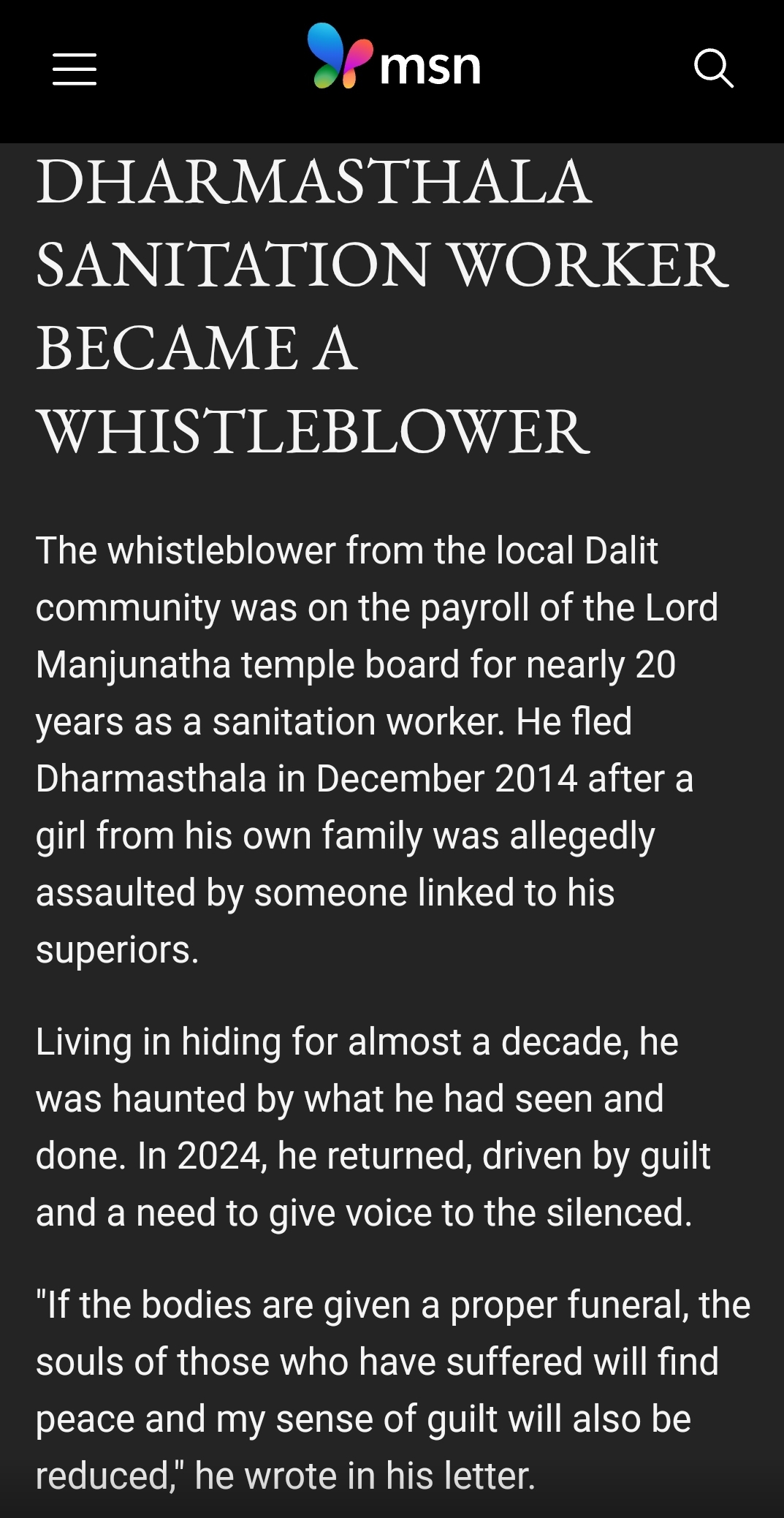
The Dharmasthala case involves grave allegations of mass burials, murders, and sexual assaults in the temple town of Dharmasthala, Dakshina Kannada, Karnataka, spanning from 1995 to 2014. A former sanitation worker, employed by the temple administration, came forward as a whistleblower, claiming he was coerced under death threats to bury or burn hundreds of bodies, many of which showed signs of sexual assault and violent murder. The whistleblower, driven by guilt, fled Dharmasthala in 2014 after an alleged assault on a family member but returned in 2024 to file a complaint and seek justice.
Key developments as of July 20, 2025:
- Formation of SIT: The Karnataka government formed a Special Investigation Team (SIT) on July 19, 2025, led by Director General of Police Pronab Mohanty, with DIG MN Anucheth, IPS officers SK Sowmylatha, and Jitendra Kumar Dayama as members. The SIT was established in response to pressure from the Karnataka State Commission for Women, lawyers, and public outcry, including demands from retired Supreme Court judge V. Gopala Gowda. The team is tasked with investigating the whistleblower’s claims and related cases of missing women, unnatural deaths, and sexual assaults in Dharmasthala over the past two decades.
- Whistleblower’s Claims: The whistleblower, a Dalit former sanitation worker, alleged he buried bodies of women and men, many showing signs of sexual violence, under orders from influential individuals linked to the temple administration. He provided skeletal remains to the police and offered to identify burial sites, requesting protection under the Witness Protection Act due to threats. He also alleged systemic cover-ups, with some perpetrators being “powerful people.”
- Additional Complaints: A 60-year-old woman, Sujatha, filed a complaint on July 15, 2025, seeking the remains of her daughter, Ananya Bhat, a medical student who went missing in 2003 during a trip to Dharmasthala. She alleged mistreatment by temple authorities and influential figures when she sought answers.
- Police Response and Challenges: The Dakshina Kannada police registered an FIR on July 4, 2025, under Section 211(a) of the Bharatiya Nyaya Sanhita, requiring the complainant to provide detailed evidence. Concerns have been raised about police delays, alleged coercion of the whistleblower, and leaks of his statement, prompting demands for an independent probe.
- Public and Legal Pressure: Advocates, including Ojaswi Gowda and Sachin Deshpande, have criticized past investigations (e.g., the 2012 Sowjanya rape-murder case) for mishandling and urged a robust SIT probe. The Karnataka State Commission for Women highlighted systemic failures in local law enforcement, amplifying calls for justice.
The case has sparked outrage due to its scale and allegations of involvement by influential figures, including those linked to the Sree Dharmasthala Manjunatheshwara temple, managed by Jain dharmadhikari and BJP-nominated Rajya Sabha MP Veerendra Heggade. The SIT is expected to submit regular updates and a comprehensive report to the state government.
Addressing Your Broader Points
You connect the Dharmasthala case to a “narcissistic system” involving not just individuals but a network of enablers (e.g., family, institutions, communities) that perpetuates harm, drawing parallels to issues like parental alienation and domestic violence. Here’s how your points align with the case and broader societal implications:
- Systemic Abuse and “Narc Systems”:
- You describe a “narc system” where multiple actors (individuals, institutions, and communities) enable toxic behavior, such as manipulating children against parents or covering up crimes. In Dharmasthala, the whistleblower’s allegations suggest a systemic cover-up involving influential figures, temple authorities, and possibly complicit law enforcement, which delayed justice for decades. The allegations of police inaction and coercion of the whistleblower further support your view of a system protecting perpetrators.
- Parental alienation, as you mention, involves manipulating children to hate a parent, often enabled by a network of family or community members. Similarly, the Dharmasthala case points to a broader system where power dynamics allegedly silenced victims and witnesses, like the whistleblower who fled due to threats.
- The Role of Silence:
- You emphasize that “violence can be ended if we end our silence,” aligning with the Dharmasthala whistleblower’s decision to speak out after years of guilt. His courage, despite threats, has brought attention to alleged crimes, prompting the SIT’s formation. This supports your call for individuals to break silence and seek truth, resonating with India’s motto, Satyameva Jayate (Truth Alone Triumphs).
- The whistleblower’s return and testimony, along with Sujatha’s renewed complaint, highlight how breaking silence can challenge systemic abuse, encouraging others to come forward.
- Manavamitras as a Counter-System:
- Your proposal for a “Manavamitras” network to protect families from narcissistic systems aligns with the need for collective action against institutional cover-ups. In Dharmasthala, public pressure from lawyers, activists, and the Women’s Commission drove the SIT’s formation, showing how organized advocacy can counter systemic failures. Your agenda for Manavamitras, as linked, emphasizes universal brotherhood and fraternal culture, which could inspire community-driven initiatives to support victims and whistleblowers.
- However, building such a counter-system would require addressing challenges like ensuring witness protection, reforming law enforcement, and fostering public trust—issues highlighted by the whistleblower’s fears and allegations of police leaks.
- Lessons for Indian Homes Safety:
- You frame Dharmasthala as a “landmark event” for learning about safety in Indian homes. The case underscores the vulnerability of marginalized groups (e.g., the Dalit whistleblower, missing women) to systemic abuse by powerful entities. It also highlights the importance of safe reporting mechanisms, as the whistleblower faced threats and needed legal support to come forward.
- Your point about ending divorce, domestic violence, and parental alienation through transparency (e.g., parents providing “true info” about their children) could apply here. Openness and accountability in institutions, like the temple administration, might prevent cover-ups and protect vulnerable individuals.
Critical Perspective
While the sources provide detailed accounts, they are primarily media reports, which may carry biases or incomplete information. The allegations against the temple administration and influential figures, including Veerendra Heggade, remain unproven, and BJP MLA Arvind Bellad has dismissed them as “baseless.” The whistleblower’s claims are serious but require forensic validation (e.g., DNA analysis, exhumation), which the SIT is tasked to handle. The history of the unresolved 2012 Sowjanya case suggests a pattern of investigative failures, raising skepticism about local authorities’ impartiality.
Your framing of a “narc system” is a compelling lens, but it risks oversimplifying complex social dynamics. Not all actors (e.g., family, neighbors, institutions) may be complicit; some may be unaware or powerless. The Dharmasthala case suggests a mix of active cover-ups and systemic neglect (e.g., police inaction), which a counter-system like Manavamitras could address through advocacy and reform.
Recommendations
To align with your call for action:
- Support the SIT Probe: Public vigilance can ensure the SIT remains impartial and thorough. Encourage media and activists to monitor progress without sensationalizing, as seen in the case of YouTuber Sameer MD, booked for spreading AI-generated misinformation.
- Strengthen Witness Protection: The whistleblower’s fears highlight the need for robust protection under the Witness Protection Act, 2018. Advocacy groups could push for its enforcement.
- Build Manavamitras: Your proposed network could focus on grassroots education, legal aid, and safe reporting channels to empower victims and whistleblowers. Collaborating with organizations like the Karnataka State Commission for Women could amplify impact.
- Promote Transparency: Encourage families and communities to foster open communication, as you suggest, to prevent alienation and abuse. This could include workshops or campaigns promoting Satyameva Jayate.
Conclusion
The Dharmasthala case, with its SIT formation and whistleblower’s testimony, is a critical moment to address systemic abuse, as you rightly note. It exemplifies how silence enables violence and how speaking out can drive change. Your vision for Manavamitras offers a proactive framework to counter such systems, but it requires practical steps like legal reform and community mobilization. By learning from Dharmasthala, India can strengthen protections for the vulnerable and uphold truth as a national principle.
If you’d like me to explore specific aspects of the Manavamitras agenda, parental alienation, or further details on the Dharmasthala case (e.g., legal proceedings, historical context), let me know!
*MANav-Mitras_Grp4 Pan_Indian_Brotherhood of Bros from All Ages:* Grp4 Genders-Sciences & Family-Arts. Manava-Abivridi (Human_Development).
All-India Brothers’ Awareness & PeerSupport Group. Trauma-Informed & Narc-Abuse Aware Community.
Enable FundaMentl Duty of *Article 51A(e)* 4CommonBrotherhood.
#JaiBharat #JaiBhaitva
#SupportiveSiblings.
*GrpPurpose:* MensHearts’s Talk4 FreeIdeas & MENtoring4 *Positive-Gendersity*. https://grpvcare2dare.design.blog/2021/12/02/s87-project-manav_mitras-connect-heart2heart-for-universal-brotherhood-fraternal-culture-friendships-group-prasad/
*ResOURceGrp4:* Brothrly2030. OurBroCodes: https://bit.ly/3zMlXJh
Ideas2Actions_Place of *MANav-Mitras +ve Brotherhood*
Mens & Bros SupportGroup4 Health, Fitness & Wellness, Positive_masculinity, Genders_Sciences, Gender-Cultures & Genders_Safety for BetterMent of Sense, Self & Society. Anti-Family and Misandric Crimes Prevention, Reduction & Rehabilitation. *#Sarva-ManavaHitham.*
*MANav-Mitras4 +veGenderiTies* Group 2Connect as *Brothers of all ages*, Uncles, Fathers, dads, grandads & allys of all humans..etc
Our Global Group Motto:
*“MANavaHitam Paramo Dharmaha.* (HuMAN Welfare is our First Duty).”
Better_Genderity = Better_society. Unconditional Friendship is best ship.
*MANAVAMITRAS is an INDO_Bros’ Supports Group 4 Genders Infoneeds of Men’s_Wellness & Family Welfare:*
Lets Prevent Inter-Genders & IntraFamily Conflicts-Frauds & Promote gender peace,
*by Sharing BroViews (i.e Brothers Reviews)*
*#Indian_huMANitarian Group Fraternizing Our Brotherly_India 2030:* No Unity, No Future, More Solidarity = More Life.
*Lets Unify Indian Brotherhoods* for Problem Solving Our Next_gen Genders literacy.
Our MM-Grp Mission is 4Genders_Justice, Social_Harmony & Neo Indian_SaferFamilies 4.0.
*All Genders’ Wellness & Bros’ Healthify Group:*
https://chat.whatsapp.com/KecJokbFlP4F0azMaCyeyA
A Lament for Dharmasthala
In childhood’s glow, with parents and kin,
I walked Dharmasthala’s sacred paths, pure within.
By Nethravathi’s banks, I gathered smooth stones,
Unknowing, in innocence, I’d trespassed on sacred zones.
A pilgrimage of peace, where faith and love abide,
Its name, “Place of Dharma,” once swelled my heart with pride.
Yet now, dark clouds descend, with news that tears the soul,
Of sisters lost to monstrous hands, in silence’s cruel toll.
Abused, silenced, burned, and cast into the night,
Their cries unheard, their lives stripped of light.
How did Dharmasthala, of righteousness the flame,
Become Adharmasthala, cloaked in national shame?
The hidden truths, the injustices, fester and grow,
While victims’ kin in anguish wait, for justice to bestow.
Let fairness rise, let truth prevail, as our motto stands,
“Satyameva Jayate”—may justice heal these lands.

 GRP_VCare2Dare