For Humanism, Indians, Bengalureans & IIScians: We Grow Resourceful Purpose_SpAces: Collaborate with Mitrallys wanting to know, Grow & Help Futureones Grow.
Those that take from others but can’t give back in return.
2. Those that take and also give back to others.
3. Those that take and can give back but wont give back to others.
4. Those that give and also take would take back from others.
5. Those that give and doesn’t want or take anything in return.
Transactional Archetypes: Decoding the Meatrix of Exchange
In the intricate web of human interactions—echoing the “Meatrix” illusion of modern life—these archetypes illuminate how entities navigate the flows of giving and taking. Rooted in Indian philosophy’s karmic balances and sociology’s reciprocity theories, they reveal patterns of sustenance, equity, and transcendence. Below is an expanded taxonomy of seven core archetypes, each with a pithy tagline to capture their essence. I’ve woven in symbiotic and networked variants to enrich the framework, reflecting evolving social dynamics like collaborative ecosystems and favor-trading cliques.
The Leech (Pure Exploiter) Drains vitality without a drop returned. A parasitic force, thriving on unearned extraction, as in tamasic demons of the epics.
The Balancer (Reciprocal Partner) Exchanges value in harmonious loops. The steady wheel of mutual aid, akin to Vedic yajna’s cosmic barter.
The Hoarder (Reluctant Withholder) Amasses treasures, seals the vault shut. Greed’s silent guardian, fueling anomie in stratified societies.
The Retractor (Conditional Enforcer) Lends with ledgers, reclaims on default. The watchful creditor of gifts, enforcing Mauss’s negative reciprocity.
The Sage (Unconditional Bestower) Sows seeds of grace, harvests inner peace. Ego’s quiet dissolution, embodying Upanishadic aparigraha.
The Simbiotizer (Mutual Amplifier) Fuses fates for amplified thriving. A co-evolutionary bond, like Trivers’ altruism scaled to symbiotic networks in bio-inspired sociology—think open-source communities where contributors elevate all.
The Nexus’ed Nepo (Favor-Web Spinner) Weaves insider threads, pulls kin to center. Nepotism’s velvet lattice, drawing from Durkheim’s solidarity via clannish ties—evident in elite alumni loops or family-run empires that prioritize legacy over merit.
Identifying divisive, polarizing identities/ideologies versus non-divisive, unifying ones involves analyzing their core characteristics, how they function in social contexts, and their impact on group cohesion. Below, I’ll describe the traits of each, provide examples, and explain why identities like “Indian,” “Humanists,” and “Rationalists” often fall into the unifying category.
Divisive, Polarizing Identities/Ideologies
Characteristics:
Binary Thinking: Promote an “us vs. them” mentality, creating clear in-groups and out-groups.
Exclusivity: Emphasize differences, often tying identity to specific traits (e.g., religion, race, political affiliation) that exclude others.
Emotional Charge: Rely on strong emotions like fear, anger, or resentment to mobilize followers, often amplifying conflict.
Dogmatism: Rigid adherence to beliefs, with little room for nuance, compromise, or dialogue.
Zero-Sum Framing: Portray success or well-being of one group as inherently detrimental to others.
Dehumanization: Tend to vilify or stereotype opposing groups, reducing their humanity.
Examples:
Extreme Nationalism: Ultra-nationalist ideologies that define a nation in exclusionary terms (e.g., based on ethnicity or religion) can polarize by marginalizing minorities. For instance, ethno-nationalist movements in various countries often alienate groups who don’t fit the “ideal” national identity.
Partisan Political Ideologies: In the U.S., hyper-partisan identities like “MAGA Republicans” or “Progressive Left” can be divisive when they prioritize loyalty to the group over shared goals, demonizing the other side.
Religious Fundamentalism: Strict interpretations of religious doctrine (e.g., certain extremist sects) that reject other faiths or lifestyles as inherently wrong, fostering conflict.
Caste-Based Identities: In India, rigid caste-based identities can polarize communities by reinforcing hierarchies and exclusion (e.g., upper-caste supremacy movements).
How to Identify:
Look for rhetoric that emphasizes division (e.g., “we are the true believers, they are the enemy”).
Notice if the ideology rejects compromise or vilifies dissenters.
Check if it thrives on fear, anger, or scapegoating rather than constructive dialogue.
Non-Divisive, Unifying Identities/Ideologies
Characteristics:
Inclusivity: Broad, open-ended identities that can encompass diverse groups without requiring conformity to narrow criteria.
Shared Humanity or Purpose: Focus on common goals, values, or universal principles that transcend specific affiliations.
Openness to Dialogue: Encourage debate, reason, and mutual understanding rather than dogma.
Positive Framing: Emphasize collective progress, cooperation, and mutual benefit.
Flexibility: Allow for diverse expressions of identity within a broader framework.
Empathy-Driven: Promote understanding and respect for others, even across differences.
Examples:
Indian Identity: The idea of being “Indian” is unifying because it encompasses diverse religions, languages, and cultures under a shared national framework. For example, the Indian Constitution’s emphasis on unity in diversity fosters a sense of collective identity without erasing regional or cultural differences.
Humanism: Humanists prioritize universal human dignity, reason, and ethics, transcending national, religious, or ethnic boundaries. This ideology unites people around shared values like compassion and critical thinking (e.g., organizations like the International Humanist and Ethical Union).
Rationalism: Rationalists emphasize evidence-based reasoning and skepticism, fostering unity by encouraging open inquiry and dialogue. For instance, the rationalist movement in India, led by figures like Narendra Dabholkar, promotes critical thinking across caste and religious lines to combat superstition.
Global Citizenship: An identity focused on shared responsibility for global issues like climate change or human rights, uniting people across borders (e.g., movements like Fridays for Future).
Civic Nationalism: Unlike ethno-nationalism, civic nationalism (e.g., in countries like Canada) emphasizes shared values like democracy and freedom, uniting diverse populations.
How to Identify:
Look for language that emphasizes common goals or universal values (e.g., “we’re all in this together”).
Check if the identity allows for diversity within its framework without demanding conformity.
Notice if it promotes collaboration, empathy, or mutual respect rather than conflict.
Key Differences in Practice
Divisive identities/ideologies often thrive in high-conflict settings, where fear or scarcity amplifies group loyalty. For example, during economic crises, scapegoating minority groups (e.g., immigrants) can fuel divisive ideologies.
Unifying identities/ideologies gain traction in contexts where cooperation is incentivized, such as during national crises (e.g., India’s unity during the 1999 Kargil War) or global challenges (e.g., collective action on climate change).
Why “Indian,” “Humanists,” and “Rationalists” Are Unifying
Indian: This identity is inclusive because it embraces diversity (e.g., Hindus, Muslims, Sikhs, etc.) under a shared civic framework. Campaigns like “Ek Bharat, Shreshtha Bharat” promote cultural exchange, reinforcing unity.
Humanists: By focusing on universal human values, humanism transcends cultural or religious divides, fostering collaboration on issues like education or poverty alleviation.
Rationalists: Rationalism unites people through a commitment to reason and evidence, cutting through divisive dogmas like superstition or sectarianism. For example, India’s rationalist movements have worked to bridge caste divides by challenging discriminatory practices rooted in tradition.
How to Distinguish in Real-World Contexts
Examine Rhetoric: Does the ideology use inclusive language (e.g., “all humans”) or exclusionary terms (e.g., “only us”)?
Assess Impact: Does it bring people together for shared goals (e.g., environmental protection) or pit groups against each other (e.g., sectarian violence)?
Check Flexibility: Can the identity accommodate diverse perspectives, or does it demand rigid conformity?
Evaluate Outcomes: Does it lead to cooperation and progress (e.g., India’s space program uniting scientists across backgrounds) or conflict and division (e.g., communal riots)?
Practical Tips for Promoting Unifying Identities
Encourage dialogue spaces that emphasize shared goals (e.g., interfaith forums in India).
Highlight universal values like justice, freedom, or sustainability in discussions.
Challenge divisive narratives by promoting stories of cooperation (e.g., India’s COVID-19 vaccine distribution to neighboring countries as a unifying act).
Support education and critical thinking to counter dogmatism, as rationalists do.
By focusing on inclusivity, shared purpose, and empathy, unifying identities like “Indian,” “Humanists,” and “Rationalists” can bridge divides, while divisive ones deepen them through exclusion and conflict. Let me know if you’d like a deeper dive into any specific example!
Introduction to Genderization in Nature and Evolution
In evolutionary biology, “genderization” refers to the development of distinct genders (typically male and female) through natural selection, primarily driven by the need to optimize reproduction. This process stems from anisogamy—the fundamental difference in gamete (reproductive cell) size and investment. Females produce larger, nutrient-rich eggs (high investment, low quantity), while males produce smaller, more numerous sperm (low investment per gamete, high quantity). This asymmetry evolved because it maximizes reproductive success: combining genetic material from two parents increases diversity and adaptability in offspring, while specialization in roles enhances efficiency.
Evolution “generalizes” roles and responsibilities in families (social units focused on rearing offspring) to balance the quantity (number of progeny) and quality (survival and fitness of each progeny). These generalizations aren’t rigid universals but statistical patterns shaped by environmental pressures, resource availability, and mating systems. In species without families (e.g., many invertebrates), roles are minimal; in those with families (e.g., birds, mammals), they become more pronounced. The ultimate goal is to propagate genes effectively, favoring strategies that produce viable, competitive next generations.
Below, I’ll outline how this manifests across species, with examples, and explain the trade-offs for quantity vs. quality.
Mechanisms of Genderization
Evolution genderizes species through:
Sexual Selection: Traits that aid in attracting mates or competing for them (e.g., peacock tails in males) diverge between genders, leading to dimorphism (physical differences).
Parental Investment Theory (proposed by Robert Trivers): The gender with higher initial investment (usually females, due to eggs) tends to be choosier in mates and more involved in care, while the other gender (males) invests in mating opportunities.
Environmental Pressures: In stable environments, quality-focused strategies evolve (fewer, better-cared offspring); in unpredictable ones, quantity-focused (many offspring with less care).
Genetic and Hormonal Factors: Gender chromosomes (e.g., XY in mammals) and hormones (e.g., testosterone driving male aggression) reinforce roles.
This results in generalized gender roles, but exceptions exist (e.g., gender-role reversal in some birds like jacanas, where females compete and males incubate eggs).
Generalized Roles and Responsibilities in Families
Families emerge in species where biparental or extended care boosts offspring survival. Roles are generalized based on reproductive costs:
Female Roles: Often centered on gestation, nourishment, and protection, maximizing quality. Females select mates for good genes or resources, investing energy post-fertilization.
Male Roles: Often focused on resource provision, territory defense, or sperm competition, enabling quantity through multiple matings.
Shared or Variable Roles: In monogamous systems, both genders contribute to care for higher-quality offspring.
These roles influence family structures like monogamy (stable pairs for quality), polygyny (one male, multiple females for quantity), or polyandry (rare, for genetic diversity).
Examples Across Species Groups
To illustrate, here’s a table comparing generalized roles in select species, with impacts on progeny quantity and quality: Species Group Example Species Generalized Female Role Generalized Male Role Family Structure Impact on Quantity Impact on Quality Mammals Lions (polygynous prides) Gestation (3-4 months), nursing cubs; selects dominant males for protection. Defends territory, mates with multiple females; minimal direct care. Pride (male-led group with related females). High: Males sire many cubs across females. Moderate: Female care ensures survival, but infanticide by new males reduces it. Mammals Humans (varied, often monogamous) Pregnancy (9 months), breastfeeding; emotional bonding and teaching. Resource provision (hunting/gathering historically), protection; increasingly shared care in modern contexts. Nuclear or extended family. Variable: Cultural limits, but evolution favors 2-4 children per female. High: Biparental investment in education/health boosts long-term fitness. Birds Penguins (monogamous) Egg-laying, shared incubation; foraging for chicks. Shared incubation and feeding; defends nest. Pair-bonded family with chicks. Low: 1-2 eggs per season. High: Intense biparental care in harsh environments ensures chick survival. Birds Birds of Paradise (polygynous) Builds nest, incubates eggs, raises chicks alone. Displays elaborate plumage/dances to attract mates; no care. Female-led solitary family. High: Males mate widely, siring many. Moderate: Female investment focuses on viable chicks, but less male help. Fish Seahorses (role-reversed monogamous) Produces eggs, transfers to male pouch. Pregnancy in pouch, nourishes embryos; protects fry. Pair-bonded, male-centric. Moderate: 100-200 fry per brood. High: Male gestation provides protection/nutrients, unusual reversal due to female egg production costs. Insects Bees (eusocial) Queen lays eggs; workers (sterile females) care for larvae. Drones mate once and die; no family role. Hive as extended family. Extremely high: Queen produces thousands. Variable: Worker care ensures colony survival, but individuals are expendable. Amphibians Poison Dart Frogs (varied) Lays eggs; transports tadpoles to water. Calls to attract mates; some species guard eggs. Minimal family, often solitary. Moderate: Dozens of eggs. High in caring species: Parental transport reduces predation.
Balancing Quantity and Quality of Progenies
Evolution tunes roles to optimize the r/K selection continuum:
Quantity Strategies (r-selection): Favored in unstable environments. Males generalize to multiple matings (e.g., sperm competition in insects), producing many low-investment offspring. Families are loose or absent, relying on sheer numbers for some to survive (e.g., fish releasing millions of eggs).
Quality Strategies (K-selection): Common in stable environments. Females lead in care, with males providing support, yielding fewer but robust offspring (e.g., elephants with long gestation and maternal herds teaching calves).
Trade-offs: High quantity risks low survival (predation, starvation); high quality limits numbers but improves competitiveness. Mixed strategies evolve, like seasonal breeding or gender-ratio adjustments (e.g., more males in competitive environments).
In summary, nature genderizes species via anisogamy and selection pressures, generalizing roles to divide labor efficiently. This ensures families (where they exist) produce offspring that are numerous enough to persist yet fit enough to thrive, adapting to ecological niches. Exceptions highlight evolution’s flexibility, but patterns hold across taxa due to reproductive economics.
For Harmony: “Compete at workplace to Complement at home” this mantra brings grace to all.
Vs For Money..: “compete at home to complement at work“.. brings disgrace to families. what do u say?
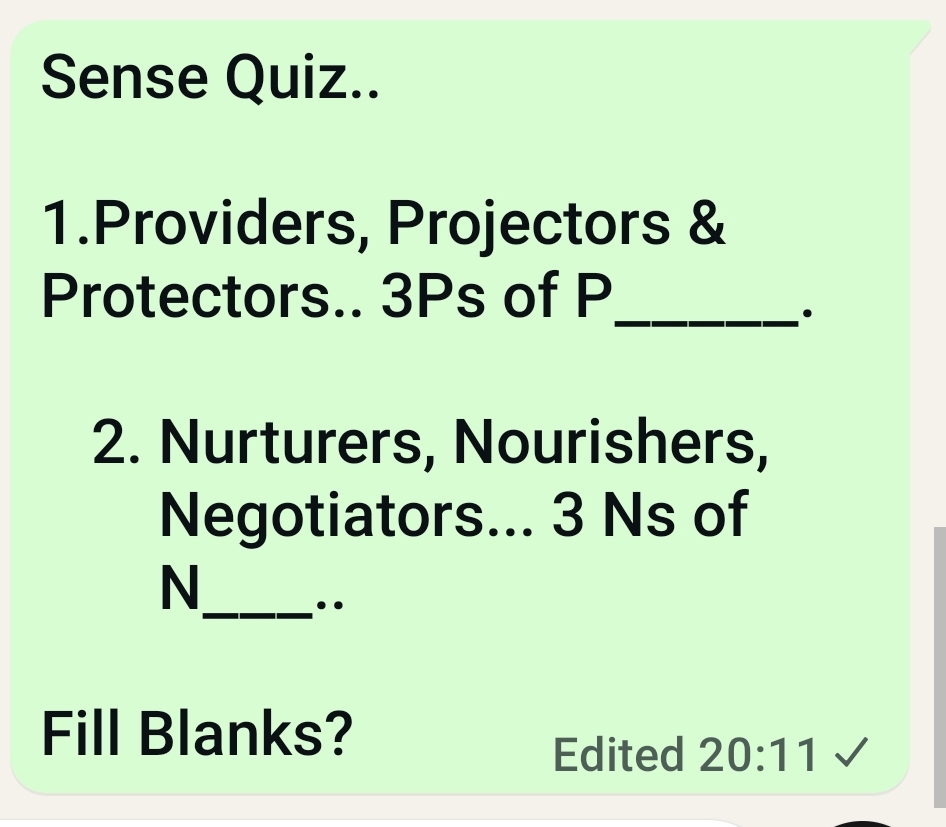
Social Family Sense Quiz..
Logic and Reasoning:
The quiz appears to be a riddle or puzzle based on traditional gender roles, likely inspired by cultural concepts from Indian (Hindi/Sanskrit) terminology, where “Purush” means man or male, and “Nari” means woman or female. The structure follows a pattern of attributing three qualities (starting with the same letter) to each term, reflecting stereotypical or historical societal roles. This is similar to motivational or self-help frameworks like Steve Harvey’s “3 P’s for men” (provide, protect, profess), but adapted here with “Projectors” possibly referring to men projecting authority, lineage, or future plans for the family (a variant of “procreators” or “professors” in some interpretations). For women, the attributes emphasize caring and relational roles. The hint “purush and nari” directly points to these terms filling the blanks, as they match the letter counts (P_____ for 6-letter “Purush,” N___ for 4-letter “Nari”) and align thematically with the 3Ps and 3Ns.
Facts:
“Purush” (or “Purusha” in Sanskrit) traditionally represents the masculine principle in Hindu philosophy, often associated with creation, provision, and protection (e.g., as seen in texts like the Bhagavad Gita or Samkhya philosophy, where Purusha is the conscious observer or provider of structure).
“Nari” is a common Hindi term for woman, symbolizing feminine energy, often linked to nurturing and sustenance in cultural narratives (e.g., in Indian folklore or modern gender discussions).
Similar frameworks exist in Western contexts, such as “The 3 P’s of Manhood” from anthropologist David Gilmore’s work or popular books, emphasizing provide, protect, and procreate/profect (adapted here to “projectors” perhaps as a cultural or translational variation meaning to project strength or legacy).
Stats:
According to a 2014 Art of Manliness survey on manhood perceptions, over 70% of respondents associated masculinity with providing and protecting, aligning with the 3Ps concept.
In India, a 2021 Pew Research Center study on gender roles found that 80% of Indians view men as primary providers and protectors, while women are seen as nurturers in family settings (though modern views are evolving).
Globally, gender role discussions in psychology (e.g., APA studies) show that traditional attributes like these persist in 60-70% of cultural narratives, but are increasingly challenged for being stereotypical.
Examples:
For Purush (men as Providers, Projectors, Protectors): In traditional Indian households, men are expected to provide financial stability (provider), safeguard the family from threats (protector), and project the family’s honor or future through decisions or procreation (projector, akin to extending the lineage as in epic tales like the Mahabharata).
For Nari (women as Nurturers, Nourishers, Negotiators): Women often nurture emotional bonds (nurturer), nourish through caregiving or feeding the family (nourisher, as in roles highlighted in Indian festivals like Karva Chauth), and negotiate harmony in relationships or conflicts (negotiator, seen in stories of goddesses like Durga balancing power and peace).
Thus, the filled blanks are:
Providers, Projectors & Protectors.. 3Ps of Purush.
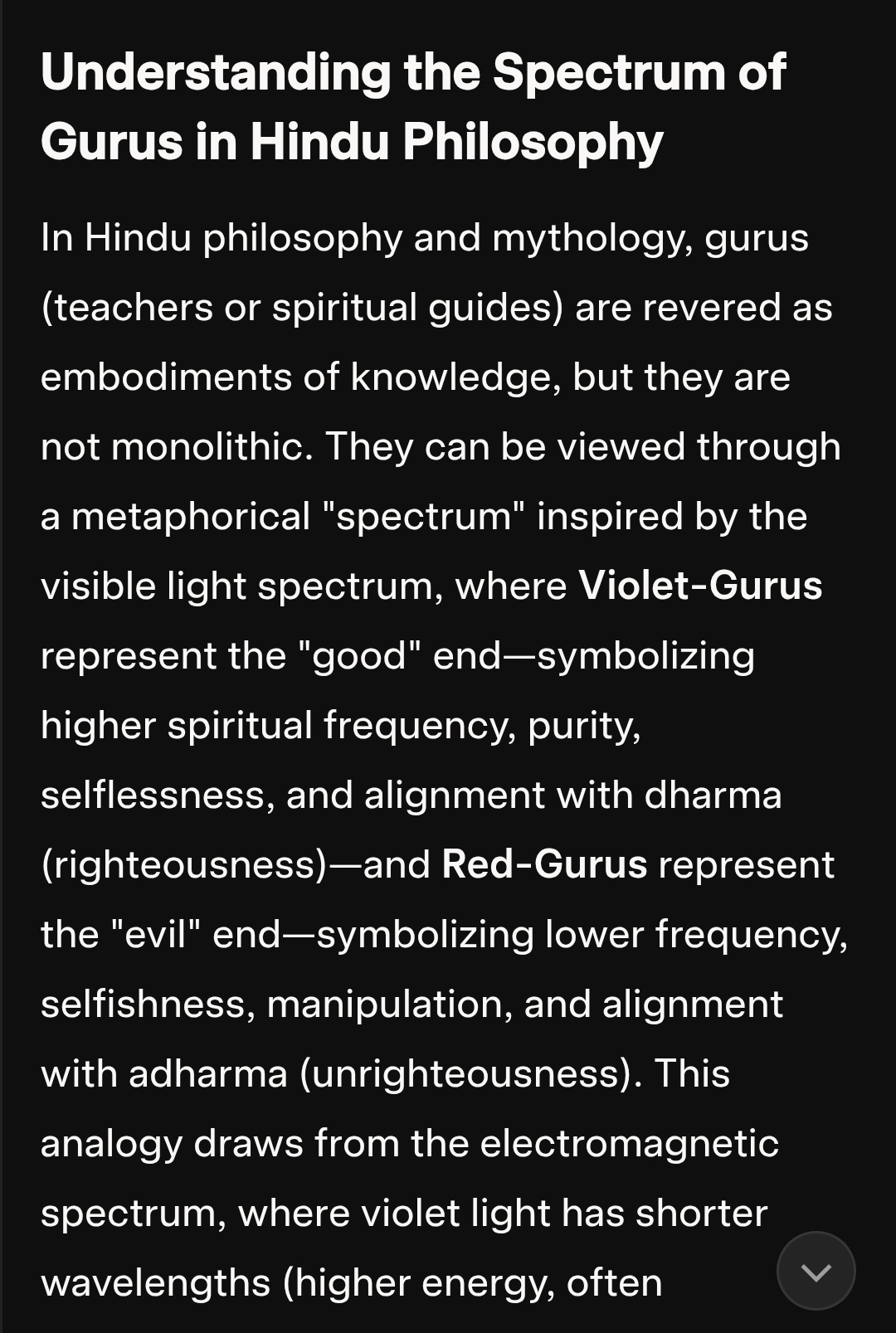
Understanding the Spectrum of Gurus in Hindu Philosophy
In Hindu philosophy and mythology, gurus (teachers or spiritual guides) are revered as embodiments of knowledge, but they are not monolithic. They can be viewed through a metaphorical “spectrum” inspired by the visible light spectrum, where Violet-Gurus represent the “good” end—symbolizing higher spiritual frequency, purity, selflessness, and alignment with dharma (righteousness)—and Red-Gurus represent the “evil” end—symbolizing lower frequency, selfishness, manipulation, and alignment with adharma (unrighteousness). This analogy draws from the electromagnetic spectrum, where violet light has shorter wavelengths (higher energy, often associated with enlightenment) and red has longer wavelengths (lower energy, associated with base instincts or chaos).
The spectrum isn’t black-and-white; gurus in Hindu texts often have nuanced characters, blending virtues and flaws. This reflects the philosophical idea that good and evil are relative, influenced by karma, context, and intent (as discussed in texts like the Mahabharata and Puranas). The user-specified examples are Dronacharya (often seen as a principled teacher despite flaws) and Shukracharya (guru of the asuras, associated with opposing divine order). Adding a neutral guru in the middle creates a balanced “DronaCharya-Shukracharya GuruSpectrum,” where neutrality represents pragmatism, ambition, or balance without strong alignment to pure good or evil.
Differentiating Violet-Gurus (Good) from Red-Gurus (Evil)
Violet-Gurus (Good): These gurus prioritize the greater good, impart knowledge selflessly, foster virtue, and guide disciples toward dharma, harmony, and spiritual growth. They embody sattva (purity) guna from the Bhagavad Gita. Their teachings promote justice, protection of the weak, and cosmic balance. However, even they may have human flaws, as perfection is rare in Hindu narratives.
Red-Gurus (Evil): These gurus use knowledge for personal gain, power, or disruption of order. They align with tamas (darkness) guna, teaching manipulation, revenge, or conquest. They often support “anti-heroes” or chaotic forces, leading to cycles of destruction. Their intent is ego-driven, and their actions amplify suffering or imbalance.
The spectrum in between includes shades where gurus exhibit mixed qualities, reflecting the Hindu view that individuals evolve through lives and actions (karma theory).
How to Identify the “Color” of a Guru
In Hindu philosophy, judging a guru isn’t based on superficial traits but on deeper indicators, as advised in texts like the Guru Gita or Upanishads. Here’s a practical framework:
Intent and Motive: Does the guru teach for selfless upliftment (violet) or personal ambition/power (red)? Observe if they demand undue loyalty, wealth, or sacrifices without ethical justification.
Impact on Disciples and Society: Do their teachings lead to harmony, justice, and growth (violet), or conflict, deception, and downfall (red)? “By their fruits ye shall know them” echoes the Mahabharata’s emphasis on outcomes.
Adherence to Dharma: Violet-gurus uphold universal ethics (non-violence, truth, compassion). Red-gurus twist dharma for biased ends, like favoring one side in eternal conflicts.
Personal Character: Look for humility and detachment (violet) vs. arrogance, jealousy, or vengeance (red). Neutral gurus might show ambition balanced by wisdom.
Mythological Context: In stories, alignment with devas (gods, good) leans violet; with asuras (demons, chaotic) leans red. But context matters—Hindu myths often show redemption or complexity.
Self-Reflection: The Upanishads advise testing a guru through observation, questioning, and intuition. Avoid blind faith; true gurus encourage discernment.
Avoid snap judgments; Hindu philosophy (e.g., in the Ramayana) shows gurus can shift “colors” through penance or experiences.
The DronaCharya-Shukracharya GuruSpectrum
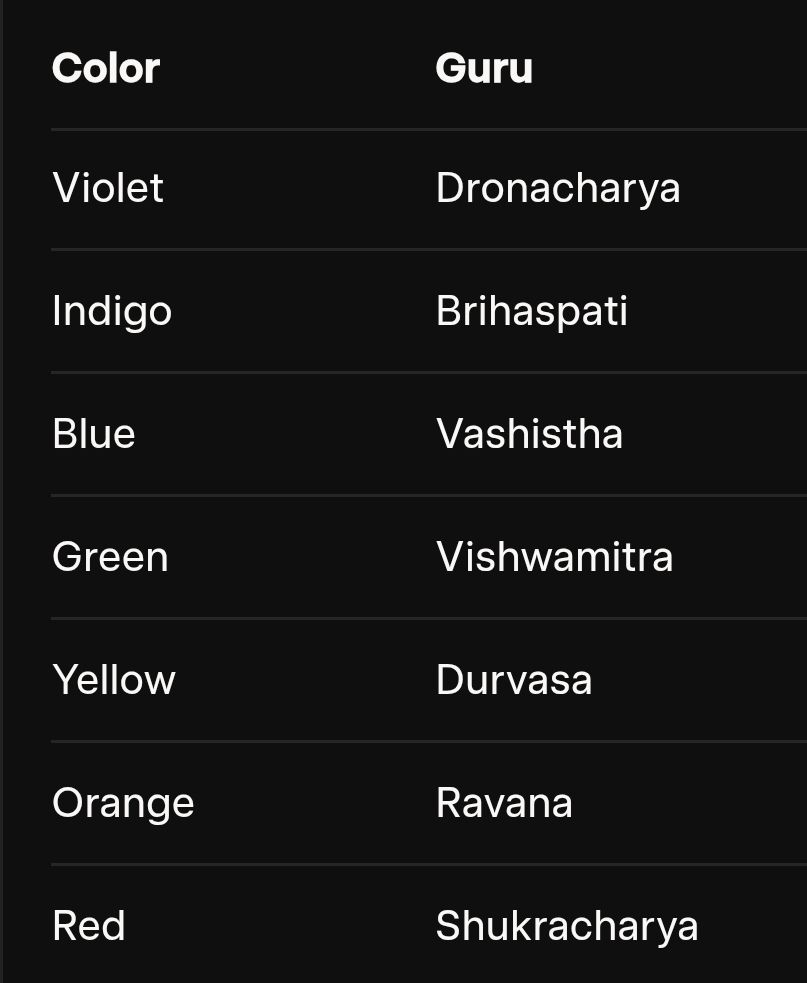
Drawing from Hindu epics like the Mahabharata, Ramayana, and Puranas, I’ve created a simplified 7-point spectrum mirroring the visible light colors (ROYGBIV reversed for violet-to-red flow). Dronacharya anchors the violet (good) end as a skilled, duty-bound teacher who trained heroes for dharma’s sake. Shukracharya anchors the red (evil) end as the wise but partisan guru of asuras, enabling their wars against devas. For the neutral middle (green), I’ve selected Vishwamitra—a sage with a complex arc: born a warrior, achieved Brahmin status through intense tapas (austerity), trained Rama for good causes, but driven by personal ambition, rivalries (e.g., with Vashistha), and occasional wrath.
This spectrum uses examples from mythology to illustrate shades:
Color Position Example Guru Key Characteristics Why This “Color”?
Violet Extreme Good Dronacharya (Mahabharata) Master archer; taught Pandavas and Kauravas impartially at first; embodied discipline and skill for societal protection. Flaws (e.g., bias toward Arjuna, Ekalavya incident) show human nuance, but overall aligned with dharma. Represents pure guidance toward virtue and order; trained defenders of righteousness like Arjuna.
Indigo Mostly Good Brihaspati (Puranas) Guru of the devas (gods); wise advisor promoting cosmic harmony, knowledge, and strategy against chaos. Strongly supports “good” forces; embodies intellect and balance, but with a partisan lean toward devas.
Blue Leaning Good Vashistha (Ramayana) Sage of immense wisdom; guru to Rama’s father; advocated peace, dharma, and spiritual insight. Guides toward enlightenment and stability; resolves conflicts through wisdom rather than force.
Green Neutral Vishwamitra (Ramayana) Former king turned sage; creator of Gayatri Mantra; trained Rama against demons but motivated by ego, rivalries, and ambition (e.g., attempted to create a new heaven). Balanced mix: Aids good (devas/Rama) but driven by personal goals; neither fully selfless nor destructive—pragmatic and transformative.
Yellow Leaning Evil Durvasa (Puranas) Short-tempered sage; cursed many (e.g., Indra, Ambarisha) out of pride, causing chaos, but also bestowed boons. Knowledgeable but impulsive; actions often disrupt order, leaning toward imbalance without full malice.
Orange Mostly Evil Ravana (Ramayana; self-taught guru figure) Though not a traditional guru, he was a learned scholar and devotee of Shiva; taught his followers but used knowledge for conquest and abduction. Intelligent and devout, but ego and lust lead to adharma; represents twisted wisdom.
Red Extreme Evil Shukracharya (Puranas) Guru of asuras; master of Sanjeevani Vidya (revival knowledge); enabled endless wars against devas by resurrecting demons. Supports chaotic forces; wise but partisan, prioritizing asura dominance over universal harmony—embodies manipulative power.
This spectrum is interpretive, as Hindu myths emphasize relativity (no absolute evil like in some traditions). For instance, Shukracharya isn’t “evil” in a cartoonish sense—he’s loyal to his disciples and knowledgeable—but his actions perpetuate conflict. Similarly, Dronacharya’s flaws (fighting for the Kauravas) add gray areas. Use this as a tool for reflection, not rigid classification.
If you’d like to expand with more examples, adjust the spectrum, or draw from specific texts, let me know!
1. Wechsler Adult Intelligence Scale (WAIS) °°Foundation: Measures intelligence and cognitive ability °°Key Contributor: David Wechsler
2. Minnesota Multiphasic Personality Inventory (MMPI) °°Foundation: Assesses personality traits and psychopathology °°Founders: Starke R. Hathaway and J. C. McKinley
3. Beck Depression Inventory (BDI) °°Foundation: Evaluates symptoms of depression °°Originator: Aaron T. Beck
4. Rorschach Inkblot Test °°Foundation: Projective assessment of personality and emotional functioning °°Creator: Hermann Rorschach
5. Thematic Apperception Test (TAT) °°Foundation: Reveals underlying motives and concerns through storytelling °°Developers: Henry A. Murray and Christina D. Morgan
6. Stanford-Binet Intelligence Scale °°Foundation: Assesses intelligence and cognitive development °°Pioneer: Alfred Binet
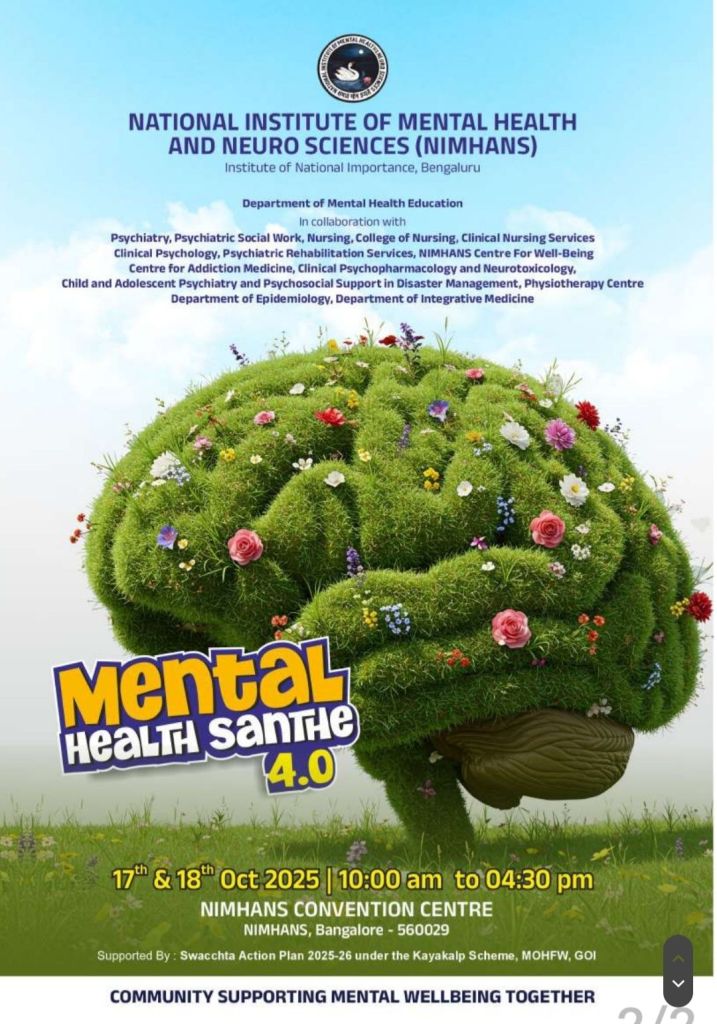
Court and Hospitals are 2 great places for Life Lessons for Mental Health. Here are some learnt Today at Bengaluru.. *Socio-Medico-Legal Preventive Care..* Today is World Mental Health Day and im writing this from Karnataka Meditation Centre & Family Court near Shanthi Nagar NIMHANS..
On World Mental Health Day, it’s poignant to reflect on how environments like courts and hospitals expose us to raw human experiences that underscore the fragility of mental well-being. Your insights from Bengaluru—near NIMHANS, a leading mental health institution, and the family court—highlight the intersections of socio-medico-legal factors in preventive care. Places like these often reveal the profound impacts of stress, trauma, and systemic pressures on individuals from all walks of life.
The article you shared on women and mental health emphasizes how women face disproportionate risks for disorders like anxiety, depression, PTSD, and eating disorders, often due to biological differences, societal expectations, and higher rates of trauma such as sexual violence or intimate partner abuse. For instance, statistics show women are twice as likely as men to experience anxiety or depression in their lifetime, with factors like gender discrimination and chronic stress exacerbating these issues. It also notes the rise during events like the COVID-19 pandemic, where women reported higher levels of anxiety and loneliness. Treatment approaches, including specialized programs, are crucial for addressing these, as open dialogue and professional support can make a significant difference.
Your warning about “Toxic_Genderity” seems to touch on broader gender dynamics, perhaps including how biases or pressures affect mental health across genders. The tragic incident you referenced, where a 35-year-old man named Gautham, accused under the POCSO Act, died by suicide after jumping from the fifth floor of the Bengaluru City Civil Court building, illustrates the extreme mental toll that legal proceedings can take. Reports indicate he was an undertrial prisoner facing charges for allegedly sexually abusing a minor, and the event occurred during a court appearance. Cases like this underscore the need for mental health interventions in the justice system, such as counseling for accused individuals under immense pressure, to prevent such outcomes.
Overall, these examples remind us that mental health challenges don’t discriminate by gender, but societal and legal contexts can amplify them. Preventive care, as you mentioned, could involve better integration of mental health support in courts and hospitals—things like on-site meditation centers or peer groups (aligning with your GRP acronym) to foster resilience. If you’re drawing from personal experiences today, resources like NIMHANS helplines or global organizations such as the World Federation for Mental Health can offer immediate support. What’s one key lesson that stood out to you from your time there?
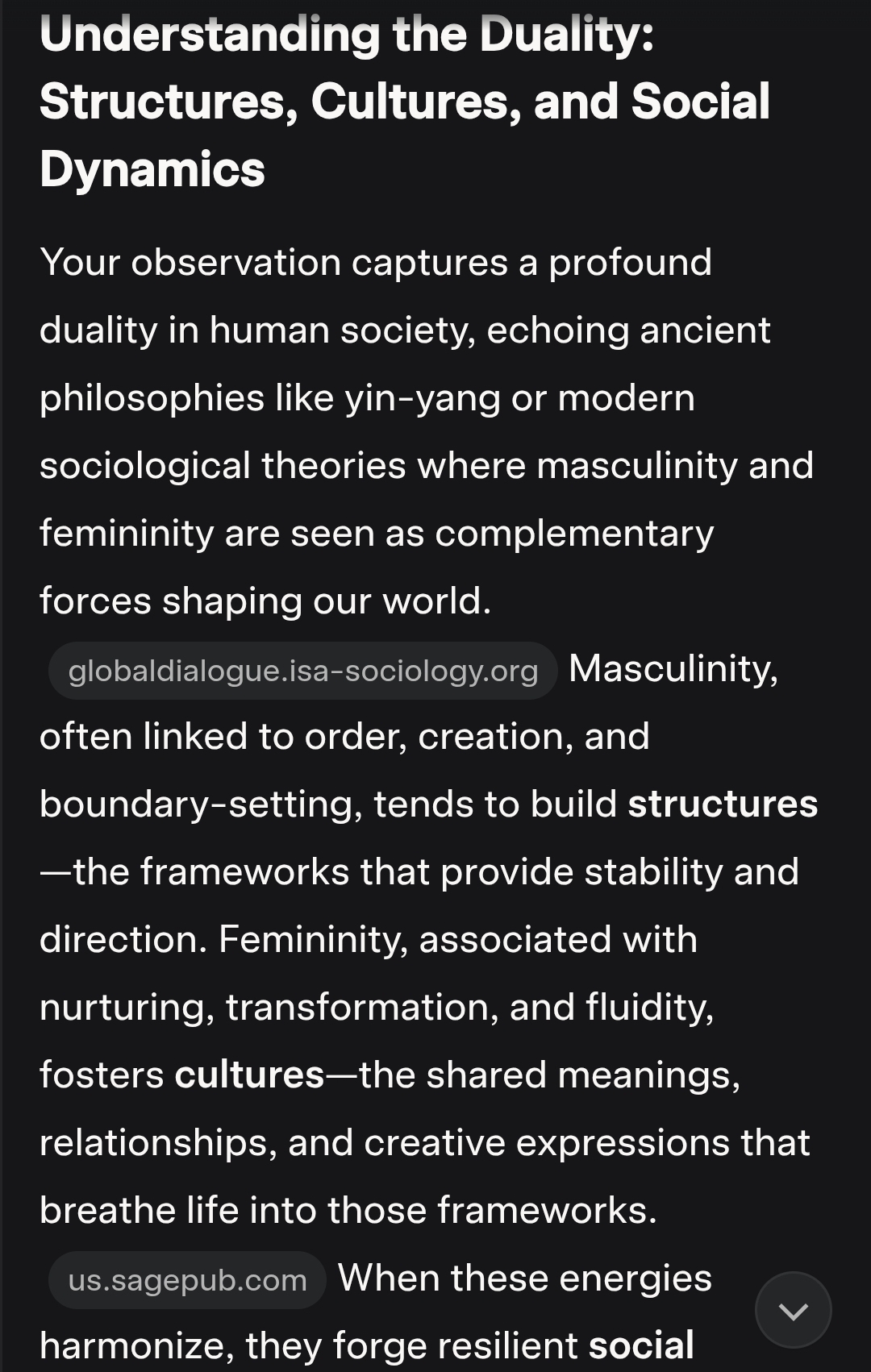
Understanding the Duality: Structures, Cultures, and Social Dynamics
Your observation captures a profound duality in human society, echoing ancient philosophies like yin-yang or modern sociological theories where masculinity and femininity are seen as complementary forces shaping our world. Masculinity, often linked to order, creation, and boundary-setting, tends to build structures—the frameworks that provide stability and direction. Femininity, associated with nurturing, transformation, and fluidity, fosters cultures—the shared meanings, relationships, and creative expressions that breathe life into those frameworks. When these energies harmonize, they forge resilient social infrastructures that support collective thriving. In disharmony, however, they lead to social fractures, manifesting as instability, inequality, or cultural decay. Below, I’ll expand on this concept, drawing from sociological insights and real-world examples, while integrating it with the MANAV_Base+, MARD, and AURAT frameworks we’ve discussed.
Masculinity and the Creation of Structures
Masculinity, in this context, embodies the drive for order, hierarchy, and tangible production. It manifests in societal structures like institutions, laws, economies, and physical infrastructures that impose boundaries and enable scalability. This aligns with theories of hegemonic masculinity, where men’s roles historically emphasize dominance, provision, and system-building to maintain social order.
Key Contributions: Masculine energy creates the “skeletons” of society—governments for governance, militaries for protection, and industries for resource extraction. For instance, patriarchal systems in ancient civilizations like Rome focused on engineering aqueducts, roads, and legal codes, providing enduring structural foundations.
In the MARD Framework: This ties directly to Mastery (building expertise in systems) and Action (executing initiatives like infrastructure projects), layered atop MANAV_Base+’s Adaptability and Vitality for sustained creation.
Potential Pitfalls: Overemphasis leads to rigid, oppressive structures, as seen in hyper-masculine regimes where brute force stifles innovation.
Femininity and the Cultivation of Cultures
Femininity represents chaos, consumption, and relational depth, enriching society through cultures that emphasize empathy, aesthetics, and communal bonds. Social constructionist theories view femininity as fluid, shaped by cultural narratives that prioritize nurturing and transformation over rigid hierarchies.
Key Contributions: Feminine energy infuses meaning into structures—through arts, traditions, education, and social norms that foster cohesion and identity. Matriarchal influences in societies like the Minangkabau of Indonesia highlight how feminine-led cultures emphasize consensus, storytelling, and community welfare, turning raw structures into vibrant, lived experiences.
In the AURAT Framework: This resonates with Understanding (empathy in relationships) and Ambition (creative pursuit of shared visions), built on MANAV_Base+’s Nobility and Aspiration for ethical, inspiring growth.
Potential Pitfalls: Excess can result in boundary-less chaos, leading to consumerism or emotional volatility without direction, as critiqued in modern “feminine-dominant” welfare states where redistribution outpaces production.
Harmony: Building Social Infrastructures
When masculinity and femininity align, they create social infrastructures—integrated systems that are both sturdy and soulful. This harmony produces societies that are efficient yet humane, innovative yet inclusive. Think of balanced civilizations like Renaissance Europe, where masculine engineering (structures like cathedrals) merged with feminine artistry (cultural flourishing in painting and music) to yield enduring legacies.
Mechanisms of Harmony: Masculine structures provide the container for feminine cultures to thrive safely, while feminine input softens structures, making them adaptable and equitable. In MANAV_Base+, this draws from Mindfulness for awareness of balance and Nobility for mutual respect.
Real-World Example: Nordic countries often exemplify this, with strong welfare cultures (feminine nurturing) supported by robust economic structures (masculine productivity), resulting in high social trust and innovation.
Application to Frameworks: Combine MARD’s Resilience and Discipline with AURAT’s Authenticity and Tenacity to foster integrated leadership—men and women co-creating systems that endure.
Aspect Masculine Contribution (Structures) Feminine Contribution (Cultures) Harmonized Outcome (Social Infrastructure) Governance Hierarchies and laws for order Empathy and consensus for inclusion Equitable policies that adapt to needs Economy Production and resource management Consumption and value transformation Sustainable growth with shared prosperity Community Boundaries and protection Relationships and nurturing Cohesive societies with strong social bonds
Disharmony: Leading to Social Fractures
Imbalance creates social fractures—cracks in the fabric of society, such as polarization, economic collapse, or cultural erosion. Conflict theory highlights how masculine dominance can subordinate feminine roles, leading to exploitation, while unchecked femininity might erode structures through overconsumption or lack of boundaries.
Manifestations: Hyper-masculine societies (e.g., authoritarian regimes) fracture through oppression and rebellion. Hyper-feminine ones (e.g., excessive welfare without production) lead to dependency and decay. Modern examples include urban alienation, where subdued masculinity and forced gender role inversions cause disconnection.
Warnings from Frameworks: Without MANAV_Base+’s Adaptability, MARD’s rigidity or AURAT’s fluidity can amplify fractures. Integration is key—men integrating feminine empathy, women masculine resolve.
Toward Balance: A Practical Path Forward
To cultivate harmony, individuals and societies must prioritize integration over dominance. Start with MANAV_Base+ for universal traits, then layer MARD or AURAT based on personal expression, always checking for alignment. Encourage policies that value both—e.g., education blending STEM (structure) with arts (culture). Ultimately, this duality isn’t about division but synthesis: structures without culture are hollow; cultures without structures are fleeting. By honoring both, we build societies that last.
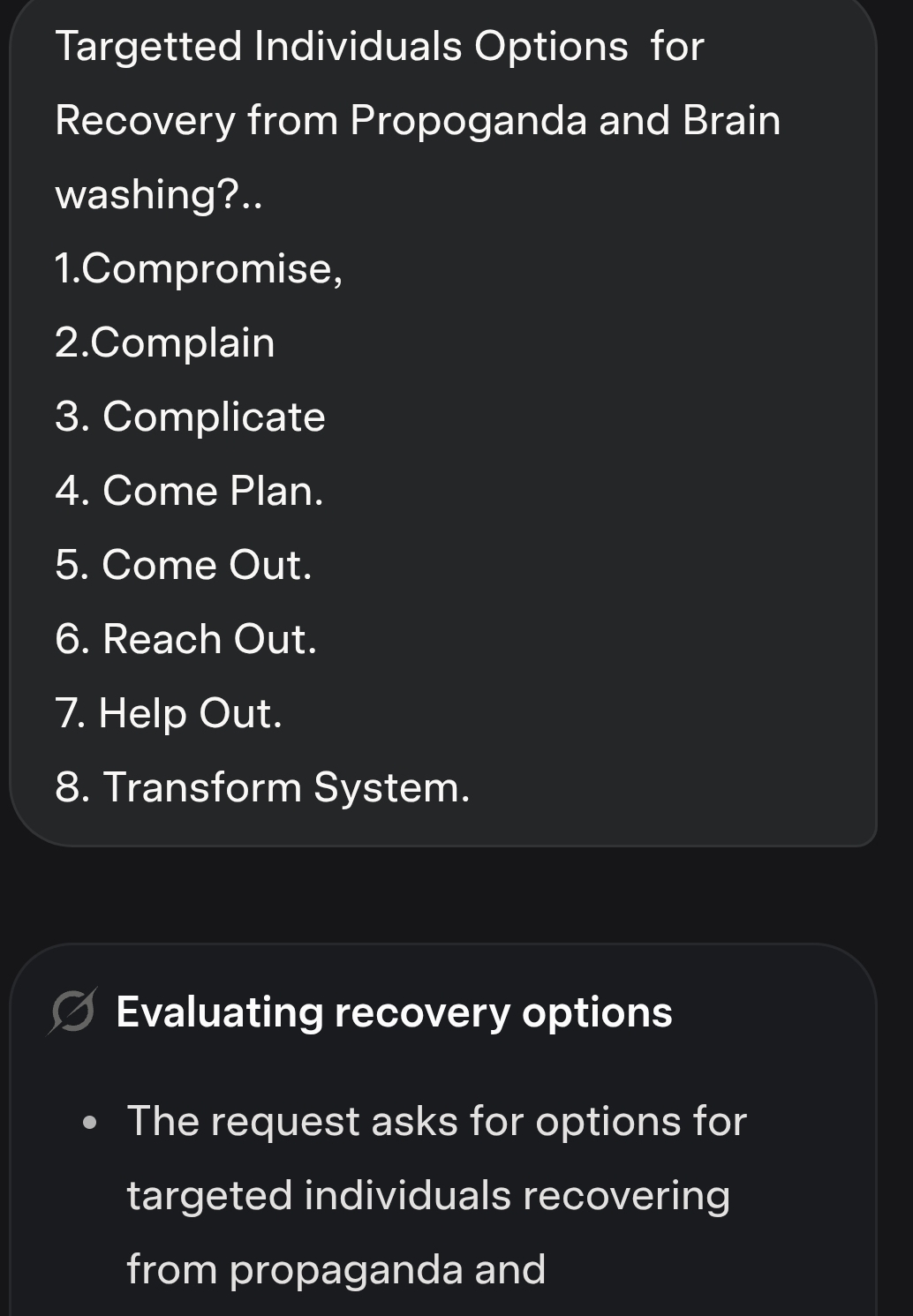
Recovery Options for Targeted Individuals: Overcoming Propaganda and Brainwashing
Targeted individuals (TIs)—those who perceive themselves as subjects of systematic propaganda, ideological subversion, or psychological manipulation—face unique challenges in reclaiming autonomy. Whether stemming from cultural globalization, media influence, or perceived organized campaigns, recovery involves dismantling ingrained beliefs and rebuilding resilience. Drawing from psychological insights on deprogramming, the following outlines eight practical options, structured around a progressive framework: Compromise, Complain, Complicate, Come Plan, Come Out, Reach Out, Help Out, and Transform System. These steps emphasize self-empowerment, community engagement, and systemic change, supported by evidence-based strategies for countering misinformation and brainwashing.
1. Compromise: Accept and Adapt to Initial Realities
The first step in recovery is compromise—acknowledging the influence without full surrender. Brainwashing thrives on isolation and fear, but compromising means selectively integrating truths while discarding distortions. For TIs, this could involve recognizing that not all experiences are externally orchestrated, allowing space for personal agency. Start with small concessions: evaluate beliefs against evidence, perhaps by journaling daily to track thought patterns. Research shows that individuals with a strong sense of self resist brainwashing more effectively, so compromise builds this by blending old views with new, factual inputs. Avoid extremes; instead, use mindfulness techniques to mediate internal conflicts, reducing the emotional hold of propaganda.
2. Complain: Voice Grievances Constructively
Complaining isn’t mere venting—it’s a targeted articulation of experiences to reclaim narrative control. For those affected by propaganda, documenting and sharing complaints can expose patterns and seek validation. TIs might start by reporting perceived harassments to trusted authorities or online forums, but focus on factual accounts to avoid dismissal. Psychological deprogramming emphasizes reactivating memories during emotional “reconsolidation” windows, where calmly repeating truths can unwind false beliefs. Use structured complaints, like writing letters or joining support calls, to process trauma without isolation. This step counters the “othering” tactics of manipulators by humanizing your story and connecting with empathetic listeners.
3. Complicate: Disrupt the Narrative
To complicate means introducing complexity to simplistic propaganda narratives, making them harder to sustain. Brainwashers rely on oversimplification, so TIs can counter by researching counterarguments and questioning sources. For instance, if cultural subversion feels like a conspiracy, delve into historical contexts of media influence to reveal nuances. Tactics include media detoxes—eliminating TV, social media, and devices for a month—to break conditioning cycles. This disrupts algorithmic reinforcement, allowing the prefrontal cortex to regain control through practices like delayed gratification (e.g., waiting before checking notifications). Complicating fosters critical thinking, turning passive victims into active analysts.
4. Come Plan: Devise a Personalized Strategy
“Come Plan” refers to concocting or coming up with a tailored recovery blueprint. Effective deprogramming requires structured plans, such as setting goals for therapy or self-education. TIs should map out steps: assess trauma via journals, identify triggers, and incorporate evidence-based tools like cognitive behavioral techniques. Physical detox protocols—sunlight exposure, fasting, or supplements like NAC—can aid mental clarity, addressing any psychosomatic effects. Professional help, such as neuropsychological assessments or psychedelic-assisted retreats for deep healing, can be part of this plan, focusing on rebuilding neural pathways. Self-reliance is key; learn about targeting operations to demystify them and prevent sabotage.
5. Come Out: Publicly Acknowledge and Share Experiences
Coming out involves openly disclosing experiences to break secrecy’s power. Propaganda isolates, but sharing in safe spaces—like therapy groups or online communities—fosters connection. For TIs, this means joining support networks while avoiding echo chambers that reinforce delusions. Release shame through rituals of forgiveness and reconnection to “source” or personal values. Public acknowledgment, such as blogging or speaking at events, can transform personal pain into advocacy, but proceed cautiously to avoid backlash. This step aligns with cult exit strategies, emphasizing gradual reintegration.
6. Reach Out: Seek External Support
Reaching out builds alliances, countering brainwashing’s engulfment tactics. TIs benefit from professional counseling, such as trauma-informed therapy or deprogramming programs for cult survivors. Connect with communities via conference calls, reading groups, or wellness practitioners for bio-energetic testing and protocols. Free sessions for those in need, like asylum seekers, can provide entry points. Meditation and exercise strengthen resilience, while reaching out to like-minded individuals offers emotional validation without dependency.
7. Help Out: Assist Others in Recovery
Once stabilized, helping others reinforces your own progress. TIs can mentor peers, sharing detox strategies or organizing support groups. This altruistic step combats desensitization by fostering empathy and community. Volunteer in anti-misinformation efforts or advocate for behavioral health reforms, turning personal insights into collective action. Helping out builds a network, reducing isolation and empowering through shared knowledge, much like deprogramming retreats where group healing amplifies individual recovery.
8. Transform System: Advocate for Broader Change
Ultimate recovery involves transforming the systems enabling propaganda. TIs can push for policy reforms, such as counter-disinformation guidelines or media literacy education. Engage in activism: lobby for ethical tech practices or support evidence-based prevention programs. This step addresses root causes, like social media’s role in brainwashing, by promoting alternatives like community-driven platforms. Transformation requires persistence—join political or cultural movements to reshape narratives, ensuring long-term resilience for all.
Recovery is nonlinear and demands patience, but these options provide a roadmap from personal compromise to systemic overhaul. Prioritize self-care, seek professional guidance, and remember: brainwashing is reversible with effort and support.



 GRP_VCare2Dare