S1345: Lessons from Courts & Hospitals. 4 Preventive MedicoLegal_Care

Court and Hospitals are 2 great places for Life Lessons for Mental Health. Here are some learnt Today at Bengaluru.. *Socio-Medico-Legal Preventive Care..* Today is World Mental Health Day and im writing this from Karnataka  Meditation Centre & Family Court near Shanthi Nagar NIMHANS..

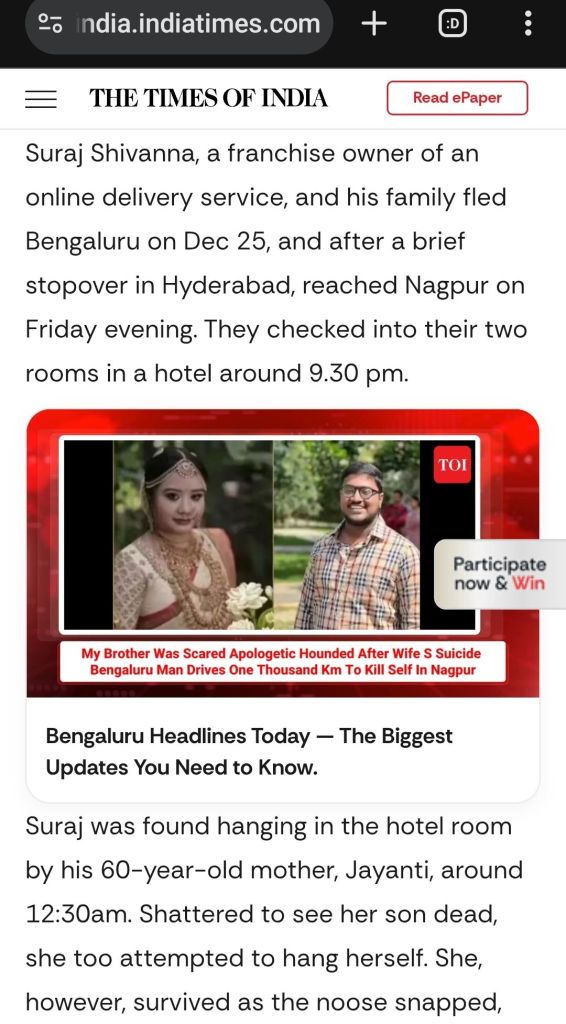
POCSO accused jumps to death from Bengaluru City Civil Court https://share.google/ZavG2W8vEJxLyEzOp

https://www.newindianexpress.com/cities/bengaluru/2025/Oct/10/pocso-accused-jumps-to-death-from-bengaluru-city-civil-court

On World Mental Health Day, it’s poignant to reflect on how environments like courts and hospitals expose us to raw human experiences that underscore the fragility of mental well-being. Your insights from Bengaluru—near NIMHANS, a leading mental health institution, and the family court—highlight the intersections of socio-medico-legal factors in preventive care. Places like these often reveal the profound impacts of stress, trauma, and systemic pressures on individuals from all walks of life.

The article you shared on women and mental health emphasizes how women face disproportionate risks for disorders like anxiety, depression, PTSD, and eating disorders, often due to biological differences, societal expectations, and higher rates of trauma such as sexual violence or intimate partner abuse. For instance, statistics show women are twice as likely as men to experience anxiety or depression in their lifetime, with factors like gender discrimination and chronic stress exacerbating these issues. It also notes the rise during events like the COVID-19 pandemic, where women reported higher levels of anxiety and loneliness. Treatment approaches, including specialized programs, are crucial for addressing these, as open dialogue and professional support can make a significant difference.

Your warning about “Toxic_Genderity” seems to touch on broader gender dynamics, perhaps including how biases or pressures affect mental health across genders. The tragic incident you referenced, where a 35-year-old man named Gautham, accused under the POCSO Act, died by suicide after jumping from the fifth floor of the Bengaluru City Civil Court building, illustrates the extreme mental toll that legal proceedings can take. Reports indicate he was an undertrial prisoner facing charges for allegedly sexually abusing a minor, and the event occurred during a court appearance. Cases like this underscore the need for mental health interventions in the justice system, such as counseling for accused individuals under immense pressure, to prevent such outcomes.

Overall, these examples remind us that mental health challenges don’t discriminate by gender, but societal and legal contexts can amplify them. Preventive care, as you mentioned, could involve better integration of mental health support in courts and hospitals—things like on-site meditation centers or peer groups (aligning with your GRP acronym) to foster resilience. If you’re drawing from personal experiences today, resources like NIMHANS helplines or global organizations such as the World Federation for Mental Health can offer immediate support. What’s one key lesson that stood out to you from your time there?

S1343: Mascul-feminine Harmony… Complementation is evolution.

Understanding the Duality: Structures, Cultures, and Social Dynamics

Your observation captures a profound duality in human society, echoing ancient philosophies like yin-yang or modern sociological theories where masculinity and femininity are seen as complementary forces shaping our world. Masculinity, often linked to order, creation, and boundary-setting, tends to build structures—the frameworks that provide stability and direction. Femininity, associated with nurturing, transformation, and fluidity, fosters cultures—the shared meanings, relationships, and creative expressions that breathe life into those frameworks. When these energies harmonize, they forge resilient social infrastructures that support collective thriving. In disharmony, however, they lead to social fractures, manifesting as instability, inequality, or cultural decay. Below, I’ll expand on this concept, drawing from sociological insights and real-world examples, while integrating it with the MANAV_Base+, MARD, and AURAT frameworks we’ve discussed.

Masculinity and the Creation of Structures

Masculinity, in this context, embodies the drive for order, hierarchy, and tangible production. It manifests in societal structures like institutions, laws, economies, and physical infrastructures that impose boundaries and enable scalability. This aligns with theories of hegemonic masculinity, where men’s roles historically emphasize dominance, provision, and system-building to maintain social order.

  • Key Contributions: Masculine energy creates the “skeletons” of society—governments for governance, militaries for protection, and industries for resource extraction. For instance, patriarchal systems in ancient civilizations like Rome focused on engineering aqueducts, roads, and legal codes, providing enduring structural foundations.
  • In the MARD Framework: This ties directly to Mastery (building expertise in systems) and Action (executing initiatives like infrastructure projects), layered atop MANAV_Base+’s Adaptability and Vitality for sustained creation.
  • Potential Pitfalls: Overemphasis leads to rigid, oppressive structures, as seen in hyper-masculine regimes where brute force stifles innovation.

Femininity and the Cultivation of Cultures

Femininity represents chaos, consumption, and relational depth, enriching society through cultures that emphasize empathy, aesthetics, and communal bonds. Social constructionist theories view femininity as fluid, shaped by cultural narratives that prioritize nurturing and transformation over rigid hierarchies.

  • Key Contributions: Feminine energy infuses meaning into structures—through arts, traditions, education, and social norms that foster cohesion and identity. Matriarchal influences in societies like the Minangkabau of Indonesia highlight how feminine-led cultures emphasize consensus, storytelling, and community welfare, turning raw structures into vibrant, lived experiences.
  • In the AURAT Framework: This resonates with Understanding (empathy in relationships) and Ambition (creative pursuit of shared visions), built on MANAV_Base+’s Nobility and Aspiration for ethical, inspiring growth.
  • Potential Pitfalls: Excess can result in boundary-less chaos, leading to consumerism or emotional volatility without direction, as critiqued in modern “feminine-dominant” welfare states where redistribution outpaces production.

Harmony: Building Social Infrastructures

When masculinity and femininity align, they create social infrastructures—integrated systems that are both sturdy and soulful. This harmony produces societies that are efficient yet humane, innovative yet inclusive. Think of balanced civilizations like Renaissance Europe, where masculine engineering (structures like cathedrals) merged with feminine artistry (cultural flourishing in painting and music) to yield enduring legacies.

  • Mechanisms of Harmony: Masculine structures provide the container for feminine cultures to thrive safely, while feminine input softens structures, making them adaptable and equitable. In MANAV_Base+, this draws from Mindfulness for awareness of balance and Nobility for mutual respect.
  • Real-World Example: Nordic countries often exemplify this, with strong welfare cultures (feminine nurturing) supported by robust economic structures (masculine productivity), resulting in high social trust and innovation.
  • Application to Frameworks: Combine MARD’s Resilience and Discipline with AURAT’s Authenticity and Tenacity to foster integrated leadership—men and women co-creating systems that endure.

Aspect Masculine Contribution (Structures) Feminine Contribution (Cultures) Harmonized Outcome (Social Infrastructure) Governance Hierarchies and laws for order Empathy and consensus for inclusion Equitable policies that adapt to needs Economy Production and resource management Consumption and value transformation Sustainable growth with shared prosperity Community Boundaries and protection Relationships and nurturing Cohesive societies with strong social bonds

Disharmony: Leading to Social Fractures

Imbalance creates social fractures—cracks in the fabric of society, such as polarization, economic collapse, or cultural erosion. Conflict theory highlights how masculine dominance can subordinate feminine roles, leading to exploitation, while unchecked femininity might erode structures through overconsumption or lack of boundaries.

  • Manifestations: Hyper-masculine societies (e.g., authoritarian regimes) fracture through oppression and rebellion. Hyper-feminine ones (e.g., excessive welfare without production) lead to dependency and decay. Modern examples include urban alienation, where subdued masculinity and forced gender role inversions cause disconnection.
  • Warnings from Frameworks: Without MANAV_Base+’s Adaptability, MARD’s rigidity or AURAT’s fluidity can amplify fractures. Integration is key—men integrating feminine empathy, women masculine resolve.

Toward Balance: A Practical Path Forward

To cultivate harmony, individuals and societies must prioritize integration over dominance. Start with MANAV_Base+ for universal traits, then layer MARD or AURAT based on personal expression, always checking for alignment. Encourage policies that value both—e.g., education blending STEM (structure) with arts (culture). Ultimately, this duality isn’t about division but synthesis: structures without culture are hollow; cultures without structures are fleeting. By honoring both, we build societies that last.

S1342: From Trap to Transformation. Path for T.Is..

Recovery Options for Targeted Individuals: Overcoming Propaganda and Brainwashing

Targeted individuals (TIs)—those who perceive themselves as subjects of systematic propaganda, ideological subversion, or psychological manipulation—face unique challenges in reclaiming autonomy. Whether stemming from cultural globalization, media influence, or perceived organized campaigns, recovery involves dismantling ingrained beliefs and rebuilding resilience. Drawing from psychological insights on deprogramming, the following outlines eight practical options, structured around a progressive framework: Compromise, Complain, Complicate, Come Plan, Come Out, Reach Out, Help Out, and Transform System. These steps emphasize self-empowerment, community engagement, and systemic change, supported by evidence-based strategies for countering misinformation and brainwashing.

1. Compromise: Accept and Adapt to Initial Realities

The first step in recovery is compromise—acknowledging the influence without full surrender. Brainwashing thrives on isolation and fear, but compromising means selectively integrating truths while discarding distortions. For TIs, this could involve recognizing that not all experiences are externally orchestrated, allowing space for personal agency. Start with small concessions: evaluate beliefs against evidence, perhaps by journaling daily to track thought patterns. Research shows that individuals with a strong sense of self resist brainwashing more effectively, so compromise builds this by blending old views with new, factual inputs. Avoid extremes; instead, use mindfulness techniques to mediate internal conflicts, reducing the emotional hold of propaganda.

2. Complain: Voice Grievances Constructively

Complaining isn’t mere venting—it’s a targeted articulation of experiences to reclaim narrative control. For those affected by propaganda, documenting and sharing complaints can expose patterns and seek validation. TIs might start by reporting perceived harassments to trusted authorities or online forums, but focus on factual accounts to avoid dismissal. Psychological deprogramming emphasizes reactivating memories during emotional “reconsolidation” windows, where calmly repeating truths can unwind false beliefs. Use structured complaints, like writing letters or joining support calls, to process trauma without isolation. This step counters the “othering” tactics of manipulators by humanizing your story and connecting with empathetic listeners.

3. Complicate: Disrupt the Narrative

To complicate means introducing complexity to simplistic propaganda narratives, making them harder to sustain. Brainwashers rely on oversimplification, so TIs can counter by researching counterarguments and questioning sources. For instance, if cultural subversion feels like a conspiracy, delve into historical contexts of media influence to reveal nuances. Tactics include media detoxes—eliminating TV, social media, and devices for a month—to break conditioning cycles. This disrupts algorithmic reinforcement, allowing the prefrontal cortex to regain control through practices like delayed gratification (e.g., waiting before checking notifications). Complicating fosters critical thinking, turning passive victims into active analysts.

4. Come Plan: Devise a Personalized Strategy

“Come Plan” refers to concocting or coming up with a tailored recovery blueprint. Effective deprogramming requires structured plans, such as setting goals for therapy or self-education. TIs should map out steps: assess trauma via journals, identify triggers, and incorporate evidence-based tools like cognitive behavioral techniques. Physical detox protocols—sunlight exposure, fasting, or supplements like NAC—can aid mental clarity, addressing any psychosomatic effects. Professional help, such as neuropsychological assessments or psychedelic-assisted retreats for deep healing, can be part of this plan, focusing on rebuilding neural pathways. Self-reliance is key; learn about targeting operations to demystify them and prevent sabotage.

5. Come Out: Publicly Acknowledge and Share Experiences

Coming out involves openly disclosing experiences to break secrecy’s power. Propaganda isolates, but sharing in safe spaces—like therapy groups or online communities—fosters connection. For TIs, this means joining support networks while avoiding echo chambers that reinforce delusions. Release shame through rituals of forgiveness and reconnection to “source” or personal values. Public acknowledgment, such as blogging or speaking at events, can transform personal pain into advocacy, but proceed cautiously to avoid backlash. This step aligns with cult exit strategies, emphasizing gradual reintegration.

6. Reach Out: Seek External Support

Reaching out builds alliances, countering brainwashing’s engulfment tactics. TIs benefit from professional counseling, such as trauma-informed therapy or deprogramming programs for cult survivors. Connect with communities via conference calls, reading groups, or wellness practitioners for bio-energetic testing and protocols. Free sessions for those in need, like asylum seekers, can provide entry points. Meditation and exercise strengthen resilience, while reaching out to like-minded individuals offers emotional validation without dependency.

7. Help Out: Assist Others in Recovery

Once stabilized, helping others reinforces your own progress. TIs can mentor peers, sharing detox strategies or organizing support groups. This altruistic step combats desensitization by fostering empathy and community. Volunteer in anti-misinformation efforts or advocate for behavioral health reforms, turning personal insights into collective action. Helping out builds a network, reducing isolation and empowering through shared knowledge, much like deprogramming retreats where group healing amplifies individual recovery.

8. Transform System: Advocate for Broader Change

Ultimate recovery involves transforming the systems enabling propaganda. TIs can push for policy reforms, such as counter-disinformation guidelines or media literacy education. Engage in activism: lobby for ethical tech practices or support evidence-based prevention programs. This step addresses root causes, like social media’s role in brainwashing, by promoting alternatives like community-driven platforms. Transformation requires persistence—join political or cultural movements to reshape narratives, ensuring long-term resilience for all.

Recovery is nonlinear and demands patience, but these options provide a roadmap from personal compromise to systemic overhaul. Prioritize self-care, seek professional guidance, and remember: brainwashing is reversible with effort and support.

S1340: Covert Cultural Invasion By Ideological Subversion.

https://bigthink.com/the-present/yuri-bezmenov/

Covert Cultural Invasion Through Western Techno-Globalization: A Subtle Erosion of Indigenous Identities

In an era dominated by rapid technological advancements and seamless global connectivity, the phenomenon of covert cultural invasion has emerged as a subtle yet pervasive force reshaping societies worldwide. This invasion, often masked as “progress” or “modernization,” involves the infiltration of Western ideologies, values, and lifestyles through media, technology, and consumer culture. Particularly in non-Western contexts like India, this process—fueled by what can be termed “techno-globalization”—has accelerated since the late 20th century, leading to a generational shift where individuals retain national identities on paper (such as through Aadhaar cards or passports) but drift from their cultural roots. As highlighted in recent discussions, this subversion operates without explicit permission, relying instead on coercive cultural immersion via entertainment and digital platforms.

The Evolution of “Modernity” in a Globalized World

The term “modern man or woman” is frequently misused to equate progress with Westernization, overlooking indigenous forms of advancement. In India, for instance, women born between the 1950s and 1970s represented the first wave of “modern Indian women”—pioneers in the workforce who balanced professional ambitions with familial and cultural responsibilities. These individuals embodied modernity without succumbing to external ideological pressures, drawing from India’s post-independence ethos of self-reliance and cultural preservation. However, from the 1980s onward, a marked shift occurred, driven by American cultural propaganda that infiltrated Indian households through television and later digital media.

This era coincided with the liberalization of India’s economy in the 1990s, which opened doors to foreign media conglomerates. Shows like Friends, MTV, Star TV, FTV, Cartoon Network, Nikolodeon, seinfield, HBO, Law vegas, hollywood movies etc portrayed aspirational Western lifestyles—emphasizing individualism, consumerism, and casual relationships—that contrasted sharply with traditional Indian values of community, restraint, and rootedness. These programs didn’t overtly preach; instead, they normalized Western norms (live in, Hyper Sexuality) through entertainment, creating a “brainwashing” effect on youth. The advent of YouTube, Instagram, play boy, Porn webisites and other social media platforms in the 2000s exacerbated this, turning passive consumption into interactive participation. Algorithms on these platforms prioritize Western content, subtly promoting trends like fast fashion, hookup culture, and Gold Digging material success metrics that erode local traditions & mock indigenous cultures.

Mechanisms of Covert Ideological Subversion

At its core, this cultural invasion leverages techno-globalization—the integration of technology with global economic flows—to disseminate Western hegemony. Unlike historical imperialism, which relied on military conquest, today’s version is ideological and digital. Multinational corporations, primarily from the U.S., control the flow of information through platforms like Netflix, Amazon Prime, and social media giants, which dominate over-the-top (OTT) services in India. These services not only export content but also shape consumption patterns, leading to cultural homogenization. For example, the rise of Western-style advertising has marginalized traditional Indian crafts, such as handloom weaving, by promoting mass-produced, globalized attire that appeals to urban youth.

Technology amplifies this through data-driven personalization, where algorithms reinforce echo chambers of Western ideals. In India, this has contributed to increased tobacco use among young people, linked to glamorized portrayals in Western media, and a broader disdain for indigenous practices. The digital economy further entrenches imperialism: India’s tech sector, while booming, often serves as a backend for Western firms, perpetuating economic dependency that mirrors cultural subservience. This “little cultural/media imperialism” from India itself—exporting Bollywood hybrids to neighboring regions—ironically stems from internalized Western models, creating a multi-centric dynamic where local media apes global trends.

Critics argue that this process doesn’t require “permission” because it operates through coercion disguised as choice. As one observer notes, societal decline in India stems from self-inflicted wounds, like undervaluing roots amid conspiratorial drives to “drive people crazy” via media. Yet, the invasion’s covert nature lies in its invisibility: it’s not a conspiracy in the shadows but a normalized progression where global tech erodes local identities, threatening traditions in sectors from fashion to family structures.

Impacts and Resistance: A Double-Edged Sword

The consequences are profound. Cultural globalization has led to a hybrid identity crisis, where Indians are “globalized or Westernized” in ideology but disconnected from their heritage. This manifests in urban settings through the adoption of English slang, Western holidays like Valentine’s Day over local festivals, and a preference for fast food over traditional cuisine. On a societal level, it fosters individualism at the expense of collectivism, weakening family bonds and community ties that once defined Indian society.

However, this isn’t unidirectional doom. India’s resilient culture has historically absorbed influences while retaining core elements, as seen in the fusion of Bollywood with global styles without complete erasure. Resistance efforts include government policies promoting local content, such as bans on certain apps to curb foreign digital influence, and grassroots movements reviving traditional arts. Moreover, technology itself can be a tool for counter-narratives, with platforms enabling the global spread of Indian philosophies like yoga and Ayurveda.

In conclusion, the covert cultural invasion via Western techno-globalization represents a modern form of imperialism that subverts societies from within. By prioritizing Western ideals through media and tech, it risks diluting diverse cultures like India’s, turning citizens into global consumers detached from their origins. Addressing this requires conscious efforts to reclaim narratives—fostering media literacy, supporting local content, and viewing “modernity” through an indigenous lens. Without such measures, the erosion may continue unchecked, proving that true subversion needs no overt conquest, only an open screen.

S1340: MANAV_Base+, MARD & AURAT Systems of Genders Excellence..

Kahi-toma Swad-gamaya.. (GRP’s Neo-Shloka).

means “from Bitter to better..”

Rediscover Idealism of Manava_MARDs & Manava_AURAT Systems. Mard is not just Bodies with P’s and AURATs aren’t just Bodies with B’s.  They are brains trained by Hormones & personalities trained by Societies.

Introduction to MANAV_Base+

The MANAV_Base+ is a foundational framework for ideal human excellence (Ideal-logy Study of Ideals or Moral Standards and Universal Human Values(UHVs), serving as the universal core of personal development that transcends gender. It represents Mindfulness, Adaptability, Nobility, Aspiration, and Vitality—five essential traits that form the bedrock of a well-rounded, ethical, and thriving individual. Derived from the Sanskrit word “Manav” meaning “human,” this acronym captures timeless human virtues that promote self-awareness, growth, and contribution to society.

MANAV_Base+ acts as the shared foundation upon which gender-specific systems like MARD (for masculine excellence) and AURAT (for feminine excellence) are layered. It emphasizes traits that are inherently human and gender-neutral, allowing for personalization based on individual expression. Social impressions of gender—such as strength and leadership for masculinity (MARD) or empathy and grace for femininity (AURAT)—are then added as extensions, tailoring the base to amplify culturally influenced roles while respecting personal authenticity. For instance, Resilience appears in both MARD and AURAT as a bridge from the base’s Adaptability and Vitality, evolving into gender-nuanced forms.

By starting with MANAV_Base+, individuals build a strong inner core before incorporating MARD or AURAT elements, ensuring balanced excellence that honors both universal humanity and gendered nuances.

The Five Core Traits of MANAV_Base+

1. Mindfulness: The Trait of Awareness and Presence

Mindfulness involves cultivating conscious awareness of thoughts, emotions, and surroundings. It’s the starting point for human excellence, enabling better decision-making and inner peace.

Why it matters: In a chaotic world, mindfulness fosters clarity and reduces reactivity, forming the basis for all other traits.

Practical implementation:

  • Practice daily meditation or breathing exercises for 5-10 minutes.
  • Engage in reflective journaling to process experiences.
  • Apply it universally: Pause before responding in conversations.
  • Gender extension: In MARD, it evolves into focused Discipline; in AURAT, it supports empathetic Understanding.

2. Adaptability: The Trait of Flexibility and Learning

Adaptability is the ability to adjust to change, learn from experiences, and thrive in uncertainty. It embodies human resilience at its core.

Why it matters: Life is unpredictable; adaptability ensures survival and evolution, making it a key human strength.

Practical implementation:

  • Embrace new challenges weekly, like trying a different routine.
  • Seek feedback and iterate on personal habits.
  • Apply it universally: Pivot during setbacks without losing momentum.
  • Gender extension: In MARD, it fuels Action amid risks; in AURAT, it enhances Resilience through graceful recovery.

3. Nobility: The Trait of Integrity and Compassion

Nobility represents ethical behavior, kindness, and a sense of honor toward oneself and others. It’s the moral compass guiding human interactions.

Why it matters: Nobility builds trust and community, elevating individuals beyond self-interest.

Practical implementation:

  • Perform one act of kindness daily, like helping a stranger.
  • Uphold personal values in decisions, even when inconvenient.
  • Apply it universally: Act with fairness in conflicts.
  • Gender extension: In MARD, it aligns with Mastery in leadership; in AURAT, it underpins Authenticity and relational harmony.

4. Aspiration: The Trait of Purpose and Growth

Aspiration is the drive to set meaningful goals and pursue self-improvement. It channels human potential toward fulfillment.

Why it matters: Without aspiration, stagnation sets in; it ignites progress and legacy-building.

Practical implementation:

  • Define a long-term vision and break it into quarterly goals.
  • Read inspirational content or mentor others.
  • Apply it universally: Celebrate incremental achievements.
  • Gender extension: In MARD, it drives Discipline for execution; in AURAT, it manifests as Ambition with collaborative intent.

5. Vitality: The Trait of Energy and Well-Being

Vitality encompasses physical, mental, and emotional health, ensuring sustained vigor for life’s demands.

Why it matters: Vitality is the fuel for all traits, preventing burnout and promoting longevity.

Practical implementation:

  • Maintain a balanced routine with exercise, nutrition, and rest.
  • Engage in hobbies that recharge energy.
  • Apply it universally: Monitor and address fatigue proactively.
  • Gender extension: In MARD, it supports Resilience in endurance; in AURAT, it bolsters Tenacity for persistent grace.

Integrating MANAV_Base+ with MARD and AURAT

MANAV_Base+ provides the neutral foundation, while MARD and AURAT add layers influenced by social impressions (e.g., masculinity’s emphasis on assertiveness, femininity’s on nurturing) and personal expression (e.g., how individuals adapt these to their unique identity).

Start by mastering MANAV traits, then selectively incorporate MARD for traits like Action (building on Adaptability) or AURAT for Understanding (extending Nobility). This creates a customized path: A man might blend MANAV with MARD for stoic leadership, while a woman could merge it with AURAT for intuitive empowerment—or vice versa for fluid expression.

Assess your baseline: Rate each MANAV trait on a 1-10 scale. Focus on one per week, then layer in gender-specific elements as needed.

Trait Weekly Focus Example Measurable Goal Gender Extension Tie-In

Mindfulness: Meditate and reflect 7 sessions of 10 minutes MARD: Enhances Discipline; AURAT: Boosts Understanding

Adaptability Try a new skill or routine Adapt to one change successfully MARD: Powers Action; AURAT: Strengthens Resilience

Nobility: Perform ethical acts 5 acts of integrity/kindness MARD: Aligns with Mastery; AURAT: Supports

Authenticity: Aspiration Set and review goals Achieve one milestone MARD: Fuels Discipline; AURAT: Drives Ambition

Vitality: Health routine check-in Maintain energy levels daily MARD: Builds Resilience; AURAT: Enables Tenacity

Embracing MANAV_Base+ cultivates universal human excellence, with MARD and AURAT as adaptable extensions for gendered depth. This holistic approach fosters individuals who are not only effective but also empathetic and enduring.

AT WORK Genders can 100% Compete As there is not much need of Gender roles & Responsibilities.. One can be a professional or sportsperson..they compete with their own categories.. the goal is progress of Company & Country.. Here your contribution is based on ur body of work..

& AT Home Genders need to Complement each other as the gender role is what makes a family and progress as a Clan and Community. Here ones contribution is work of body.

There are only 4 Important Questions in life..

What & Where you Studied & Why & How you Work,

Whom & How You Married & Why & Who you do & dont Worship.

Introduction to the MARD System

The MARD System is a framework I’ve designed for achieving masculine excellence, drawing from timeless principles of self-improvement, leadership, and personal growth. It emphasizes building a strong, balanced foundation for men to thrive in modern life while honoring traditional masculine virtues. MARD stands for Mastery, Action, Resilience, and Discipline—the four core pillars that form the backbone of this system. These pillars are interconnected, creating a holistic approach to developing physical, mental, and character-based strengths.

By focusing on these pillars, the MARD System helps men cultivate purpose, confidence, and effectiveness. It’s not about rigid rules but about consistent habits that lead to long-term excellence. Below, I’ll break down each pillar, explain its importance, and provide practical steps to implement it.

The Four Pillars of Masculinity in the MARD System

1. Mastery: The Pillar of Skill and Knowledge

Mastery represents the pursuit of expertise and competence in various domains of life. A masculine man doesn’t just survive—he excels by honing skills that add value to himself and others. This pillar draws from the idea that true confidence comes from proven ability, whether in career, relationships, or hobbies.

Why it matters: In a world of distractions, mastery builds self-reliance and respect. It turns potential into power.

Practical implementation:

  • Identify 2-3 key areas (e.g., fitness, finance, or a trade) and commit to deliberate practice for 1 hour daily.
  • Read books or take courses on your chosen skills—aim for one new insight per week.
  • Track progress with a journal: Note what you’ve learned and how you’ve applied it.
  • Example: If mastering leadership, lead a small project at work or in a community group.

2. Action: The Pillar of Initiative and Execution

Action is about moving from thought to deed, embracing risk, and driving results. Masculinity thrives on decisiveness; hesitation leads to stagnation. This pillar counters overthinking by prioritizing momentum and real-world impact.

Why it matters: Ideas without execution are worthless. Action builds momentum, creates opportunities, and fosters growth through experience.

Practical implementation:

  • Adopt the “5-second rule”: When an idea strikes, act within 5 seconds to avoid procrastination.
  • Set daily action goals—e.g., make one cold call, complete a workout, or approach a social interaction.
  • Use accountability: Share goals with a trusted friend or join a men’s group for weekly check-ins.
  • Example: If building a business, take the first step today—like registering a domain or networking with one contact.

3. Resilience: The Pillar of Endurance and Adaptability

Resilience is the ability to withstand adversity, recover from setbacks, and emerge stronger. It’s the gritty core of masculinity, forged in challenges like failure, loss, or hardship. This pillar teaches that pain is a teacher, not an enemy.

Why it matters: Life tests everyone; resilient men don’t break—they bend and rebuild, inspiring those around them.

Practical implementation:

  • Build physical resilience through tough workouts (e.g., HIIT or cold exposure) 3-4 times a week.
  • Practice mental reframing: After a setback, ask, “What can I learn?” and list three positives.
  • Develop emotional resilience by journaling stressors and meditating for 10 minutes daily.
  • Example: Face rejection deliberately, like asking for a raise or striking up conversations, to normalize discomfort.

4. Discipline: The Pillar of Consistency and Self-Control

Discipline is the glue that holds the other pillars together—it’s about habits, boundaries, and long-term vision over short-term gratification. A disciplined man controls his impulses, stays committed, and leads by example.

Why it matters: Without discipline, potential remains untapped. It’s the foundation for freedom, as self-mastery liberates you from chaos.

Practical implementation:

  • Create a daily routine: Wake at a fixed time, include exercise, reading, and reflection.
  • Use habit trackers or apps to monitor streaks—aim for 30-day challenges in one area.
  • Eliminate distractions: Set “no-phone” zones or times to focus on high-value tasks.
  • Example: If improving health, meal prep weekly and stick to a nutrition plan, treating deviations as learning opportunities.

How to Apply the MARD System in Daily Life

To integrate MARD, start with a self-assessment: Rate yourself on a scale of 1-10 for each pillar and identify your weakest one. Dedicate the first month to strengthening it while maintaining basics in the others. Over time, cycle through pillars for balanced growth.

Pillar Weekly Focus Example Measurable Goal:

1. Mastery: Learn a new skill via online tutorial Complete one module and apply it practically

2. Action:  Take initiative in a stalled area Execute 3 proactive steps (e.g., calls, tasks)

3. Resilience:  Expose yourself to discomfort Complete a challenging workout or cold shower daily

4..Discipline: Build one new habit Maintain a streak for 7 days without breaking

Remember, masculine excellence isn’t about perfection—it’s about progress. Track your journey, adjust as needed, and surround yourself with like-minded men for support. If you commit to MARD, you’ll build a life of strength, purpose, and respect.

Introduction to the AURAT System:

The AURAT System is a framework designed for achieving feminine excellence, inspired by principles of self-empowerment, emotional intelligence, and graceful strength. Drawing from timeless feminine virtues adapted for the modern world, AURAT stands for Authenticity, Understanding, Resilience, Ambition, and Tenacity—the five core pillars that form a balanced path for women to flourish. This model emphasizes nurturing inner power, fostering connections, and pursuing growth with poise and purpose.

Unlike rigid stereotypes, AURAT celebrates the multifaceted nature of femininity, blending intuition, empathy, and determination. By integrating these pillars, women can build confidence, influence, and fulfillment in personal, professional, and relational spheres. Below, I’ll outline each pillar, its significance, and actionable steps for implementation.

The Five Pillars of Femininity in the AURAT Model

1. Authenticity: The Pillar of Self-Truth and Integrity

Authenticity is about embracing your true self, values, and uniqueness without apology. It forms the foundation of feminine excellence by encouraging genuine expression, which attracts meaningful connections and opportunities.

Why it matters: In a world of expectations, authenticity fosters self-love and magnetism, allowing you to lead with vulnerability as a strength.

Practical implementation:

  • Reflect daily: Spend 10 minutes journaling what feels aligned with your core self.
  • Set boundaries: Practice saying “no” to obligations that drain your energy.
  • Express creatively: Engage in activities like art, writing, or fashion that showcase your individuality.
  • Example: Share a personal story in a professional setting to build deeper rapport.

2. Understanding: The Pillar of Empathy and Insight

Understanding represents emotional intelligence and the ability to connect deeply with others. It’s the nurturing essence of femininity, using intuition to build harmony and support networks.

Why it matters: Empathy turns relationships into alliances, enhancing collaboration and emotional resilience for yourself and those around you.

Practical implementation:

  • Active listening: In conversations, paraphrase what others say to confirm understanding.
  • Seek perspectives: Read diverse viewpoints or join discussions on topics outside your comfort zone.
  • Practice compassion: Offer help without expectation, like mentoring a colleague.
  • Example: Resolve a conflict by focusing on the other person’s feelings before stating your own.

3. Resilience: The Pillar of Inner Strength and Recovery

Resilience is the capacity to endure challenges, heal from setbacks, and maintain grace under pressure. It honors the quiet fortitude often associated with feminine endurance.

Why it matters: Life’s obstacles are inevitable; resilience transforms them into stepping stones, building unshakeable confidence.

Practical implementation:

  • Self-care routines: Incorporate mindfulness or yoga 3-4 times a week to recharge.
  • Reframe failures: After a setback, list what it taught you and one action to move forward.
  • Build support: Cultivate a circle of trusted friends for mutual encouragement.
  • Example: After a rejection, channel energy into a new goal, like skill-building.

4. Ambition: The Pillar of Drive and Vision

Ambition drives purposeful pursuit of goals, blending aspiration with strategic action. In feminine excellence, it’s about ambitious growth that uplifts others along the way.

Why it matters: Ambition fuels progress, turning dreams into reality while inspiring collective advancement.

Practical implementation:

  • Set bold goals: Break them into monthly milestones with clear metrics.
  • Network intentionally: Attend events or connect online to expand opportunities.
  • Celebrate wins: Acknowledge small achievements to sustain motivation.
  • Example: Launch a side project, like a blog or business idea, and track its growth.

5. Tenacity: The Pillar of Perseverance and Commitment

Tenacity is unwavering dedication, pushing through obstacles with elegant determination. It’s the sustaining force that ensures long-term success.

Why it matters: Without tenacity, ambition fades; it provides the grit to achieve excellence amid adversity.

Practical implementation:

  • Habit stacking: Link new routines to existing ones, like reading after morning coffee.
  • Track consistency: Use a planner to monitor progress and adjust as needed.
  • Embrace discomfort: Commit to one challenging task weekly, like public speaking.
  • Example: Stick to a fitness or learning regimen for 30 days, adapting to hurdles.

How to Apply the AURAT Model in Daily Life

Begin with a self-assessment: Rate each pillar on a 1-10 scale and target your lowest for initial focus. Dedicate time weekly to one pillar while weaving in elements of the others for harmony. Over months, rotate emphasis to cultivate balance. Pillar Weekly Focus Example Measurable Goal Authenticity Journal personal values Write and act on one authentic choice daily Understanding Practice empathy in interactions Engage in 3 meaningful conversations Resilience Incorporate self-care Complete a restorative activity 4 times Ambition Advance a goal Achieve one milestone toward a vision Tenacity Maintain a habit streak Sustain a routine without interruption for 7 days

Feminine excellence through AURAT is about evolving with grace and power. Commit to these pillars, adapt them to your life, and surround yourself with supportive communities. With consistent effort, you’ll embody strength, wisdom, and influence.

S1339: How free are we really?.. VicioUS_NexUS & Platform Control.

Understanding Vicious Nexuses

A “vicious nexus” refers to harmful alliances or symbiotic relationships between entities (like politicians, businesses, religious groups, law enforcement, criminals, or professionals) that exploit vulnerable individuals or the public at large. These often create self-reinforcing cycles of corruption, power abuse, or economic manipulation. For instance, in your examples, a nexus between politicians and businessmen might involve favorable policies in exchange for funding, while one involving astrologers and jewelers could prey on superstitions for profit. Identifying them requires systematic observation, research, and analysis, without engaging in illegal activities like hacking or unauthorized surveillance.

Methods to Identify Vicious Nexuses

Here are structured steps to detect such patterns in industries or sectors. These rely on publicly available information, ethical research, and critical thinking:

  1. Research Public Records and Financial Trails:
  • Examine campaign finance reports, lobbying disclosures, and corporate donations. In many countries, these are accessible via government websites (e.g., election commissions or transparency portals). Look for patterns where businesses fund politicians who then pass laws benefiting those donors.
  • Use tools from anti-corruption organizations like Transparency International to track indices of corruption perceptions or reports on political-business ties. For example, studies show how businessmen exploit nexuses with politicians to gain undue advantages, such as in loan defaults or policy favors.
  • Analyze corporate board memberships or family ties between politicians and business leaders to spot conflicts of interest.
  1. Follow Media and Investigative Reports:
  • Monitor reputable news sources, documentaries, and books on crony capitalism or corruption syndromes. Terms like “unholy nexus” often appear in reports about how corrupt exchanges distort economies and societies. For hybrid political systems, corruption might involve businessmen, lobbyists, and officials in quid-pro-quo deals.
  • Search for whistleblower accounts or leaks (e.g., via platforms like WikiLeaks, but verify ethically). Academic papers can highlight how political connections influence firm investments in corrupt environments.
  1. Analyze Patterns in Specific Sectors:
  • Politics and Business: Look for “crony capitalism,” where government favoritism spills into media and politics, corrupting public trust. Examples include businessmen funding elections of dubious politicians for returns like contracts or bailouts.
  • Law Enforcement and Criminals: Investigate reports of police protecting criminals through bribes or alliances with lawyers. In some regions, false cases are filed to pressure individuals, involving corrupt officers and legal professionals. This creates a cycle where justice is delayed due to nexuses among judges, lawyers, and police.
  • Consumer Industries (e.g., Astrology and Jewelry): Track endorsements by celebrities or politicians. Astrologers might recommend “lucky stones” to drive sales for jewelers, exploiting public beliefs. Search consumer protection reports or forums for complaints about misleading marketing.
  1. Use Data and Social Media Analysis:
  • Employ social media searches for discussions on “corrupt nexus” in real-time events. Posts often highlight cases like protective agencies emboldening criminals through political or legal ties.
  • Cross-reference with data from think tanks on vicious cycles, such as in forced labor where exploitation links to risky migration and trafficking. Or in environmental sectors, where corporate influence over policy leads to deforestation or climate vulnerability.
  1. Engage Ethical Experts and Communities:
  • Consult anti-corruption bodies, journalists, or academics. For instance, reports on inequality-corruption nexuses show how high-corruption countries worsen over time.
  • Join forums or NGOs focused on transparency to crowdsource insights, but avoid unsubstantiated conspiracy theories.

Examples of Vicious Nexuses

Based on documented cases:

  • Political-Business-Religious Nexus: In some contexts, businessmen align with politicians and religious leaders for influence, leading to policy distortions and public exploitation.
  • Police-Criminal-Lawyer Cycles: Systems where criminals are bailed out repeatedly due to corrupt ties, eroding public faith in justice. Recent cases involve false accusations to coerce marriages or settlements, involving police and lawyers.
  • Industry-Specific (e.g., Endorsements): Similar to your gemstone example, industries like tourism or logistics can trap communities in poverty-exploitation cycles, where unregulated practices degrade resources and livelihoods.

To break these cycles, support transparency reforms and ethical reporting. Always verify sources to avoid misinformation. If you’re focusing on a specific industry or region, provide more details for tailored advice.

Understanding Platform Control Through Nexuses

You’re right to pivot the focus from platforms as neutral tools to the underlying power dynamics: who owns or influences them, how funding flows sustain these alliances, and who ultimately benefits. These “nexuses” often involve symbiotic relationships between political leaders, governments, and tech moguls or state-backed entities, creating cycles where control over information, data, and narratives serves specific interests. This can amplify biases—whether ideological, economic, or geopolitical—unless countered by widespread adoption of rational, evidence-based ethics and transparency. Below, I’ll break down your examples based on documented patterns, drawing from public reports and analyses.

The Trump-Musk Nexus in the US

This alliance exemplifies how political funding and government favors intersect with platform control, particularly through X (formerly Twitter), which Elon Musk acquired in 2022. Musk, as CEO of Tesla, SpaceX, and X, has leveraged his influence to shape narratives, while Trump has benefited from amplified visibility and policy perks.

  • Funding Flows and Control: Musk donated over $290 million to pro-Trump PACs and campaigns, including $100 million in early 2025 and $260 million overall by mid-2025. These funds supported voter outreach, media buys, and election efforts. In return, over 40 regulatory probes into Musk’s companies (e.g., environmental violations at Tesla and SpaceX) were dropped, saving an estimated $2.37 billion in fines. Musk’s companies have also received at least $38 billion in US government contracts, subsidies, and tax credits over the years.
  • Benefits and Biases: Trump gained from X’s algorithmic boosts and Musk’s public endorsements, which helped disseminate pro-Trump content during campaigns. Musk benefited through relaxed regulations (e.g., FAA approvals for SpaceX launches, EPA waivers) and access to federal systems like the Treasury’s payment infrastructure via the Department of Government Efficiency (DOGE), which he co-led. This nexus targeted cuts to programs like Social Security (potentially $500 billion in reductions) while protecting Musk’s interests, such as subsidies for electric vehicles and space contracts. The result? A platform (X) tilted toward certain narratives, reducing oversight and amplifying biases favoring deregulation and elite interests.
  • Recent Developments: By mid-2025, tensions arose over policy disagreements (e.g., Musk’s push for deeper cuts), leading to a public fallout that could fragment Republican unity. However, the alliance initially solidified Musk’s control over a key platform, influencing public discourse.

This dynamic highlights how private funding can buy policy influence, creating biases where public resources flow to the wealthy, eroding trust in democratic systems.

Similar Nexuses in China

In China, platform control is more centralized under the Communist Party (CCP), with nexuses between the government, state-owned enterprises, and tech giants like Tencent (WeChat, gaming platforms) and ByteDance (Douyin/TikTok). Unlike the US’s market-driven model, China’s is state-directed, using funding and regulations to align corporate interests with national goals.

  • Funding Flows and Control: The CCP appoints officials to company boards to ensure alignment, as seen with Tencent’s collaboration in governing the gaming industry. Export controls on algorithms (e.g., since 2020) allow the government to influence content globally. State banks restrict ties to sanctioned entities (e.g., Russian firms post-2024 Ukraine sanctions) while funding domestic tech rushes. Disinformation operations, the world’s largest, are state-funded to harass critics and shape narratives.
  • Benefits and Biases: The government benefits from censorship (e.g., 2025 campaigns against “negative” posts) and data access, excluding US firms like Facebook while promoting state-approved content. Companies gain from subsidies and market dominance but must comply, creating a bias toward CCP propaganda. This nexus extends to alliances with Russia, providing tech (e.g., navigation equipment, intelligence) for its Ukraine war, deepening Sino-Russian ties.

The outcome is a controlled digital ecosystem that prioritizes state security over open discourse, fostering communal biases rooted in nationalism.

Similar Nexuses in Russia

Russia’s approach mirrors China’s but emphasizes foreign influence operations, with the government funding media and platforms to project power abroad. Key players include state-controlled RT (Russia Today) and platforms like VKontakte (VK), often under Kremlin-aligned oligarchs.

  • Funding Flows and Control: The Kremlin funds covert ops, e.g., $10 million to US-based Tenet Media in 2024 to produce pro-Russian content via right-wing influencers. This involved RT employees directing narratives on platforms like YouTube. Domestically, laws block foreign platforms (e.g., Facebook ban since 2022), pushing users to state-influenced ones. Ties with China include tech transfers for military use.
  • Benefits and Biases: The government benefits by disrupting elections (e.g., 2024 US polls) and spreading disinformation via seized domains and AI-enhanced accounts. Influencers gain payments, but the nexus creates biases favoring authoritarian narratives, undermining global trust.

This setup uses funding to export influence, aligning with China’s “no limits” partnership for mutual geopolitical gains.

Promoting Rational and Ethical Values

To counter these biases, “communitizing” (spreading collectively) rational ethics—through education, transparency laws, and independent oversight—could help. For instance, mandating funding disclosures for platforms or international standards for data ethics might disrupt vicious cycles. In the US, reforms like emoluments enforcement; in China/Russia, global pressure on disinformation. Ultimately, awareness of these nexuses empowers users to demand accountability, fostering less biased systems. If you have a specific nexus or region in mind, I can dive deeper.

S1338: ARCHITECTs “Archi-Thinking” Process. By GRP & GROK.

Intro Pic..

Just as EDIPT outlines the design thinking process for positive  We have developed a parallel framework for “architectural thinking” focused on structured, constructive building and system design. This draws from established architectural design processes (typically 5-7 phases) but expands it into a comprehensive 9-phase acronym using “ARCHITECT” to emphasize holistic construction from inception to completion. It emphasizes methodical progression, integration, and realization, adapting real-world architectural steps for a thinking model that promotes stability, functionality, and innovation in physical or systemic builds.

These Archi steps are towards positive, methodical creation, while specializing in architectural contexts like buildings, infrastructure, or even software architectures. Each phase builds upon the last, ensuring feasibility, compliance, and enduring value.

ARCHITECT Acronym for Architectural Thinking (Positive Constructions)

Phase Step Description

A Assess:  Evaluate the project’s requirements, site constraints, client needs, and environmental factors to establish a solid foundation. This mirrors empathizing but focuses on practical scoping and feasibility studies.

R Research:  Investigate regulations, materials, precedents, and technologies to inform decisions and avoid pitfalls. This step ensures compliance and innovation by gathering data on best practices and constraints.

C Conceptualize: Brainstorm and sketch initial ideas, forms, and layouts to visualize the overall structure and aesthetic. This aligns with ideation but emphasizes spatial and functional concepts over abstract brainstorming.

H Hone: Refine the concepts through iterations, addressing feedback and optimizing for efficiency, cost, and usability. This develops the design in detail, bridging broad ideas to precise plans.

I Integrate: Combine systems (e.g., structural, mechanical, electrical) into a cohesive whole, ensuring all elements work harmoniously. This step focuses on interdisciplinary synthesis for robustness.

T Technicalize: Create detailed drawings, specifications, and models to translate the design into buildable instructions. This is akin to prototyping but produces technical documentation for execution.

E Evaluate: Review bids, costs, and proposals from contractors to select the best path forward, negotiating for value and quality. This assesses viability before commitment.

C Construct: Oversee the building phase, managing implementation to ensure adherence to the design and resolving on-site issues. This realizes the vision through active coordination.

T Turnover: Finalize the project with inspections, testing, and handover, ensuring it meets standards and is ready for use. This inverts termination by focusing on completion and long-term sustainability rather than destruction.

This ARCHITECT framework can be applied iteratively for complex projects, such as designing a sustainable building: Start by assessing the site’s ecology, research green materials, conceptualize eco-friendly layouts, hone for energy efficiency, integrate solar systems, technicalize blueprints, evaluate contractor bids, construct with oversight, and turnover with certifications. It’s a conceptual tool for understanding structured creation—real-world architecture requires professional expertise and adherence to codes.

S1337: Global Histories of Architecture.

Ancient to Modern Architectural  Evolution.

History of Global Architecture

Created in celebration of World Architecture Day on October 6, 2025, with the theme “Design for Strength.” Credits to the BACED group of Bengaluru Based Architects & Designers (BACED_Grp4 Designers @Bengaluru).

Join their WhatsApp group for more discussions: https://chat.whatsapp.com/EQXjzwZV0Zy3jsN25a0NML

This chart provides a comprehensive overview of global architectural history, incorporating diverse civilizations for a more inclusive perspective. Periods may overlap due to regional developments.

S1336: Agyan se JeevanGyan, From Ignorance to LifeLessons.

Agyan Charam Gyan, Vigyan Karam Gyan, SwaGyan Dharam Gyan, JeevanGyan Param Gyan.

The phrase “Agyan Charam Gyan, Vigyan Karam Gyan, SwaGyan Dharam Gyan, JeevanGyan Param Gyan” appears to be a transliterated Hindi or Sanskrit philosophical saying, likely rooted in Indian spiritual traditions such as Hinduism, Vedanta, or related schools of thought. It structures a progression or classification of knowledge (gyan), emphasizing levels from basic or paradoxical understanding to ultimate enlightenment. Here’s a breakdown, translation, and interpretation based on common philosophical concepts:

Literal Translation

  • Agyan Charam Gyan: Ignorance (agyān) is ultimate/extreme knowledge (charam gyān).
  • Vigyan Karam Gyan: Science (vigyān) is knowledge of action (karam/karma gyān).
  • SwaGyan Dharam Gyan: Self-knowledge (swa-gyān) is knowledge of dharma/religion/duty (dharam gyān).
  • JeevanGyan Param Gyan: Knowledge of life/the soul (jeevan gyān) is supreme knowledge (param gyān).

Interpretation

This seems to outline a hierarchy of knowledge, moving from apparent contradictions to profound spiritual insight. It may draw inspiration from texts like the Bhagavad Gita (e.g., Chapter 4 on Jnana Karma Sannyasa Yoga, which discusses knowledge, action, and ignorance) or broader Vedantic ideas, where knowledge evolves from worldly to divine.

  • Agyan Charam Gyan: This paradoxical line suggests that true wisdom begins with recognizing one’s ignorance. In philosophy, “charam” (extreme or peak) can imply the foundational or ultimate realization—similar to Socrates’ idea that “I know that I know nothing” is the height of wisdom. Ignorance isn’t praised but seen as a starting point; unchecked, it veils true knowledge, as in Gita 5.15 where ignorance covers knowledge. Realizing this “extreme” state propels one toward higher understanding.
  • Vigyan Karam Gyan: Here, science (vigyān, often meaning applied or special knowledge) is linked to karma (action or cause-effect). It refers to empirical, scientific, or practical knowledge of how the world operates through actions and their consequences. This aligns with worldly pursuits, like understanding physics, biology, or ethics in action, but it’s considered a lower or intermediate level compared to spiritual insight.
  • SwaGyan Dharam Gyan: Self-knowledge (ātma-gyān or self-awareness) is equated with dharma (righteous duty, moral order, or religion). This emphasizes introspection and understanding one’s true nature, which forms the basis of ethical living and spiritual practice. In traditions like Advaita Vedanta, knowing the self (“Who am I?”) is the core of dharma, leading beyond mere rituals to inner harmony.
  • JeevanGyan Param Gyan: Knowledge of life or the soul (jeevan as life force or jīva, the individual soul) is the supreme (param) knowledge. This points to the highest realization: understanding the essence of existence, the unity of the soul with the divine (Brahman), and transcending the cycle of birth and death (moksha). It’s the pinnacle, where all lower forms of knowledge converge into enlightenment.

Overall, the saying portrays knowledge as a ladder: starting from humbly accepting ignorance, advancing through practical/science-based action, deepening into self-awareness and ethics, and culminating in supreme spiritual wisdom about life itself. It encourages seekers to progress beyond material science (vigyān) and self-reflection to ultimate truth.

If this is from a specific text, guru, or context (e.g., a mantra, poem, or modern spiritual discourse), providing more details could help refine the explanation.

Design a site like this with WordPress.com
Get started