For Humanism, Indians, Bengalureans & IIScians: We Grow Resourceful Purpose_SpAces: Collaborate with Mitrallys wanting to know, Grow & Help Futureones Grow.
Due to Multiple reasons there crops an Imbalance of Parental influences on the Children. This has a very large impact on kids value systems for equitable valuation of Paternal+Maternal Sides.
The Lopsided or Skewed Parenting where a Child Is non-positively Influenced rather had “Undue_Influence” or Over-sInfluenced Inequitably by one parent or parental side (Majorly Maternally Advantaged and minority Paternal Sided).
These Resources help Build Parental Equivalence. and Balanced Parenting against Narc and Single Sided Parenting.
We Vs They, Ours Vs Theirs.. Polarized thinking creates More Inequalities & injustices instead of Equality and Justice.
Ancient Reservation Systems started from Cavemen times when one group reserved the best caves and lands for their own bloodlines and clans. exceeding beyond their needs and marginalizing Others.. by claiming Gods Promised lands, waters and keeping hoarding excess even when others/neighbhours needed those shareable natural resources. Privilegizing (Favoured In-Group) & Marginalizing (Tragetted/Out-Groups) Pyramid scheme Structurization.
The evolution of reservation systems in India is a complex interplay of historical, social, political, and religious factors, spanning from ancient times to the modern era.
The concept of “reservation” or affirmative action in India, particularly in politics and society, has roots in addressing inequalities stemming from caste, religious, regional, linguistic and economic disparities. Below is a detailed derivation of the evolution of reservation systems across different periods in Indian history, followed by an analysis of whether these systems are driven by government (politics), religion (God), or societal notions of justice (good).
Evolution of Reservation Systems in India
1. Ancient India (Vedic Period, ~1500 BCE–500 BCE)
In ancient India, societal organization was heavily influenced by the Vedic varna system (Elitic Textually Created), which categorized society into four varnas (Colored-Description): Brahmins (priests), Kshatriyas (warriors), Vaishyas (traders), Shudras (laborers) & Ati-Shudras(Outsiders). This was not initially a rigid caste system but a functional division based on occupation and aptitude. but later devolved in Clan & Surname based Systems.
Representation & Reservation Elements:
The varna system was theoretically merit-based but became hereditary and inheretory over time, creating divisive polarized social hierarchies. There was no formal “reservation” system, but certain privileges were reserved for Brahmins (Academics) and Kshatriyas (Monarchal), such as access to wealth, education and governance.
Tribal and indigenous groups (often outside the varna framework) were marginalized, with limited representation and targeting in Vedic society.
Religious texts like the Rigveda and Manusmriti (later) reinforced social stratification, with duties and rights assigned based on varna & jati.
Roots:
By God (Religion): The varna system was justified through religious texts, claiming divine sanction (e.g., Purusha Sukta in the Rigveda). God derived Chosen ones for being served and others to serve the elites.
By Society (Good): The system was seen as a way to maintain social order and harmony, though it laid the foundation for exclusionary practices.
2. Aryan India (Post-Vedic to Classical Period, ~500 BCE–1200 CE)
As the varna system evolved into the more rigid jati (caste) system, social stratification deepened. The emergence of Buddhism and Jainism challenged Vedic hierarchies, advocating for equality, but their influence waned over time.
Representation & Reservation Elements:
No formal reservation system existed, but certain castes monopolized roles in governance, priesthood, and trade.
Buddhist sanghas and Jain communities provided alternative social structures, offering representation to marginalized groups, including Shudras and women, in religious contexts.
The Gupta Empire (4th–6th century CE) saw some administrative inclusion of lower castes in local governance, but this was not systematic.
Roots:
By God (Religion): Caste hierarchies were increasingly justified by religious doctrines, particularly in Brahmanical texts like the Dharmashastras.
By Society (Good): The caste system was rationalized as a means of social stability, though it entrenched inequalities.
By Government (Politics): Limited political representation existed through local councils (e.g., sabhas and samitis), but these were dominated by upper castes.
3. Islamic India (Medieval Period, ~1200 CE–1757 CE)
The arrival of Islamic rulers, starting with the Delhi Sultanate and later the Mughal Empire, introduced new dynamics to social and political representation.
Representation & Reservation Elements:
Islamic rulers often appointed local Hindu elites (Brahmins and Kshatriyas) to administrative roles to maintain stability, preserving existing caste hierarchies.
Religious minorities, including Muslims and later Sikhs, were sometimes given preferential treatment in governance (e.g., jagirdars and mansabdars under the Mughals).
No formal reservation system existed, but land grants and administrative positions were distributed to secure loyalty, often favoring specific communities.
Lower castes and tribal groups remained largely excluded from power structures.
Roots:
By Government (Politics): Representation was driven by political expediency, with rulers balancing religious and caste groups to maintain control.
By God (Religion): Islamic rulers introduced concepts like zimmi (protected non-Muslims), which granted limited rights to Hindus and other non-Muslims, influenced by religious principles.
By Society (Good): Social hierarchies persisted, with upper castes retaining influence under Islamic rule, justified as maintaining societal order.
4. British India (Colonial Period, ~1757 CE–1947 CE)
The British colonial period marked a significant shift, as the British introduced formal administrative and political structures that interacted with existing caste and religious divisions.
Representation & Reservation Elements:
Early British Rule: The British relied on upper-caste elites for administration, reinforcing caste hierarchies. Lower castes and tribal groups were marginalized.
19th Century Reforms: Social reformers like Jyotirao Phule and movements like the Brahmo Samaj and Arya Samaj challenged caste inequalities, laying the groundwork for affirmative action.
1909 Morley-Minto Reforms: Introduced separate electorates for Muslims, marking the first formal “reservation” in political representation based on religion.
1932 Communal Award & Poona Pact: The British proposed separate electorates for Depressed Classes (Scheduled Castes), but B.R. Ambedkar and Mahatma Gandhi negotiated the Poona Pact, which provided reserved seats for Scheduled Castes within a general electorate.
Census and Categorization: British censuses formalized caste and tribal identities, creating categories like “Scheduled Castes” and “Scheduled Tribes” for administrative purposes.
Roots:
By Government (Politics): The British introduced reservations to manage communal tensions and ensure political stability, not out of altruism.
By Society (Good): Social reform movements pushed for uplifting marginalized groups, influencing early reservation policies.
By God (Religion): Religious identities (Hindu, Muslim, Sikh) were politicized, leading to religion-based reservations like separate electorates.
5. Modern India (Post-Independence, 1947–Present)
Post-independence, India adopted a constitutional framework that formalized reservation systems to address historical inequalities, particularly for Scheduled Castes (SCs), Scheduled Tribes (STs), and later Other Backward Classes (OBCs).
Representation & Reservation Elements:
Constitution of India (1950): Articles 15, 16, 330, and 332 provided for reservations in education, employment, and political representation for SCs and STs. Seats were reserved in legislatures proportional to their population.
Mandal Commission (1980): Recommended 27% reservation for OBCs in government jobs and education, implemented in 1990, sparking widespread debate.
73rd and 74th Amendments (1992): Reserved seats for SCs, STs, and women in local governance (panchayats and municipalities).
Recent Developments: Debates continue over expanding reservations (e.g., for economically weaker sections [EWS] under the 103rd Amendment, 2019) and addressing sub-categorization within reserved groups.
Current Scope: Reservations apply to government jobs, educational institutions, and political representation. As of 2025, approximately 49.5% of government jobs and educational seats are reserved (15% for SCs, 7.5% for STs, 27% for OBCs), with an additional 10% for EWS.
Roots:
By Government (Politics): The state drives reservations as a policy to address historical injustices and ensure political representation, as enshrined in the Constitution.
By Society (Good): Reservations reflect societal demands for justice and equality, driven by movements like Ambedkar’s advocacy for Dalits and backward caste agitations.
By God (Religion): While religion is less directly tied to modern reservations, religious minorities (e.g., Muslims, Christians) have sought inclusion in OBC or EWS categories, and religion-based quotas remain a contentious issue.
Analysis: Roots of Representation & Reservation Systems
The roots of India’s reservation systems can be analyzed through the lenses of government (politics), religion (God), and society (good):
By Government (Politics):
Primary Driver in Modern India: The modern reservation system is a state-driven mechanism, formalized through constitutional provisions and legislation. Political considerations, such as balancing communal and caste interests, have historically shaped reservation policies (e.g., Morley-Minto Reforms, Poona Pact, Mandal Commission).
Historical Context: In ancient and medieval India, political rulers (Hindu kings, Islamic sultans, British colonizers) used representation to secure loyalty and maintain power, often favoring specific groups.
5 Supportive Ally-Systems for Mens Self-help & Peer-Development.
We are the Average of 5 people we choose to be close, associate or follow.
So can get the Priorities Right.. Self +Family +Company +Community +Society. Eg. for young people it can be 1. Me My Body-Mind, 2. My Parents, Spouse, kids & Relations, 3. My College & Colleagues 4. my Stakeholders and clients 5. my Nation & Society.
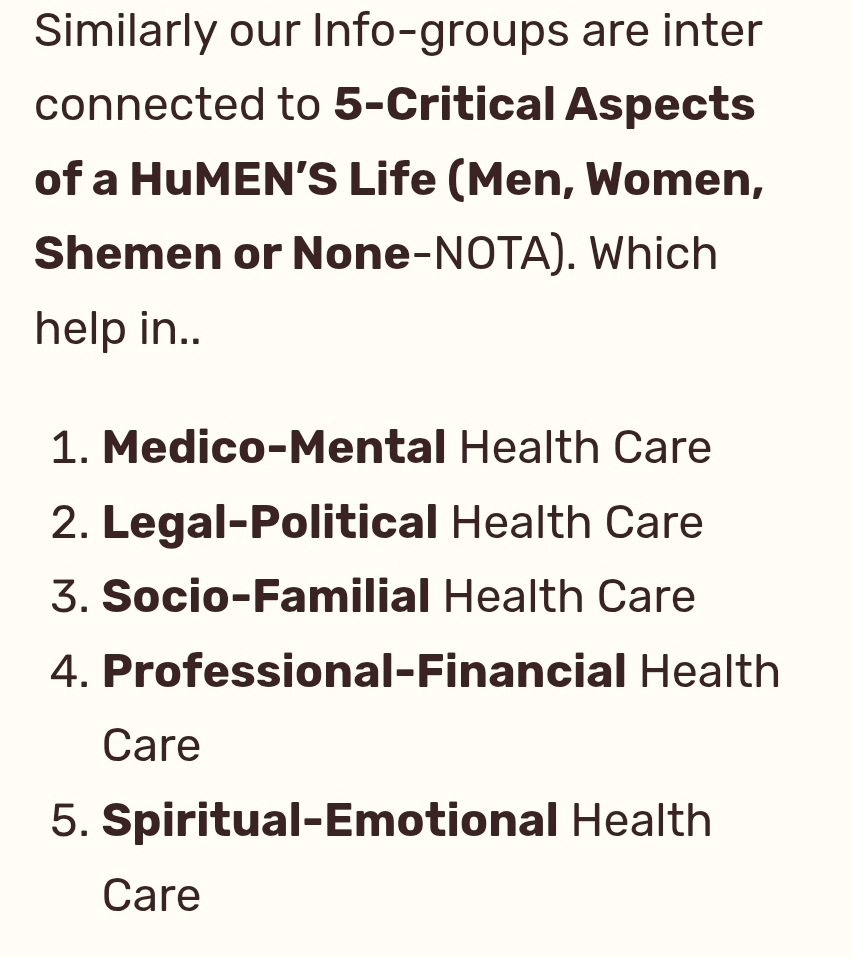
Similarly our Info-groups are inter connected to 5-Critical Aspects of a HuMEN’S Life (Men, Women, Shemen or None-NOTA). Which help in..
Medico-Mental Health Care
Legal-Political Health Care
Socio-Familial Health Care
Professional-Financial Health Care
Spiritual-Emotional Health Care
Medico-Mental: Be Physically & Mentally Fit.. Get right daily medicare for Mind and Body.. Consult Near Medical Professionals, Helplines & Websources on health. Here are some info resources on WA. Medical Care Group Arogya-Mitras: https://chat.whatsapp.com/5vxA8YuaUkLHIWHxkTB4Dd
2. Legal-Political Healthcare: Protect your legal identity and political integrity with good legal Helplines, legal professionals and political networks.
3. Socio-Familial Health Care. Reach out to your own communities of integrity & family or relatives. build the fortress of trust and social security. Integration Heals & Isolation Hurts.
4. Professional-Financial Health & Welfare. Become Educationally & professionally for and strong, maintain good congenial relations & reputation with your fellow graduates and alma mater, it really matters for your career & professional growth. Secure your Financials and Property & Money management.
Life is not all about Money as the Hyper-Capitalists project
nor about all about Power as the Hyper-Communists Project
nor about SuperBeing_God as the Religious Radicals Think.
Our Life is about Us-Humanity as Humanists Suggest.
Shift Focus from Personal-Money to Social-Harmony.. Follow and Practice a Spiritual path from any religion of your choice. Like Buddha Says Buddam, Dhamam, Sangham..
Connect to Higher EuPowers (Super & MasterSystems), Connect to Literatures or Scriptures (Knowledge-Wisdom) & Connect to Peergroups (Associates-Alliances).
Meditate to Medicare.
SAMAna-Mitras is an Indian National Group4 *Meditatively, Morally, Ethically & Spiritually, Evolving our Coll(rr)ective Indian_Consciousness2030.*
I see here are 3 – 4 Scenarios Mixed up where effect or appearance of skies is similar, but triggering actions & intent may be different..
Scene1 (most cases): The Jet trails are Naturally occuring due to flight movement & local Weather also plays a major role.. in cooler & more humid & lesser windy air conditions the Exhaust trails stay distinct & for long time near Airports or Near high Aeroplane or jet activities .. (Yes its a chemical too Co2 & H2O but not with other chemicals like in Scenario 2 & 3)
AND in dry & hotter & windy & sunny climatic conditions the Exhaust diffuses faster..
Scene2 (few cases) : Chemtrails for cloudseeding or real genuine open geo-scientific purposes as funded, sanctioned & intended by govt or R&D met dept for social, scientific and technological reasons.
Scene3 (rare cases): There are Controversial geo-engineering tech or hidden or forbidden or secretive defense sciences that are under trial run but need to be brought under trail if its harming deliberately or unknowingly, or negligently the innocent public.
Scene4 (Rarest of rareCases): Intentional War or Malicious Scenarios where the public or target population is been exposed to toxic chemicals intended to hurt the population.
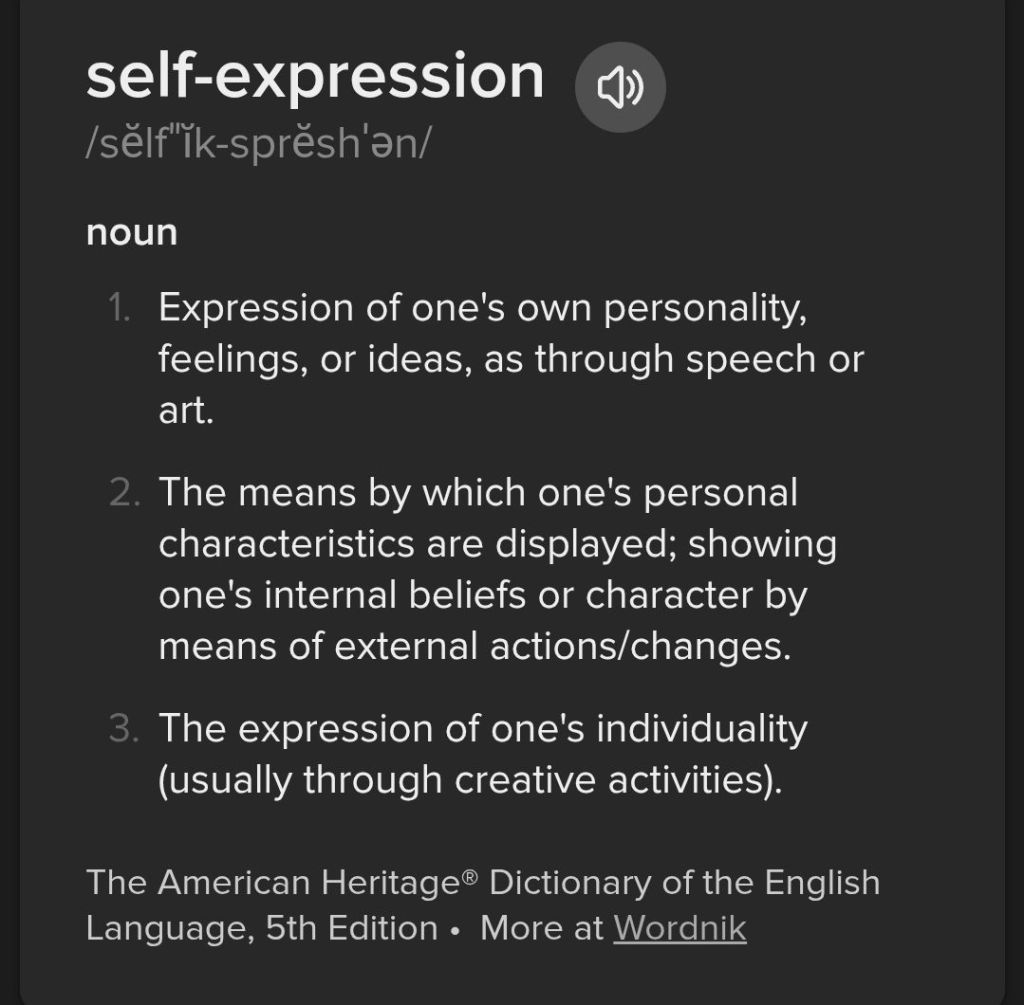
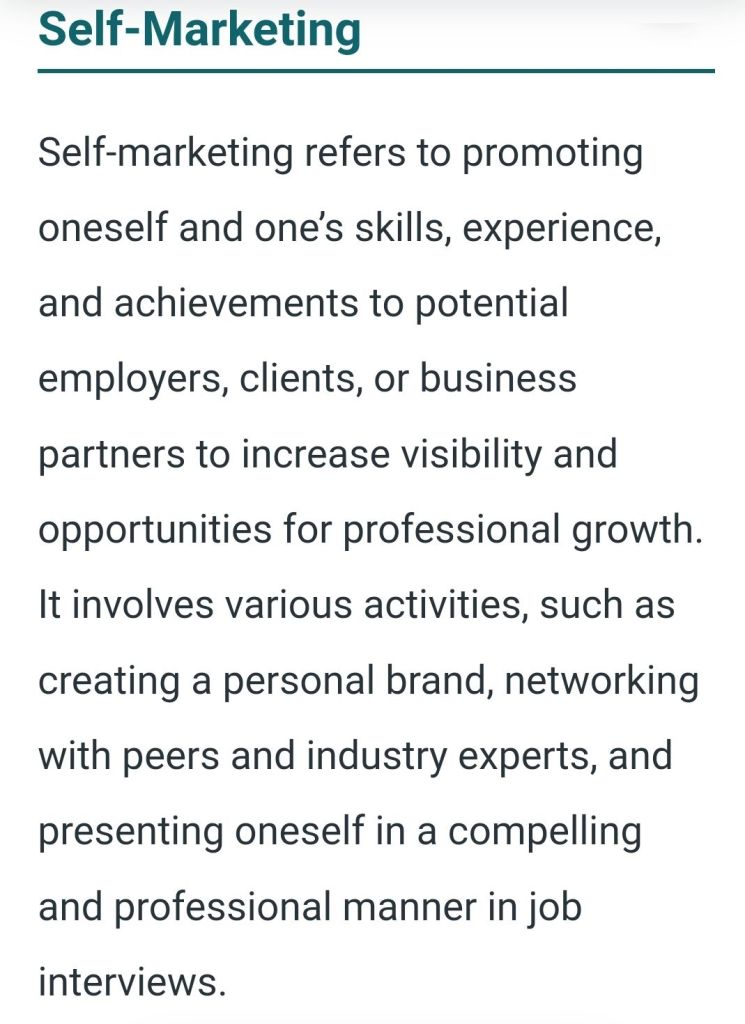
One is related to freedom of expression (Article 19(1)a of Co of India) & Other is related to Freedom of Practicing Profession, Trade or Marketing (Article 19(1)g).
One is for more Self & Social_Benefits & Other for more Personal & Professional_Profits.
If We dont know the difference then its hard to know which is which and we may assume interchangeably.
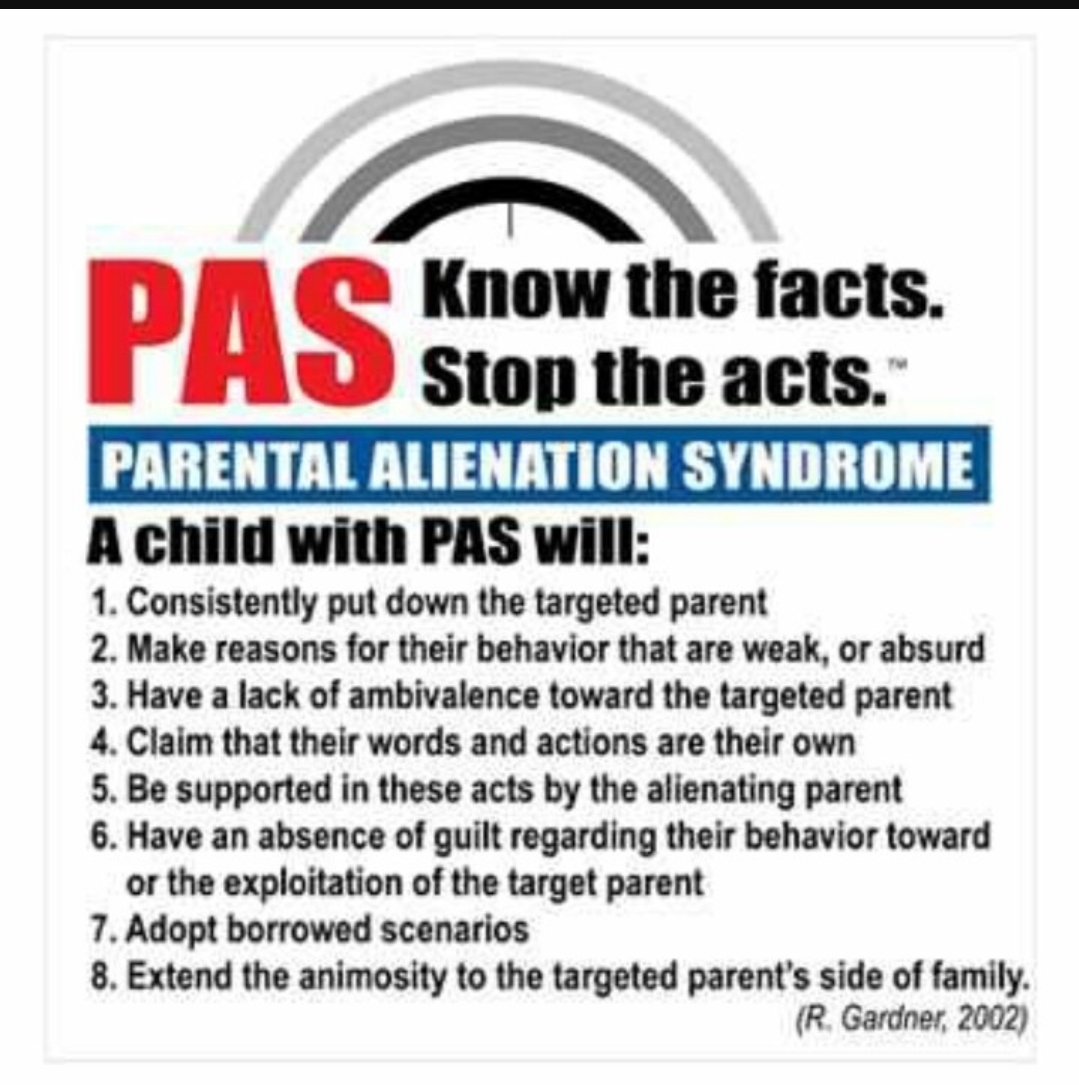
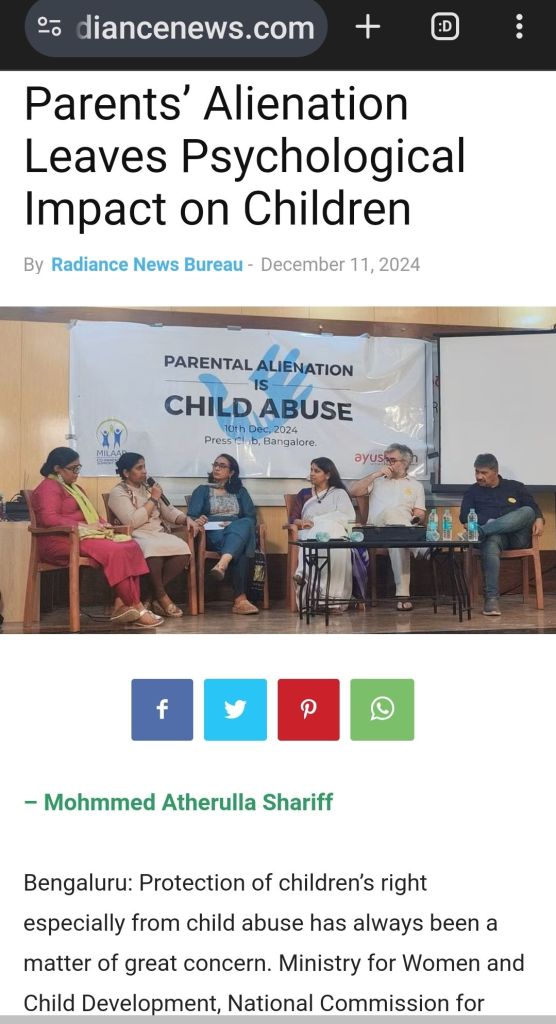
Indian Homes and Children are being subject to PAS.. Parental Alienation Syndrome. Link2Think.
Please do the PAS_test to check if Your home and child passes or Fails the PAS_test.
Questn: How to Know if a child/Spouse is having Parental Alienation (PA) and also if other side has been Parentally Alienating (Abnormal) or Parentally Integrating (Normal).
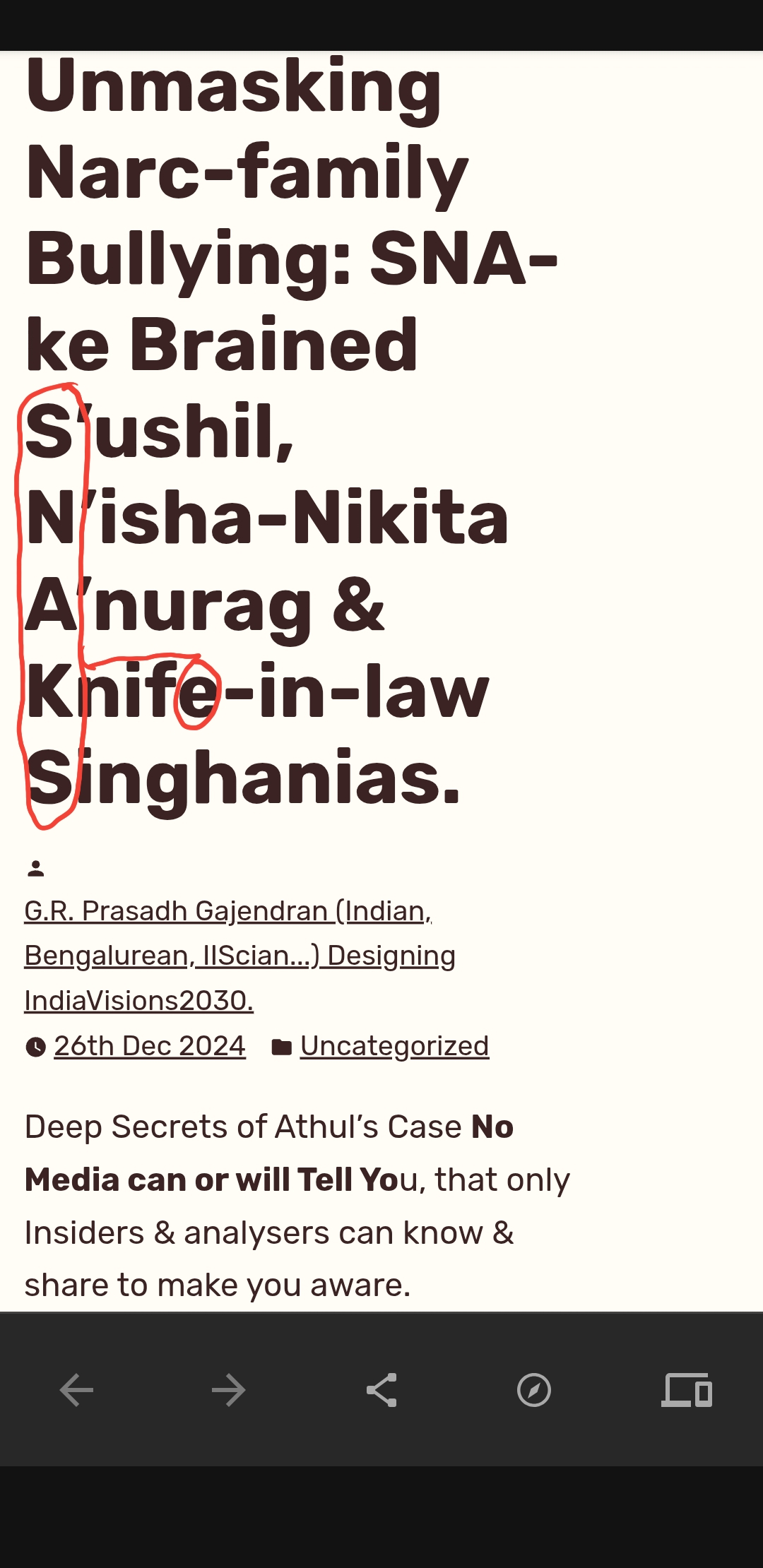
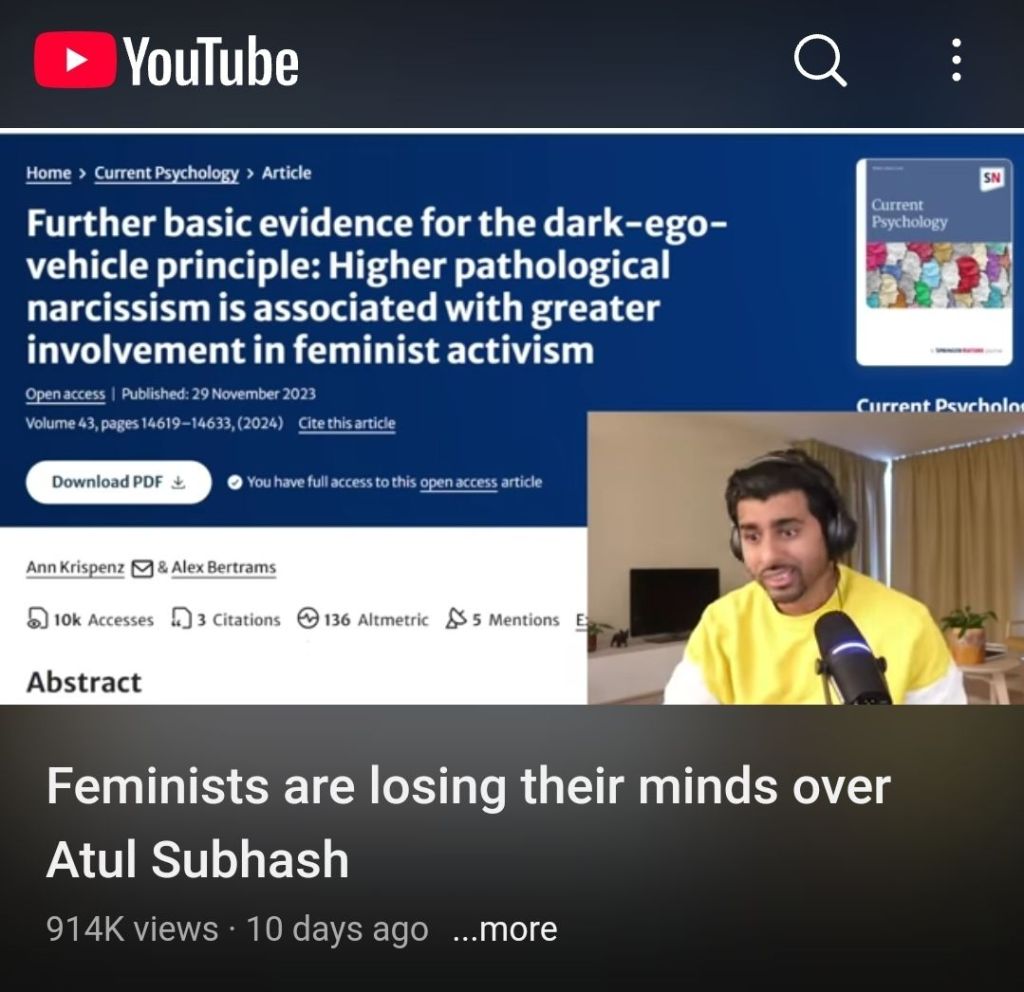
Deep Secrets of Athul’s Case No Media can or will Tell You, that only Insiders & analysers can know & share to make you aware.
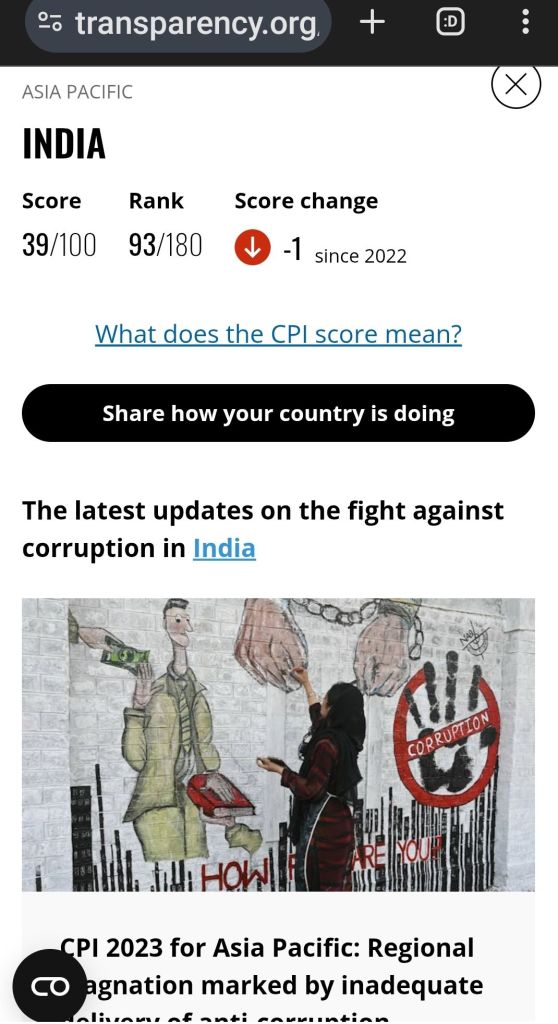
These 4+1 accused(Narc-Nexus) may or maynot be punished rationally or satisfactory by the delayed, mis-abled, corruptive-biased & outdated socio-medico-legal systems.
Even if they are jailed & hung (zero probability as Section 306 IPC max punishment is 10 years), the “narc-abuse of innocent trapped spouses, empathic inlaws & children of narcs” will continue in homes, neighbhorhoods & courts as these 5 morally poor humans are only the symptoms (Fruits) not the cause (Roots) of the rotteness in Indian Socio-Civic Systems.
Until We the people address the Roots of Issues of Risky Marriages & Relations, without holistic-resolutions there will be 1000 more Athuls or Athulyas who will be targets & victims of Narc-abuse with help of biased systems.
but the factors that enabled & empowered the marital-atrocity on Indian Man & also his child lies in psychology & sociology.
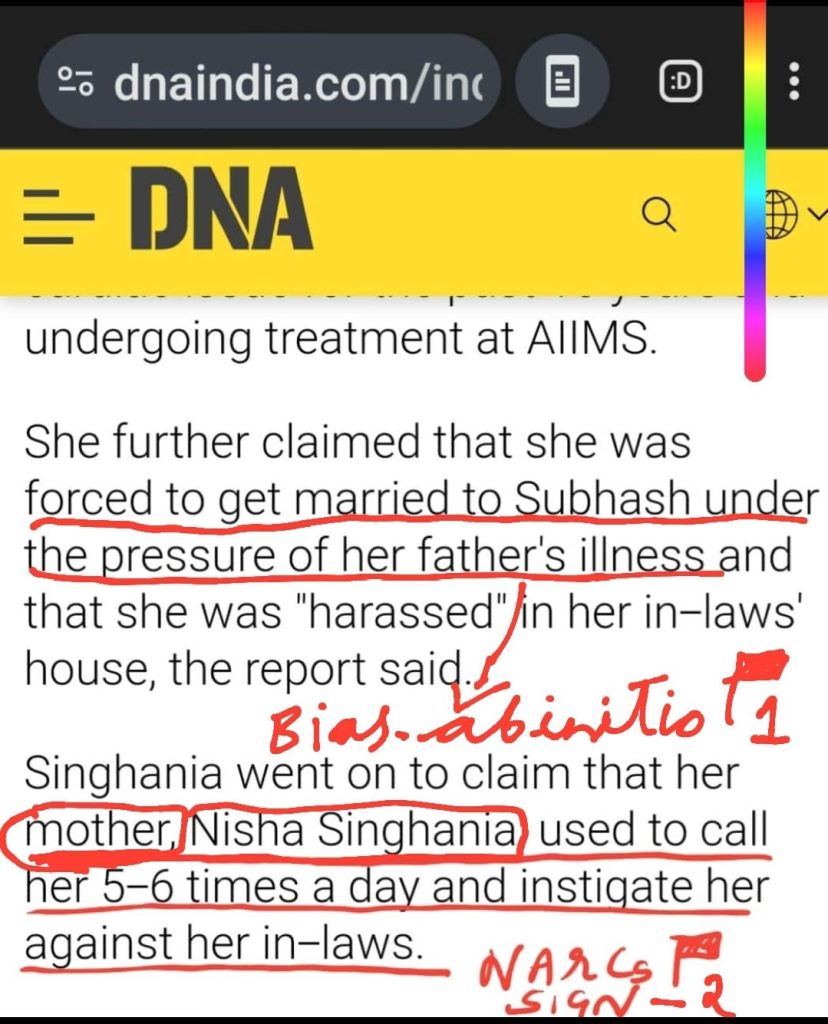
Nikhita-Nisha Singhania is classic Narc Mother-daughter Codependents.
Athul Died due to PostModern A.I & ML (Abusive Inlaws & Marital Legal-terrorism).. no more Indian Brother or sister shall die. That is Project Rakshabandhan..
Merry Christmas to all in group!!.. Its a celebration of hope from Jesus Christ the Son of God & in his Goodness who taught about new testament of love & Spiritual fellowship or warmth of brotherhood. and this is reflected in Sun of God too where day of December marks the celestial event where sun/son returns to north as it would stop its southern sojourn and return for spring and summer of Northern Hemisphere.
Bengaluru & Christmas have a Special connection. We have like Bengaluru Flower Show there is Bengaluru Cake Show, the Koshys Christmas Cake & the Christmas mass at churches.. I studied in a Bangalore convent and loved the celebrations, the christmas carols, decorated cribs, Christmas Trees & also Christy Gifts.
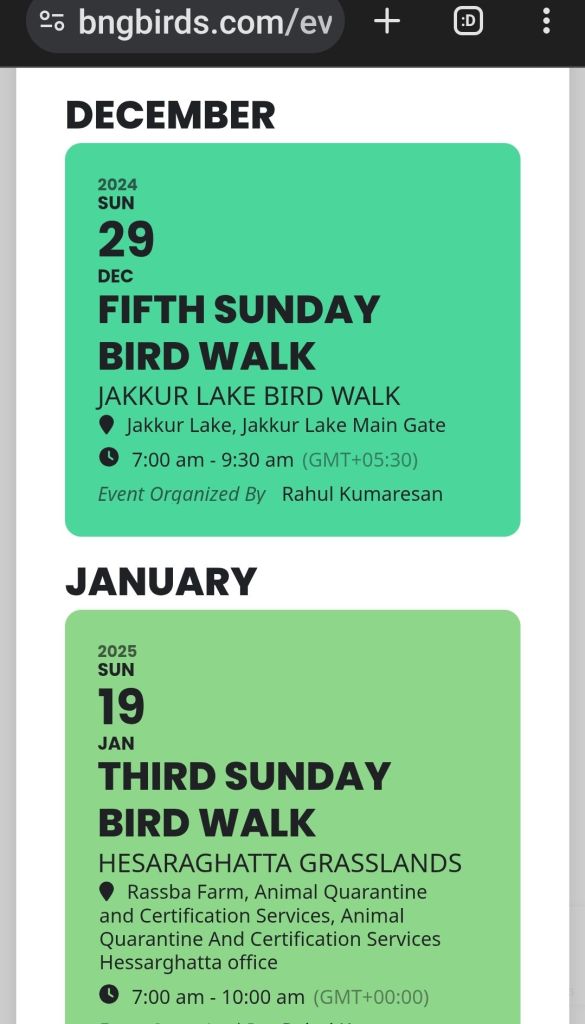
Below is a gift to the group & community.. This christmas gift is non-material but experiential in nature,..
you can take part in the gift of bangalore on Dec 29 2024..
Jesus & Socrates were Narcified & Crucified (40.CE) by the Ancient Narcs of Israel,
“Athul was Narcified & Courtified” by the modern Narcs (2024 BCE) of India.
Crucification involved nailing on Cross and bleeding to death.(4hours/person)
Courtification involves delaying on Cross-examinations and pleading to death. (8years/case).
History never stopped repeating since Jesus or Adams times.. There have been, are and will be Black-sheeps and Wolves in society. We need more Sheepdogs:Sheep Ratio to protect from the Narc-Wolves & their helpers the Black-Sheep.
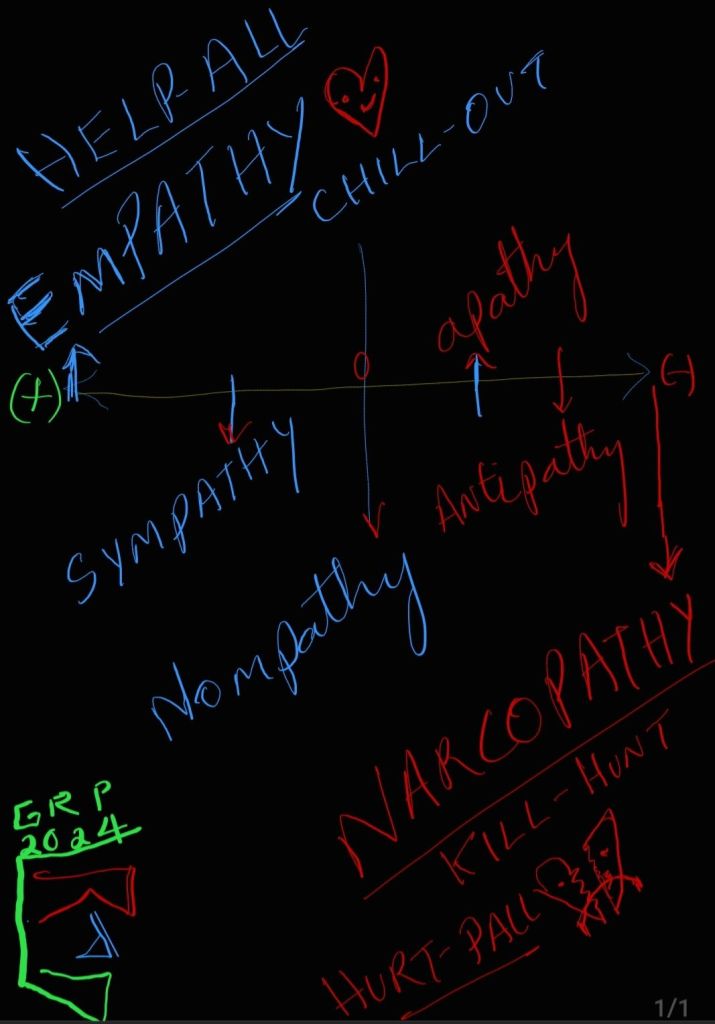
Explained: “How Narcs umbrella aids the Narc-Nexus to harm society”, the Narcs-Umberalla or Narcosphere have multiple candidates which are typed as Egopaths (Mild Narcissism), Sociopaths (Average Narcism), Psychopaths (Extremes) & Radical-narcs or Dark Empaths (Severe Sadistic Impact on targets, victims & society). one common Neural Network factor is low mirror neurons in the brain thus makes them lack empathy or sympathy for their targets/victim groups.
and their Polar opposites are the Empaths-umberalla with mild empaths(Normals), intuitive Empaths, Social-empaths & Radical-empaths.
Narcs seldom operate alone.. they need & form negative nexus with other narcs to target the Empaths.. this is identified as the “Narc-Nexus“. It may include alliance between Malignant-Narcs with Narc trained “Flying-Monkeys”(sheeple or mind-slaves) or Gaslighted and in the dark Narcs, Normals or even Unaware-Innocents or SemiAware_Ignorant Empaths.
best example of this is in an Indian case of Athul Subhash 2024 (an intellectual Empath) Honey Trapped by Mother-In law Nisha Singhania (A Dark Triad Narcopath) along with the help of her daughter Nikita Singhania and others in her Narc Family empire. Narc Nexus included the Corrupt Judge of Jaunpur Rita Kaushik. and in future will include Vyom Athul Modi Athul’s Biological son but the Singhania families enslaved child.
Premise.. If u have physical pain in your feet check where is the thorn or corn, & If u have emotional pain in ur mind check where are the Narc & Darks.
Similar Case of Jesus Christ. Where Innocent Empath-Jesus was framed, defamed & crucified by Narc-Nexus between the conspirators High Priests of Jew-temple, Judas Iscariot, Judge Pontius Pilot & Roman Soldiers.
Where Birds of Same Feather Flock together under the sun, also nearby there in the dark Predators & Scavengers of Same cLaws Sulk together. (Eg. Chicken, Doves, Hawks & Vultures).
Social Ideal Scenario 1: True-Litigators +Ethical Advocates + Uncorruptable Or Unbiased Judges + Rational Supportive Environments=Upholding Constitution & Serves Justice.
Social real scenario 2: Fake-litigators +Unethical Advocates +Corrupt Judges +Irrational Exploitative Environments = Frauding Constitution & Enables Injustices.
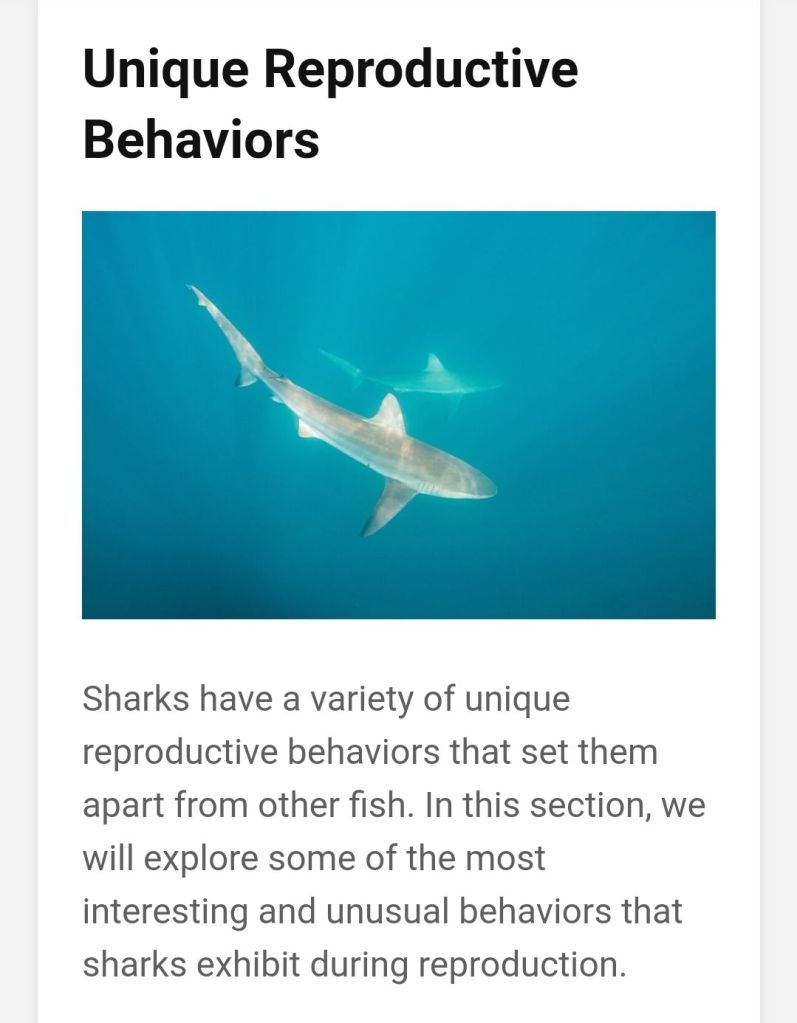
Similarly Narcs are Deviant Sharks,..
Narcs are either aided, Sided or impeded by Environments. Narc Thrive by Corrupting the systems by undue influence & taking undue advantages,
Atul Subhash Suicide : PIL In Supreme Court Seeks Reform Of Domestic Violence & Dowry Laws To Prevent Harassment Of Innocent Husbands
Athul was a Bahujan, he was Courtified by a Bania-Minded_Bahu/Saas system & a Baman-Minded_Judge system. so request Bahujans and general public to be careful to seek for moral compatibility during Bahujan or any Marriages..
there maybe Bahujan Bride or groom but with Supremacistic Bhraminical mindset too.. so intercaste or interfaith marriages are good to reduce castism as suggested by Ambedkar, but with some precautions as “moral compatibility” is to be checked before marriage. if unchecked Bahujan Spouses are vulnerable & at risk in any anti-bahujan families so plz take care..

 GRP_VCare2Dare