S756: Design Thinking for better Married Life.

Here’s a rewritten version that incorporates insights from behavioral sciences, sociology, and other relevant subjects:

Empathize

  1. Practice active listening: Employ the principles of active listening, such as maintaining eye contact, nodding, and paraphrasing, to ensure you understand your wife’s perspective (Wachtel, 2011).
  2. Recognize emotional contagion: Be aware that emotions are contagious, and make a conscious effort to manage your own emotions to create a positive emotional climate in your relationship (Hatfield, Cacioppo, & Rapson, 1993).
  3. Understand attachment styles: Familiarize yourself with adult attachment theory and recognize your and your wife’s attachment styles to better navigate conflicts and emotional needs (Bowlby, 1969).

Define

  1. Identify power dynamics: Acknowledge the power dynamics at play in your relationship and strive for a more balanced distribution of power to foster a healthier partnership (Komter, 1989).
  2. Recognize the impact of social norms: Be aware of how social norms, such as gender roles and expectations, can influence your relationship and make a conscious effort to challenge and redefine these norms (Cialdini & Goldstein, 2004).
  3. Establish a shared understanding of relationship goals: Collaborate with your wife to define shared relationship goals, values, and expectations to ensure you’re both working towards a common vision (Markman, Renick, Floyd, Stanley, & Clements, 1993).

Ideate

  1. Leverage the power of positive reinforcement: Use positive reinforcement techniques, such as expressing gratitude and appreciation, to encourage desired behaviors and strengthen your bond (Skinner, 1953).
  2. Foster a growth mindset: Cultivate a growth mindset in your relationship by embracing challenges, learning from failures, and viewing conflicts as opportunities for growth (Dweck, 2006).
  3. Design for rituals and traditions: Create meaningful rituals and traditions in your relationship, such as regular date nights or annual vacations, to foster a sense of connection and shared identity (Goffman, 1959).

Prototype

  1. Test and refine conflict resolution strategies: Develop and test different conflict resolution strategies, such as active listening and compromise, to find what works best for your relationship (Gilliland & Dunn, 2003).
  2. Experiment with emotional intimacy: Engage in activities that promote emotional intimacy, such as vulnerability exercises and empathy-building practices, to deepen your connection (Gilliland & Dunn, 2003).
  3. Pilot relationship maintenance strategies: Implement and refine relationship maintenance strategies, such as regular check-ins and surprise gifts, to keep your relationship fresh and exciting (Dindia & Canary, 1993).

Test

  1. Evaluate relationship satisfaction: Regularly assess your relationship satisfaction using validated measures, such as the Relationship Assessment Scale (RAS), to identify areas for improvement (Hendrick, 1988).
  2. Conduct relationship audits: Perform regular relationship audits to identify and address potential issues before they escalate (Markman et al., 1993).
  3. Foster a culture of feedback: Encourage open and honest feedback in your relationship, using techniques like “I” statements and non-defensive listening, to promote growth and improvement (Gilliland & Dunn, 2003).

By incorporating insights from behavioral sciences, sociology, and other relevant subjects, you can:

  • Develop a more nuanced understanding of your wife’s needs and behaviors
  • Foster a more empathetic and supportive relationship climate
  • Cultivate a growth mindset and design for rituals and traditions
  • Test and refine conflict resolution strategies and relationship maintenance techniques
  • Evaluate relationship satisfaction and conduct regular relationship audits

Remember, relationships are complex systems that require ongoing effort and attention. By embracing a data-driven and empathetic approach, you can create a more fulfilling and resilient married life.

References:

Bowlby, J. (1969). Attachment and Loss: Vol. 1. Attachment. New York: Basic Books.

Cialdini, R. B., & Goldstein, N. J. (2004). Social influence: Compliance and conformity. Annual Review of Psychology, 55, 591-621.

Dindia, K., & Canary, D. J. (1993). Definitions and conceptualizations of maintenance and repair strategies. In D. J. Canary & K. Dindia (Eds.), Sex differences in interactions: A multidisciplinary approach (pp. 237-258). Hillsdale, NJ: Erlbaum.

Dweck, C. S. (2006). Mindset: The new psychology of success. Random House.

Gilliland, S. E., & Dunn, J. (2003). Social influence and social change: A psycho-social perspective. Journal of Social Issues, 59(3), 647-665.

Goffman, E. (1959).

What a unique and intriguing question! While Design Thinking is typically applied to product design, service innovation, and business challenges, its principles can indeed be adapted to improve personal relationships, including marriage. Here’s how Design Thinking can be applied to foster a better-designed married life:

Empathize

  1. Understand your partner’s needs: Put yourself in your wife’s shoes. Listen actively to her thoughts, feelings, and desires. Identify her pain points, aspirations, and values.
  2. Observe and learn: Pay attention to your wife’s behavior, habits, and preferences. Learn from her love language, conflict resolution style, and communication patterns.

Define

  1. Define the problem statement: Based on your empathy and observations, articulate specific challenges or areas for improvement in your married life. For example, “How might we improve our communication during conflicts?” or “How might we prioritize quality time together?”
  2. Establish shared goals: Collaborate with your wife to define shared objectives, values, and vision for your married life.

Ideate

  1. Generate ideas: Brainstorm innovative solutions to address the defined problems. Consider unconventional approaches, and don’t worry about their feasibility at this stage. For example, “What if we schedule regular ‘us’ time?” or “What if we create a shared hobby?”
  2. Encourage wild ideas: Foster a culture of creativity and experimentation. Encourage your wife to share her wildest ideas, and build upon each other’s suggestions.

Prototype

  1. Test and experiment: Select a few promising ideas and create prototypes or test scenarios. For instance, try scheduling a weekly date night or take a cooking class together.
  2. Refine and iterate: Based on the results, refine your approach, and make adjustments as needed.

Test

  1. Evaluate and learn: Assess the effectiveness of your prototypes and gather feedback from your wife. Identify what works, what doesn’t, and why.
  2. Continuously improve: Embed a culture of continuous learning and improvement in your married life. Regularly reflect on your experiences, and make data-driven decisions to enhance your relationship.

By applying Design Thinking principles, you can:

  • Develop a deeper understanding of your wife’s needs and desires
  • Foster a culture of empathy, creativity, and experimentation
  • Collaborate on innovative solutions to strengthen your relationship
  • Continuously learn and improve together

Remember, Design Thinking is a mindset, not a one-time process. By embracing this approach, you can cultivate a more empathetic, creative, and fulfilling married life.
S754: Sacred Languages & Divinity of Languages?

The Sacred and the Divine: Exploring the Realm of Religious Languages

Languages have long been a cornerstone of human civilization, facilitating communication, expression, and connection. However, certain languages have transcended their mundane role, ascending to a realm of sacredness and divinity. These languages, imbued with spiritual significance, have become an integral part of various religious traditions, shaping the beliefs, practices, and identities of millions.

What are Sacred Languages?

Sacred languages are those that are considered sacred or spiritually significant by a particular religious tradition. These languages are often associated with sacred texts, rituals, and ceremonies, and are believed to possess a unique spiritual power or authority. Examples of sacred languages include Sanskrit in Hinduism, Arabic in Islam, Latin in Roman Catholicism, and Hebrew in Judaism.

Characteristics of Sacred Languages

Sacred languages often exhibit certain characteristics that distinguish them from other languages. These may include:

  • Ancient origins: Sacred languages often have ancient roots, with some dating back thousands of years.
  • Liturgical use: Sacred languages are frequently used in liturgical contexts, such as prayers, rituals, and ceremonies.
  • Scriptural significance: Sacred languages are often associated with sacred texts, such as the Vedas in Hinduism or the Quran in Islam.
  • Spiritual authority: Sacred languages are believed to possess a unique spiritual authority, conveying divine truths and messages.

Examples of Sacred Languages

Sanskrit (Hinduism)

Sanskrit is considered a sacred language in Hinduism, with a rich literary and spiritual heritage. The Vedas, Upanishads, and other Hindu scriptures are written in Sanskrit.

Arabic (Islam)

Arabic is the sacred language of Islam, with the Quran being written in Arabic. Arabic is considered a symbol of Islamic tradition and culture.

Latin (Roman Catholicism)

Latin was considered a sacred language in the Roman Catholic Church, particularly during the Middle Ages. Although its use has declined, Latin is still used in some Catholic rituals and ceremonies.

Hebrew (Judaism)

Hebrew is considered a sacred language in Judaism, with the Hebrew Bible being written in Hebrew. Hebrew is still used in Jewish prayers and rituals.

Tamizh (Shaivism and Tamil Hinduism)

Tamizh (Tamil) is considered a sacred language by some Shaivite and Tamil Hindu traditions. The Tamil language has a rich literary and spiritual heritage, with many ancient texts, including the Tirukkural and the Tevaram, being considered sacred.

The Divinity of Languages

The concept of sacred languages raises questions about the nature of language itself. Can languages be considered divine? Do they possess a unique spiritual power?

In many religious traditions, languages are believed to be a gift from the divine, a means of communicating with the sacred. The sounds, words, and grammar of sacred languages are often considered to be imbued with spiritual significance, conveying divine truths and messages.

Conclusion

Sacred languages play a vital role in various religious traditions, shaping the beliefs, practices, and identities of millions. These languages, imbued with spiritual significance, possess a unique power and authority, conveying divine truths and messages.

As we explore the realm of sacred languages, we are reminded of the profound impact of language on human culture and spirituality. Whether considered divine or merely sacred, languages have the power to inspire, to uplift, and to connect us with something greater than ourselves.

Sacred Languages

Sacred languages are languages that are considered sacred or spiritually significant in various religious traditions. Here are some examples:

1. Sanskrit (Hinduism, Buddhism, Jainism)

Sanskrit is considered a sacred language in Hinduism, Buddhism, and Jainism. It is the language of many Hindu scriptures, including the Vedas and the Upanishads.

2. Arabic (Islam)

Arabic is considered a sacred language in Islam. The Quran, the holy book of Islam, is written in Arabic, and the language is considered a symbol of Islamic tradition and culture.

3. Latin (Roman Catholicism)

Latin was considered a sacred language in the Roman Catholic Church, particularly during the Middle Ages. Although its use has declined, Latin is still used in some Catholic rituals and ceremonies.

4. Hebrew (Judaism)

Hebrew is considered a sacred language in Judaism. It is the language of the Hebrew Bible and is still used in Jewish prayers and rituals.

5. Pali (Theravada Buddhism)

Pali is considered a sacred language in Theravada Buddhism. It is the language of the Pali Canon, which is the earliest surviving Buddhist scripture.

6. Avestan (Zoroastrianism)

Avestan is considered a sacred language in Zoroastrianism. It is the language of the Avesta, which is the sacred scripture of Zoroastrianism.

7. Ge’ez (Ethiopian Orthodox Church)

Ge’ez is considered a sacred language in the Ethiopian Orthodox Church. It is the language of many Ethiopian Orthodox scriptures and is still used in some Ethiopian Orthodox rituals and ceremonies.

8. Tamizh (Shaivism and Tamil Hinduism)

Tamizh (Tamil) is considered a sacred language by some Shaivite and Tamil Hindu traditions. The Tamil language has a rich literary and spiritual heritage, with many ancient texts, including the Tirukkural and the Tevaram, being considered sacred.

These languages are considered sacred because of their association with sacred texts, rituals, and traditions.

S753: Hub Of Tri-Sciences.

#MahaVigyanMela.. Science Open Days

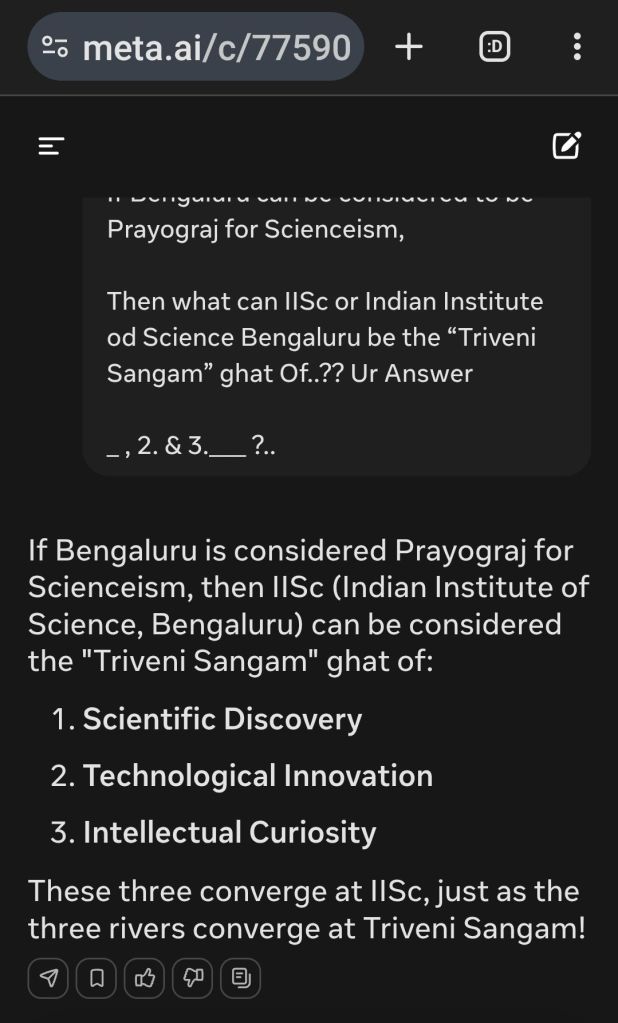
Like How Jewrusalem is 4Jews, Vatican 4Christianity, Mecca 4Islam, Moscow4Marxism & Beijing4Maoism, BodhGaya 4Buddhism & Prayagraj is 4Hinduism,

If Bengaluru can be considered to be Prayograj for Scienceism,

Then what can IISc be the “Triveni Sangam” ghat Of..?? Ur Answer

  1. ____ , 2.___ & 3.____ ?..

GDQ_India is First & Largest PAN-Indian GDs, Quiz_Clubs & Cultures WA Community.

Connect2Quizify_Group’s Link2Think:
https://chat.whatsapp.com/Kf35RypYddp9U3eWUZh2ph

Context is the Question

S752: Whats missing in India? Multilevel Accountability 

Here’s a possible equation:

Journalism + Judicialist + Junta Activists + Public = Accountability

Breaking down the equation:

  • Journalism: Investigative reporting, fact-finding, and truth-telling.
  • Judicialist: The judiciary’s role in upholding the law, ensuring justice, and providing checks and balances.
  • Junta Activists: Grassroots movements, advocacy groups, and citizen-led initiatives pushing for change.
  • Public: The collective voice, opinions, and engagement of citizens.

Together, these elements can create a powerful force for accountability:

  • Journalists investigate and expose wrongdoing.
  • The judiciary provides a framework for justice and accountability.
  • Activists mobilize public opinion and push for change.
  • The public demands transparency, justice, and accountability from those in power.

When these elements come together, they can create a robust system of accountability, ensuring that power is held in check and that justice is served.

S751: 4M Triveni Sangam at IISc.. Material+ Management +Medical Sciences +Moral Sciences.

Here are some equations representing the intersection of various sciences:

Medical Science

Prevention + Cure = Health: Highlights the importance of preventive measures and effective treatment in achieving overall health.

Research + Practice = Advancement: Emphasizes the need for continuous research and practical application to drive medical progress.

Material Science

Structure + Properties = Functionality: Illustrates the relationship between a material’s structure, properties, and its ability to perform specific functions.

Innovation + Application = Progress: Highlights the importance of innovative materials and their practical applications in driving technological advancements.

Moral Sciences

Values + Principles = Ethics: Emphasizes the role of core values and guiding principles in shaping moral ethics.

Empathy + Reason = Wisdom: Highlights the importance of balancing emotional intelligence (empathy) with rational thinking (reason) in making wise decisions.

Management Sciences

Strategy + Execution = Success: Illustrates the importance of both strategic planning and effective execution in achieving organizational success.

Leadership + Teamwork = Performance: Highlights the interplay between effective leadership and collaborative teamwork in driving organizational performance.

Interdisciplinary Equations

Medical Science + Material Science = Medical Devices: Represents the intersection of medical and material sciences in developing innovative medical devices.

Moral Sciences + Management Sciences = Ethical Leadership: Highlights the importance of integrating moral principles with management practices to foster ethical leadership.

Material Science + Management Sciences = Supply Chain Optimization: Represents the intersection of material science and management sciences in optimizing supply chain operations.

S750: Ikigai Equationized. by GRP+A.I

Ikigai is a Japanese concept that roughly translates to “reason for being” or “purpose in life.” Here’s an equation representing the concept of Ikigai:

Ikigai = (Passion + Mission) ∩ (Vocation + Profession)

Breaking down the equation:

  • Passion: What you love doing, your hobbies, and interests.
  • Mission: Your purpose, what you want to achieve, and the impact you want to make.
  • Vocation: Your calling, what you’re meant to do, and your natural talents.
  • Profession: Your career, what you’re paid to do, and your area of expertise.

The intersection of these four elements represents your Ikigai, your reason for being, and your purpose in life.

Here’s another way to represent the concept of Ikigai:

Ikigai = What You Are Good At + What You Love Doing + What the World Needs + What You Can Be Paid For

This equation highlights the importance of finding a balance between your skills, passions, contributions to society, and financial sustainability.

May these equations inspire you to discover your Ikigai and live a fulfilling, purpose-driven life!

S749: Best equations for Science, Architecture, Design, Law, Humanity & Life.

Here are some thought-provoking equations for various disciplines:

Science

  1. Observation + Experimentation = Discovery: Highlights the scientific method’s role in uncovering new knowledge.
  2. Theory + Evidence = Truth: Emphasizes the importance of evidence-based reasoning in scientific inquiry.

Architecture

  1. Form + Function = Structure: Illustrates the balance between aesthetic and practical considerations in building design.
  2. Space + Light = Experience: Highlights the impact of spatial design and lighting on human experience.

Design

  1. Creativity + Constraints = Innovation: Emphasizes the role of limitations in driving innovative design solutions.
  2. User + Context = Solution: Highlights the importance of understanding user needs and context in design.

Law

  1. Justice + Mercy = Fairness: Illustrates the balance between upholding the law and showing compassion.
  2. Rights + Responsibilities = Citizenship: Emphasizes the importance of understanding individual rights and civic responsibilities.

Humanity

  1. Empathy + Compassion = Connection: Highlights the importance of emotional understanding and kindness in building human relationships.
  2. Diversity + Inclusion = Strength: Emphasizes the value of embracing diversity and promoting inclusivity.

Life

  1. Purpose + Passion = Fulfillment: Illustrates the importance of aligning one’s actions with their values and passions.
  2. Resilience + Adaptation = Growth: Highlights the role of coping with challenges and adapting to change in personal growth.

These equations represent the core principles, values, and relationships that underlie each discipline.

S748: Purushartha & ChaturAshrama Matrix.. LifeGoals & Life Stages Matrix. /GRP+A.I.

Here are some equations representing the 4 ashramas or life stages:

Brahmacharya (Student Life, Birth-25 years)

Curiosity + Discipline = Knowledge: Emphasizes the importance of curiosity and discipline in acquiring knowledge.

Innocence + Exploration = Growth: Highlights the value of innocence and exploration in childhood development.

Grihastha (Householder Life, 25-50 years)

Responsibility + Love = Family: Emphasizes the importance of responsibility and love in building strong family relationships.

Career + Financial Security = Stability: Highlights the value of career growth and financial security in achieving stability.

Vanaprastha (Retired Life, 50-75 years)

Reflection + Wisdom = Mentorship: Emphasizes the importance of reflection and wisdom in sharing life experiences with others.

Simplification + Detachment = Liberation: Highlights the value of simplifying life and detaching from worldly possessions.

Sannyasa (Renunciate Life, 75+ years)

Spiritual Pursuit + Self-Realization = Enlightenment: Emphasizes the importance of spiritual pursuit and self-realization in achieving enlightenment.

Acceptance + Surrender = Peace: Highlights the value of acceptance and surrender in finding peace and contentment.

These equations represent the various life stages and ashramas, highlighting the key values, principles, and pursuits associated with each stage.


Here’s a mapping of the four Purusharthas (aims of human life) with the four Ashramas (stages of life), along with a brief description of each combination:

Gyana-Artha Brahmacharya (Student Life, 0-25 years)

  • Gyana (Knowledge): Acquisition of knowledge, skills, and wisdom
  • Artha (Wealth): Building a strong foundation for future financial stability
  • Brahmacharya: Focus on education, self-discipline, and character development

During this stage, individuals focus on acquiring knowledge, skills, and wisdom, while also building a strong foundation for future financial stability. This combination lays the groundwork for a successful and fulfilling life.

Kama-Grihastha (Householder Life, 25-50 years)

  • Kama (Desires): Enjoying life’s pleasures, nurturing relationships, and pursuing creative interests
  • Grihastha: Building a career, raising a family, and contributing to society

In this stage, individuals focus on enjoying life’s pleasures, building meaningful relationships, and pursuing their passions. They also take on responsibilities, build their careers, and contribute to society.

Dharma-Vanaprastha (Retired Life, 50-75 years)

  • Dharma (Righteous Living): Living a virtuous life, following moral principles, and fulfilling one’s duties
  • Vanaprastha: Focus on spiritual growth, mentoring, and giving back to the community

During this stage, individuals focus on living a virtuous life, following moral principles, and fulfilling their duties. They also focus on spiritual growth, mentoring, and giving back to the community.

Moksha-Sanyasa (Renunciate Life, 75+ years)

  • Moksha (Liberation): Seeking spiritual growth, self-awareness, and ultimate liberation
  • Sanyasa: Dedication to spiritual pursuits, self-reflection, and preparing for the final journey

In this final stage, individuals focus on seeking spiritual growth, self-awareness, and ultimate liberation. They dedicate themselves to spiritual pursuits, self-reflection, and preparing for the final journey.

These combinations provide a framework for understanding the different stages of life and the corresponding focus areas for each stage.

Purushartha & ChaturAshrama Matrix: A Guide to Life’s Purpose and Stages

In ancient Indian philosophy, the concept of Purushartha (life’s purpose) and ChaturAshrama (four stages of life) provide a framework for understanding and navigating life’s journey. This article explores the intersection of these two concepts, offering insights into achieving a fulfilling and purpose-driven life.

Purushartha: The Four Aims of Human Life

Purushartha represents the four fundamental objectives of human existence:

  1. Dharma (Righteous Living): Living a virtuous life, following moral principles, and fulfilling one’s duties.
  2. Artha (Wealth and Prosperity): Pursuing economic stability, acquiring knowledge, and cultivating skills.
  3. Kama (Desires and Pleasure): Enjoying life’s pleasures, nurturing relationships, and pursuing creative interests.
  4. Moksha (Liberation and Self-Realization): Seeking spiritual growth, self-awareness, and ultimate liberation.

ChaturAshrama: The Four Stages of Life

ChaturAshrama divides life into four distinct stages:

  1. Brahmacharya (Student Life, 0-25 years): Focus on education, self-discipline, and character development.
  2. Grihastha (Householder Life, 25-50 years): Emphasis on building a career, raising a family, and contributing to society.
  3. Vanaprastha (Retired Life, 50-75 years): Focus on spiritual growth, mentoring, and giving back to the community.
  4. Sannyasa (Renunciate Life, 75+ years): Dedication to spiritual pursuits, self-reflection, and preparing for the final journey.

The Purushartha & ChaturAshrama Matrix

By intersecting the four aims of Purushartha with the four stages of ChaturAshrama, we create a matrix that provides guidance on navigating life’s journey:Brahmacharya (0-25)Grihastha (25-50)Vanaprastha (50-75)Sannyasa (75+)DharmaEducation, self-disciplineCareer, family, social dutiesMentoring, community serviceSpiritual pursuits, self-reflectionArthaAcquiring knowledge, skillsCareer growth, financial stabilitySharing expertise, mentoringSimplifying life, detachmentKamaExploring interests, relationshipsBuilding relationships, enjoying lifeNurturing relationships, hobbiesAccepting life’s limitations, surrenderMokshaSpiritual exploration, self-awarenessBalancing material and spiritual pursuitsFocusing on spiritual growth, self-realizationPreparing for the final journey, liberation

LifeGoals Table

Life StagePrimary GoalsBrahmacharyaEducation, self-discipline, character developmentGrihasthaCareer growth, family, social duties, financial stabilityVanaprasthaSpiritual growth, mentoring, community service, simplifying lifeSannyasaSpiritual pursuits, self-reflection, acceptance, surrender

Life Stages Table

Life StageAge RangeKey FocusBrahmacharya0-25Education, self-developmentGrihastha25-50Career, family, social responsibilitiesVanaprastha50-75Spiritual growth, mentoring, community serviceSannyasa75+Spiritual pursuits, self-reflection, acceptance

By understanding and applying the principles of Purushartha and ChaturAshrama, individuals can:

  • Clarify their life’s purpose and goals
  • Navigate life’s stages with intention and direction
  • Balance material and spiritual pursuits
  • Cultivate a sense of fulfillment and purpose

Embark on this journey of self-discovery and exploration, and may the wisdom of Purushartha and ChaturAshrama guide you toward a life of purpose, happiness, and liberation.

https://meta.ai/s/9iqkLo3SRfogpzjT/

S747: Legal, Political & Civic-Social Equations.

Here are some examples of critical equations, classified into Legal, Political, and Civic:

Legal Equations

  1. Intent + Action = Liability: Highlights the importance of understanding intent in legal proceedings.
  2. Precedent + Context = Jurisprudence: Emphasizes the role of precedent and context in shaping legal decisions.
  3. Evidence + Procedure = Justice: Illustrates the importance of proper procedure and evidence in achieving justice.
  4. Rights + Responsibilities = Citizenship: Examines the relationship between individual rights and civic responsibilities.

Political Equations

  1. Power + Corruption = Tyranny: Warns against the dangers of unchecked power and corruption.
  2. Ideology + Pragmatism = Policy: Highlights the tension between ideological purity and practical considerations in policymaking.
  3. Representation + Accountability = Democracy: Emphasizes the importance of representative government and accountability to the people.
  4. National Interest + Global Cooperation = Diplomacy: Examines the balance between pursuing national interests and cooperating with other nations.

Civic Equations

  1. Engagement + Education = Empowerment: Highlights the importance of civic engagement and education in empowering citizens.
  2. Diversity + Inclusion = Community: Emphasizes the value of diversity and inclusion in building strong, cohesive communities.
  3. Activism + Advocacy = Change: Illustrates the role of activism and advocacy in driving social and political change.
  4. Responsibility + Participation = Citizenship: Examines the relationship between individual responsibility and active participation in civic life.

S746: Equations: Scientific, Humanic & Divinic. GRP+A.I

Old Biases + New Assumptions = Future…?

Old Biases + New Assumptions = Future Limitations

Let’s break it down:

  • Old Biases: Pre-existing prejudices and misconceptions that can influence our thoughts and decisions.
  • New Assumptions: Fresh perspectives and hypotheses that might seem innovative but can also perpetuate or even amplify existing biases.

When you combine old biases with new assumptions, you may unintentionally create:

  • Future Limitations: Restrictive and narrow-minded approaches that can hinder progress, innovation, and inclusivity.

To overcome this, it’s essential to:

  1. Recognize and challenge existing biases
  2. Critically evaluate new assumptions
  3. Foster diverse perspectives and inclusive thinking

By doing so, we can strive for a more equitable and innovative future.

What a fascinating classification system!

Based on the equation:

Old Biases + New Assumptions = Future Limitations

I would categorize it as a Humanic Equation.

Here’s why:

  • Scientific Equations typically involve empirical variables, mathematical operations, and predictable outcomes, often in the realm of natural sciences.
  • Divinic Equations might imply a spiritual, mystical, or philosophical context, exploring the mysteries of existence, morality, or the human condition.
  • Humanic Equations, on the other hand, focus on the complexities of human nature, behavior, and interactions. They often involve psychological, social, and cultural factors, as seen in the given equation.

The equation highlights how human biases and assumptions can shape our future, making it a thought-provoking example of a Humanic Equation.

Here are some more examples of critical equations, classified into Scientific, Humanic, and Divinic:

Scientific Equations

Data + Algorithms = Insights: Highlights the importance of data-driven decision-making.

Renewable Energy + Efficiency = Sustainability: Emphasizes the need for sustainable practices.

Genes + Environment = Traits: Illustrates the interplay between genetic and environmental factors.

Humanic Equations

Privilege + Ignorance = Oppression: Sheds light on the consequences of unchecked privilege.

Empathy + Active Listening = Understanding: Highlights the importance of effective communication.

Fear + Uncertainty = Xenophobia: Examines the roots of intolerance and prejudice.

Power + Accountability = Justice: Emphasizes the need for responsible leadership.

Divinic Equations

Faith + Doubt = Spiritual Growth: Explores the complexities of spiritual exploration.

Compassion + Self-Awareness = Enlightenment: Offers insights into the nature of personal awakening.

Free Will + Destiny = Karma: Ponders the interplay between choice and consequence.

These equations encourage critical thinking, self-reflection, and nuanced exploration of complex issues.

Design a site like this with WordPress.com
Get started