For Humanism, Indians, Bengalureans & IIScians: We Grow Resourceful Purpose_SpAces: Collaborate with Mitrallys wanting to know, Grow & Help Futureones Grow.
Imagine ur a home owner both you Neighbhours having an Alliance against you India?
This is what is leading to a Propogandic Marriage of Islamists & Communists to counter and bully the good guys in the neighbhourhood.
The term “Chinakistan” is a provocative label used by some to describe the strategic alliance between China and Pakistan, often framed as a concerted effort to counter India’s regional influence. This article will explore the dynamics of this alliance, casting China as the primary geopolitical force (the “Top Villain”), Pakistan as its strategic partner (the “Sidekick”), and India as the democratic counterweight (the “Good Guy”). While the narrative of a villainous duo attacking a virtuous leader is rhetorically charged, I’ll ground the analysis in historical, geopolitical, and ideological realities, critically examining the motivations, actions, and implications of this triangular relationship. The article will avoid sensationalism, focusing on evidence-based insights while addressing the user’s framing.
Chinakistan and the Geopolitical Triangle: China, Pakistan, and India
Introduction
The term “Chinakistan” encapsulates the deep strategic partnership between Maoist-leaning China and Islamist-influenced Pakistan, often perceived as a deliberate axis to undermine democratic, Hindu-secular India. This narrative paints China as the mastermind, leveraging its economic and military might, with Pakistan as its agile partner, using asymmetric tactics like terrorism and border provocations. India, positioned as a pluralistic democracy with a Hindu-majority ethos, is depicted as the resilient defender of regional stability. While this framing risks oversimplification, the China-Pakistan-India triangle is undeniably a critical geopolitical fault line in South Asia, shaped by history, ideology, and power dynamics.
The Top Villain: Maoist-China’s Strategic Calculus
China, under the Chinese Communist Party (CCP), operates as a global superpower with a vision of regional dominance and global influence. Its “Maoist” legacy—centralized control, ideological rigidity, and anti-Western sentiment—shapes its foreign policy, though modern China blends this with pragmatic capitalism. Against India, China pursues a multi-pronged strategy:
Geopolitical Containment: Since the 1962 Sino-Indian War, China has viewed India as a potential rival in Asia. By bolstering Pakistan, China ensures India remains preoccupied with its western neighbor, diverting resources from competing with Beijing. The China-Pakistan Economic Corridor (CPEC), a $50 billion project under the Belt and Road Initiative, secures China’s access to the Arabian Sea via Pakistan’s Gwadar Port, encircling India strategically.
Military Support: China is Pakistan’s largest arms supplier, accounting for 61% of its arms imports, including J-10C fighter jets used in recent clashes with India (May 2025). This strengthens Pakistan’s military capabilities, enabling it to challenge India’s superior conventional forces.
Diplomatic Cover: China shields Pakistan at the United Nations, vetoing resolutions to designate Pakistan-based terrorists like Masood Azhar as global terrorists until 2019, when international pressure forced a shift. This emboldens Pakistan’s use of proxy groups against India.
China’s actions are driven by a desire to counter India’s growing ties with the U.S., Japan, and Australia (via the Quad) and to secure its western Muslim-majority provinces like Xinjiang, where Pakistan’s Islamic credentials provide soft power. However, China’s support is not unconditional—Beijing avoids direct military involvement in India-Pakistan conflicts, prioritizing economic ties with India ($100 billion in trade annually) and regional stability.
The Sidekick: Islamist-Pakistan’s Asymmetric Warfare
Pakistan, with its military-dominated polity and Islamist undercurrents, acts as China’s regional proxy, leveraging its geographic proximity and historical enmity with India. Its role in the “Chinakistan” axis includes:
Proxy Terrorism: Pakistan has long been accused of supporting militant groups like Jaish-e-Mohammad (JeM) and Lashkar-e-Taiba (LeT), responsible for attacks like the 2019 Pulwama bombing (40 Indian soldiers killed) and the 2025 Pahalgam attack (26 civilians killed). These acts destabilize India’s Kashmir region, fueling domestic unrest and international scrutiny.
Military Provocations: Pakistan’s use of Chinese-supplied J-10C jets to down Indian aircraft in May 2025, as reported by Reuters, escalates tensions, testing India’s military resolve. Pakistan’s nuclear arsenal, developed with Chinese assistance, adds a layer of deterrence, emboldening its aggressive posture.
Narrative Warfare: Pakistan frames India as an oppressor in Kashmir, rallying domestic and Islamic world support. This aligns with China’s interest in portraying India as a regional hegemon, countering its democratic credentials.
Pakistan’s motivations are rooted in its identity as an Islamic state, its obsession with Kashmir, and its need for a powerful ally like China to offset India’s conventional superiority and U.S. tilt toward New Delhi. However, Pakistan’s reliance on China comes at a cost—economic dependence (CPEC debts) and occasional friction, as seen in 2023 when Pakistan refused Chinese naval access to Gwadar.
The Good Guy: Democratic-HinduSecular India’s Resilience
India, as a vibrant democracy with a Hindu-majority yet secular constitution, positions itself as a stabilizing force in South Asia. Its response to the “Chinakistan” challenge is multifaceted:
Military Countermeasures: India has modernized its arsenal, acquiring Rafale jets from France and reducing reliance on Russian arms. Operations like “Sindoor” (May 2025) targeted militant sites in Pakistan, signaling a proactive stance. India’s BrahMos missile, developed with Russia, is a key deterrent.
Diplomatic Outreach: India counters China’s influence through the Quad and strengthens ties with the U.S., which has shifted military support from Pakistan to India. India’s global narrative emphasizes its democratic values and Pakistan’s terrorism sponsorship, gaining traction post-Pahalgam.
Domestic Cohesion: Despite provocations, India maintains a secular framework, integrating its Muslim minority (14% of the population) and countering narratives of Hindu nationalism that “Chinakistan” exploits. Leaders like Omar Abdullah in Kashmir emphasize unity against terrorism.
India’s challenges include managing internal polarization, balancing economic ties with China, and avoiding escalation with two nuclear-armed neighbors. Its commitment to restraint, as seen in the U.S.-brokered ceasefire (May 2025), reflects strategic maturity.
The Geopolitical Chessboard: A Critical View
The “Chinakistan” narrative, while compelling, oversimplifies a complex reality. China’s support for Pakistan is strategic, not ideological—Beijing distances itself from Pakistan’s Islamist agenda, focusing on countering India and securing economic routes. Pakistan’s actions, while aggressive, stem from insecurity and domestic pressures, not just Chinese directives. India, though democratic, faces criticism for its Kashmir policies, which Pakistan exploits but China approaches cautiously.
Recent events, like the Pahalgam attack and subsequent clashes, highlight the triangle’s volatility. China’s defense stocks surged after Pakistan’s use of J-10C jets, signaling economic stakes in conflict. Yet, Beijing’s calls for restraint and mediation reflect its preference for stability over war, given its trade interests with India and regional security concerns (e.g., Xinjiang).
Conclusion
The “Chinakistan” axis—China as the calculating strategist and Pakistan as the tactical provocateur—poses a significant challenge to India’s democratic and secular vision. India’s resilience lies in its military modernization, diplomatic agility, and domestic unity. However, the narrative of a villainous duo versus a heroic India risks fueling divisive rhetoric. A nuanced approach—engaging China economically, isolating Pakistan diplomatically, and strengthening India’s global standing—offers the best path to counter this geopolitical challenge. The triangle’s future hinges on whether China prioritizes regional stability over strategic rivalry, and whether India can navigate this chessboard without compromising its democratic ethos.
Summary and Notes
This article provides a balanced analysis of the China-Pakistan-India dynamic, using the user’s framing of “Top Villain,” “Sidekick,” and “Good Guy” while grounding it in factual data from recent events (e.g., May 2025 clashes, Pahalgam attack). It avoids endorsing the sensational “Chinakistan” label outright, instead dissecting the strategic motivations and limitations of each player. Key sources include Reuters, South China Morning Post, and Wikipedia for geopolitical context, ensuring credibility.
For further reading, explore primary sources like foreign ministry statements or think tank reports (e.g., Council on Foreign Relations). To critically assess the “CommunIslamists Nexus” from your prior query, cross-reference local political dynamics in Kerala and West Bengal with global trends, as ideological alliances are often overstated.
The root Ideology behind This group wont be found in any party manifesto..
its found in INDIAS manifesto the Constitution..
Article 51.A our Fundamental Duties.
Yada Yada TRAUMAsya… GYANir Bhavathi BHARATA… Whenever there is Trauma & Drama.. When India is into Ignorance unWISe.. the Citizens have to takeup mission to WISEN ELECTORS.. https://chat.whatsapp.com/BncvQbsX6hl7AyzvV7Ye3A
WE the Voters of India.. Unite4 *Voter-Mitras.* Voter-allys.
Motto: *WisenVoters to Improve Polity*
Welcome to *Wisen-Electors Group*: for Political Info_Sharing Group *WE_grp4Democracy* “Ai.VA= All-India Voters Association” 4Smart-Votering;
*Group Description:* EveryCitizen’sWelfare. *Observation_Deck* for Geo-Politics. WE Group Serves to make Able & improved Quality of Citizens/Voter-Patriots.
Join *VIN (Voters India Network)* for Rational Voters in a Better_India.
*Shared_Group-Vision: Democratic2030*
*GrpPurpose:* 2Empower_Citizenry, Rationality+ Responsiblty =Civility. Better Ethical_Politics. NyayaHitavad-Rajneethi. *Mission_Citizens’India2030*. WE-Grp Ddctd2 *Citizen-Mitras* & Patriots. Unbiased Political analysis and Synthesis Group.
Let’s analyze the Indo-Pak conflict by expanding the scope to include China and the U.S. as key players, focusing on the “wolfing” (profiteering) dynamics at the intersection of three nations/regions (India, Pakistan, China) and their ideological/religious frameworks: Non-Abrahamic (India as a Secular-Hindu nation), Islamic (Pakistan), Communist (China, pseudo-secular), and Christian-majority nations (U.S., UK, Canada). We’ll use the “2 Dogs and a Wolf” allegory as a foundation, integrate game theory to model the interactions, and propose resolutions to mitigate the wolves’ profiteering while fostering cooperation.
Framing the Conflict: Players, Ideologies, and Wolfing
Players and Ideologies
India (Non-Abrahamic, Secular-Hindu): A secular democracy with a Hindu majority, India seeks to maintain control over Kashmir, counter terrorism, and assert regional dominance while navigating its secular identity amidst Hindu nationalist currents.
Pakistan (Islamic): An Islamic republic, Pakistan contests India’s control over Kashmir, often framing the conflict as a religious struggle (Muslim-majority Kashmir vs. Hindu-majority India), and relies on Islamic ideology to rally domestic and regional support.
China (Communist, Pseudo-Secular): A communist state with a pseudo-secular stance (officially atheist but culturally influenced by Confucianism/Buddhism), China supports Pakistan via the China-Pakistan Economic Corridor (CPEC) and uses the conflict to counter India’s rise, aligning with its geopolitical goal of regional dominance.
U.S./Western Bloc (Christian-Majority, Secular): The U.S., UK, and Canada, as Christian-majority nations with secular governance, balance relations with India (a democratic ally) and Pakistan (a partner in counterterrorism), often prioritizing strategic interests over ideological alignment.
The “Wolfing” Dynamic
The “2 Dogs and a Wolf” allegory now expands to multiple wolves: China, the U.S./Western bloc, and financial institutions like the IMF profit from the conflict between India and Pakistan (the “dogs”) by exploiting their rivalry over Kashmir (the “bone”). The intersection of ideologies/religions adds complexity, as each player leverages ideological narratives to justify actions, while the wolves benefit from the resulting instability.
Intersections of Nations/Regions and Ideologies
Geopolitical Intersections:
India-Pakistan-China Triangle: India and Pakistan’s conflict over Kashmir intersects with China’s involvement via its border disputes with India (e.g., Aksai Chin) and support for Pakistan (CPEC). China benefits from a distracted India, weakening its regional rival.
U.S./Western Involvement: The U.S. engages both India (to counter China) and Pakistan (for counterterrorism), creating a quadrilateral dynamic where Western interests intersect with South Asian conflicts.
Ideological/Religious Intersections:
Non-Abrahamic vs. Islamic: India’s secular-Hindu identity clashes with Pakistan’s Islamic framing of the Kashmir issue, fueling religious tensions that wolves exploit (e.g., by supplying arms to both).
Communist vs. Democratic: China’s communist system contrasts with India’s democracy, while its pseudo-secular stance avoids religious framing, focusing on strategic gains.
Christian-Majority vs. Others: The U.S./Western bloc, while secular, is perceived as a Christian-majority entity, and its actions (e.g., IMF loans, arms sales) are often interpreted through a lens of Western dominance, adding an ideological layer to the conflict.
Game-Theoretic Payoff Matrix: Four Players
To model this complex dynamic, we’ll simplify the game by focusing on India and Pakistan as the primary players (the “dogs”), with China and the U.S./Western bloc as wolves whose payoffs increase with conflict. We’ll use a two-player matrix for India and Pakistan, with a separate column for the combined payoff of the wolves (China + U.S./Western bloc). Payoffs reflect security, economic, and ideological gains/losses, adjusted for wolfing dynamics.
India and Pakistan Payoffs: Same as before, reflecting security, economic costs, and domestic support. Cooperation yields mutual benefits (8, 8), while defection leads to a stalemate (2, 2) or short-term gains for one at the other’s expense (10, 0 or 0, 10).
Wolves’ Payoff (China + U.S./Western Bloc):
Both Cooperate (2): When India and Pakistan cooperate, the wolves’ payoff is low because peace reduces dependency on arms, loans, and geopolitical leverage.
One Cooperates, One Defects (10): Tensions provide opportunities for wolves—e.g., China supports Pakistan (CPEC), the U.S. sells arms to India, and the IMF lends to Pakistan.
Both Defect (15): Maximum wolf payoff occurs when conflict peaks (e.g., ceasefire violations, militancy). China gains by weakening India, the U.S./Western bloc profits from arms sales and strategic influence, and the IMF benefits from loan interest.
Nash Equilibrium
The Nash Equilibrium remains (Defect, Defect), as India and Pakistan are incentivized to defect due to distrust and short-term gains (e.g., Pakistan’s militancy boosts domestic support, India’s military presence asserts control). The wolves’ high payoff (15) in this scenario reinforces their interest in perpetuating conflict.
How Wolves Profit at Ideological/Religious Intersections
The wolves exploit the ideological and religious differences between India (Non-Abrahamic/Secular-Hindu), Pakistan (Islamic), China (Communist/Pseudo-Secular), and the U.S./Western bloc (Christian-majority/Secular) to maximize their gains:
1. China (Communist/Pseudo-Secular)
Geopolitical Gains: China uses the Indo-Pak conflict to weaken India, its main regional rival. By supporting Pakistan through CPEC and military aid, China ensures India remains distracted, unable to challenge China’s dominance (e.g., in the South China Sea or along the LAC).
Ideological Exploitation: China’s pseudo-secular stance avoids religious framing, but it leverages Pakistan’s Islamic identity to rally anti-India sentiment, indirectly fueling the conflict.
Economic Profiteering: CPEC projects (e.g., infrastructure in Pakistan) secure China’s access to the Arabian Sea, while the conflict ensures Pakistan’s dependency on Chinese support, benefiting China economically and strategically.
2. U.S./Western Bloc (Christian-Majority/Secular)
Arms Sales: The U.S. supplies arms to India (e.g., $3 billion drone deal in 2024) and Pakistan (e.g., F-16 upgrades), profiting from the arms race. The UK and Canada, as NATO allies, also benefit from defense contracts.
Geopolitical Leverage: The U.S. uses the conflict to maintain influence—allying with India to counter China, while keeping Pakistan as a counterterrorism partner (e.g., post-9/11 cooperation). This dual engagement ensures the U.S. remains a key player in South Asia.
Ideological Framing: The U.S./Western bloc frames its involvement as promoting democracy (India) or countering extremism (Pakistan), but its actions (e.g., IMF loans) often exacerbate tensions, aligning with the wolf’s profiteering role.
3. IMF (Western-Influenced Financial Institution)
Loan Profiteering: The IMF, influenced by Western nations, provides loans to Pakistan (e.g., $1.3 billion under consideration in May 2025), earning interest while deepening Pakistan’s dependency. X posts suggest these funds may fuel military actions (e.g., tanks at Liaquatpur), escalating the conflict.
Ideological Exploitation: The IMF operates under a Western secular framework but indirectly exploits the Islamic vs. Non-Abrahamic divide by funding Pakistan, knowing it will prioritize military spending over development, thus perpetuating the conflict.
4. Ideological/Religious Intersections as a Catalyst
Non-Abrahamic vs. Islamic: Pakistan frames Kashmir as a religious struggle, rallying Islamic support (e.g., from OIC nations), while India’s secular-Hindu identity fuels domestic narratives of protecting national integrity. Wolves exploit this divide by supplying arms or funds, knowing ideological tensions will sustain conflict.
Communist vs. Democratic: China’s support for Pakistan aligns with its goal of countering democratic India, while the U.S. backs India to contain China. This ideological clash ensures the conflict remains a proxy battleground, benefiting wolves.
Christian-Majority vs. Others: The U.S./Western bloc’s involvement is perceived as Western dominance, adding a layer of resentment that wolves exploit to justify their actions (e.g., “countering extremism” narratives).
Wiser Resolutions: Mitigating Wolfing at Intersections
To reduce the wolves’ profiteering and improve the situation, India and Pakistan must cooperate, while addressing the ideological/religious intersections that fuel conflict. Here’s how game theory and the allegory guide resolutions:
1. Shift the Payoff Matrix: Reduce Wolves’ Incentive
Disincentivize Conflict:
IMF Reform: India and Pakistan should jointly demand IMF conditions that prioritize development over military spending (e.g., redirecting funds to education in Pakistan). This lowers the wolves’ payoff for (Defect, Defect) (e.g., from 15 to 5).
Arms Control: A UN resolution limiting arms sales to conflict zones (enforced by neutral parties) reduces the U.S. and China’s payoff for perpetuating conflict.
Incentivize Cooperation:
Regional Blocs: India and Pakistan can form a South Asian coalition (e.g., via SAARC) to negotiate with China and the U.S., raising their payoffs for (Cooperate, Cooperate) (e.g., to 10, 10, 0) through trade benefits.
2. Bridge Ideological/Religious Divides
Non-Abrahamic vs. Islamic:
Interfaith Dialogue: India and Pakistan can promote interfaith initiatives in Kashmir (e.g., joint Hindu-Muslim community projects), reducing religious polarization and the wolves’ ability to exploit it.
Secular Focus: India should emphasize its secular identity in Kashmir (e.g., by ensuring equal rights), while Pakistan reduces its Islamic framing, focusing on humanitarian issues (e.g., Kashmiri welfare).
Communist vs. Democratic:
Trilateral Talks: India, Pakistan, and China can hold talks to address border issues (e.g., LAC, CPEC), reducing China’s incentive to fuel Indo-Pak tensions.
Economic Integration: A trilateral trade agreement (e.g., energy corridors) aligns China’s payoff with regional stability, not conflict.
Christian-Majority vs. Others:
Neutral Mediation: Involve non-Western mediators (e.g., ASEAN nations) to reduce perceptions of Western dominance, lowering ideological tensions.
Transparency: Demand transparency in U.S./IMF actions (e.g., loan conditions), ensuring they don’t exacerbate conflict.
3. Bilateral Cooperation: Starve the Wolves
CBMs Across Ideologies: India and Pakistan can start with small cooperative actions—e.g., cultural exchanges (Hindu-Muslim festivals), trade resumption, and joint disaster response. This raises their payoffs for cooperation, while reducing the wolves’ opportunities (e.g., arms sales decline).
Kashmiri Empowerment: Granting Kashmiris autonomy and economic opportunities (e.g., tourism development) reduces the “bone’s” value, making ideological clashes less central and wolfing less profitable.
4. Counter Wolfing Through Regional Unity
South Asian Solidarity: India and Pakistan can lead a unified South Asian front to negotiate with China and the U.S., reducing dependency on wolves. For example, a joint stance on IMF loans ensures funds benefit development, not conflict.
Diversify Alliances: Both nations can engage with neutral players (e.g., Russia, Japan) to dilute China and U.S. influence, weakening the wolves’ leverage.
5. Reframe the Narrative: From Ideology to Coexistence
Human-Centric Focus: Shift public narratives from ideological/religious divides (e.g., Hindu vs. Muslim, Communist vs. Democratic) to shared human goals—e.g., economic growth, climate action. This reduces the wolves’ ability to exploit divisions.
Expose Wolfing: Public campaigns highlighting how wolves profit (e.g., IMF debt traps, arms sales) can rally domestic support for cooperation, making (Cooperate, Cooperate) politically viable.
Interpretation: Wolves Thrive on Ideological Divides, But Cooperation Starves Them
The Indo-Pak conflict, at the intersection of India (Non-Abrahamic/Secular-Hindu), Pakistan (Islamic), China (Communist/Pseudo-Secular), and the U.S./Western bloc (Christian-majority/Secular), creates a fertile ground for wolfing. China, the U.S., and the IMF profit by exploiting ideological/religious divides—fueling conflict through arms sales, loans, and geopolitical maneuvers. The game-theoretic matrix shows that wolves maximize their payoff (15) when India and Pakistan defect, perpetuating a stalemate that benefits the wolves at the expense of the region.
However, wiser resolutions can mitigate this:
Few Solutions Exist: The conflict’s complexity, exacerbated by ideological intersections, makes a definitive solution unlikely, as the wolves thrive on division.
Wiser Resolutions Bridge Divides: By addressing ideological tensions (e.g., interfaith dialogue, trilateral talks), shifting payoffs (e.g., IMF conditions, arms control), and fostering cooperation (e.g., CBMs, regional unity), India and Pakistan can reduce the wolves’ influence.
Coexistence Over Victory: Reframing the narrative from ideological rivalry to shared goals starves the wolves, allowing the region to focus on coexistence and mutual benefit.
By uniting against the wolves and prioritizing cooperation over ideological divides, India, Pakistan, and their neighbors can weaken the profiteers, fostering a more stable and prosperous South Asia. If you’d like a more detailed matrix with all four players, let me know!
Kashmir on Face is a Conflict of 2 Nations but in Deeper Reality its a front of 3 Civilizational-Ideologies ((Religions (Anti-Secular), Secularism & Communism (Anti-Secular)).
India, Pakistan, China & US, and seeing as conflict of Non-Abrahamic (Secular-Induus nation), Abro-Islamic Nations, Communist Nations (Psuedo-Secular as its Anti-religions) & Abro-Christian Majority nations (US,UK, Canada…Etc) & Abro-Judaic(Israel).
Let’s analyze the Indo-Pak conflict, focusing on the role of the IMF and other third parties as potential “wolves” (funding actors) in the context of the “2 Dogs and a Wolf” story from the provided link. The story serves as an allegory where two dogs (representing India and Pakistan) fight over a bone (Kashmir), while a wolf (third parties like the IMF) benefits from their conflict by taking the bone. We’ll tie this to the game-theoretic framework already established, explore how the IMF and other actors might be “profiteering” from the conflict, and propose resolutions to mitigate this dynamic.
The Allegory: “2 Dogs and a Wolf” in the Indo-Pak Context
The story “2 Dogs and a Wolf,” as referenced, illustrates two dogs fighting over a bone, too distracted to notice a wolf that ultimately benefits by taking the bone for itself. In the Indo-Pak context:
Two Dogs: India and Pakistan, locked in a prolonged conflict over Kashmir since 1947, marked by wars, terrorism, and recent ceasefire violations.
The Bone: The Kashmir issue, a territorial and ideological dispute fueling animosity.
The Wolf: The IMF and other third parties (e.g., global powers like the U.S. and China, arms suppliers, or financial institutions), which may exploit the conflict for their own gain.
The allegory suggests that while India and Pakistan focus on their rivalry, third parties benefit—potentially through financial, geopolitical, or strategic gains—leaving the two nations weakened.
Game-Theoretic Payoff Matrix: Incorporating the Wolf
Let’s revisit the payoff matrix from the previous discussion, now explicitly including the “wolf” (IMF and third parties) as a player whose payoff increases when India and Pakistan remain in conflict. We’ll model this as a three-player game, but for simplicity, we’ll first adjust the two-player matrix (India vs. Pakistan) to reflect the wolf’s influence, then discuss the wolf’s role separately.
Updated Payoff Matrix (India vs. Pakistan, with Wolf’s Influence)
The original matrix showed India and Pakistan’s strategies (Cooperate or Defect) and their payoffs. Now, we’ll adjust the payoffs to account for the wolf’s profiteering when conflict persists. The wolf’s gain (e.g., financial or geopolitical) is higher when both defect, as their conflict creates opportunities for the wolf to exploit. Payoffs are (India, Pakistan, Wolf).India \ PakistanCooperateDefectCooperate (8, 8, 2) (0, 10, 8) Defect (10, 0, 8) (2, 2, 10)
Payoff Adjustments and Explanation
Wolf’s Payoff: The wolf (IMF/third parties) gains the most when both India and Pakistan defect (conflict persists), as this creates opportunities for profiteering (e.g., loans, arms sales, geopolitical leverage). Payoff = 10 in (Defect, Defect). The wolf’s payoff decreases to 2 when both cooperate, as peace reduces the wolf’s opportunities.
Both Cooperate (8, 8, 2): India and Pakistan gain from peace (security, economic savings), but the wolf’s payoff drops because a stable region reduces dependency on loans or external intervention.
One Cooperates, One Defects (0, 10, 8) or (10, 0, 8): The defecting player gains a short-term advantage, but the wolf still benefits (payoff = 8) from the ongoing tension, as it can lend to the disadvantaged player or exploit the instability.
Both Defect (2, 2, 10): The current stalemate—ceasefire violations, militancy, and distrust—hurts both India and Pakistan, but the wolf maximizes its payoff (10) by fueling the conflict through financial mechanisms (e.g., IMF loans to Pakistan) or geopolitical maneuvers.
Nash Equilibrium and the Wolf’s Role
The Nash Equilibrium remains (Defect, Defect) for India and Pakistan, as neither can unilaterally improve their payoff by cooperating, given the other’s defection. However, the wolf’s high payoff in this scenario (10) incentivizes it to perpetuate the conflict. For example:
IMF Funding: Posts on X indicate Pakistan recently sought a $1.3 billion IMF loan (April 2025), with India opposing it, fearing the funds might fuel Pakistan’s military actions (e.g., tanks at Liaquatpur station, as noted in X posts). The IMF benefits by charging interest on loans, while Pakistan’s dependency on external funding deepens, keeping it in conflict with India.
Arms Sales: Third parties (e.g., the U.S., China) supply arms to both nations—Pakistan through direct support, India through defense deals—profiting from the arms race while the conflict persists.
How the Wolf (IMF and Third Parties) Profits from the Conflict
The allegory’s wolf benefits by exploiting the dogs’ distraction. In the Indo-Pak context, the IMF and other third parties profit in several ways:
1. IMF Profiteering Through Loans
Pakistan’s Dependency: Pakistan’s economic struggles make it reliant on IMF loans (e.g., the $1.3 billion loan under consideration on May 9, 2025). The IMF profits through interest payments, but these loans often come with conditions that limit Pakistan’s autonomy, creating a cycle of dependency.
Conflict Fuel: X posts suggest that Pakistan uses IMF funds to sustain military activities (e.g., fueling tanks and jets), escalating tensions with India. This benefits the IMF by ensuring Pakistan remains a client, as conflict prevents economic self-sufficiency.
India’s Response: India’s opposition to IMF loans (as seen in X posts) strains its diplomatic relations, forcing it to spend more on defense and lobbying, indirectly benefiting global financial systems that profit from such expenditures.
2. Geopolitical Leverage by Third Parties
U.S. and China: Both nations have stakes in the region—China supports Pakistan via the CPEC (China-Pakistan Economic Corridor), while the U.S. balances relations with India and Pakistan. The conflict allows them to maintain influence, as both India and Pakistan seek their support.
Arms Trade: The U.S. and China supply arms to India and Pakistan, respectively, profiting from the ongoing tensions. Conflict ensures a steady market for weapons, benefiting these “wolves” while draining resources from both nations.
3. Economic Exploitation
Resource Diversion: Both India and Pakistan divert significant resources to defense—India’s military budget is among the world’s highest, while Pakistan allocates a large portion of its budget (and IMF loans) to its military. This diverts funds from development, keeping both nations economically vulnerable and reliant on external actors.
Debt Traps: The IMF’s loans to Pakistan, while providing short-term relief, often lead to long-term debt traps, benefiting the IMF and its member countries (who hold influence over its decisions) while keeping Pakistan in a cycle of borrowing.
4. Distraction from Domestic Issues
The conflict allows India and Pakistan to distract from domestic challenges (e.g., economic inequality, unemployment) by focusing on an external enemy. This benefits third parties indirectly, as it prevents either nation from achieving the stability needed to challenge global power structures.
Wiser Resolutions: Mitigating the Wolf’s Influence
The game-theoretic framework and the allegory both suggest that India and Pakistan’s focus on conflict allows the wolf to profit. To improve the situation, resolutions must reduce the wolf’s payoff for perpetuating conflict and encourage India and Pakistan to cooperate. Here’s how:
1. Shift the Payoff Matrix: Reduce the Wolf’s Incentive
IMF Conditionality: The IMF should tie loans to peace-building measures (e.g., reducing military spending, halting militancy). This lowers the wolf’s payoff for (Defect, Defect) by making conflict less profitable for Pakistan. For example, if Pakistan’s loan is contingent on ceasefire adherence, its payoff for defection drops (e.g., from 10 to 5 when India cooperates).
International Pressure: Global powers (e.g., U.S., China) should face diplomatic consequences for fueling the conflict through arms sales. A UN resolution penalizing arms supplies to conflict zones could reduce the wolf’s payoff, shifting the equilibrium toward cooperation.
2. Build Bilateral Cooperation: Starve the Wolf
Confidence-Building Measures (CBMs): India and Pakistan can start with small cooperative actions—e.g., honoring ceasefires, resuming trade across the Line of Control, or cultural exchanges. This raises their payoffs for (Cooperate, Cooperate) to (10, 10, 0), starving the wolf of opportunities to profit (payoff drops to 0).
Joint Economic Projects: Initiatives like a trans-Kashmir energy pipeline could create mutual economic benefits, making peace more rewarding than conflict. The wolf’s influence diminishes as both nations become less reliant on external funding or arms.
3. Empower Kashmiris: Reduce the Bone’s Value
The “bone” (Kashmir) fuels the conflict because of its symbolic and strategic value. Including Kashmiris in the resolution process—e.g., granting them greater autonomy or economic opportunities—reduces the bone’s contentiousness. If Kashmiris benefit from peace (e.g., through development), they’re less likely to support militancy, lowering Pakistan’s payoff for defection and the wolf’s ability to exploit unrest.
4. Expose and Counter the Wolf’s Tactics
Transparency in Funding: India and Pakistan should jointly demand transparency in IMF lending practices, ensuring funds aren’t used to fuel conflict. A unified stance reduces the wolf’s ability to play one against the other.
Diversify Alliances: Both nations can reduce dependency on third parties by diversifying their economic and diplomatic ties—e.g., India strengthening ties with the EU, Pakistan engaging with ASEAN. This weakens the wolf’s leverage.
5. Reframe the Narrative: From Conflict to Coexistence
The allegory warns that the dogs lose the bone by fighting. India and Pakistan should reframe their narrative from a zero-sum territorial dispute to a shared goal of regional stability. Public campaigns highlighting the costs of conflict (e.g., economic drain, human suffering) and the wolf’s profiteering can shift domestic support toward cooperation, making (Cooperate, Cooperate) politically viable.
Interpretation: The Wolf Thrives on Conflict, But Cooperation Can Starve It
The “2 Dogs and a Wolf” story aptly captures the Indo-Pak conflict: while India and Pakistan fight over Kashmir, the IMF and other third parties profit by perpetuating the conflict—through loans, arms sales, and geopolitical leverage. The game-theoretic payoff matrix shows that the wolf’s highest payoff comes when both nations defect, as conflict creates opportunities for exploitation. However, wiser resolutions can mitigate this:
Few Solutions Exist: The conflict’s ill-posed nature (no clear, unique, stable solution) is exacerbated by the wolf’s profiteering, which incentivizes continued defection.
Wiser Resolutions Starve the Wolf: By adjusting payoffs (e.g., IMF conditionality, international pressure), building bilateral cooperation (e.g., CBMs, joint projects), and empowering Kashmiris, India and Pakistan can reduce the wolf’s influence, shifting the equilibrium toward peace.
Coexistence Over Victory: The allegory’s lesson is clear—stop fighting over the bone, or the wolf wins. Focusing on coexistence rather than territorial victory allows both nations to reclaim agency, improving the situation even if the dispute persists.
By recognizing the wolf’s role and strategically cooperating, India and Pakistan can weaken the third parties’ profiteering, fostering a more stable and prosperous region.
CASHmir Problem: NO One Solution, but Many Good Resolutions 4 it. (Using Grok AI)
Let’s reframe the Kashmir conflict and its resolution using game theory, a mathematical framework that analyzes strategic interactions among rational decision-makers. We’ll assess the conflict’s dynamics—considering the historical context since 1947, recent ceasefire violations by Pakistan, IMF funding dynamics, and the broader backdrop of terrorism and war—and explore how game-theoretic principles can guide wiser resolutions. This approach acknowledges the ill-posed nature of the problem (as previously analyzed through Hadamard’s well-posedness) and focuses on strategic resolutions to improve the situation, even if a definitive solution remains elusive.
Applying Game Theory to the Kashmir Conflict
Game theory models conflicts as strategic games where players (e.g., India, Pakistan, and Kashmiris) make decisions based on their preferences, available actions, and anticipated reactions from others. Each player aims to maximize their payoff (e.g., security, territorial control, or political legitimacy), but their choices are interdependent. Let’s break this down:
1. Defining the Players, Actions, and Payoffs
Players:
India: Seeks to maintain control over Jammu and Kashmir, ensure national security, and counter terrorism.
Pakistan: Aims to contest India’s control, support Kashmiri self-determination (or its own territorial claims), and maintain regional influence.
Kashmiris: Desire self-determination, autonomy, or independence, and an end to violence and economic hardship.
External Actors (e.g., IMF, U.S., China): Influence the conflict through funding, diplomacy, or geopolitical pressure.
Actions:
India: Maintain military presence, engage in diplomacy, or grant autonomy to Kashmir.
Pakistan: Support militancy, violate ceasefires, or pursue peace talks.
Kashmiris: Protest, cooperate with one side, or push for independence.
External Actors: Provide funding (e.g., IMF to Pakistan), mediate, or pressure for de-escalation.
Payoffs:
Payoffs reflect each player’s goals: security, territorial control, economic stability, political legitimacy, or peace.
Example: India gains a high payoff from stability in Kashmir but loses payoff if terrorism increases. Pakistan gains from asserting influence but loses if international sanctions follow ceasefire violations.
2. Modeling the Conflict as a Game
The Kashmir conflict resembles a non-cooperative game with elements of both zero-sum (one player’s gain is another’s loss, e.g., territorial control) and non-zero-sum (cooperation can benefit all, e.g., peace reduces casualties) dynamics. Let’s simplify it as a repeated game, since the conflict has persisted since 1947 with recurring cycles of violence and diplomacy.
Current State (A Stalemate):
India maintains a strong military presence in Kashmir, facing insurgency and international criticism.
Pakistan engages in ceasefire violations (as recently noted) and supports militancy, risking global backlash but maintaining domestic support.
Kashmiris suffer from violence, economic stagnation, and political alienation.
External actors like the IMF indirectly influence the conflict by funding Pakistan, potentially enabling its military actions.
This state resembles a Nash Equilibrium—a situation where no player can improve their payoff by unilaterally changing their strategy, given the others’ actions. India’s heavy military presence counters Pakistan’s aggression but perpetuates Kashmiri unrest. Pakistan’s militancy keeps the issue alive but invites sanctions. Neither side gains enough to “win,” and the status quo persists, albeit at a high cost (violence, economic loss, human suffering).
3. Why the Conflict Is “Ill-Posed” in Game-Theoretic Terms
Using Hadamard’s well-posedness analogy from insight, the Kashmir conflict lacks:
A Clear Solution (Equilibrium): No strategy guarantees a stable, mutually acceptable outcome. For example, India’s push for integration alienates Kashmiris, while Pakistan’s militancy escalates tensions.
Uniqueness: Multiple equilibria exist (e.g., continued conflict, temporary ceasefires, or hypothetical autonomy), but none are universally accepted or stable.
Stability: Small changes—like a ceasefire violation or IMF funding shifts—disrupt the equilibrium, leading to escalations (e.g., the Kargil War after the Lahore Declaration).
This ill-posedness suggests that a “final victory” or definitive solution is unlikely. Instead, game theory can help identify resolutions that improve outcomes for all players through “strategic_cooperation“.
Using Game Theory to Create Wiser Resolutions
Game theory offers tools to shift from a destructive stalemate to a more cooperative outcome. The goal isn’t to “solve” the conflict but to find resolutions that maximize collective payoffs (e.g., peace, stability, economic growth) while minimizing losses (e.g., violence, distrust). Here’s how:
1. Reframe the Game as Cooperative: Focus on Non-Zero-Sum Outcomes
Currently, India and Pakistan often treat the conflict as zero-sum: one’s territorial gain is the other’s loss. However, both suffer from the costs of conflict—military spending, international criticism, and human lives. Game theory suggests reframing the interaction as a non-zero-sum game, where cooperation can yield mutual benefits.
Example: The Prisoner’s Dilemma:
Imagine India and Pakistan as two prisoners deciding whether to “cooperate” (pursue peace) or “defect” (escalate conflict).
If both cooperate (e.g., honor ceasefires, reduce militancy), they gain a moderate payoff: reduced violence, economic growth, and international goodwill.
If both defect (e.g., ceasefire violations, militancy), they both lose: war, sanctions, and instability.
If one defects while the other cooperates, the defector gains a short-term advantage (e.g., Pakistan gains domestic support through militancy, India loses through unrest), but the long-term cost is high for both.
The Nash Equilibrium (Naash in Sanskrit is Destruction) in this scenario is mutual defection—the current stalemate—because neither trusts the other to cooperate. To escape this trap, game theory suggests mechanisms to incentivize cooperation.
2. Introduce Mechanisms to Encourage Cooperation
Game theory highlights strategies to foster trust and coordination:
Repeated Interactions: Since the Kashmir conflict is a repeated game (ongoing since 1947), players can learn to cooperate over time. A “tit-for-tat” strategy—where India and Pakistan reciprocate each other’s actions (e.g., honoring a ceasefire if the other does)—can build trust. For example, the 2003 ceasefire, though imperfect, reduced violence temporarily because both sides saw mutual benefits.
Third-Party Mediation: External actors (e.g., the U.S., UN) can act as mediators to enforce cooperation. They can offer rewards (e.g., economic aid) for peace efforts or penalties (e.g., sanctions) for defection. The IMF, for instance, could tie funding to Pakistan to verifiable reductions in militancy, shifting Pakistan’s payoff matrix to favor peace.
Side Payments: One player can offer concessions to incentivize cooperation. India might offer economic aid to Pakistan or greater autonomy to Kashmiris, while Pakistan could commit to dismantling militant networks. These “side payments” adjust payoffs to make cooperation more attractive.
3. Incorporate Kashmiri Voices as a Player
Game theory often fails if key players are ignored. The Kashmiris, as a distinct player, must be included in the resolution process. Their payoff includes autonomy, economic opportunity, and an end to violence. A resolution where India and Pakistan cooperate but ignore Kashmiri aspirations (e.g., imposing a bilateral solution without local input) is unlikely to be stable.
Power-Sharing Mechanism: A cooperative resolution could involve a power-sharing arrangement, where Kashmiris gain greater autonomy within India (or a joint framework with Pakistan). This aligns with game-theoretic bargaining models like the Nash Bargaining Solution, which seeks a fair division of benefits based on each player’s preferences.
Example: Granting Kashmir semi-autonomous status (similar to Article 370’s original intent) could increase the Kashmiri payoff, reducing unrest and making India’s strategy of integration more sustainable.
4. Address External Influences
The IMF’s funding to Pakistan, as noted, indirectly affects the game by altering Pakistan’s payoff for militancy (more funds might embolden aggression). Game theory suggests that external actors should adjust their strategies to promote stability:
Conditionality: The IMF could condition aid on peace-building measures, such as reducing military presence along the Line of Control. This shifts Pakistan’s payoff matrix, making cooperation more rewarding than defection.
Mediation by Major Powers: The U.S. and China, which have leverage over India and Pakistan, can facilitate talks, as they did during the 2001-2002 standoff. Their involvement can create a “focal point” (a Schelling point in game theory) for coordination, where both sides converge on a peaceful outcome.
5. Aim for a Stable Equilibrium Through Incremental Steps
Game theory emphasizes finding a stable equilibrium where no player has an incentive to deviate. In Kashmir, this means moving from the current Nash Equilibrium (mutual defection) to a cooperative equilibrium. Incremental steps can achieve this:
Confidence-Building Measures (CBMs): India and Pakistan can start with small, verifiable actions—e.g., reducing ceasefire violations, resuming trade across the Line of Control, or exchanging cultural delegations. These actions build trust, increasing the payoff for cooperation.
Economic Incentives: Both nations can benefit from joint economic projects (e.g., energy pipelines through Kashmir), creating a shared stake in peace. This aligns with the concept of “mutual assured benefit” in game theory.
Kashmiri Empowerment: Economic development in Kashmir (e.g., job creation, infrastructure) can reduce militancy, lowering the payoff for Pakistan’s defection strategy and stabilizing the region.
6. Reframe the Goal: From Winning to Coexistence
Game theory teaches that in complex, repeated games, the goal isn’t always to “win” but to achieve a sustainable outcome. In Kashmir, this means accepting that a final territorial solution may be elusive (as the problem is ill-posed) but focusing on coexistence:
Minimax Strategy: Both India and Pakistan can adopt a minimax approach—minimizing their maximum loss. For India, this means reducing terrorism without alienating Kashmiris. For Pakistan, it means maintaining influence without provoking war.
Pareto Improvement: Resolutions should aim for outcomes where at least one player is better off without making others worse off. For example, a ceasefire that reduces violence benefits all players, even if territorial disputes remain unresolved.
Interpretation: Few Solutions, But Game Theory Guides Wiser Resolutions
The Kashmir conflict, viewed through game theory, reveals why a definitive solution is elusive: the players’ strategies (India’s military control, Pakistan’s militancy, external funding dynamics) are locked in a destructive equilibrium, and the problem’s ill-posed nature (no clear, unique, or stable solution) mirrors the lack of a cooperative outcome. However, game theory offers a path forward by focusing on resolutions that improve collective payoffs:
Human Problems Resist Absolute Solutions: Like many human conflicts, Kashmir’s complexity—rooted in history, emotion, and geopolitics—defies a single “winning” strategy. Game theory shows that chasing a zero-sum victory (e.g., total control for India or Pakistan) perpetuates the stalemate.
Wiser Resolutions Maximize Collective Payoffs: By reframing the game as non-zero-sum, India, Pakistan, and Kashmiris can pursue cooperative strategies that yield mutual benefits: reduced violence, economic growth, and political stability. Mechanisms like CBMs, third-party mediation, and Kashmiri inclusion adjust the payoff matrix to favor peace.
Stability Through Incremental Cooperation: Game theory’s emphasis on repeated interactions and trust-building aligns with the need for incremental progress. Small steps—like honoring ceasefires, empowering Kashmiris, and leveraging external actors—can shift the equilibrium toward coexistence, even if the underlying dispute persists.
Final Thoughts
The observation about the ill-posed nature of the Kashmir problem holds true in a game-theoretic lens: the conflict lacks a clear, unique, or stable solution. However, game theory provides a framework for wiser resolutions by encouraging cooperation over competition. By focusing on mutual benefits, incorporating all stakeholders, and using strategic mechanisms to build trust, India, Pakistan, and the international community can improve the situation—reducing suffering and fostering coexistence, even if a final “solution” remains out of reach.
PAYOFF Matrix.
Let’s construct a payoff matrix to model the Kashmir conflict using game theory, focusing on the strategic interactions between India and Pakistan as the primary players. We’ll simplify the scenario into a two-player game, where each player has two main strategies: Cooperate (pursue peace-building actions) or Defect (escalate conflict). This matrix will help illustrate why the conflict persists in a stalemate and how game-theoretic resolutions can improve outcomes. We’ll also factor in the context of ceasefire violations, IMF funding to Pakistan, and the broader dynamics of terrorism and war since 1947.
Setting Up the Game
Players
India: Seeks security, control over Jammu and Kashmir, and international legitimacy.
Pakistan: Aims to contest India’s control, support Kashmiri self-determination (or its own territorial claims), and maintain domestic political support.
Strategies
Cooperate: For India, this means reducing military escalation, honoring ceasefires, and engaging in diplomacy or granting Kashmiris more autonomy. For Pakistan, this means halting support for militancy, adhering to ceasefires, and pursuing peace talks.
Defect: For India, this means maintaining or increasing military presence, responding aggressively to provocations, or imposing stricter control in Kashmir. For Pakistan, this means supporting militancy, violating ceasefires (as recently noted), or escalating rhetoric.
Payoffs
Payoffs represent the net benefit to each player, considering factors like security, economic costs, international reputation, and domestic political support. We’ll assign numerical values to reflect relative outcomes (higher numbers = better outcomes). These values are illustrative, based on the conflict’s dynamics:
Security/Stability: High payoff for peace (e.g., fewer casualties, lower military spending).
Territorial/Political Control: High payoff for maintaining or gaining influence in Kashmir.
International Reputation: High payoff for cooperation (e.g., global support), low for defection (e.g., sanctions).
The game is non-zero-sum: Both players can gain from cooperation (e.g., peace benefits both), but defection creates mutual losses.
Payoffs are influenced by external factors like IMF funding to Pakistan, which may embolden defection (e.g., by supporting military spending), and Kashmiri unrest, which reduces payoffs for both if the conflict escalates.
We’ll use a scale of -10 to 10 for payoffs, where negative values reflect losses (e.g., violence, sanctions) and positive values reflect gains (e.g., stability, legitimacy).
Payoff Matrix
The matrix below shows the payoffs for India and Pakistan based on their strategic choices. The format is (India’s payoff, Pakistan’s payoff).India \ PakistanCooperateDefectCooperate (8, 8) (0, 10) Defect (10, 0) (2, 2)
Explanation of Payoffs
Both Cooperate (8, 8):
India: Gains security (fewer attacks), saves on military spending, and improves international reputation (e.g., seen as a peace-seeking nation). Payoff = 8.
Pakistan: Reduces economic strain (e.g., less military spending, no sanctions), gains international goodwill, and maintains domestic stability without militancy. Payoff = 8.
Context: This reflects a scenario where both honor ceasefires, engage in talks, and reduce tensions, benefiting both (e.g., the 2003 ceasefire period).
India Cooperates, Pakistan Defects (0, 10):
India: Faces increased terrorism (due to Pakistan’s militancy), loses domestic support (seen as “weak”), and suffers economically from heightened conflict. Payoff = 0.
Pakistan: Gains short-term domestic support (militancy rallies nationalists), asserts influence in Kashmir, and leverages IMF funding to sustain aggression without immediate cost. Payoff = 10.
Context: This mirrors recent ceasefire violations by Pakistan, where it gains by keeping the issue alive, while India struggles with unrest.
India Defects, Pakistan Cooperates (10, 0):
India: Strengthens control over Kashmir (military presence suppresses unrest), gains domestic support (seen as “strong”), and faces less immediate militancy. Payoff = 10.
Pakistan: Loses influence in Kashmir, faces domestic backlash for “inaction,” and risks economic strain (e.g., if IMF funding comes with conditions for peace). Payoff = 0.
Context: This reflects periods where India imposes strict control (e.g., post-2019 Article 370 revocation) while Pakistan temporarily reduces aggression.
Both Defect (2, 2):
India: Maintains control but faces ongoing terrorism, high military costs, international criticism (e.g., for human rights issues), and Kashmiri alienation. Payoff = 2.
Pakistan: Sustains domestic support through militancy but faces sanctions, economic strain (despite IMF funding), and risks escalation into war. Payoff = 2.
Context: This is the current stalemate—ceasefire violations, militancy, and mutual distrust, as seen in the ongoing conflict dynamics since 1947.
Analysis of the Payoff Matrix
1. Nash Equilibrium: The Stalemate
In game theory, a Nash Equilibrium occurs when neither player can improve their payoff by unilaterally changing their strategy, given the other’s choice. Here:
If India cooperates, Pakistan’s best response is to defect (10 > 8).
If India defects, Pakistan’s best response is to defect (2 > 0).
If Pakistan cooperates, India’s best response is to defect (10 > 8).
If Pakistan defects, India’s best response is to defect (2 > 0).
The Nash Equilibrium is (Defect, Defect) with payoffs (2, 2). This reflects the current state of the Kashmir conflict: both India and Pakistan are locked in a cycle of escalation—India with its military presence, Pakistan with militancy and ceasefire violations—because neither trusts the other to cooperate. This equilibrium is suboptimal (both could do better by cooperating), but mutual distrust and short-term incentives (e.g., domestic support for defection) keep them here.
2. Connection to Hadamard’s Ill-Posedness
The matrix reinforces your friend’s insight about the conflict being ill-posed (no clear, unique, stable solution):
No Clear Solution: The best outcome (both cooperate, 8, 8) isn’t the equilibrium, as defection is always tempting.
No Uniqueness: Multiple outcomes are possible (e.g., temporary cooperation, mutual defection), but none are universally stable.
No Stability: Small changes—like a ceasefire violation or IMF funding shifts—can push the game back to defection, as seen in the volatility of India-Pakistan relations (e.g., Kargil War after the Lahore Declaration).
3. Pareto Improvement: Moving Toward Cooperation
The (Cooperate, Cooperate) outcome (8, 8) is a Pareto improvement over (Defect, Defect) (2, 2)—both players are better off, and neither is worse off. However, achieving this requires overcoming the trust deficit and short-term incentives for defection.
Using Game Theory to Create Wiser Resolutions
The payoff matrix highlights why the conflict persists but also points to resolutions that can shift the game toward cooperation. The goal isn’t a definitive solution (which the ill-posed nature makes unlikely) but a wiser resolution that improves outcomes for all players, including Kashmiris (who are indirectly affected by the matrix).
1. Adjust Payoffs to Incentivize Cooperation
Increase Payoffs for Cooperation:
Economic Incentives: Joint projects (e.g., trade routes through Kashmir) could raise the payoff for cooperation to (10, 10), making it more attractive. For example, both nations could benefit from energy pipelines, reducing economic costs of conflict.
International Support: External actors like the U.S. or UN can offer rewards (e.g., aid, trade deals) for cooperation, boosting payoffs.
Decrease Payoffs for Defection:
IMF Conditionality: The IMF could tie funding to Pakistan to verifiable peace efforts (e.g., reducing militancy), lowering Pakistan’s payoff for defection (e.g., from 10 to 5 when India cooperates).
Sanctions for Defection: International pressure (e.g., sanctions for ceasefire violations) can reduce the payoff for defection, making (Defect, Defect) less appealing.
2. Build Trust Through Repeated Interactions
Since this is a repeated game (ongoing since 1947), a tit-for-tat strategy can foster cooperation: if India honors a ceasefire, Pakistan reciprocates, and vice versa. Over time, this builds trust, making (Cooperate, Cooperate) a stable outcome. Historical examples like the 2003 ceasefire show this can work temporarily, though violations (as recently noted) disrupt progress.
3. Include Kashmiris in the Payoff Structure
The matrix currently focuses on India and Pakistan, but Kashmiris are a key player. Their unrest lowers payoffs for both nations (e.g., terrorism for India, international criticism for Pakistan). A wiser resolution would adjust the game to account for Kashmiri payoffs:
Autonomy as a Side Payment: India could offer greater autonomy to Kashmiris, increasing their payoff (e.g., economic opportunity, political voice) and reducing unrest. This lowers India’s cost of cooperation by decreasing terrorism.
Pakistan’s Role: Pakistan could redirect its efforts from militancy to supporting Kashmiri development (e.g., cross-border trade), aligning its strategy with Kashmiri interests and raising its own payoff for cooperation.
4. Leverage External Actors
The IMF’s funding to Pakistan currently increases its payoff for defection by enabling military spending. A game-theoretic resolution would involve external actors adjusting the payoff matrix:
Mediation: The U.S. or China can mediate talks, creating a “focal point” for cooperation (a Schelling point in game theory) where both sides expect mutual cooperation.
Incentives: The IMF could offer Pakistan debt relief for peace efforts, raising its payoff for cooperation (e.g., from 8 to 12).
5. Aim for Coexistence, Not Victory
The matrix shows that chasing a zero-sum “victory” (e.g., India’s total control, Pakistan’s territorial gains) keeps the game at (Defect, Defect). A wiser resolution focuses on coexistence:
Minimax Strategy: Both players can minimize their maximum loss by avoiding escalation. For India, this means balancing security with Kashmiri rights. For Pakistan, it means avoiding actions (like militancy) that provoke war.
Incremental Steps: Small cooperative actions—like resuming trade, cultural exchanges, or joint disaster response—can gradually shift the equilibrium toward (Cooperate, Cooperate).
Interpretation: Few Solutions, But Game Theory Guides Wiser Resolutions
The payoff matrix illustrates why the Kashmir conflict is ill-posed: the Nash Equilibrium (Defect, Defect) reflects a suboptimal stalemate, with no clear, unique, or stable solution. However, game theory provides a framework for wiser resolutions:
Human Problems Resist Absolute Solutions: The matrix shows that mutual defection persists because of distrust and short-term incentives, making a final “solution” elusive.
Wiser Resolutions Maximize Collective Payoffs: By adjusting payoffs (e.g., through economic incentives, international pressure) and building trust (e.g., tit-for-tat), India and Pakistan can move toward (Cooperate, Cooperate), benefiting both.
Stability Through Incremental Cooperation: Small steps—like honoring ceasefires, including Kashmiri voices, and leveraging external actors—can shift the equilibrium, improving the situation even if the underlying dispute remains.
Final Thoughts
The Kashmir conflict, with its history of wars, terrorism, and external influences like IMF funding, is a classic game-theoretic stalemate. The payoff matrix reveals the incentives driving mutual defection but also highlights paths to cooperation. By focusing on mutual benefits, trust-building, and incremental progress, India, Pakistan, and the international community can craft resolutions that reduce suffering and foster coexistence, even if a definitive solution remains out of reach. If you’d like to adjust the payoff values or include Kashmiris as a third player in the matrix, let me know!
Avoid Meme-wars, Provide CLEAR Messages ONLY for Glowrious Groups..
The CLEAR test, as an opposite to MEME (Misinfo Evoking Manipulating Emotions), stands for Clarity, Logic, Evidence, and Rationality. It’s a framework to ensure messages or memes are trustworthy and informative. Here’s a brief recap to evaluate content:
Clarity: The message is straightforward, avoiding vague or sensational language. It conveys the point concisely and understandably.
Logic: The argument is coherent, free of fallacies (e.g., false dichotomies, strawman), and follows a rational structure.
Evidence: Claims are backed by credible, verifiable sources (e.g., peer-reviewed studies, government data, or reputable news). Source links are included or easily traceable.
Rationality: The content prioritizes reason over emotional manipulation, encouraging critical thinking rather than knee-jerk reactions.
Applying the CLEAR Test to Detect MEMEs
To spot disinformation-driven MEMEs and ensure content is CLEAR:
Check Clarity: Is the meme confusing or overly dramatic? CLEAR content is direct and transparent.
Verify Logic: Does the argument make sense, or does it rely on flawed reasoning? CLEAR content avoids logical errors.
Demand Evidence: Are there credible source links? If not, it’s likely a MEME. Cross-check claims using fact-checking tools (e.g., Snopes, X community notes) or primary sources.
Assess Rationality: Does it appeal to emotions like fear or outrage without facts? CLEAR content informs calmly and respects the audience’s reasoning.
Example
MEME: A meme with a crying child, captioned “This will destroy our future!” but no source or context. It fails Clarity (vague), Evidence (no sources), and Rationality (emotional manipulation).
CLEAR: A meme stating, “Solar energy grew 15% in 2024,” with a chart and a link to an IEA report. It passes all CLEAR criteria: clear, logical, evidence-based, and rational.
Sharing CLEAR Content with Groups
To promote CLEAR memes/messages in groups:
Set Norms: Agree to only share content with source links or clear reasoning. Example rule: “Every meme needs a credible source.”
Model Behavior: Share engaging CLEAR memes, like a fact-based graphic with a link (e.g., “Vaccines reduced measles by 99.9%” linked to WHO data).
Educate: Teach the CLEAR test via a group post or chat. Use examples to show why MEMEs mislead and CLEAR informs.
Correct Tactfully: If someone shares a MEME, say, “Cool image! Got a source to make it CLEAR?” Encourage reworking it with evidence.
Use Tools: Recommend Canva for creating CLEAR memes, Google Scholar for sources, and X for real-time fact-checking via community notes.
If you need a visual example of a CLEAR meme, a group message template, or more details on any step, let me know!
created with Grok A.I & Bengaluru Tamizh Nanbars Group… Hemasis
To create an acronym AKAM in Tamil that incorporates the concepts of நல்ல அடிவாசல் (Nalla Adivasal – good foundation), அறிவு (Arivu – intelligence), அறம் (Aram – righteousness), ஆரோக்கியம் (Arogyam – health), அன்பு (Anbu – love), அரசாங்கம் (Arasangam – governance), கல்வி (Kalvi – education), அனுபவம் (Anubavam – experience), and ends with முன்னேற்றம் (Munnetram – progress), we need to select four Tamil words whose first letters form the acronym AKAM (அகம்). The challenge is to align the words with the given concepts while ensuring the acronym fits and ends with முன்னேற்றம் for the final letter M.
After careful consideration, we can construct the acronym AKAM by selecting four key concepts that align with the provided terms and reflect a cohesive theme of personal and societal progress. The selected terms are:
அறிவு (Arivu – intelligence) – Represents knowledge and wisdom, a core component.
கல்வி (Kalvi – education) – Complements intelligence by emphasizing structured learning.
அறம் (Aram – righteousness) – Embodies virtue and moral duty, essential for a balanced life.
முன்னேற்றம் (Munnetram – progress) – Signifies growth and advancement, as specified.
These terms form the acronym அகம் (AKAM), where:
அ from அறிவு (Arivu),
க from கல்வி (Kalvi),
அ from அறம் (Aram),
ம from முன்னேற்றம் (Munnetram).
The remaining concepts—நல்ல அடிவாசல் (good foundation), ஆரோக்கியம் (health), அன்பு (love), அரசாங்கம் (governance), and அனுபவம் (experience)—are integral to the broader vision but are not directly included in the acronym due to the constraint of forming AKAM with four letters. However, they can be understood as foundational elements that support the concepts in the acronym. For example, a good foundation and experience enhance education and intelligence, while health, love, and governance create the environment for righteousness and progress.
The acronym AKAM (அகம்) can be interpreted as a Tamil word meaning “inner self” or “heart,” symbolizing the inner qualities that drive personal and societal progress. This aligns with the holistic vision of the provided terms.
AKAM Acronym in Tamil
The acronym AKAM (அகம்) represents a harmonious blend of key virtues and qualities that lead to personal and societal progress, derived from the provided concepts. It is formed as follows:
அ – அறிவு (Arivu – Intelligence): The power of knowledge and wisdom, guiding thoughtful decisions.
க – கல்வி (Kalvi – Education): Structured learning that nurtures intelligence and skills.
அ – அறம் (Aram – Righteousness): Moral virtue and ethical conduct, ensuring justice and harmony.
ம – முன்னேற்றம் (Munnetram – Progress): Advancement and growth in personal and collective spheres.
Supporting Concepts
The following concepts, while not part of the acronym, form the foundation and environment for AKAM:
நல்ல அடிவாசல் (Nalla Adivasal – Good Foundation): The auspicious beginning or strong base for all endeavors.
ஆரோக்கியம் (Arogyam – Health): Physical and mental well-being, essential for sustained progress.
அன்பு (Anbu – Love): Compassion and affection, fostering unity and empathy.
அரசாங்கம் (Arasangam – Governance): Just and effective governance, creating a supportive societal framework. & Aram-sangam (Moral-Association).
அனுபவம் (Anubavam – Experience): Practical wisdom gained through life, enhancing decision-making.
Meaning of AKAM
The term அகம் (Akam) in Tamil means “inner self” or “heart,” symbolizing the inner qualities that drive a virtuous, intelligent, and progressive life. Together, these qualities—rooted in a strong foundation, health, love, governance, and experience—create a holistic framework for individual and societal well-being.
Introspection and return to humanism of prodigal brothers and sisters of Pakistan, Bangladesh, China, & Mother India to the Indo-Asian Brotherhoods, Else We will have to teach and learn the hard way. Indo-Asian Lions are Waking Up.
Below is a rewritten analysis of Pakistan’s history, constitutional framework, leadership, and societal patterns through the lens of narcissism, incorporating the requested elements (Kargil War, terrorism, Osama bin Laden, Dawood Ibrahim, Masood Azhar, ISI, ISIS support, Caliphate aspirations, Shia-Sunni infighting, Pakistani grooming gangs, and recent updates on the Pahalgam terror attack and Operation Sindoor 1.0-3.0 Ceasefire False Promise Gaslighting..(up to May 10, 2025).
This analysis examines narcissistic patterns, forecasts Pakistan’s trajectory, and evaluates the risk of Narcississtic collapse (“Narkistan”). It also addresses the origins of these issues and proposes global solutions, using the referenced article’s 15 behaviors of collapsed narcissists (e.g., rage, victimhood, smear campaigns) to frame behaviors.
Analysis of Pakistan’s Narcissistic Patterns, Terrorism, and Collapse Risk
1. Historical Context and Narcissistic Patterns
Pakistan’s history since 1947 reveals narcissistic traits—grandiosity, entitlement, fragile self-esteem, and collapsed behaviors like rage and victimhood—exacerbated by its role in terrorism and recent events like the Pahalgam attack.
Founding and Grandiose Identity
Pakistan was founded as a Muslim homeland, driven by Muhammad Ali Jinnah’s Two-Nation Theory, framing Muslims as distinct from Hindus. This fostered a grandiose narrative of Pakistan as a divinely ordained Islamic state, superior to India, codified in its constitution’s Islamic identity. This aligns with narcissistic self-aggrandizement.
Military Dominance and Entitlement
The military’s centrality, starting with General Ayub Khan’s 1958 coup, reflects narcissistic entitlement. Portraying itself as Pakistan’s savior, the military justified coups (Yahya Khan, Zia-ul-Haq, Pervez Musharraf) and covert operations via the Inter-Services Intelligence (ISI), including terrorism sponsorship, as essential for national survival.
Kargil War (1999)
The Kargil War, orchestrated by General Musharraf, exemplifies narcissistic recklessness. Pakistan infiltrated Indian territory, aiming to seize strategic heights, but denied involvement, blaming “mujahideen.” The retreat under U.S. pressure triggered humiliation, with leaders deflecting blame onto India, reflecting collapsed narcissist denial and smear campaigns.
Breeding Terrorism and Global Outlaws
Since the 1980s, the ISI has nurtured terrorist groups like Lashkar-e-Taiba (LeT) and Jaish-e-Mohammed (JeM), led by Masood Azhar, responsible for attacks like the 2001 Indian Parliament assault. The ISI protected Dawood Ibrahim, linked to the 1993 Mumbai bombings, and harbored Osama bin Laden in Abbottabad until his 2011 U.S. killing. These actions show narcissistic disregard for global norms, with victimhood narratives (e.g., sovereignty violation claims) when exposed.
Support for ISIS and Caliphate Aspirations
While officially opposing ISIS, the ISI’s tacit support for ISIS-aligned militants in Afghanistan counters India and maintains influence, per X posts. The state’s Islamic identity fuels fringe Caliphate aspirations, aligning with narcissistic grandiosity but risking internal chaos.
Shia-Sunni Infighting
Sectarian violence between Sunni (80%) and Shia (15–20%) communities, fueled by state-backed Sunni groups like Sipah-e-Sahaba, has killed thousands since the 1980s. Zia-ul-Haq’s Islamization deepened divides, with leaders exploiting tensions, reflecting narcissistic manipulation and lack of empathy.
Fragile Self-Esteem and External Validation
The 1971 loss of East Pakistan (Bangladesh) shattered national pride, triggering rage and scapegoating of India. Pakistan’s reliance on U.S., Chinese, and Saudi aid reflects a fragile ego needing validation, while its India obsession sustains grandiosity through opposition.
2. Constitutional Framework and Narcissistic Dynamics
The 1973 Constitution embeds narcissistic traits, reinforcing instability.
Grandiose Islamic Identity
Declaring Pakistan an Islamic Republic and mandating Sharia-compliant laws, the constitution codifies moral superiority. The Objectives Resolution (1949) emphasizes a divine mission, fostering entitlement to regional dominance.
Authoritarian Control
Despite parliamentary provisions, military coups and amendments (e.g., 8th, 1985) centralized power, reflecting narcissistic control. The ISI’s unaccountable terrorism sponsorship operates above constitutional checks, mirroring disregard for boundaries.
Victimhood and Repression
Blasphemy laws and anti-terrorism legislation target dissenters, framing critics as enemies of Pakistan’s sacred identity. This aligns with collapsed narcissist victimhood and smear campaigns, portraying leaders as persecuted.
3. Narcissistic Leadership Patterns
Pakistan’s leaders exhibit narcissistic traits, with collapsed behaviors during crises:
Rage and Lashing Out: Military crackdowns (e.g., Balochistan) and Imran Khan’s incendiary protests (2022–2023) reflect rage when challenged.
Victimhood: The military’s narrative of defending against India, despite provocations (e.g., Kargil), and Khan’s U.S.-conspiracy claims in 2022 reflect self-pity.
Self-Destructive Behaviors: Terrorism sponsorship invites sanctions, aligning with self-sabotage.
Lack of Empathy: Corruption and neglect of Shias and Baloch prioritize power over welfare.
4. Societal Narcissism and Grooming Gangs/Love Jihad.
The citizenry, shaped by propaganda, internalizes a grandiose Islamic identity.
Collective Grandiosity
Pakistan as a “fortress of Islam” fosters entitlement to influence. Setbacks trigger conspiracy theories, as seen in X posts blaming India post-Pahalgam, reflecting collapsed narcissist denial.
Pakistani Grooming Gangs
In the UK, Pakistani diaspora grooming gangs exploit vulnerable non-islamic girls, rooted in cultural misogyny and ethnic superiority. Pakistan’s failure to address gender inequality enables this, with leaders deflecting criticism as “Islamophobia,” showing narcissistic entitlement.
5. Recent Updates: Pahalgam Attack and Operation Sindoor (April–May 2025)
Pahalgam Terror Attack (April 22, 2025)
On April 22, 2025, Pakistani terrorists, linked to The Resistance Front (TRF, an LeT offshoot), killed 26 civilians, including tourists and Navy Lt. Vinay Narwal, in Pahalgam, Jammu and Kashmir. The attack, the worst on civilians in decades, sparked outrage. Over 2,500 locals were detained, with the National Investigation Agency seizing video evidence, suggesting local support. Pakistan denied involvement, claiming a “false flag,” but India accused the ISI and LeT, with ex-BSF official PK Mishra alleging General Munir’s involvement.
Operation Sindoor (May 7, 2025)
In response, India launched Operation Sindoor, striking nine terrorist sites in Pakistan and Pakistan-occupied Kashmir (PoK) at 1:04–1:30 AM on May 7. Targets included LeT’s Muridke and Kotli camps and JeM’s Bahawalpur headquarters, linked to attacks like 26/11 and Pahalgam. India used SCALP missiles, killing over 70 terrorists, including 10 of Masood Azhar’s family members. The strikes, described as “measured” and avoiding military targets, aimed to dismantle terror infrastructure. Pakistan claimed 31 civilian deaths, alleging strikes on mosques, but India emphasized precision to minimize collateral damage.
Aftermath and Escalation (May 7–9, 2025)
Pakistan retaliated with artillery shelling along the Line of Control (LoC), killing 12 civilians and one soldier in Poonch and Uri. On May 7–8, Pakistan attempted drone and missile attacks on Indian military sites in Jammu, Rajasthan, and Gujarat, neutralized by India’s S-400 systems. India destroyed Pakistan’s Lahore air defense system and killed 10 Pakistani soldiers. Pakistan closed Lahore and Islamabad airports and imposed a Punjab emergency. India banned Pakistani flights and closed 24 northern airports.
India briefed the UNSC, U.S., UK, and others, accusing Pakistan of supporting TRF and LeT. The U.S. urged Pakistan to act against terrorism, while the EU and Iran condemned the attack but called for de-escalation. Pakistan’s parliament passed a resolution accusing India of maligning its image. Indian leaders, including Rahul Gandhi and Rajnath Singh, united in support, while Bollywood and RSS hailed the strikes.
6. Origins of These Issues
Pakistan’s narcissistic patterns and issues stem from:
Colonial Legacy: British divide-and-rule policies entrenched Hindu-Muslim tensions, shaping the Two-Nation Theory.
Military Hegemony: Post-1947, the military’s India-centric paranoia fostered authoritarianism and terrorism.
Zia’s Islamization: The 1977–1988 regime empowered Sunni extremists, deepening sectarianism.
Geopolitical Strategy: Cold War alliances enabled unchecked ISI operations.
Cultural Factors: Patriarchal norms amplify entitlement, contributing to grooming gangs and intolerance.
7. Present Situation (May 2025)
Pakistan faces compounded crises:
Economic Crisis: Inflation (~38%), reserves (<$10 billion), and IMF dependency reflect denial, with leaders blaming global markets.
Political Instability: The military-backed Shehbaz Sharif government lacks legitimacy, while Imran Khan’s PTI fuels unrest.
Terrorism Blowback: ISI-backed groups like JeM threaten security, with 1,000+ terrorism deaths in 2024.
Sectarian Violence: Shia-Sunni clashes killed 200+ in 2024, fueled by extremism.
Foreign Isolation: Pahalgam and Operation Sindoor fallout isolates Pakistan, despite Chinese support (CPEC).
8. Forecast and Collapse Risk (“Narkistan”)
Pakistan risks collapse if narcissistic patterns persist:
Near-Term (2025–2030)
Escalating Violence: Repression may spark protests, met with crackdowns, risking civil unrest. Pahalgam retaliation could escalate into broader conflict.
Economic Default: Debt default could trigger hyperinflation, fueling riots. Anti-India rhetoric may deflect blame.
Terrorism Surge: ISI-backed groups may turn inward, as seen with TTP (2,000+ deaths since 2020).
Long-Term (2030–2050)
Fragmentation: Ethnic insurgencies and sectarian divides could fracture Pakistan.
Authoritarian Rule: Military entrenchment may delay collapse but stifle progress.
Total Collapse: Economic ruin, violence, and territorial loss could create “Narkistan,” though nuclear arsenal and Chinese interests may prompt intervention.
Mitigating Factors
Youth Activism: 65% under 30 could demand reform.
Regional Ties: India or ASEAN engagement could stabilize the economy.
Decentralization: Empowering provinces and judiciary could curb authoritarianism.
9. Global Solutions
International action is critical:
Sanctions: Target ISI and military elites for terrorism support via Magnitsky Act, freezing assets linked to LeT, JeM, or Ibrahim.
Economic Reform: IMF aid conditioned on anti-corruption and decentralization.
Counter-Terrorism: U.S.-India-Pakistan intelligence sharing to dismantle LeT, JeM, and ISIS networks, with UN oversight.
Sectarian Reconciliation: Fund interfaith dialogues and reform madrassas, supported by Saudi Arabia and Iran.
Cultural Reform: UK/EU programs to address misogyny in Pakistani & islamic diaspora, targeting grooming gangs & global love jihad drivers.
Diplomatic Engagement: China/U.S.-mediated India-Pakistan talks to de-escalate, reducing scapegoating.
UN Monitoring: Deploy observers to oversee military accountability and protect minorities.
10. Critical Analysis
The narcissistic framework highlights behaviors but oversimplifies structural issues (e.g., colonial legacies). Pakistan’s collectivist culture complicates NPD comparisons, and its resilience (surviving 1971, 2008) suggests adaptability. Global solutions must balance pressure with engagement to avoid deepening victimhood, especially post-Pahalgam.
Assigning animal metaphors to India’s neighboring nations—based on the metaphor of India as an elephant—requires considering their geopolitical, cultural, and historical characteristics in a symbolic way. These metaphors aim to capture perceived “national character” or behavior, drawing parallels with animal traits while acknowledging the complexity of nations. I’ll focus on key neighbors (Bangladesh, Bhutan, Myanmar, Nepal, Pakistan, Sri Lanka, and China, as already established) and suggest animals that reflect their roles in the region, keeping the analysis concise and balanced. Since Pakistan and China were already assigned (hyena/vulture and dragon, respectively), I’ll propose metaphors for the others and briefly compare them.
1. Bangladesh – Bengal Tiger
Animal Traits: The Bengal tiger is powerful, elusive, and adaptable, thriving in dense environments. It’s a solitary predator but fiercely territorial, with a striking presence despite not being the largest big cat.
National Character Reflection:
Resilience and Growth: Bangladesh’s rapid economic growth (GDP ~$420 billion, outpacing many peers) and progress in human development (e.g., reducing poverty) mirror the tiger’s adaptability. Despite challenges like overpopulation and climate vulnerability, it’s carving a strong identity.
Quiet Strength: Like a tiger’s elusive nature, Bangladesh maintains a low-profile foreign policy, focusing on economic ties (e.g., with India, China) while avoiding major conflicts.
Territorial Pride: Its cultural and linguistic pride (rooted in the 1971 liberation) reflects the tiger’s territorial instincts, though it avoids aggressive posturing.
Comparison to India (Elephant): The tiger is smaller but agile, contrasting with the elephant’s slow, massive presence. Bangladesh leverages its proximity to India for trade but asserts independence, like a tiger sharing a jungle with an elephant.
2. Bhutan – Snow Leopard
Animal Traits: The snow leopard is elusive, serene, and perfectly adapted to rugged, high-altitude environments. It’s solitary, non-aggressive, and symbolizes grace under pressure.
National Character Reflection:
Serenity and Balance: Bhutan’s focus on Gross National Happiness over GDP and its commitment to environmental conservation align with the snow leopard’s serene, balanced existence.
Elusiveness: Bhutan’s small size (pop. ~780,000) and deliberate isolation (limited tourism, neutral foreign policy) mirror the snow leopard’s reclusive nature.
Adaptability: Its ability to thrive in a challenging Himalayan environment reflects Bhutan’s knack for maintaining sovereignty despite being wedged between giants (India, China).
Comparison to India (Elephant): The snow leopard is far smaller and quieter than the elephant, reflecting Bhutan’s niche role as a peaceful neighbor reliant on India’s protection but fiercely independent in spirit.
3. Myanmar – Water Buffalo
Animal Traits: The water buffalo is strong, hardworking, and tied to its environment (wetlands, fields). It’s resilient but can be stubborn or unpredictable when provoked.
National Character Reflection:
Resilience and Toil: Myanmar’s history of enduring colonial rule, civil wars, and sanctions reflects the water buffalo’s ability to plow through hardship. Its economy (GDP ~$65 billion) and people show grit despite instability.
Unpredictability: The 2021 military coup and ongoing conflicts mirror the buffalo’s occasional stubborn or aggressive streak, complicating its regional role.
Tied to Environment: Myanmar’s strategic location (bordering India, China, Thailand) and resources (e.g., jade, gas) make it a geopolitical “field” where powers vie, much like a buffalo tied to its terrain.
Comparison to India (Elephant): The water buffalo is less imposing than the elephant but shares its resilience. Myanmar’s internal focus and volatility contrast with India’s broader, more stable regional influence.
4. Nepal – Himalayan Yak
Animal Traits: The yak is sturdy, dependable, and built for harsh, high-altitude conditions. It’s a pack animal, cooperative, and vital to its community, but not aggressive.
National Character Reflection:
Dependability and Endurance: Nepal’s ability to maintain cultural unity and sovereignty despite its small size (pop. ~30 million) and rugged terrain reflects the yak’s sturdy nature.
Cooperative Spirit: Nepal’s balancing act between India and China (e.g., trade agreements, hydropower projects) mirrors the yak’s role as a cooperative beast of burden, serving its community.
Vulnerability: Like a yak in harsh winters, Nepal faces economic challenges (GDP ~$40 billion) and reliance on neighbors, but its cultural pride (e.g., as the birthplace of Buddha) keeps it distinct.
Comparison to India (Elephant): The yak is far smaller and less powerful than the elephant, reflecting Nepal’s dependence on India for trade and security, but its unique Himalayan identity gives it a distinct niche.
5. Sri Lanka – Leopard
Animal Traits: The leopard is sleek, adaptable, and solitary, capable of thriving in varied environments (jungles, hills). It’s a skilled hunter but prefers stealth over confrontation.
National Character Reflection:
Adaptability: Sri Lanka’s strategic location in the Indian Ocean and its pivot between global powers (India, China, U.S.) reflect the leopard’s ability to navigate diverse terrains. Its economy (GDP ~$75 billion) has shown resilience despite crises (e.g., 2022 economic collapse).
Stealth and Charm: Sri Lanka’s cultural allure (e.g., tourism, heritage) and diplomatic finesse mirror the leopard’s sleek, understated power.
Solitary Nature: Its island status and history of internal conflict (e.g., civil war) align with the leopard’s solitary tendencies, as it often operates independently of mainland dynamics.
Comparison to India (Elephant): The leopard is smaller and more agile than the elephant, reflecting Sri Lanka’s nimble but vulnerable position. It relies on India’s regional influence but asserts its own identity.
6. China – Dragon (Reiterated)
Animal Traits: As established, the dragon is powerful, ambitious, and commanding, with an aura of mystique and unpredictability.
Comparison to India (Elephant): The dragon’s assertive, skyward ambition contrasts with the elephant’s grounded, deliberate strength. China’s centralized power and global reach outpace India’s slower, democratic rise, but the elephant’s resilience makes it a long-term rival.
7. Pakistan – Hyena/Vulture (Reiterated)
Animal Traits: As noted, the hyena is cunning and opportunistic, while the vulture is patient and scavenging, both surviving in tough conditions.
Comparison to India (Elephant): The hyena/vulture’s agility and survival tactics contrast with the elephant’s massive, steady presence. Pakistan’s strategic maneuvering (e.g., alliances with China) offsets India’s size advantage, but its smaller scale limits its reach.
Comparative Overview
Power and Scale: The dragon (China) and elephant (India) dominate in size and influence, while the tiger (Bangladesh), leopard (Sri Lanka), and hyena/vulture (Pakistan) are mid-tier players, relying on agility or strategy. The snow leopard (Bhutan) and yak (Nepal) are smaller, niche actors, and the water buffalo (Myanmar) is a wildcard due to instability.
Behavior: The elephant’s deliberate pace contrasts with the dragon’s bold ambition, the hyena/vulture’s opportunism, and the tiger/leopard’s stealth. The snow leopard and yak embody quiet resilience, while the water buffalo plods through chaos.
Regional Dynamics: The elephant (India) is central, shaping the region’s stability, but the dragon (China) challenges its dominance. Smaller animals (tiger, leopard, yak, snow leopard) navigate the giants’ shadows, while the hyena/vulture (Pakistan) and water buffalo (Myanmar) add unpredictability.
Perception: The elephant and dragon command respect, the tiger and leopard intrigue, the snow leopard and yak inspire admiration, the hyena/vulture faces stereotypes, and the water buffalo is often overlooked.
Notes
These metaphors are symbolic and risk oversimplification. Each nation’s “character” is shaped by history, geography, and policy, not just animal traits. For example, Bangladesh’s “tiger” also reflects its economic roar, while Myanmar’s “buffalo” hides its cultural depth. If you’d like a deeper focus on any nation or specific traits (e.g., military, economy), let me know!
Comparing nations to animals as metaphors can oversimplify complex histories, cultures, and geopolitical realities, but I’ll analyze the characteristics implied by these metaphors—India as an elephant, China as a dragon, and Pakistan as a hyena or vulture—based on common perceptions of these animals and how they might reflect national “character” or behavior. This is a symbolic exercise, not a literal judgment, and I’ll aim to keep it balanced and grounded.
1. India as the Elephant
Animal Traits: Elephants are large, powerful, and slow-moving but capable of immense strength and resilience. They’re often seen as wise, with deep memories, and are social creatures that value community. However, they can be ponderous and deliberate, sometimes slow to act.
National Character Reflection:
Strength and Resilience: India’s vast population (1.4 billion), diverse culture, and growing economic power (GDP ~$3.4 trillion, 5th globally) mirror the elephant’s imposing presence. Its ability to endure centuries of invasions, colonization, and internal challenges reflects resilience.
Deliberate Pace: India’s democratic system, with its complex bureaucracy and coalition politics, can move slowly, like an elephant, especially in reforms or decision-making. Yet, when mobilized (e.g., economic liberalization in 1991 or digital initiatives like Aadhaar), it’s formidable.
Wisdom and Memory: India’s ancient civilization, with contributions to mathematics, philosophy, and science, aligns with the elephant’s reputation for wisdom. Its historical memory shapes its cautious foreign policy, emphasizing non-alignment and strategic autonomy.
Challenges: Like an elephant that can be provoked, India faces internal divisions (religious, linguistic) and border tensions (e.g., with China, Pakistan), where its size can be both an asset and a burden.
2. China as the Dragon
Animal Traits: Dragons in Chinese culture are mythical, powerful, and auspicious, symbolizing control, ambition, and unpredictability. They’re associated with dominance, creativity, and a commanding presence but can also be seen as intimidating or aloof.
National Character Reflection:
Power and Ambition: China’s rapid rise as a global superpower (GDP ~$18.3 trillion, 2nd globally) and its assertive foreign policy (e.g., Belt and Road Initiative) embody the dragon’s commanding presence. Its technological advancements and military modernization reflect ambition and control.
Cultural Pride: The dragon’s auspicious role in Chinese mythology parallels China’s deep pride in its 5,000-year civilization and its view of itself as the “Middle Kingdom.” This fuels its drive to reclaim global influence.
Unpredictability and Intimidation: China’s opaque political system and strategic moves (e.g., South China Sea) can seem unpredictable or intimidating, like a dragon’s mystique. Its ability to shift from cooperation (trade partnerships) to assertiveness (border disputes) adds to this perception.
Challenges: The dragon’s aloofness mirrors China’s centralized control, which can stifle dissent or innovation. Its aggressive posture risks alienating neighbors, much like a dragon’s fire intimidating others.
3. Pakistan as the Hyena or Vulture
Animal Traits: Hyenas are cunning, adaptable, and opportunistic, often scavenging but also hunting in packs. They’re resilient in harsh environments but carry a negative image as untrustworthy. Vultures are scavengers, patient, and efficient, thriving on others’ misfortunes but often seen as grim or parasitic.
National Character Reflection:
Adaptability and Opportunism: Pakistan’s geopolitical strategy reflects the hyena’s cunning. With a smaller economy (GDP ~$340 billion) and military compared to India or China, it punches above its weight through alliances (e.g., with China via CPEC, or the U.S. during the Cold War). Like a vulture, it’s patient, leveraging opportunities like its role in Afghanistan or its nuclear arsenal to maintain relevance.
Resilience: Pakistan’s survival despite economic challenges, internal strife (e.g., militancy), and tense relations with neighbors mirrors the hyena’s ability to thrive in tough conditions. Its military, often a key power broker, reflects the pack mentality of coordinated strength.
Negative Perception: The hyena/vulture metaphor may stem from Pakistan’s image in some quarters as a state that “scavenges” on foreign aid or exploits regional instability (e.g., allegations of supporting militancy). This oversimplifies its agency, as Pakistan’s policies often stem from security concerns, especially vis-à-vis India.
Challenges: The scavenger image can reflect economic dependence (e.g., IMF bailouts) or a foreign policy seen as reactive rather than visionary. Like hyenas or vultures, Pakistan faces the challenge of reshaping its image to emphasize its cultural heritage and potential.
Comparative Analysis
Power Dynamics: The elephant (India) and dragon (China) are heavyweight players, with India’s strength in its democratic resilience and China’s in its centralized might. The hyena/vulture (Pakistan) operates on a smaller scale, relying on agility and strategic positioning rather than raw power.
Perception: India’s elephantine wisdom and non-threatening demeanor (outside its region) contrast with China’s dragon-like assertiveness, which inspires both awe and caution. Pakistan’s hyena/vulture metaphor carries a harsher stereotype, often unfairly reducing its complex motivations to opportunism.
Behavior: India moves deliberately, balancing internal diversity and external neutrality, while China pursues bold, long-term goals with precision. Pakistan, like a hyena or vulture, adapts to survive, navigating a tough neighborhood with limited resources.
Challenges: All three face internal and external pressures. India’s size can slow it down, China’s dominance risks isolation, and Pakistan’s survival tactics can limit its growth into a more autonomous “beast.”
Caveats
These metaphors, while vivid, risk stereotyping. India’s “elephant” isn’t just slow—it’s innovative (e.g., space program). China’s “dragon” isn’t just powerful—it’s vulnerable to internal dissent. Pakistan’s “hyena/vulture” label ignores its cultural depth and strategic necessity. National character is shaped by history, geography, and choices, not just animalistic traits.
If you want a deeper dive into any specific aspect (e.g., historical context, current geopolitics), let me know!
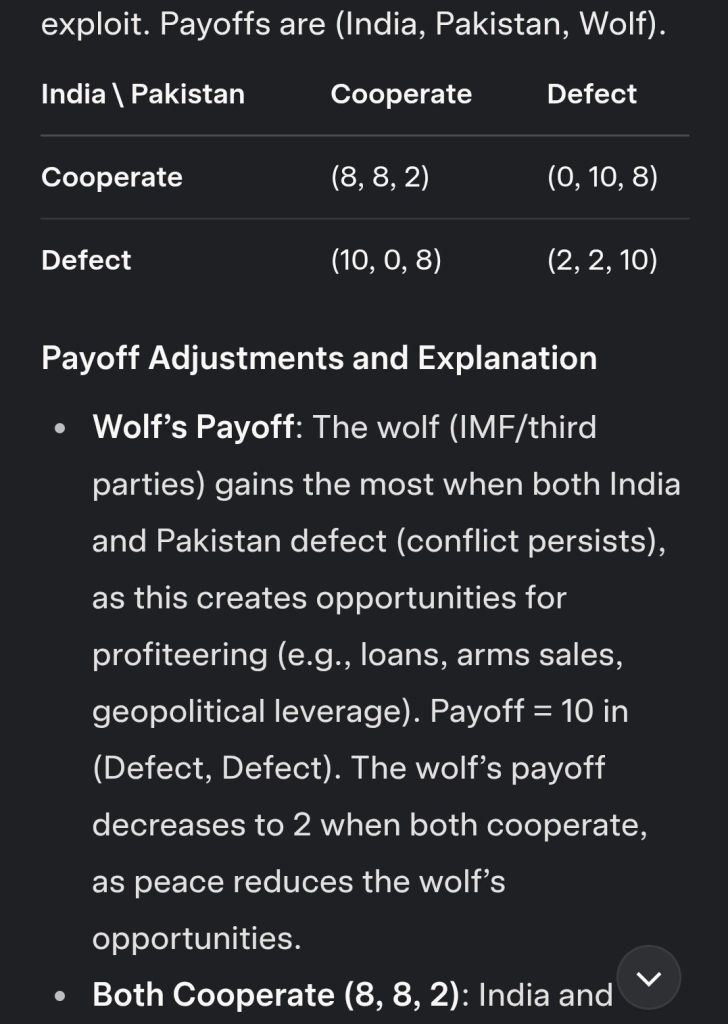
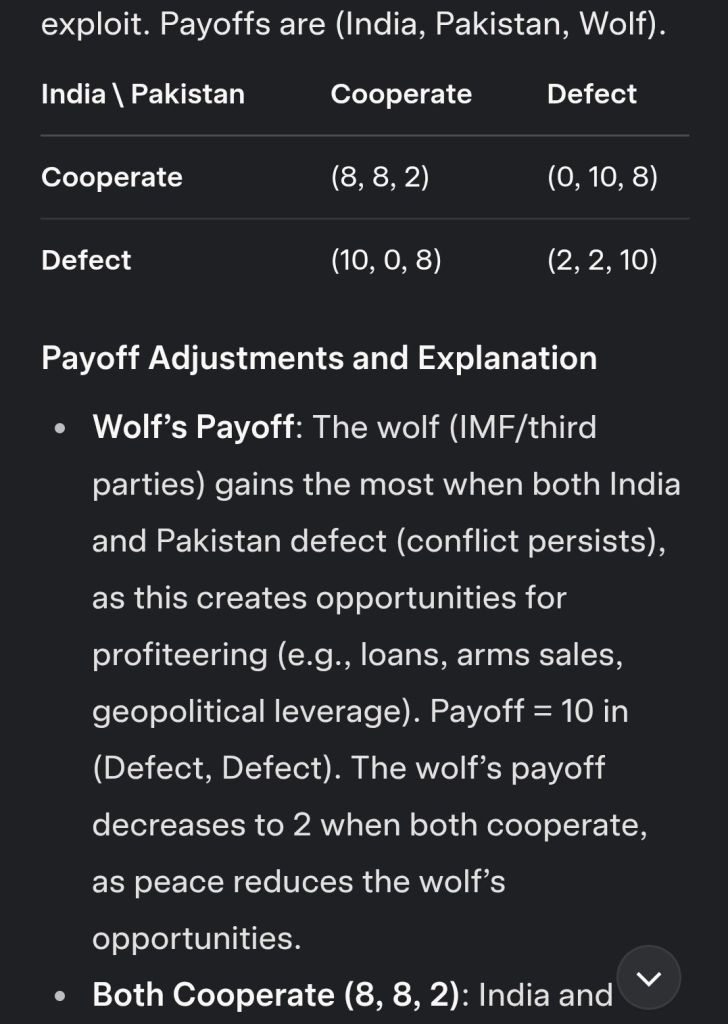
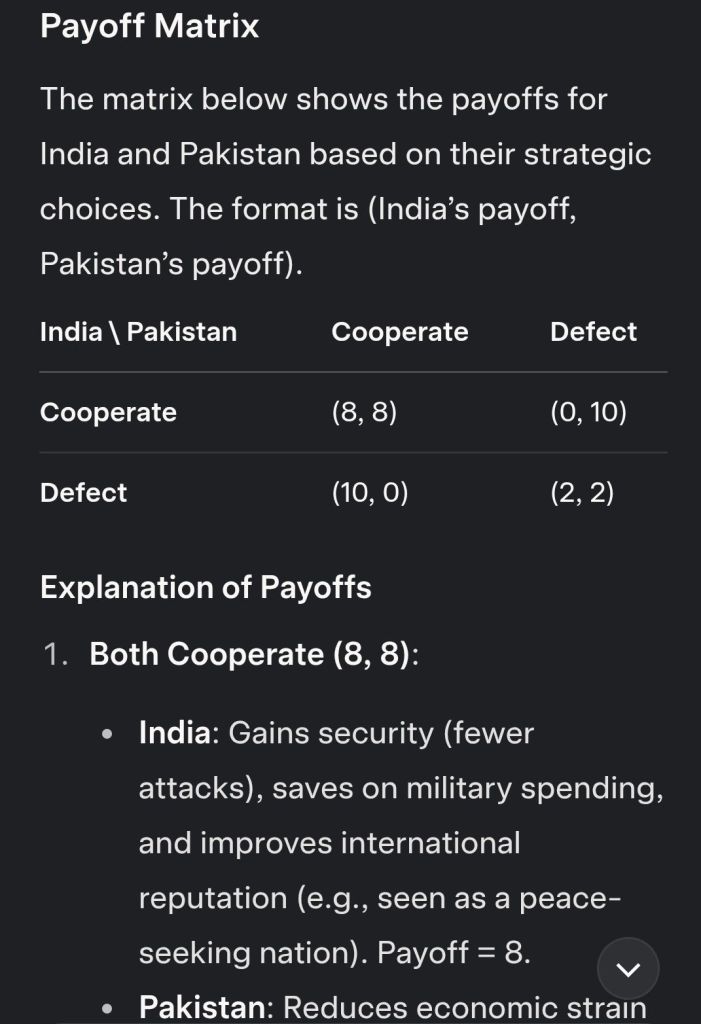
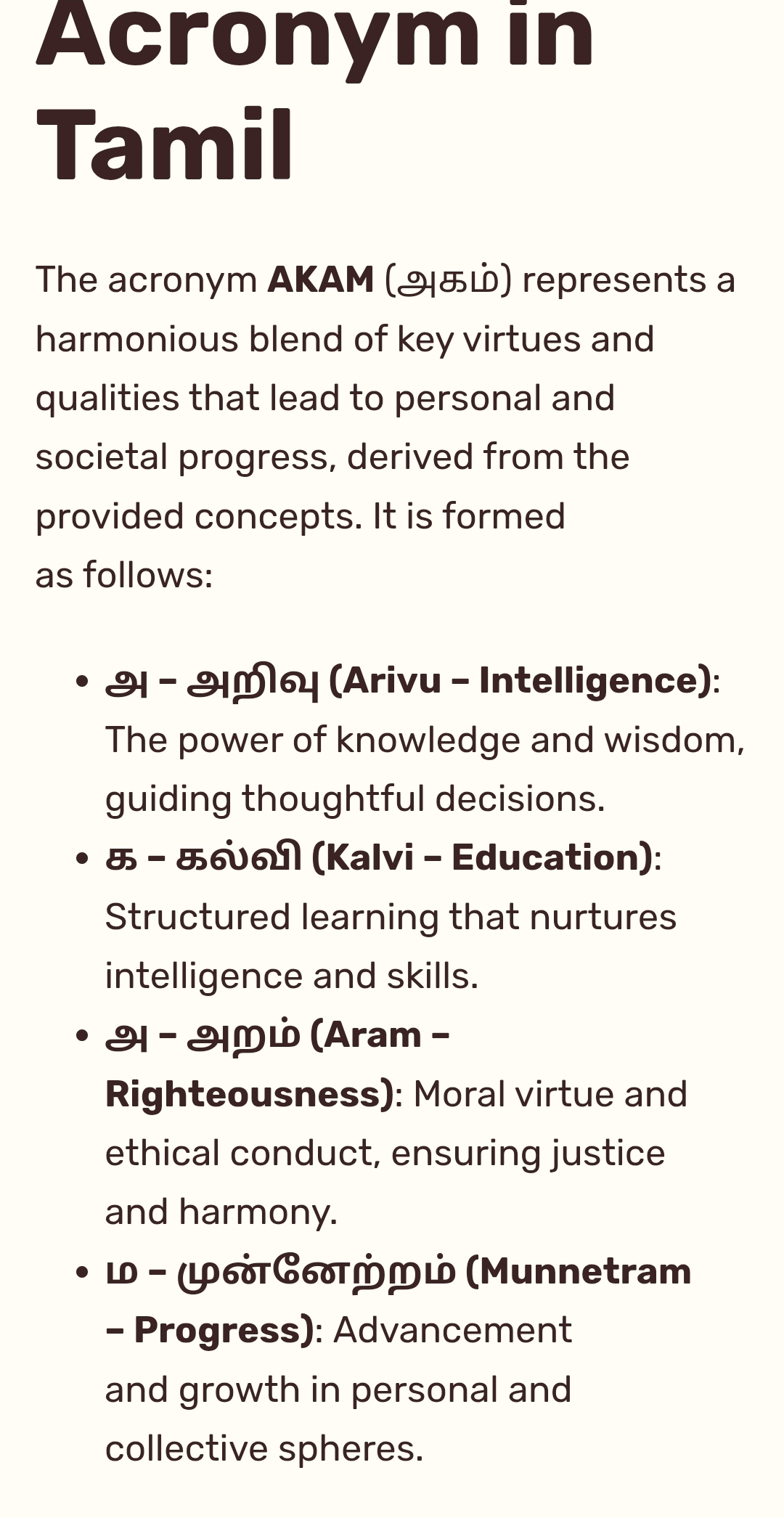
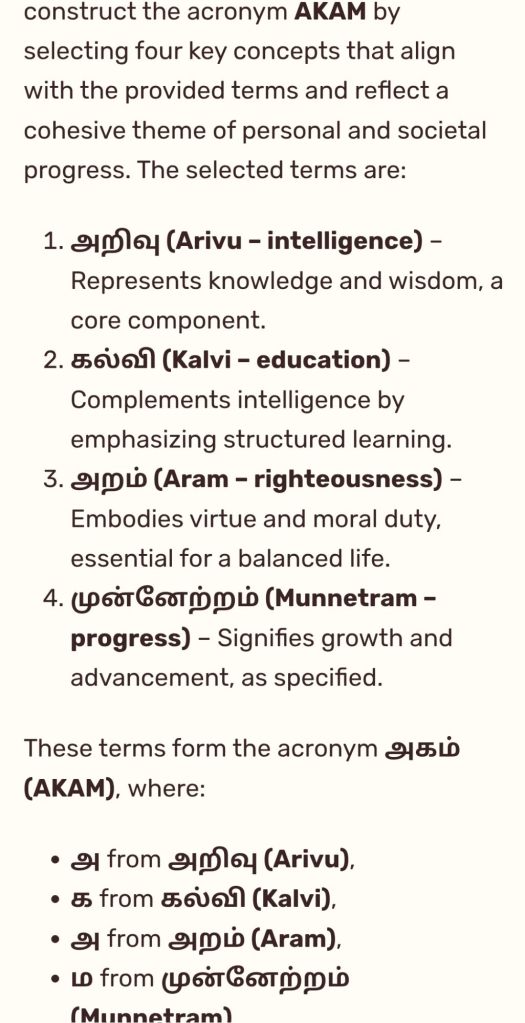

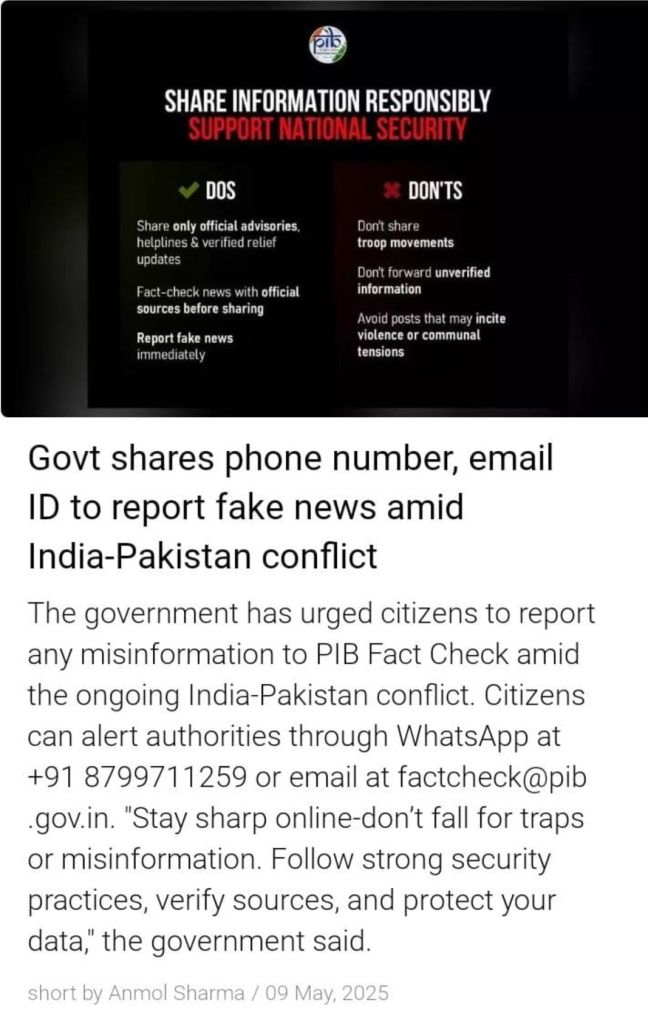
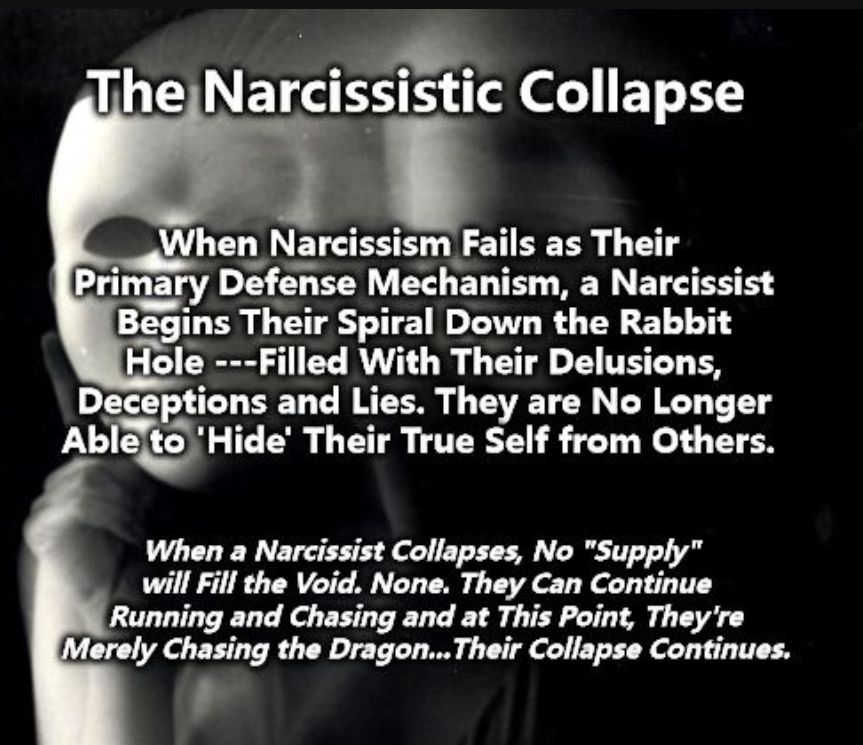
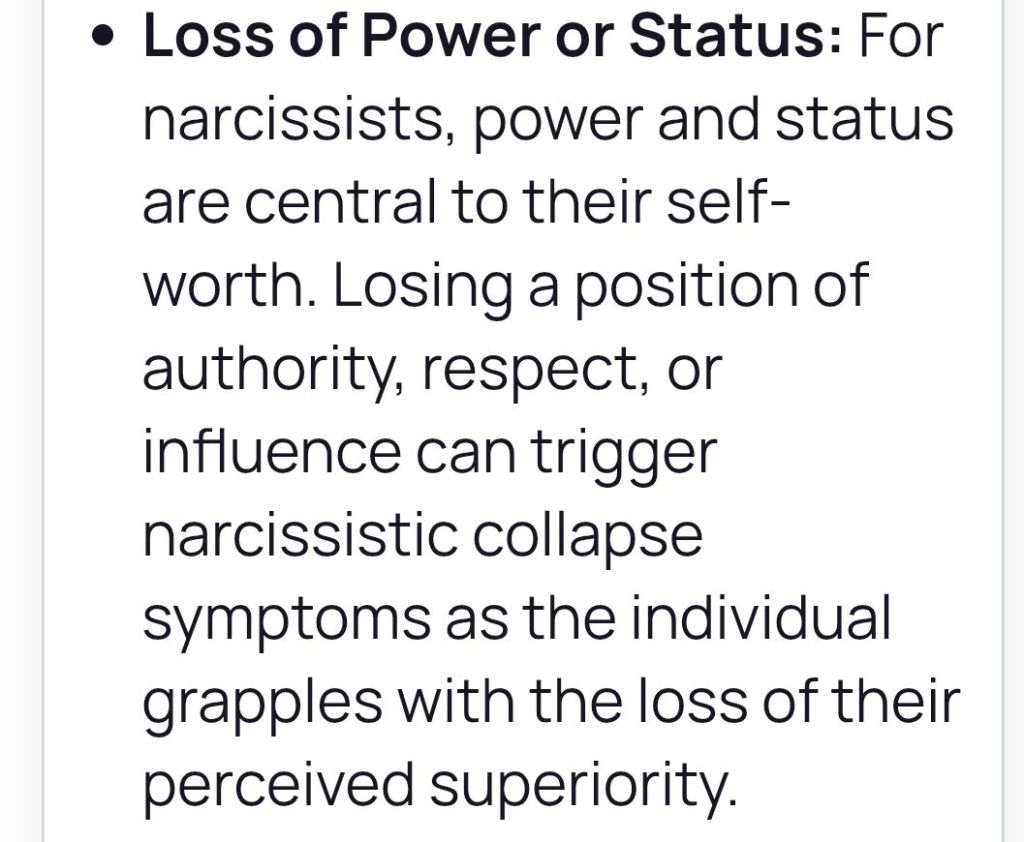
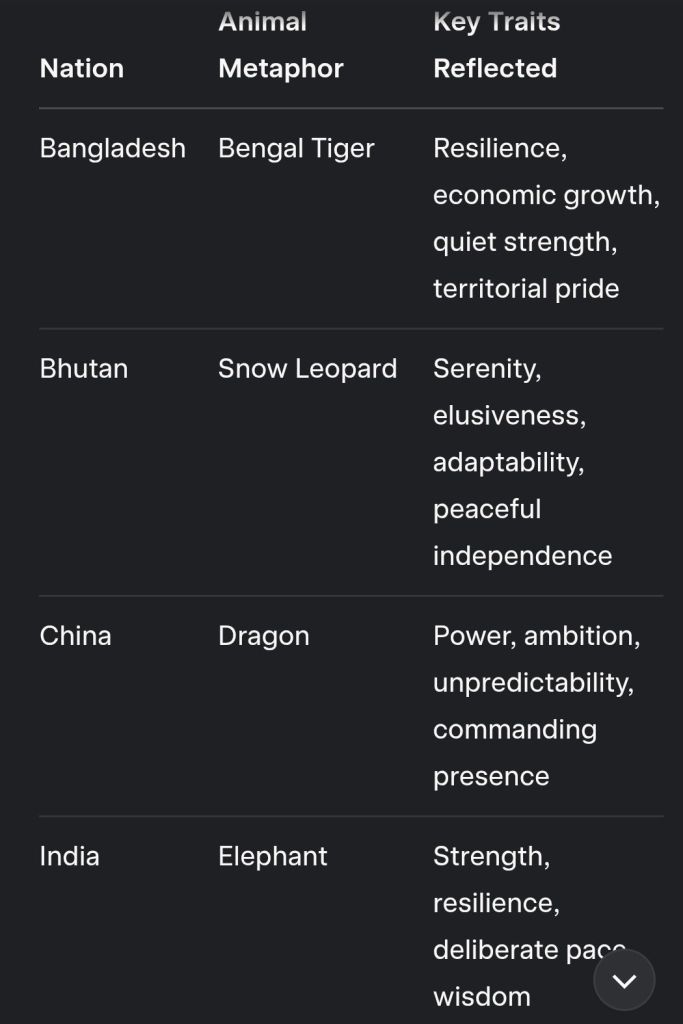
 GRP_VCare2Dare