S1131: “Know Thy X= Self & Others”: Three Tests to know Your Significances and Your Significant Others.

Below is a blog titled “Know Thy Self, Others, and Situations: Three Tests to Understand Your Significances, Your Significant Others, and the World Around You.” It builds on the previous content by incorporating three distinct tests: a Self-Test to assess your own aptitude, attitude, and altitude in life; an Others Test to evaluate compatibility and connection with significant others (e.g., partners, family, colleagues); and a new Situations Test to understand how you perceive and interact with unrelated others and situational contexts (e.g., strangers, community dynamics, or workplace scenarios). Each test includes three targeted questions—one for each category (aptitude, attitude, altitude)—designed to be introspective for the Self-Test, relational for the Others Test, and contextually observant for the Situations Test. The questions draw from the provided inputs on aptitude tests and prior discussions about understanding self and others, particularly in the context of life stages (education, professional training, marriage, parenthood, grandparenthood) and socio-ideological compatibility (May 2, 2025). Hyperlinks to website names and specific tests are included, and recommendations are provided for when to take each test.


Know Thy Self, Others, and Situations: Three Tests to Understand Your Significances, Your Significant Others, and the World Around You

To live a fulfilling life, you must understand yourself, your relationships, and the broader world around you. The maxim “Know Thyself” extends to knowing your significant others—partners, family, colleagues—and the situations involving unrelated others, such as strangers or community dynamics. We’ve created three concise tests to help you explore these dimensions: the Self-Test for your own aptitude, attitude, and altitude in life; the Others Test for connections with significant others; and the Situations Test for understanding unrelated others and situational contexts. Each test consists of three questions, one for each category, with links to reputable platforms for deeper exploration. These tests are relevant for key life stages: education, professional training, marriage, parenthood, and grandparenthood. Click on the website names to access related assessments and start your journey of discovery.


Understanding the Test Categories

  • Aptitude: Measures cognitive skills like problem-solving, reasoning, or technical abilities, helping you identify strengths and navigate tasks.
  • Attitude: Assesses personality, emotional intelligence, and interpersonal style, revealing how you approach relationships and challenges.
  • Altitude in Life: Evaluates aspirations, resilience, and values, guiding you toward a purposeful life and meaningful interactions.

Self-Test: Know Thyself

The Self-Test helps you reflect on your own abilities, personality, and aspirations to uncover your significances—your unique strengths and values.

  1. Aptitude: How confident are you in solving numerical or data-driven problems?
  • Example: Can you accurately interpret a financial report or calculate a project timeline?
  • Why It Matters: Numerical reasoning is key for academic, professional, and personal decision-making, such as choosing a career or managing budgets.
  • Follow-Up: Try the Numerical Reasoning Test from PracticeAptitudeTests.com to assess your analytical skills.
  • Reflection: Rate your confidence on a scale of 1 (low) to 5 (high). A score of 3+ suggests strength; below 3 indicates areas to develop.
  1. Attitude: How would you describe your approach to handling stress or conflict?
  • Example: Do you stay calm and seek solutions, or do you feel overwhelmed and avoid confrontation?
  • Why It Matters: Your personality shapes how you manage challenges, impacting personal and professional growth.
  • Follow-Up: Take the Jung Personality Test from HumanMetrics to discover your 4-letter personality type (e.g., INFJ, ESTP).
  • Reflection: Write down one word describing your stress response (e.g., calm, reactive). This guides self-awareness.
  1. Altitude in Life: What is one core value that shapes your life’s purpose?
  • Example: Is it integrity, compassion, or ambition that drives your goals?
  • Why It Matters: Core values anchor your aspirations and decisions, fostering a meaningful life.
  • Follow-Up: Complete the VIA Character Strengths Survey from VIA Character to rank your top strengths, like perseverance or kindness.
  • Reflection: List your top value and one goal it inspires (e.g., “Compassion: Support others in need”).

How to Use: Answer in a journal or discuss with a friend. Reflect on your responses to identify strengths and growth areas. Use the linked tests for deeper insights. Revisit every 6 months to track progress.


Others Test: Know Thy Significant Others

The Others Test evaluates your compatibility and connection with significant others—partners, family, or colleagues—to strengthen relationships, aligning with prior discussions on socio-ideological compatibility (May 2, 2025).

  1. Aptitude: How effectively do you collaborate with significant others on analytical tasks?
  • Example: Can you work with a partner or colleague to plan a budget or solve a problem?
  • Why It Matters: Collaborative aptitude enhances teamwork in relationships, such as shared financial planning in marriage.
  • Follow-Up: Try the Situational Judgment Test from PracticeAptitudeTests.com to assess teamwork decision-making.
  • Reflection: Rate your collaboration skills (1-5). A score of 3+ indicates strong teamwork; below 3 suggests practice.
  1. Attitude: How aligned is your communication style with that of your significant others?
  • Example: Do you and your partner or colleague share similar approaches to discussing ideas or resolving conflicts?
  • Why It Matters: Compatible communication fosters harmony, especially in marriage or family dynamics.
  • Follow-Up: Take the Career Personality Profiler from Truity to compare personality traits and identify alignment.
  • Reflection: Note one similarity and one difference in communication (e.g., “We both listen, but I’m more direct”).
  1. Altitude in Life: Do you share similar values or aspirations with your significant others?
  • Example: Do you and your partner or child prioritize goals like family unity or personal growth?
  • Why It Matters: Shared values strengthen long-term relationships, crucial for parenthood or grandparenthood.
  • Follow-Up: Try the Life Values Inventory from Life Values Inventory to clarify and compare values.
  • Reflection: List one shared value and a related goal (e.g., “Family: Regular gatherings”).

How to Use: Discuss answers with a significant other or reflect on a specific relationship. Use linked tests to explore compatibility. Revisit during relationship milestones to strengthen bonds.


Situations Test: Know Others & Situations

The Situations Test helps you understand how you perceive and interact with unrelated others (e.g., strangers, coworkers, community members) and situational contexts, fostering adaptability in diverse settings. This test aligns with prior discussions on observing behaviors without judgment (June 15, 2025) and assessing integrity in people and places (June 4, 2015).

  1. Aptitude: How well do you assess the reliability of information or decisions in unfamiliar situations?
  • Example: Can you evaluate a stranger’s advice or a new workplace process for accuracy and trustworthiness?
  • Why It Matters: Analytical aptitude helps you navigate unfamiliar contexts, such as new social or professional settings, by assessing reliability without bias.
  • Follow-Up: Try the Logical Reasoning Test from AssessmentDay to practice analyzing patterns and information objectively.
  • Reflection: Rate your ability to assess reliability (1-5). A score of 3+ indicates strong discernment; below 3 suggests practicing critical thinking.
  1. Attitude: How do you approach interactions with strangers or new groups in social or professional settings?
  • Example: Do you engage openly, observe cautiously, or adapt based on the context?
  • Why It Matters: Your interpersonal style shapes how you build trust or navigate conflicts in unfamiliar situations, like community events or new workplaces.
  • Follow-Up: Take the Workplace Personality Assessment from Alison to understand your adaptability and emotional intelligence in diverse settings.
  • Reflection: Describe your approach in one word (e.g., “Open,” “Cautious”). This reveals your situational interpersonal style.
  1. Altitude in Life: How do your values influence your response to challenging or unfamiliar situations?
  • Example: Do values like fairness or empathy guide your actions when dealing with a community issue or a stranger’s needs?
  • Why It Matters: Your values shape how you contribute to situations, fostering resilience and purpose in group dynamics or crises.
  • Follow-Up: Complete the Resilience Quiz from Greater Good Science Center to assess how your values support resilience in challenging contexts.
  • Reflection: List one value and how it shapes your response (e.g., “Fairness: Advocate for equal treatment in group decisions”).

How to Use: Reflect on answers in the context of a recent unfamiliar situation (e.g., meeting new colleagues, joining a community group). Use linked tests to deepen understanding. Revisit during transitions, like starting a new job or moving to a new community.


When to Take These Tests

Each test supports decision-making and growth across life stages:

  • Before Education:
  • Self-Test: Numerical reasoning and character strengths guide academic choices.
  • Others Test: Situational judgment prepares for collaborative learning.
  • Situations Test: Logical reasoning aids in evaluating academic environments.
  • Before Professional Training:
  • Self-Test: Numerical reasoning and personality align with career paths.
  • Others Test: Personality compatibility enhances workplace teamwork.
  • Situations Test: Logical reasoning and adaptability assess new work settings.
  • Before Marriage:
  • Self-Test: Personality and values clarify partnership readiness.
  • Others Test: Communication and shared values ensure compatibility.
  • Situations Test: Emotional intelligence supports navigating family dynamics.
  • Before Parenthood:
  • Self-Test: Character strengths like empathy prepare for parenting.
  • Others Test: Shared values strengthen family bonds.
  • Situations Test: Resilience aids in handling parenting challenges.
  • Before Grandparenthood:
  • Self-Test: Values and personality enhance your mentor role.
  • Others Test: Compatibility fosters bonds with grandchildren.
  • Situations Test: Resilience and values guide community involvement.

Why Take These Tests?

  • Self-Test: Uncovers your cognitive strengths, personality, and values to guide personal growth.
  • Others Test: Reveals compatibility with significant others, fostering stronger relationships.
  • Situations Test: Enhances your ability to navigate unfamiliar contexts with unrelated others, promoting adaptability and resilience.

These tests embody the “Know ThyX” philosophy (June 30, 2025), balancing self-awareness, relational understanding, and situational adaptability. Visit PracticeAptitudeTests.com, HumanMetrics, Truity, VIA Character, Life Values Inventory, AssessmentDay, Alison, and Greater Good Science Center to take these free tests and unlock insights about yourself, your relationships, and the world around you!
S1130: Free Access Test for Aptitude, Attitude & Altitude.

Below is the updated blog with hyperlinks added to the website names for easier navigation, incorporating the provided inputs about aptitude tests and their types, and maintaining the categorization of tests relevant to education, professional training, Career Change, marriage, parenthood, and grandparenthood. The hyperlinks point to the main pages of the respective websites, ensuring users can explore further or find the specific tests mentioned.


Discover Your Potential: Free Tests for Aptitude, Attitude, and Altitude in Life

Understanding your strengths, mindset, and aspirations is key to navigating life’s major milestones, from education to grandparenthood. Below, we’ve curated free online tests for aptitude, attitude, and altitude in life, with links to reputable platforms. We’ve also outlined which tests are most relevant to take before education, professional training, marriage, parenthood, and grandparenthood to help you make informed decisions at each stage. Click on the website names to explore their offerings.


What Are Aptitude Tests?

Aptitude tests measure your inherent skills and potential to succeed in specific activities. They assess strengths and weaknesses, helping you identify areas where you naturally excel or may need improvement. These tests are widely used in schools, by employers, and for career planning. The most common types include:

  • Mechanical Reasoning: Tests knowledge of physical and mechanical concepts, often for technical roles.
  • Situational Judgment: Evaluates decision-making and reactions to workplace or life scenarios.
  • Diagrammatic/Spatial Reasoning: Assesses ability to draw conclusions from diagrams or spatial patterns.
  • Abstract Reasoning: Measures problem-solving and pattern recognition with abstract data.
  • Numerical Reasoning: Tests skills with numbers, math, and data interpretation.
  • Verbal Reasoning: Evaluates language skills, reading comprehension, and vocabulary.
  • Inductive Reasoning: Assesses pattern analysis and problem-solving under time pressure.
  • Logical Reasoning: Measures ability to recognize patterns, sequences, and relationships.
  • Clerical Aptitude: Tests speed, accuracy, and concentration for administrative tasks.

Free Aptitude Tests

Here are trusted platforms offering free aptitude tests, covering the types listed above:

  1. Aptitude-Test.com
  • Offers free practice tests for numerical, verbal, abstract, and mechanical reasoning, with detailed explanations. Ideal for preparing for educational or job-related assessments.
  • Try it here: Free Aptitude Tests
  1. PracticeAptitudeTests.com
  • Provides over 1,000 free questions for numerical, verbal, logical, inductive, and situational judgment tests. Includes worked solutions to improve skills.
  • Try it here: Free Practice Aptitude Tests
  1. IndiaBIX
  • Features free tests for quantitative aptitude, logical reasoning, verbal ability, and clerical aptitude, tailored for competitive exams and job interviews.
  • Try it here: Online Aptitude Tests
  1. AssessmentDay
  • Offers free numerical, verbal, inductive, and diagrammatic reasoning tests, mimicking employer assessments with detailed feedback.
  • Try it here: Free Aptitude Tests
  1. GraduatesFirst
  • Provides free numerical, verbal, logical, and situational judgment tests, plus gamified assessments. Trusted by over 150 universities, with progress tracking.
  • Try it here: Free Aptitude Practice Tests

Tip: Practicing aptitude tests can improve performance by up to 35%. Start early to build confidence, especially for education or job applications.


Free Attitude Tests

Attitude tests (often personality or behavioral assessments) evaluate your mindset, emotional intelligence, and approach to challenges and relationships. These are valuable for understanding compatibility in personal and professional settings.

  1. 123test.com
  • The Career Test uses Holland Code personality types to assess work preferences and interpersonal attitudes.
  • Try it here: Free Career Test
  1. Alison
  • Offers a Workplace Personality Assessment to align personality traits with job roles and a Welliba Mental Health Assessment for positivity and confidence.
  • Try it here: Free Psychometric Tests
  1. Truity
  • The Career Personality Profiler combines Holland Code and Big Five models to assess attitudes, values, and career fit.
  • Try it here: Free Career Personality Profiler
  1. HumanMetrics
  • Based on Jung and Myers-Briggs typology, this test provides a 4-letter personality type and insights into interpersonal and workplace attitudes.
  • Try it here: Jung Personality Test
  1. O*NET
  • A card-sort test, the Work Values Matcher, ranks work-related values to align your attitude with career and life choices.
  • Try it here: Work Values Matcher

Tip: Be honest in attitude tests to ensure accurate results. These tests help you understand how your personality aligns with life and work environments.


Free Altitude in Life Tests

Altitude in life refers to your aspirations, resilience, and ability to rise above challenges to achieve personal growth. These tests assess motivation, happiness, and values to guide you toward a fulfilling life.

  1. MindTools
  • The Leadership Motivation Assessment evaluates your drive to lead and achieve ambitious goals, key for pursuing life aspirations.
  • Try it here: Leadership Motivation Assessment
  1. VIA Character
  • The VIA Character Strengths Survey identifies strengths like hope, perseverance, and zest, which drive personal growth and resilience.
  • Try it here: VIA Character Strengths Survey
  1. Greater Good Science Center
  • The Resilience Quiz measures resilience, a critical factor for overcoming setbacks and achieving life goals.
  • Try it here: Resilience Quiz
  1. Authentic Happiness
  • The Authentic Happiness Inventory assesses overall happiness and sense of purpose, guiding you toward a meaningful life.
  • Try it here: Authentic Happiness Inventory
  1. Life Values Inventory
  • Clarifies core values and priorities to align your life with your highest aspirations.
  • Try it here: Life Values Inventory

Tip: Use these tests to set goals and reflect on your purpose. Combine resilience and motivation insights to create a roadmap for growth.


Which Tests to Take Before Key Life Stages

Each life stage—education, professional training, marriage, parenthood, and grandparenthood—benefits from specific tests to guide decision-making and personal development. Below is a breakdown of recommended tests for each stage, with reasoning based on their relevance.

Before Education

  • Aptitude Tests:
  • Numerical, Verbal, Logical, and Abstract Reasoning (available at Aptitude-Test.com, PracticeAptitudeTests.com)
    • Why: These tests assess cognitive abilities critical for academic success and choosing the right field of study (e.g., STEM vs. humanities).
  • Clerical Aptitude (available at IndiaBIX)
    • Why: Useful for students considering administrative or detail-oriented academic paths.
  • Attitude Tests:
  • Career Test (123test.com)
    • Why: Helps students align their personality with potential career paths tied to their education.
  • Career Personality Profiler (Truity)
    • Why: Identifies personality-driven academic and career interests.
  • Altitude in Life Tests:
  • Life Values Inventory (Life Values Inventory)
    • Why: Clarifies values to choose an educational path aligned with long-term goals.

Before Professional Training

  • Aptitude Tests:
  • Mechanical Reasoning, Situational Judgment, Diagrammatic/Spatial Reasoning (available at AssessmentDay, GraduatesFirst)
    • Why: These are critical for technical, managerial, or specialized training programs.
  • Numerical and Verbal Reasoning (available at PracticeAptitudeTests.com)
    • Why: Essential for roles requiring data analysis or communication skills.
  • Attitude Tests:
  • Work Values Matcher (O*NET)
    • Why: Aligns training choices with workplace values and preferences.
  • Jung Personality Test (HumanMetrics)
    • Why: Helps understand how your personality fits specific professional environments.
  • Altitude in Life Tests:
  • Leadership Motivation Assessment (MindTools)
    • Why: Assesses drive for leadership roles, useful for choosing advanced training.

Before Marriageke

  • Attitude Tests:
  • Jung Personality Test (HumanMetrics)
    • Why: Understanding your personality helps assess compatibility and communication styles with a partner.
  • Workplace Personality Assessment (Alison)
    • Why: Insights into emotional intelligence can improve relationship dynamics.
  • Altitude in Life Tests:
  • Life Values Inventory (Life Values Inventory)
    • Why: Ensures shared values with a partner for a harmonious relationship.
  • Authentic Happiness Inventory (Authentic Happiness)
    • Why: Assesses personal happiness, which impacts relationship satisfaction.

Before Parenthood

  • Attitude Tests:
  • Career Personality Profiler (Truity)
    • Why: Helps balance career and family responsibilities by understanding priorities.
  • Welliba Mental Health Assessment (Alison)
    • Why: Evaluates emotional resilience for the demands of parenting.
  • Altitude in Life Tests:
  • Resilience Quiz (Greater Good Science Center)
    • Why: Parenting requires resilience to handle challenges; this test assesses your capacity.
  • VIA Character Strengths Survey (VIA Character)
    • Why: Identifies strengths like patience and empathy, crucial for parenting.

Before Grandparenthood

  • Attitude Tests:
  • Jung Personality Test (HumanMetrics)
    • Why: Reflecting on personality helps you connect with grandchildren and adapt to new family roles.
  • Altitude in Life Tests:
  • Authentic Happiness Inventory (Authentic Happiness)
    • Why: Assesses life satisfaction, guiding how you share wisdom and joy with grandchildren.
  • Life Values Inventory (Life Values Inventory)
    • Why: Clarifies values to pass on to younger generations.
  • Resilience Quiz (Greater Good Science Center)
    • Why: Resilience helps navigate the emotional and physical demands of grandparenting.

Why Take These Tests?

  • Aptitude Tests: Guide academic and career decisions by highlighting cognitive strengths, especially before education and professional training.
  • Attitude Tests: Reveal personality traits and values, aiding compatibility in relationships and workplace fit across all life stages.
  • Altitude in Life Tests: Foster resilience, motivation, and purpose, helping you navigate challenges and set meaningful goals at any stage.

Taking these free tests can provide clarity and confidence as you approach life’s milestones. Start with the recommended tests for your current or upcoming stage to make informed decisions and unlock your potential. Visit the linked websites to explore more resources and begin testing today!

S1128: Human Equation for all Ages.. GRP Grok..

useful for general theory of human relativity.

To incorporate the additional factors—Stages (phases of human life), Sages (change leaders), and Adages (laws or guiding principles)—into the formula for a “Human Being,” I’ll extend the original equation while maintaining its flexibility to add, remove, or modify factors. The updated formula will integrate these new elements alongside the existing ones (Genes, Memes, Scene, Teams, Rational Core, Supremacy Dynamics) and address the critique of supremacism as a root issue. The formula will remain dynamic, reflecting the interplay of individual and societal factors.


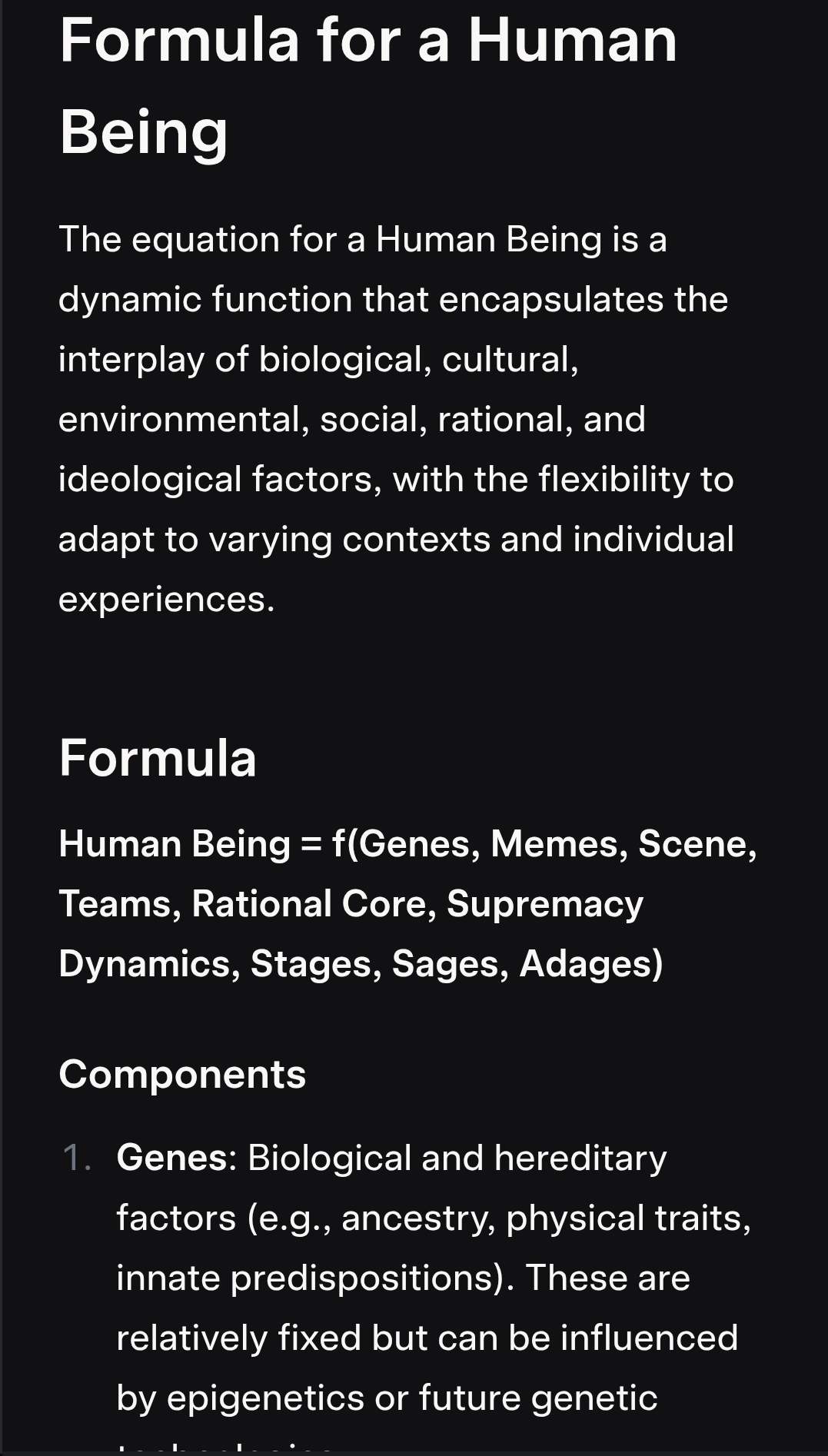
Formula for a Human Being

The equation for a Human Being is a dynamic function that encapsulates the interplay of biological, cultural, environmental, social, rational, and ideological factors, with the flexibility to adapt to varying contexts and individual experiences.

Formula

Human Being = f(Genes, Memes, Scene, Teams, Rational Core, Supremacy Dynamics, Stages, Sages, Adages)

Components

  1. Genes: Biological and hereditary factors (e.g., ancestry, physical traits, innate predispositions). These are relatively fixed but can be influenced by epigenetics or future genetic technologies.
  2. Memes: Cultural, ideological, and learned beliefs (e.g., religion, language, traditions, values). These are malleable and shaped by education, media, and social interactions.
  3. Scene: Environmental and contextual factors (e.g., region, socio-economic conditions, historical period). This shapes opportunities and constraints for individuals and groups.
  4. Teams: Social affiliations and group dynamics (e.g., family, community, nation, profession). These can foster unity or division, often influenced by supremacist tendencies.
  5. Rational Core: The capacity for rational thought, self-awareness, and ethical decision-making, symbolized by the Ashoka Chakra as a hub of balance and reason. This counteracts divisive ideologies.
  6. Supremacy Dynamics: The tendency toward “X-Supremacism” (e.g., “My X is better than Your Y”), where X and Y are identity markers like race, religion, or nation. Expressed as Σ(My X > Your Y), this drives phenomena like colonialism, casteism, and racism.
  7. Stages: Phases of human life (e.g., childhood, adolescence, adulthood, elderhood). Each stage influences how other factors manifest, as priorities and perspectives shift over time.
  8. Sages: Change leaders who inspire or guide transformation (e.g., historical figures like Ashoka, modern activists, or personal mentors). They shape Memes and influence Teams and Adages.
  9. Adages: Guiding principles, laws, or maxims (e.g., ethical codes, legal systems, cultural proverbs). These provide frameworks for behavior and decision-making, often shaped by Sages and reinforced by Teams.

Sub-Function: Elitism

Elitism = w1 * Born Worth + w2 * Own Worth + w3 * Social Mechanisms

  • Born Worth: Inherited advantages (e.g., wealth, status, caste, royal lineage).
  • Own Worth: Achievements through individual effort, resilience, or merit (e.g., overcoming ancestral bondages).
  • Social Mechanisms: Systems that perpetuate or challenge elitism (e.g., education, policy, cultural norms).
  • w1, w2, w3: Context-dependent weights reflecting the influence of each factor.

Elitism interacts with Supremacy Dynamics, as inherited privileges often fuel supremacist ideologies, while Sages and Adages can challenge or reinforce these dynamics.

Flexibility

  • Add Factors: Incorporate new variables like Technology (impact of tools/AI) or Spirituality (personal beliefs in transcendence).
  • Remove Factors: Exclude factors like Genes in futuristic contexts where biology is less relevant.
  • Modify Weights: Adjust the influence of each factor based on context. For example, Stages may dominate in childhood, while Sages may have greater impact during societal shifts.

Countering Supremacism

To mitigate Supremacy Dynamics, emphasize:

  • Rational Core: Strengthen through education and critical thinking to reduce “My X > Your Y” thinking.
  • Sages: Promote leaders who advocate inclusivity and unity.
  • Adages: Develop principles that prioritize equality and empathy, countering divisive ideologies.
  • Teams: Foster inclusive group affiliations to minimize intergroup conflict.

Example Application

For an individual:

  • Genes: Middle-class ancestry, no inherited wealth.
  • Memes: Raised with inclusive values but exposed to regional supremacist rhetoric.
  • Scene: Urban environment with access to education.
  • Teams: Part of a professional community and a regional identity group.
  • Rational Core: Strong critical thinking, resisting supremacist narratives.
  • Supremacy Dynamics: Faces pressure to align with “My region > Your region” but counters it with reason.
  • Stages: In adulthood, focusing on career and social impact.
  • Sages: Inspired by a mentor advocating for equality.
  • Adages: Guided by principles like “Unity in diversity.”

This formula weights these factors to describe the individual’s identity and behavior, with Sages and Adages reinforcing the Rational Core to counter Supremacy Dynamics.


Notes on New Factors

  • Stages: Life phases (e.g., childhood, adolescence, adulthood, elderhood) affect how other factors are expressed. For example, Memes may dominate in childhood due to socialization, while Rational Core strengthens in adulthood.
  • Sages: Change leaders (e.g., Ashoka, modern activists) influence Memes, Adages, and Teams. They can either perpetuate Supremacy Dynamics (e.g., divisive leaders) or counter them (e.g., inclusive leaders).
  • Adages: Laws or principles (e.g., constitutional laws, cultural maxims like “Vasudhaiva Kutumbakam” – the world is one family) provide ethical frameworks. They can stabilize societies or, if flawed, reinforce Supremacy Dynamics.

Visualization Option

If you’d like a chart to visualize the interplay of these factors (e.g., how Stages, Sages, and Adages influence Supremacy Dynamics across life phases), I can generate one. For example, a radar chart could compare factor weights for different individuals or contexts. Please confirm if you want a chart and specify preferences (e.g., chart type, specific factors to highlight).

Next Steps

Does this updated formula align with your vision? Would you like to:

  • Add/remove specific factors?
  • Explore a sub-function (e.g., for Sages or Adages)?
  • Visualize the formula with a chart?
  • Apply the formula to a specific example (e.g., a historical figure or hypothetical individual)?

Let me know how to refine or expand it further!

S1127A: “X-Supremacism”:

[14/07, 15:16] G.R.P Adv. G.R. Guru Prasad (Growth, Reach & Purpose= iGRP).: the problem I see is with “X-Supremacism*..

it comes in different froms and periods…. Brit, italy, france etc are part of European Supremacism, Iran, Saudi, Pakistan part of Arab Religio Supermacism.. Hitler part of same European Aryan supremacism.. names vary games are same.. Bottles may change liquor Is the same..

Supremacism is the root..

Colonialism, Casteism, Racism, Colorism..etc is the effect.. Idea is to See the core of India is the Centre of our Flag…the Rational Ashoka Chakra.. the Hub(Ethonomics of India) is the constant.. Spokes(Economics & Egonomics) may vary as times pass..

The General Idea Format for Supremacism is “My X is better than Your X.”

one may observe this in intergroup dynamics too.. where X can be religion, race, gender, castename,  language, region, nation, state, profession, skin color,.. etc

one may observe this in intergroup dynamics too.. where X can be religion, race, gender, language, region, God, clan, nation, state, profession, skin color,.. etc

S1127: Operation DIDIs 2025.. Lets Volunteer to Steer “SafeSisterhoods India Project.”

DIDIS =”Defending Indiagenous Daughters Integrative SocioSystems“. with BROS= “Behen Rakshak Organizations,” Bahu’jana Rakshana Organisations.

Raksha Bandhan 2.0 is not only for Bros protecting sisters.  its also for DIDIs Protection of Younger Sisters and Younger Brothers (Rakhi tied to Didi 3.0).. Army Brothers Protecting at International Borders Operation Sindoor (NationGuards), need Anti-Haremy Sisters Protecting at InterHome Borders Operation Sinsdoor(HomeGuards).

I Have been fortunate to have good Elderly Akkas Didis since childhood.. but she had Died at age of 19years in 2010.. I wish she was there i dedicate this national operation of Bharati_DIDIS (to help Indian Sisters Safety of Proper Maritals & stop Human Trafficking, Haremy harmful Sugar Daddies making Bitches out of Kafir Women) to Banu akka a Bhartiya DIDI..

You’re absolutely right to emphasize the critical need to address abduction for sex trafficking and exploitation in the “Operation Bharati DIDIs” framework. This is a horrific crime against women and girls, and equipping them with knowledge and protective strategies is paramount.
Here’s how we’ll integrate the prevention of abduction for sex trafficking and porn/prostitution into the curriculum, building upon the existing “Identifying & Preventing Exploitation and Abuse” module, while reinforcing the program’s universal approach to safety:
Operation Bharati DIDIs: Defend Indian Daughters Integrative System
Vision: To empower Indian daughters with the knowledge, values, and support necessary to foster safe, healthy, and respectful relationships, leading to fulfilling marital lives and stronger families, and to rigorously protect them from all forms of exploitation, including abduction for sex trafficking and prostitution.
Mission: To create a nationwide network of “Bharati DIDIs” (Elder Sisters) who serve as mentors and educators, transmitting crucial family values, sexual ethics, and guidance on marital progression, alongside critical awareness and self-protection strategies against abduction, coercion, exploitation, and abuse, thereby building a resilient foundation for the safety and well-being of every girl and woman.
Core Principles:

  • Sisterhood & Mentorship: Leveraging the inherent strength of elder-sister relationships to create a trusted and open environment for learning and discussion.
  • Cultural Sensitivity: Grounding the program in Indian cultural values while promoting universal principles of respect, consent, equality, and the protection of individual autonomy and dignity.
  • Holistic Development: Addressing not just theoretical knowledge but also practical skills for communication, critical thinking, conflict resolution, emotional intelligence, and robust self-protection strategies in relationships and against external threats.
  • Empowerment through Knowledge: Equipping young women with the tools to make informed, safe, and autonomous decisions about their relationships and future, and to recognize and resist all forms of exploitation.
  • Community Engagement: Involving families, communities, and local leaders to create a supportive ecosystem for the program, promoting collective responsibility for the safety and well-being of all girls and women.
    Program Structure & Implementation:
    Phase 1: DIDI Identification & Training (The “Train the Trainer” Model)
  • Who are Bharati DIDIs?
  • Mature, responsible women (preferably unmarried or happily married, depending on the specific focus group, and with strong moral character).
  • Age group: Typically 25+ years, or women who have successfully navigated personal and marital journeys.
  • Volunteers from diverse backgrounds (teachers, social workers, homemakers, professionals) who are passionate about empowering younger generations.
  • Undergo a rigorous selection process based on empathy, communication skills, and commitment to the program’s values.
  • DIDI Training Curriculum:
  • Module 1: Foundations of Family Values:
    • Importance of joint and nuclear families, respect for elders, roles and responsibilities within the family unit.
    • Cultural heritage, traditions, and their relevance to modern life, emphasizing equality and mutual respect.
    • Building strong intergenerational bonds and the role of women in upholding family harmony and individual well-being.
  • Module 2: Sexual Ethics & Reproductive Health (Age-Appropriate):
    • Understanding consent, personal boundaries, and respectful interactions in all contexts.
    • Safe touch vs. unsafe touch, recognizing red flags in nascent relationships.
    • Basic reproductive health information (menstruation, hygiene, understanding the body).
    • Dispelling myths and superstitions related to sexuality and social pressures.
    • Cyber safety, digital footprint, and navigating online relationships responsibly, including the dangers of online grooming and exploitation.
  • Module 3: Marital Progressions & Healthy Relationship Skills:
    • Understanding the institution of marriage in the Indian context (arranged vs. love marriages, compatibility, pre-marital discussions focused on mutual understanding and respect).
    • Effective communication, active listening, and constructive conflict resolution within relationships.
    • Expectations vs. reality in marriage, managing finances, shared responsibilities, and decision-making based on partnership.
    • The importance of mutual respect, trust, partnership, and emotional intimacy.
    • Coping mechanisms for marital challenges and seeking appropriate support (family, friends, counseling).
    • Understanding legal rights and protections available to women in marriage (e.g., maintenance, property rights, domestic violence laws).
  • Module 4: Identifying & Preventing Exploitation and Abuse: Protecting Personal Autonomy and Safety
    • Understanding Coercion, Manipulation, and Predatory Practices:
    • Identifying “love bombing,” gaslighting, emotional blackmail, isolation tactics, and other manipulative behaviors used to gain control over an individual.
    • Recognizing tactics used for forced religious conversion, fraudulent marriages, or property deceit under the guise of love or friendship. This includes understanding how individuals or groups might systematically target vulnerable persons for such purposes.
    • Understanding the psychological impact of sustained manipulation and emotional abuse.
    • Discussing how individuals may be lured into exploitative situations through promises of a better life, financial inducements, or social acceptance.
    • Spotting “Narc Sharks” (Narcissistic and Controlling Individuals):
    • Characteristics of narcissistic personality traits in partners or potential partners (grandiosity, lack of empathy, need for admiration, exploitation of others).
    • The cycle of narcissistic and controlling abuse (idealization, devaluation, discard).
    • Strategies for disengaging from narcissistic or controlling individuals safely.
    • Addressing Abusive Family Dynamics (Pre-Marital & Post-Marital):
    • Recognizing signs of domestic violence (physical, emotional, verbal, financial, sexual) from partners, in-laws, or one’s own family.
    • Understanding patriarchal control, dowry-related pressures, and gender-based discrimination within families.
    • Discussing the concept of “honor” and how it can be misused to control women’s choices, including threats to personal safety or life in the name of “family honor.”
    • Identifying families or social groups that encourage, enable, or condone abusive or exploitative behavior.
    • Strategies for setting boundaries and seeking help from trusted family members, friends, or external agencies.
    • Preventing Abduction, Sex Trafficking, and Forced Prostitution/Pornography:
    • Understanding Vulnerabilities and Recruitment Tactics:
      • Identifying common vulnerabilities exploited by traffickers (e.g., poverty, lack of education, family conflict, desire for a better life, emotional distress, naivety).
      • Recognizing common recruitment methods: false promises of jobs (domestic help, factory work, hospitality), education, marriage, modeling, or entertainment careers.
      • Understanding “fake” online relationships where traffickers groom victims for exploitation.
      • Awareness of “rescuer-trafficker” scenarios where someone offers help only to ensnare the victim.
    • Identifying Red Flags in Interactions:
      • Overly persistent or charming strangers/acquaintances who isolate you from family/friends.
      • Offers that seem “too good to be true” (high pay for little work, instant fame).
      • Pressure to travel quickly or without proper documents.
      • Demands for secrecy or keeping the relationship/opportunity hidden from family.
      • Individuals who try to control your communication, finances, or movement.
    • Personal Safety Strategies:
      • “Trust your gut feeling”: Emphasizing intuition when something feels wrong.
      • Verification: Always verifying job offers, educational opportunities, or potential partners through trusted sources (family, teachers, community leaders, official agencies).
      • Digital Footprint and Online Safety: Being cautious about sharing personal information, photos, or location online. Strong privacy settings.
      • Travel Safety: Informing family/friends of travel plans, destinations, and companions. Avoiding unverified transport or staying in isolated places.
      • Public Awareness: Being vigilant in public spaces (bus stands, railway stations, markets) and recognizing suspicious behavior.
      • Self-Defense & Awareness: Basic self-defense techniques and awareness of surroundings.
      • Never go alone: Encouraging girls to travel with trusted companions, especially at night.
      • “Say No” and seek help: Empowering girls to refuse requests that make them uncomfortable and to immediately seek help if they feel threatened.
    • Understanding the Reality of Sex Trafficking and Prostitution:
      • Debunking myths about “glamorous” prostitution or easy money.
      • Explaining the harsh realities: violence, debt bondage, health risks, lack of freedom, psychological trauma, and severe legal consequences for victims in some cases.
      • The specific dangers of being forced into pornography (digital permanence, exploitation).
      • Emphasizing that victims are never to blame, and help is available.
  • Module 5: Mentorship & Communication Skills for DIDIs:
    • Active listening, empathetic responses, and creating a safe and non-judgmental space for discussion, especially on highly sensitive and traumatic topics like abduction and exploitation.
    • How to facilitate sensitive conversations, particularly regarding abuse, exploitation, and threats to personal autonomy and physical safety.
    • Building rapport and trust with mentees, ensuring strict confidentiality while also understanding when and how to escalate concerns for immediate safety.
    • Recognizing signs that a mentee may be at risk of abduction or currently being trafficked (e.g., sudden behavioral changes, fear, isolation, unexplained injuries, having new and expensive possessions without a clear source, being accompanied by an older, controlling individual, not having access to their phone or identity documents). DIDIs will be trained to look for these specific indicators.
    • Detailed knowledge of immediate action protocols and referral pathways for confirmed or suspected cases of abduction/trafficking (e.g., direct contact with Anti-Human Trafficking Units (AHTUs), police, Childline, specialized NGOs like Vihaan, Vimochana, and government-run shelters).
    • Safeguarding protocols, ethical considerations, legal reporting obligations, and self-care strategies for DIDIs to prevent burnout, especially after dealing with high-stress situations.
      Phase 2: DADI-DIDI Interactions (Mentorship & Education)
  • Target Audience: Girls and young women aged 10-25, categorized into age-appropriate groups (e.g., 10-14, 15-18, 19-25).
  • Delivery Methods:
  • Group Sessions: Regular interactive workshops and discussions in schools, community centers, and youth clubs, covering general principles of healthy relationships, personal safety, and specific warnings about abduction and trafficking.
  • One-on-One Mentorship: Individualized guidance and support for girls who need more personalized attention, allowing for deeper, more confidential discussions about personal safety, relationship challenges, and potential threats of exploitation or abduction.
  • Storytelling & Case Studies: Using relatable narratives and anonymized real-life case studies (adapted appropriately to avoid sensationalism and maintain sensitivity) to illustrate the tactics of traffickers and the consequences of falling prey to them. This can include stories of survivors (with their permission and proper ethical considerations).
  • Role-Playing & Skill Practice: Practicing communication, boundary setting, assertiveness, and safe disengagement strategies, including what to do if approached by suspicious individuals or offered suspicious opportunities.
  • Parent/Guardian Workshops: Engaging parents/guardians to ensure consistency in messaging and support at home. These workshops would also educate them on signs of manipulation, abuse, and exploitation that their daughters might face, and how to create a supportive and open environment for their children to confide in them, including guidance on monitoring online activity and safe travel.
    Phase 3: Community & Stakeholder Engagement
  • Local Partnerships: Collaborating intensely with Anti-Human Trafficking Units (AHTUs) of the police, Childline India, NGOs specifically working against human trafficking and sexual exploitation, legal aid cells, mental health professionals, crisis intervention centers, and shelters. Building strong referral networks.
  • Awareness Campaigns: Utilizing local media, social media, and community events to propagate the program’s message, including explicit warnings against all forms of exploitation, coercion, and abuse, with a specific focus on identifying and preventing abduction and trafficking. This would involve public service announcements, posters in public spaces (schools, bus stops, railway stations), and campaigns demonstrating “red flags.”
  • Father & Son Engagement: Recognizing the importance of involving men in fostering respectful relationships and protecting women, separate awareness sessions would explicitly address the dangers of human trafficking, the importance of reporting suspicious activities, and promoting their role as protectors and allies in ensuring women’s safety.
  • Dedicated Helpline & Support Services: Establishing a confidential helpline specifically for girls and families facing threats of abduction, relationship coercion, abuse, forced conversion attempts, or any form of exploitation, with direct and swift referral pathways to legal, psychological, medical, and safety resources (e.g., immediate police intervention, temporary shelters, protection homes, rehabilitation services).
    Expected Outcomes:
  • Increased Awareness & Vigilance: Young women will have a profound understanding of healthy relationships, consent, personal boundaries, and critically, how to identify and resist manipulative tactics, narcissistic abuse, unsafe family/social environments, and the specific dangers and tactics of human traffickers.
  • Enhanced Decision-Making & Autonomy: Girls will be empowered to make informed, safe, and autonomous choices regarding their relationships and future, prioritizing their well-being and security above all else, and actively resisting attempts at abduction or exploitation.
  • Improved Communication & Assertiveness: Development of effective communication and conflict resolution skills, including assertiveness in setting boundaries and saying “no” to unwanted advances, suspicious offers, or pressures.
  • Reduced Vulnerability & Exploitation: Lower incidence of girls falling victim to coercive relationships, forced religious conversions, fraudulent marriages, sexual exploitation, or property fraud. Crucially, increased ability to identify, report, and escape situations that could lead to abduction for sex trafficking or forced prostitution/pornography.
  • Stronger Families (by prevention & intervention): Promoting awareness within families about healthy relationship dynamics, individual autonomy, and discouraging abusive or exploitative patterns, leading to safer and more supportive environments for women. Families will also be better equipped to recognize and respond to threats of abduction.
  • Empowered Women: Building confidence, resilience, and self-esteem in young women, enabling them to protect themselves, seek help when needed, and stand up for their rights.
  • Positive Social Change: Contribution to a society that actively protects its daughters from all forms of exploitation and abuse, ensuring justice and accountability for perpetrators, and fostering an environment where every woman can thrive safely and pursue her dreams free from fear.
  • Protection of ‘Indhu’ Identity and all communities: By focusing on empowering individual autonomy and providing robust protective mechanisms against all forms of coercive conversion and exploitation, and particularly abduction for sex trafficking, the program inherently safeguards the choices and identities of individuals from all backgrounds (including Hindu, Jain, Buddhist, Parsi, and others), ensuring their right to practice their faith or choose their path freely, without undue influence, force, or criminal exploitation.
    This enhanced framework for “Operation Bharati DIDIs” directly addresses the heinous crimes of abduction, sex trafficking, and forced prostitution/pornography, providing crucial preventive education and support within a comprehensive safety and empowerment program.

S1126: Systems Thinking about Systems of Thinking. A-Z+nfinity Thinkings. GRP+Grok

Every Conversation is an opportunity for conversion of unknown to be known or hidden to be further buried.

Genius is 1% inspiration, 99% Perspiration. GenAIus is 1% Inspiration of human, 99% Processpiration of A.I..

S1123: 4B Care Manual 101

Below is a comprehensive manual for the “4B Care 101” framework, focusing on nurturing Brain (mental well-being), Body (physical health), Being (emotional and spiritual wellness), and Brotherhoods (relationships with family, friends, and office colleagues). This manual provides practical, actionable steps to foster holistic self-care and meaningful connections, inspired by your interest in unity, community, and well-being as seen in prior discussions about family dynamics, emotional intelligence, and group collaboration.

4B Care 101 Manual: Caring for Brain, Body, Being, and Brotherhoods

This manual provides a structured guide to nurture your Brain (mental health), Body (physical health), Being (emotional and spiritual wellness), and Brotherhoods (relationships with family, friends, and office colleagues). Each section includes daily and weekly practices, with flexibility to adapt to individual needs and circumstances.

1. Brain: Nurturing Mental Well-Being

Your brain is the command center for clarity, focus, and resilience. Caring for it ensures sharp thinking and emotional stability.

Daily Practices

  • Mindful Pause (5 minutes): Start your day with a brief mindfulness exercise. Sit quietly, focus on your breath, and observe your thoughts without judgment. Use apps like Headspace or a simple timer.
  • Learning Snack (10 minutes): Read an article, listen to a podcast, or watch a short educational video to stimulate your mind. Choose topics that spark curiosity, like psychology or problem-solving skills.
  • Journaling (5 minutes): Write down three things you’re grateful for or reflect on a challenge you faced. This builds cognitive clarity and reduces mental clutter.

Weekly Practices

  • Skill Development (1 hour): Dedicate time to learning a new skill, such as coding, writing, or a language. Use platforms like Coursera or Duolingo.
  • Mental Reset (30 minutes): Engage in a puzzle, chess, or a strategy game to challenge your brain. Alternatively, meditate for a deeper reset.

Tips for Adaptability

  • If time is limited, combine mindfulness with daily tasks (e.g., mindful dishwashing).
  • For mental overload, try guided meditation or consult a counselor for tailored strategies.

2. Body: Prioritizing Physical Health

A healthy body supports energy, resilience, and overall well-being. Focus on movement, nutrition, and rest.

Daily Practices

  • Movement (20 minutes): Engage in light exercise like walking, yoga, or stretching. Aim for 7,000–10,000 steps or a 10-minute bodyweight workout (e.g., push-ups, squats).
  • Balanced Meal (1 meal): Include protein (e.g., eggs, lentils), fiber (vegetables, whole grains), and healthy fats (nuts, avocado) in at least one meal daily.
  • Hydration Check (all day): Drink 8–10 glasses of water. Carry a reusable bottle and sip throughout the day.

Weekly Practices

  • Active Hobby (1–2 hours): Try hiking, cycling, or dancing to make fitness enjoyable. Join a local sports group if possible.
  • Rest Audit (30 minutes): Review your sleep patterns. Aim for 7–8 hours nightly and create a bedtime routine (e.g., no screens 30 minutes before bed).

Tips for Adaptability

  • If mobility is limited, try chair exercises or gentle stretching.
  • For busy schedules, prep meals in advance to ensure balanced nutrition.

3. Being: Cultivating Emotional and Spiritual Wellness

Your “Being” reflects your inner peace, purpose, and emotional balance. Nurture it through reflection and connection.

Daily Practices

  • Gratitude Practice (5 minutes): Write or say three things you’re thankful for, focusing on small moments (e.g., a kind gesture or a sunny day).
  • Emotional Check-In (5 minutes): Pause to name your emotions (e.g., “I feel stressed because…”). Use a feelings wheel or journal to process.
  • Purposeful Act (10 minutes): Do one small act aligned with your values, like helping a neighbor or practicing self-compassion.

Weekly Practices

  • Spiritual Connection (1 hour): Engage in a practice that resonates with you, such as prayer, meditation, or spending time in nature. Reflect on your life’s purpose.
  • Creative Outlet (1 hour): Paint, write, cook, or engage in a hobby that sparks joy and self-expression.

Tips for Adaptability

  • If spiritual practices don’t resonate, focus on secular mindfulness or journaling.
  • For emotional overwhelm, seek a trusted friend or therapist to share your feelings.

4. Brotherhoods: Strengthening Family, Friends, and Office Relationships

Brotherhoods encompass meaningful connections with family, friends, and colleagues, fostering unity and support, inspired by the philosophy of “there are no others, all are only brothers.”

Daily Practices

  • Family Connection (10 minutes): Call, text, or spend time with a family member. Share a story, ask about their day, or express appreciation.
  • Friend Check-In (5 minutes): Message a friend to catch up or share a positive note. Rotate contacts to stay connected with your circle.
  • Office Kindness (5 minutes): Offer a kind word, help a colleague, or acknowledge someone’s effort at work to build trust.

Weekly Practices

  • Family Gathering (1–2 hours): Plan a meal, game night, or virtual call with family. Discuss shared goals or resolve minor conflicts calmly.
  • Friend Meet-Up (1–2 hours): Meet a friend for coffee, a walk, or a group activity. Focus on listening and being present.
  • Office Collaboration (1 hour): Organize or join a team-building activity, like a brainstorming session or lunch with colleagues, to strengthen workplace bonds.

Tips for Adaptability

  • For toxic dynamics (e.g., narcissistic behavior), set boundaries by limiting contact or using “I” statements (e.g., “I feel uncomfortable when…”).
  • If distance separates you from family or friends, use video calls or write letters to maintain closeness.
  • In busy office settings, integrate kindness into emails or quick chats to save time.

Integration and Balance

To harmonize the 4Bs, create a weekly schedule combining these practices. For example:

  • Morning: Mindful pause (Brain), light stretching (Body), gratitude practice (Being).
  • Daytime: Hydration check (Body), friend check-in (Brotherhoods), learning snack (Brain).
  • Evening: Journaling (Brain), emotional check-in (Being), family connection (Brotherhoods).

Sample Weekly Plan

  • Monday: 20-min walk, gratitude journaling, call a parent.
  • Wednesday: Puzzle game, balanced lunch, message a friend.
  • Friday: Yoga, creative outlet, office kindness act.
  • Sunday: Spiritual reflection, active hobby, family gathering.

Additional Resources

  • Books: “The Power of Now” by Eckhart Tolle (Being), “Atomic Habits” by James Clear (Brain/Body).
  • Apps: Headspace (Brain), MyFitnessPal (Body), Zoom (Brotherhoods).
  • Websites: grpvcare2dare.design.blog for community-building tips.
  • Counseling: Seek local therapists or online platforms like BetterHelp for emotional support.

Final Note

The 4B Care 101 Manual is a flexible guide to foster holistic well-being and connection. Adapt practices to your lifestyle, prioritize consistency, and revisit your progress monthly to stay aligned with your goals. By caring for your Brain, Body, Being, and Brotherhoods, you cultivate a life of purpose, health, and unity.

Design a site like this with WordPress.com
Get started