S743: Trulse Factor

True + False = Trulse

Black+White = Grey

Red +Yellow = Orange

(1+ 0)/2 = 0.5

Tagged mesage Conclusion Sun Cannot Rise/Set in N/S is ‘Trulse’..

here is more detailed Truth/Fact: Sunrise Direction at the South Pole

The direction of sunrise depends on the latitude and time of year. At the South Pole, which is located at a latitude of 90° S, the sunrise direction varies throughout the year due to the Earth’s tilt and orbit.

During the Southern Hemisphere’s Summer Solstice (Around December 21/22)

The sun rises in the north, specifically from the northern horizon.

This phenomenon occurs because the South Pole is tilted towards the Sun during the Southern Hemisphere’s summer.

During the Equinoxes (Around March 20/21 and September 22/23)

The sun rises approximately in the east.

This is similar to sunrise directions at lower latitudes during the equinoxes.

During the Southern Hemisphere’s Winter Solstice (Around June 20/21)

The sun does not rise above the horizon at the South Pole, as the pole is tilted away from the Sun.

This period is known as the Polar Night, which can last several months.

In summary, the sun does rise/set from the north at the South Pole, but only during the Southern Hemisphere’s summer solstice. The sunrise direction varies throughout the year due to the Earth’s tilt and orbit.

S742: Neo-Abuses Awareness for Safer Citizens.

As Technologies advance Types of Abuses also Advances. A

Abuse Prevention Begins with Awareness & InterActions.

Here’s the updated list:

Types of Neo-Abuses

  1. Relational Narcissistic Abuse: A form of emotional abuse that occurs in intimate relationships.
  2. Narc Nexus Abuse: Refers to the network or web of relationships that a narcissist creates to manipulate and control others.
  3. Targeted Individuals Abuse: Refers to the experience of being subjected to organized stalking and harassment by individuals or groups.
  4. Systemic Oppression Abuse: Refers to the ways in which societal systems and institutions perpetuate abuse and oppression against marginalized groups.
  5. Legal Subsystems Abuse: Refers to the ways in which legal systems and institutions can perpetuate abuse and oppression against individuals or groups.
  6. Cyber Abuse: Refers to the use of technology to harass, intimidate, or control others, including:
  7. Online harassment: Sending threatening or abusive messages, emails, or comments.
  8. Cyberstalking: Using technology to track or monitor someone’s online activities.
  9. Identity theft: Stealing someone’s personal information or identity.
  10. Revenge porn: Sharing intimate images or videos without consent.
  11. Online impersonation: Creating fake profiles or pretending to be someone else online.
  12. Technology or Phone Abuse: Refers to the use of technology or phones to control, manipulate, or harass others, including:
  13. Text message abuse: Sending threatening, abusive, or harassing text messages.
  14. Phone call abuse: Making threatening, abusive, or harassing phone calls.
  15. GPS tracking: Using GPS tracking devices or apps to monitor someone’s location without their consent.
  16. Spyware or malware: Installing spyware or malware on someone’s device to monitor their activities without their consent.
  17. Digital financial abuse: Using technology to control or manipulate someone’s finances, such as monitoring their spending or restricting their access to money.

Recovery and Support

Recovering from neo-abuses requires a comprehensive approach that addresses the physical, emotional, and psychological impacts. Here are some steps to support recovery:

For Survivors

  1. Seek professional help: Consult with therapists, counselors, or psychologists specializing in trauma and abuse recovery.
  2. Support groups: Join support groups, either online or in-person, to connect with others who have experienced similar abuses.
  3. Self-care: Engage in activities that promote relaxation and stress reduction, such as yoga, meditation, or deep breathing exercises.
  4. Boundary setting: Establish healthy boundaries with others to protect yourself from further abuse.
  5. Education and awareness: Learn about the abuse you experienced, its effects, and how to prevent future occurrences.

For Supporters

  1. Listen and believe: Listen to the survivor’s story without judgment and believe their experiences.
  2. Validate emotions: Acknowledge and validate the survivor’s feelings, even if you don’t fully understand their experiences.
  3. Respect boundaries: Respect the survivor’s boundaries and avoid pushing them to disclose more than they’re comfortable sharing.
  4. Encourage self-care: Support the survivor in practicing self-care and stress-reduction techniques.
  5. Seek education: Learn about the abuse and its effects to better support the survivor.

Additional Resources

  1. Hotlines and helplines: Provide access to hotlines and helplines, such as the National Domestic Violence Hotline (1-800-799-7233) or the National Alliance on Mental Illness (NAMI) Helpline (1-800-950-6264).
  2. Online resources: Share online resources, such as the National Coalition Against Domestic Violence (NCADV) or the Trauma Center at Justice Resource Institute.
  3. Supportive communities: Connect survivors with supportive communities, such as online forums or local support groups.

*SAINTians Alert4 Our Safer_India2030:*
by = *FPI= #Fraud_Preventers India* & Safety_Promoters Group: All_Crime_Preventers & Lie_Detectors Group..
Prevent Evil, Frauds  Abuse& Sufferings (ie EFAS). *Safe 4m EFAS* (Sure, Aware, Fenced & Empowered). *Truth is our Birthright, Satyam jayam.*

*All-India Public Safety InfoSharers, Let’s Secure_OurInnocent Indians with SAINTech_AlertSharers.*
ur Invited2Share: https://chat.whatsapp.com/DoA6q5GxdVtFCxWgfPCeO4

S741: “Complex Multi Abuse”.. Recovering from the worst case Scenarios life can cause to a Human.

Neo-Abuses every Social Worker and Counsellors need to know about. Many only know about Physical, Verbal and Sexual Abuse.. but New Terminologies like Social Media abuse, Cyber-Digital Abuse, Narc-Family Abuse, Religio-cult Abuse, Legal-Financial Abuse, Negative-Neighbhor/Relatives Abuse are factors to be also Considered and Countered for Citizens to be Holistically Free and Healthy.

  1. Relational Narc Abuse
  2. Narc Nexus Abuse
  3. Targetted Individuals Abuse
  4. Systemic Oppression Abuse
  5. Legal Subsystems Abuse
  6. Cult Abuse.

“Complex Multi Abuse:” = Child Parental Abuse + School-Edu Teachers Abuse + Sexual/Marital Relatives Abuse + Substance-Behavioural Abuse+ Communal-Clan Abuse+ Occupational Official Abuse + Governmental-SocioPolitical Systems Abuse +Environmental Natural disasteral spiritual Abuse..

These Abuses Dynamically and exponentially adds on Damage to an Individuals Life.

Here are some key points about the neo-abuses you listed:

Relational Narcissistic Abuse

A form of emotional abuse that occurs in intimate relationships

Perpetrator manipulates and exploits partner for emotional gratification

Can include gaslighting, emotional blackmail, and projection

Victims often experience anxiety, depression, and PTSD

Narc Nexus Abuse

Refers to the network or web of relationships that a narcissist creates to manipulate and control others

Can include flying monkeys (people who do the narcissist’s bidding) and proxy abuse (using others to abuse the victim)

Victims may experience social isolation, reputational damage, and emotional distress

Targeted Individuals Abuse

Refers to the experience of being subjected to organized stalking and harassment by individuals or groups

Can include surveillance, sabotage, and psychological manipulation

Victims often experience anxiety, depression, and PTSD

Systemic Oppression Abuse

Refers to the ways in which societal systems and institutions perpetuate abuse and oppression against marginalized groups

Can include racism, sexism, homophobia, transphobia, ableism, and classism

Victims may experience internalized oppression, anxiety, depression, and PTSD

Legal Subsystems Abuse

Refers to the ways in which legal systems and institutions can perpetuate abuse and oppression against individuals or groups

Can include police brutality, judicial bias, and institutional racism

Victims may experience trauma, anxiety, depression, and PTSD

Social workers and counselors need to be aware of these forms of abuse to provide effective support and advocacy for their clients.

Recovery

Recovering from neo-abuses requires a comprehensive approach that addresses the physical, emotional, and psychological impacts. Here are some steps to support recovery:

For Survivors

  1. Seek professional help: Consult with therapists, counselors, or psychologists specializing in trauma and abuse recovery.
  2. Support groups: Join support groups, either online or in-person, to connect with others who have experienced similar abuses.
  3. Self-care: Engage in activities that promote relaxation and stress reduction, such as yoga, meditation, or deep breathing exercises.
  4. Boundary setting: Establish healthy boundaries with others to protect yourself from further abuse.
  5. Education and awareness: Learn about the abuse you experienced, its effects, and how to prevent future occurrences.

For Supporters

  1. Listen and believe: Listen to the survivor’s story without judgment and believe their experiences.
  2. Validate emotions: Acknowledge and validate the survivor’s feelings, even if you don’t fully understand their experiences.
  3. Respect boundaries: Respect the survivor’s boundaries and avoid pushing them to disclose more than they’re comfortable sharing.
  4. Encourage self-care: Support the survivor in practicing self-care and stress-reduction techniques.
  5. Seek education: Learn about the abuse and its effects to better support the survivor.

Additional Resources

  1. Hotlines and helplines: Provide access to hotlines and helplines, such as the National Domestic Violence Hotline (1-800-799-7233) or the National Alliance on Mental Illness (NAMI) Helpline (1-800-950-6264).
  2. Online resources: Share online resources, such as the National Coalition Against Domestic Violence (NCADV) or the Trauma Center at Justice Resource Institute.
  3. Supportive communities: Connect survivors with supportive communities, such as online forums or local support groups.

Remember, recovery from neo-abuses is a unique and ongoing process. Be patient, supportive, and understanding, and prioritize the survivor’s well-being and safety.

*Support and Recovery Group for Targetted Individuals, Szhizophernics & Health & Justice seeking friends*

all members here have faced & are facing similar extreme Life abuses that the large world have trouble seeing, acknowledging or supporting..

Plz feel free to be here and exchange  ur experiences *We Understand and Trust You*.

Our Group Motto: *Become Empowered & Free Individuals (EIs)* who are Stronger, Safer & Supportive.

https://chat.whatsapp.com/LFp5V9114J4DHINAKcv29R

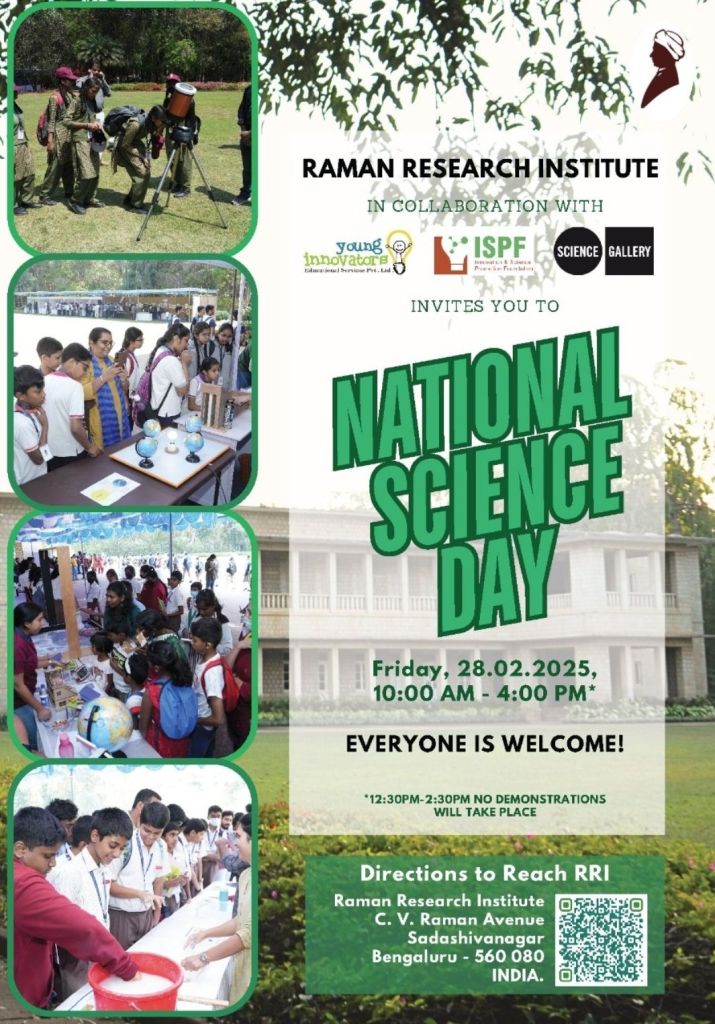
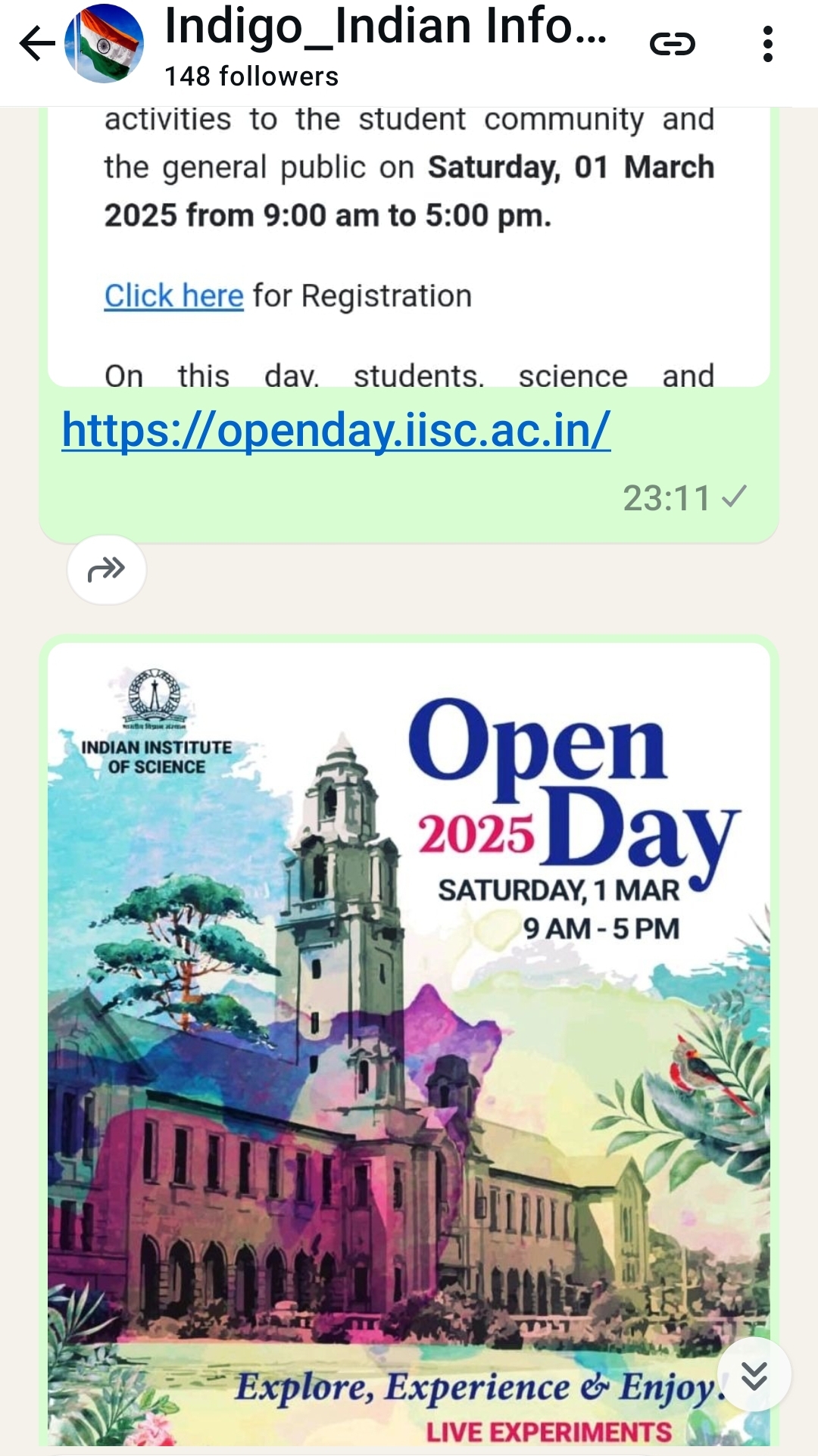
S740: IISc & Other Open Days 2025.. Registration Links & Info.

3+ Excellent Institutes Having Open day for Science Day, Enjoy the Festival of Sciences. #MahaScienceMelas..

IISc Open Day 1st March Info: https://whatsapp.com/channel/0029Vah4hLU5kg6ydM0UtA0h/577

IIAP Open Day 2nd March 2025:

https://whatsapp.com/channel/0029Vah4hLU5kg6ydM0UtA0h/583

3. RRI Open Day.

Exploring.. the depth… ESPians Motto: *Love For Science, Live By Science, Lead With Science.*

*ESP. Place: SciTech_Mitras_Grp:*
Citizens-Mission 4 More Scientific & Rationally_able_India🇮🇳 /2030:
https://chat.whatsapp.com/DCQ5If3f8FuDy3JVJaBq8L

S739: GOD in Politics. GRP +A.I.

Can Nations be Ruled by GOD or G.O.D? 

Real GOD Ruled Nation is one with *G.O.D = Goodness Of Democracy..

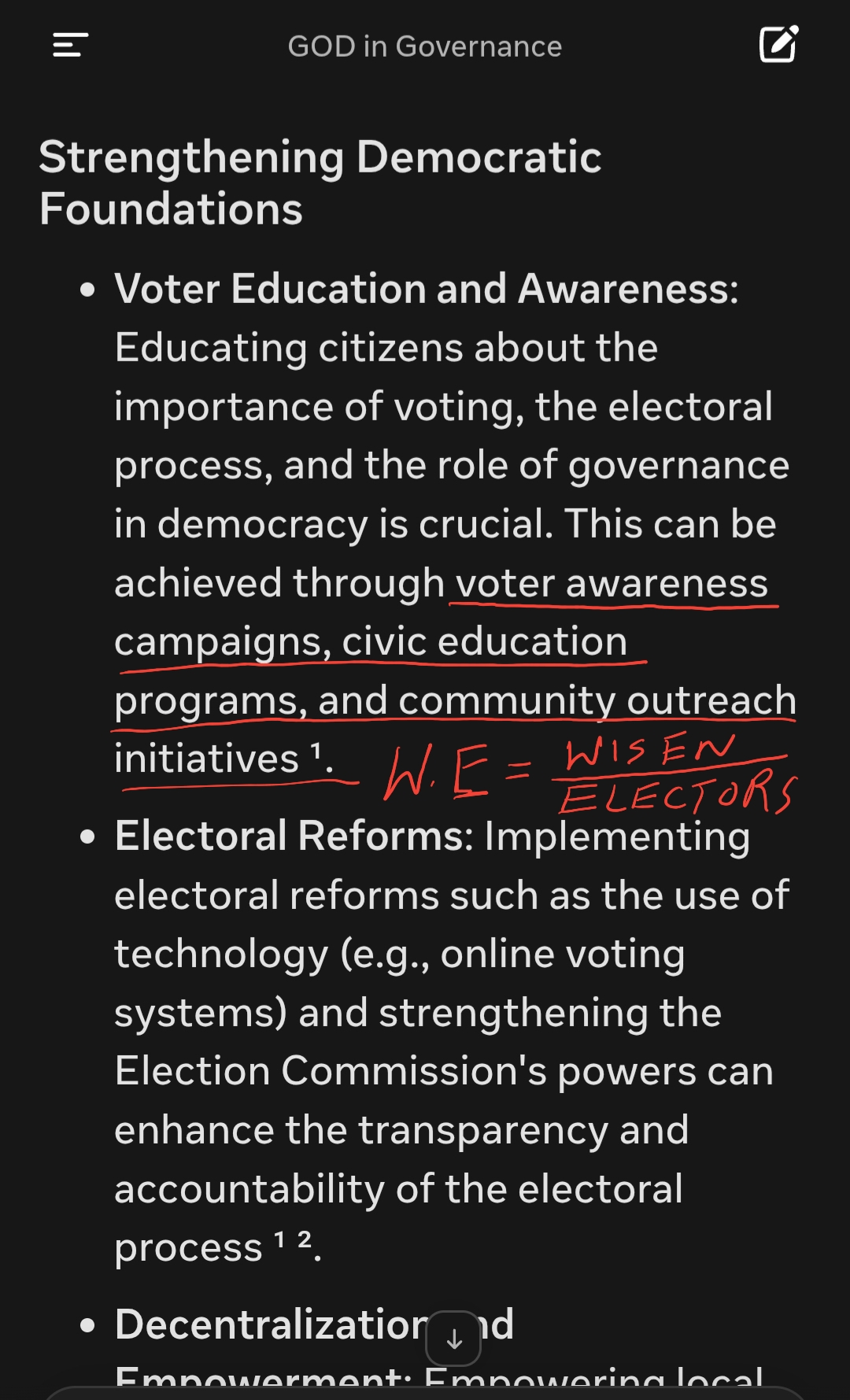
True RAMrajya.. involves R.A.M = Rationality, Altruism & Morality Ruled Nations and Nationals.

there is long way to go to reach peoples G.O.D.. Goodness of Democracy..

How can India as a Nation develop its Democracy, Governance & Voting Citizens?

Developing a nation like India, with its diverse population and complex governance structures, requires a multifaceted approach. To strengthen India’s democracy, governance, and voting citizens, several key areas need attention.

Strengthening Democratic Foundations

Voter Education and Awareness: Educating citizens about the importance of voting, the electoral process, and the role of governance in democracy is crucial. This can be achieved through voter awareness campaigns, civic education programs, and community outreach initiatives ¹.

Electoral Reforms: Implementing electoral reforms such as the use of technology (e.g., online voting systems) and strengthening the Election Commission’s powers can enhance the transparency and accountability of the electoral process ¹ ².

Decentralization and Empowerment: Empowering local governments and decentralizing decision-making processes can bring governance closer to the people, making it more responsive to their needs ³.

Fostering Good Governance

Transparency and Accountability: Promoting transparency in government functioning and ensuring accountability through mechanisms like the Right to Information (RTI) Act can help build trust between citizens and the government ².

Anti-Corruption Measures: Implementing robust anti-corruption laws and enforcing them strictly can help reduce corruption, which is a significant challenge to good governance in India ².

Encouraging Active Citizenship: Encouraging citizens to participate actively in governance through public consultations, town hall meetings, and citizen engagement platforms can foster a sense of ownership and responsibility among citizens ³.

Enhancing Voter Participation

Voter Registration Drives: Conducting voter registration drives, especially among young and first-time voters, can help increase voter turnout ¹.

Voting Infrastructure: Improving voting infrastructure, including the availability of polling stations and the condition of voting machines, can make the voting process more accessible and convenient ¹.

Addressing Voter Apathy: Addressing voter apathy by highlighting the importance of voting and the impact it can have on governance and policy-making can encourage more citizens to participate in the electoral process ².

By focusing on these areas, India can strengthen its democratic foundations, foster good governance, and enhance voter participation, ultimately moving closer to realizing the ideals of “Goodness of Democracy” (G.O.D.) and “Rationality, Altruism, and Morality” (R.A.M.) in its governance and society.

S737: Are Vedas, Biblical or Arabic Writings True Or False?

That Vedas, Sangam Literatures, other scriptures..  are ancient *knowledge bases*.. They may be in form of Prose, Poems or theorems..

Some Fans or Fanatics of Scriptures may defend saying all are true. 

Some Skeptics may offend saying all are false.. Maybe due to their lack of tools to analyse scriptures..

They need not be all accepted as True or All as False.. as We Have come up with a new tool called the Trulse Index of a Content..

This can be used to see that A written work, claims or article can be analysed by degrees of Truthity or Falsity.

Satyapatheye Jayathe.. The True Paths shall Triumph first before the truth..

S42: Tool of ‘Trulse-Index’? NEED4 TRUST-Indices & Project DeepDarshi /SAINTians-grp.

S736: Toxic Genderism More In Cities or Villages? #Justice4Athul.

In India is Toxic Feminism & Toxic Masculinism more in Urban cities, Rural Towns & villages?

Here’s a rewritten version with authentic basis sources:

Toxic feminism is a complex and multifaceted issue in India, and its prevalence varies across urban and rural areas. While research suggests that toxic feminism might be more pronounced in urban areas.

Urban Factors Contributing to Toxic Feminism

  1. Western Influence and Social Media: A study published in the Journal of Women and Social Work notes that urban Indian women are more likely to be influenced by Western feminist ideologies, which can sometimes be misinterpreted or taken to extremes (Belliappa, 2018). Social media platforms, more accessible in urban areas, can amplify these ideas.
  2. Education and Awareness: Research by the Centre for Women’s Development Studies (CWDS) highlights that urban women’s greater access to education and awareness about feminist issues can sometimes lead to a more radicalized understanding of feminism (CWDS, 2019).
  3. Changing Social Dynamics: India’s urban areas are experiencing rapid social changes, including shifting gender roles and expectations. A study by the Indian Journal of Gender Studies notes that this can lead to confusion, anxiety, and, in some cases, toxic feminist reactions (Raju, 2017).

Rural Factors Mitigating Toxic Feminism

  1. Stronger Community Bonds: Research by the Indian Institute of Rural Management (IIRM) emphasizes the importance of strong community ties and social support systems in rural areas, which can help mitigate the influence of toxic feminist ideologies (IIRM, 2020).
  2. Traditional Values: A study published in the Journal of Rural Development highlights the significance of traditional values, such as respect for elders, family, and community, in rural Indian societies (Kumar, 2018). These values can help counterbalance extreme feminist ideologies.

Important Note

It’s essential to recognize that toxic feminism is not representative of the broader feminist movement in India or globally. Feminism, in its true spirit, aims to promote equality, justice, and human rights for all individuals.

References:

Belliappa, J. (2018). Urban Indian Women and Western Feminism: A Critical Analysis. Journal of Women and Social Work, 33(2), 147-162.

Centre for Women’s Development Studies (CWDS). (2019). Women’s Empowerment and Feminist Movements in India.

Indian Institute of Rural Management (IIRM). (2020). Rural Development and Women’s Empowerment.

Kumar, R. (2018). Traditional Values and Rural Development in India. Journal of Rural Development, 37(2), 151-166.

Raju, S. (2017). Changing Gender Roles and Expectations in Urban India. Indian Journal of Gender Studies, 24(2), 147-162.

S735: How Human Values & Nature’s Valves are Interlinked? Q&A by GRP+A.I

Human Actions Impact Natures Reactions & Further Progressions. Nipple Causes & Ripple Effects in Nature-Human Interaction Cycles..

Here’s a rewritten version of the analysis with references and basis from scientific articles:

The statement “Human Values & Nature’s Valves are linked” suggests a profound connection between human values and the natural world. This connection is supported by various scientific studies and theories.

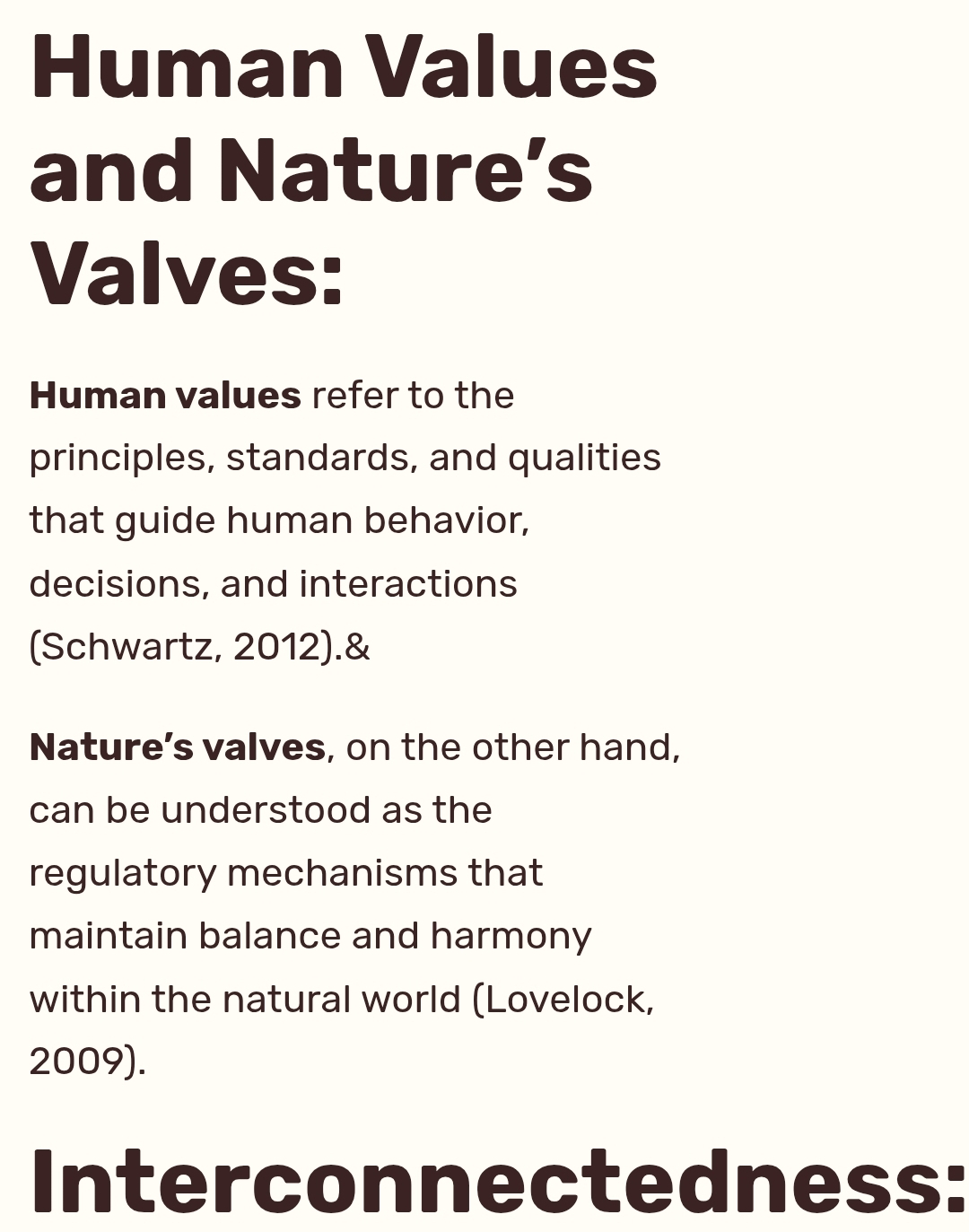
Human Values and Nature’s Valves:

Human values refer to the principles, standards, and qualities that guide human behavior, decisions, and interactions (Schwartz, 2012).&

Nature’s valves, on the other hand, can be understood as the regulatory mechanisms that maintain balance and harmony within the natural world (Lovelock, 2009).

Interconnectedness:

Studies have shown that human values and nature’s valves are interconnected, reflecting the intricate web of relationships between human societies and the natural world (Berkes, 2012). For example, research on traditional ecological knowledge has demonstrated that indigenous communities’ values and practices are closely tied to the natural environment (Berkes, 2012).

Balance and Harmony:

Just as nature’s valves maintain balance and harmony in the environment, human values can promote balance and harmony within human societies and between humans and nature (Kellert, 1993). Research on environmental ethics has emphasized the importance of values such as respect, reciprocity, and responsibility in promoting a harmonious relationship between humans and the natural world (Leopold, 1949).

Regulation and Governance:

Nature’s valves can be seen as a form of regulation, maintaining the health and resilience of ecosystems (Holling, 1973). Similarly, human values can inform governance and decision-making, promoting the well-being of both humans and the natural world (Ostrom, 2010).

Reciprocity and Responsibility:

The connection between human values and nature’s valves highlights the importance of reciprocity and responsibility. Humans have a responsibility to respect and care for nature, just as nature provides for human needs and well-being (Leopold, 1949). Research on environmental citizenship has emphasized the importance of values such as responsibility, justice, and compassion in promoting a sustainable relationship between humans and the natural world (Dobson, 2010).

In conclusion, the statement “Human Values & Nature’s Valves are linked” is supported by various scientific studies and theories. By recognizing the interconnectedness of human values and nature’s valves, we can foster a deeper appreciation for the importance of human values in promoting a harmonious and sustainable coexistence with nature.

References:

Berkes, F. (2012). Sacred ecology: Traditional ecological knowledge and resource management. Taylor & Francis.

Dobson, A. (2010). Citizenship and the environment. Oxford University Press.

Holling, C. S. (1973). Resilience and stability of ecological systems. Annual Review of Ecology and Systematics, 4, 1-23.

Kellert, S. R. (1993). The biological basis for human values of nature. In S. R. Kellert & E. O. Wilson (Eds.), The biophilia hypothesis (pp. 42-69). Island Press.

Leopold, A. (1949). A sand county almanac. Oxford University Press.

Lovelock, J. (2009). The vanishing face of Gaia: A final warning. Allen Lane.

Ostrom, E. (2010). A polycentric approach for coping with climate change. Policy Research Working Paper 5095, World Bank.

Schwartz, S. H. (2012). An overview of the Schwartz theory of basic values. Online Readings in Psychology and Culture, 2(1), 1-20.

S734: Can Our Kindness Bring Us Rain? GRP +A.I

What a thoughtful and creative question! While kindness alone cannot directly bring rain, it can have a positive impact on the environment and the community.

Here are some indirect ways kindness can be connected to rain:

Environmental kindness: When we show kindness to the environment by reducing pollution, conserving water, and protecting natural habitats, we contribute to a healthier ecosystem. This, in turn, can help regulate the water cycle and lead to more balanced precipitation patterns.

Community kindness: Kindness can bring people together, fostering a sense of community and cooperation. When communities work together to address environmental issues, such as restoring watersheds or implementing sustainable agriculture practices, they can help mitigate the effects of droughts and floods.

Climate kindness: By showing kindness to the planet through climate-conscious actions, such as reducing carbon emissions, using renewable energy sources, and promoting sustainable land use, we can help mitigate the effects of climate change, which can lead to more extreme weather patterns, including droughts and floods.

While kindness alone cannot directly bring rain, it can contribute to a more harmonious relationship between humans and the environment, which can have a positive impact on the planet’s ecosystems and weather patterns.

References:

https://scroll.in/article/970919/indias-thar-desert-is-turning-green-that-isnt-a-good-thing

Create your own website, free on WordPress.com.Create your own website.
Start free