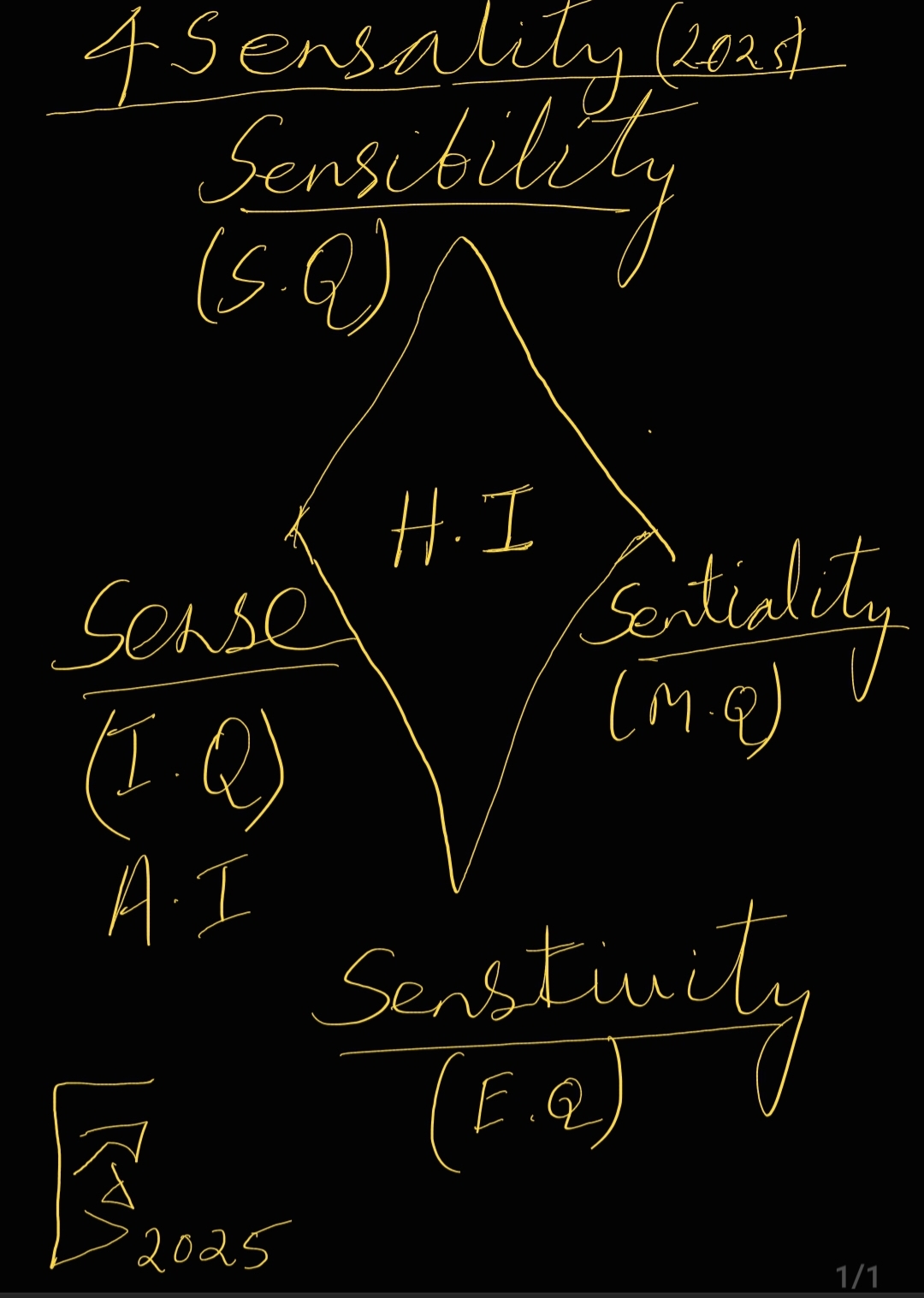
H.I Diamond Model of Human Intelligence by GRP+A.I ere’s the rewritten text with sources and an explanation of the concept of “Sentality” or “Sentiality” created by, Guru Prasad & A.I: The Human Intelligence Equation Human Intelligence (HI) = (0.3 * S) + (0.25 * Se) + (0.20 * Sb) + (0.25 * St) Where: IntroducingContinue reading “S766: “Sentality” the Synergy Factor in Quad-Human Sensality.”
Category Archives: Uncategorized
S765: Sense, Sensitivity & Sensibility: The Human Growth Triad. GRP+A.I
Sense, Sensitivity, and Sensibility: The Triad of Human Growth and Development As humans, we strive for growth, development, and self-actualization. Our journey towards becoming the best version of ourselves requires a harmonious blend of three essential qualities: Sense, Sensitivity, and Sensibility. In this article, we’ll delve into the significance of each, exploring how they intersectContinue reading “S765: Sense, Sensitivity & Sensibility: The Human Growth Triad. GRP+A.I”
S764: How Many & Which all Languages Kids should learn? GRP +Meta A.I.
#Linguistic Secularity & #Linguistic_Polarity In India, a country with incredible linguistic diversity, it’s wonderful that you’re thinking about the optimal languages for a child’s welfare and societal benefit. Optimal languages for a child’s welfare and Indian society: 1. Mother Tongue (Regional Language): A child’s mother tongue is the foundation of their linguistic and cultural identity.Continue reading “S764: How Many & Which all Languages Kids should learn? GRP +Meta A.I.”
S763: Hinditva..
Here’s a revised analysis: Egalitarianism vs. Supremacy “My way or the highway” Hinditva (Hindi Supremacy) Official Language vs. National Language Overall Implications Critical Considerations This revised analysis acknowledges the distinction between Hindi being an official language and not the national language of India, highlighting the importance of linguistic diversity and inclusivity.
S762: Cultured & Cultic Languages Differences..
Cultured languages and cultic languages are two distinct concepts: Cultured Languages Cultic Languages Key differences: Keep in mind that these distinctions are not always clear-cut, and languages can exhibit characteristics from both categories. Here’s a list of references that support the concepts and examples: Books Journals Online Resources Please note that this is not anContinue reading “S762: Cultured & Cultic Languages Differences..”
S761: 2 or 3 Language Theory Comparison for your Sons & Daughters Education. GRP+A.I
The debate surrounding the 2-language versus 3-language theory in Indian education is ongoing. Here’s a brief overview: Two-Language Theory Focuses on teaching two languages, typically the regional language and English. Pros: Simplified curriculum Reduced burden on students Increased focus on other subjects Cons: Limited language exposure Potential disadvantage for students who need to learn HindiContinue reading “S761: 2 or 3 Language Theory Comparison for your Sons & Daughters Education. GRP+A.I”
S760: Statementology
Statementology is a term that refers to the study and analysis of statements, propositions, or assertions. It involves examining the structure, meaning, and implications of statements, as well as the context in which they are made. Statementology can encompass various aspects, including: Statementology can be applied in various fields, such as: By examining statements andContinue reading “S760: Statementology”
S759: True, False, Trulse & Other Possibilities of a Statement.
#StateMENtology: Study of Statements possibilities: A philosophical question! True, False, Trulse, Maybe, and other possibilities are terms used to describe the nature of statements or propositions. In essence:
S758: Using DT for Life Stages from Educating to Managing to Retiring? GRP +A.I
Common Design Thinking (DT) Principles Across Life Stages. Design Thinking has 5 Steps of EDIPT= (Empathize, Define, Ideate, Project-Proto, Test) Empathy: Understand yourself, your partner, your child, or your own needs and emotions. Flexibility: Be adaptable and open to change, growth, and learning. Communication: Establish open, honest, and respectful communication with yourself, your partner, yourContinue reading “S758: Using DT for Life Stages from Educating to Managing to Retiring? GRP +A.I”
S757: DT for DaTing, Marrying & Living Long Life.
Design Thinking for a Divorce-Free and Safe Marriage in the Indian Context Background Marriage is a significant life decision, and selecting the right partner and family can be a challenging task. In India, where family and social dynamics play a crucial role, it’s essential to approach this decision with care and consideration. Design thinking, aContinue reading “S757: DT for DaTing, Marrying & Living Long Life.”
 GRP_VCare2Dare