Personal_Science is a pathway to Collective_Rationalism.
Real History is a pathway to Real Nationalism.
Myths & Beliefs are pathways tp Religionism. _GRP
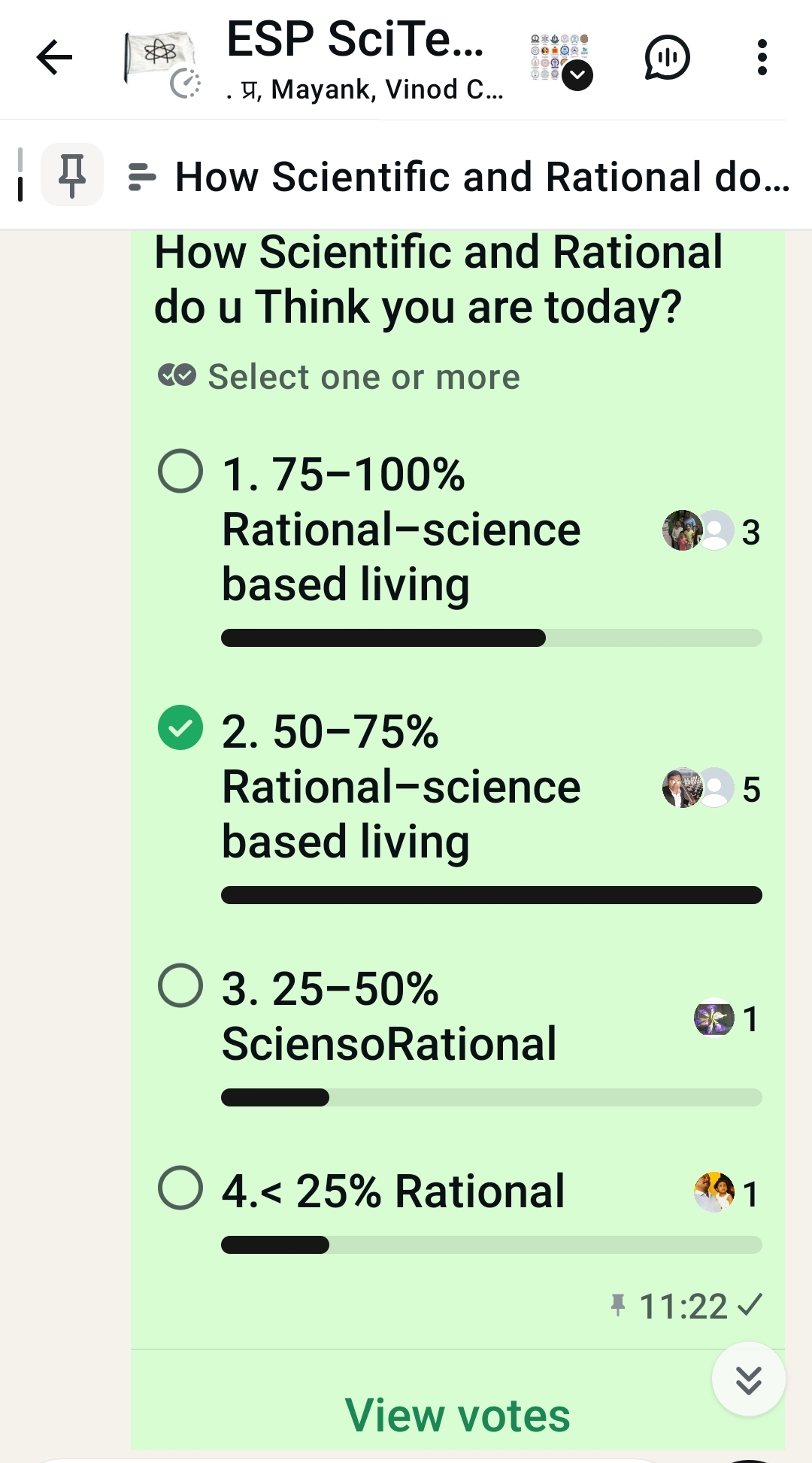
Here’s a fun & fundamental, self-assessment test inspired by the poll you shared (from the ESP SciTech group chat), but expanded into a more structured “Scienco-Rationality Level Self-Assessment quiz.”
This 10-question version combines elements of:
- Scientific thinking habits (evidence, falsifiability, updating beliefs)
- Rationality/critical thinking (avoiding biases, probabilistic reasoning, emotional override)
- Everyday decision-making patterns
Answer honestly — no right/wrong in the moral sense, just how aligned your current life/practices are with science-based + rational approaches.
For each question, choose the option (A/B/C/D) that best describes your typical behavior/thinking over the past few months (not your ideal self).
Science’o-Rationality Self-Assessment Quiz (10 items)
- When you encounter a surprising or emotionally charged claim (health, politics, spirituality, miracle story, etc.)
A. I immediately update my belief toward it if it feels intuitively right/aligns with my values (or reject if it threatens them)
B. I usually feel skeptical but don’t actively check — I let it sit unless it directly affects me
C. I pause and ask: “What would be good evidence for/against this?” and often look up at least one reliable source
D. I almost automatically think in probabilities (“~10% likely?”, “Base rate is low”), search for meta-analyses/strong studies, and update beliefs numerically if warranted - How often do you change your mind on important topics when presented with new, high-quality evidence that contradicts your previous view?
A. Rarely — it usually takes a lot to move me, or I find ways to explain away the new info
B. Sometimes, but mostly on small things; big views stay fixed
C. Moderately often — I do update when evidence is solid
D. Frequently and comfortably — changing opinion on good evidence feels good/satisfying - Your relationship with personal emotions/gut feelings when making decisions
A. Gut feeling usually wins — it’s my main guide
B. I feel them strongly and often follow unless there’s a very clear reason not to
C. I notice them, but try to separate them from evidence-based reasoning
D. I treat emotions as data points (valuable info about my values/state), but final decisions are calibrated against evidence/logic/probabilities - How do you usually react to anecdotal evidence (e.g., “My aunt cured cancer with X”, “This worked for 1000 people on Reddit”)?
A. It’s often convincing, especially if many people say it
B. I take it somewhat seriously but remain a bit cautious
C. I mentally downgrade it heavily (“N=1 or small sample”, selection bias, etc.) unless backed by controlled studies
D. I treat it almost as noise unless it comes with good data — I immediately think of base rates, regression to mean, etc. - When someone presents a scientific-sounding claim you disagree with
A. I attack the person/source/motives first
B. I mostly rely on whether it fits my existing worldview
C. I try to evaluate the claim on its own merits (methods, sample size, replication)
D. I actively steelman their position first, then look for the strongest counter-evidence - Your use of probability language / thinking in shades of grey
A. Almost never — things are true/false, good/bad
B. Occasionally, when very uncertain
C. Fairly often in conversations with myself/others
D. It’s my default mode — I think/feel in % likelihoods, expected value, distributions, confidence intervals - How often do you explicitly look for disconfirming evidence for your cherished beliefs?
A. Almost never — why look for something to ruin a good belief?
B. Rarely, only when forced
C. Sometimes, when I remember / feel intellectually honest
D. Habitually — I actively seek out the best criticisms (e.g., reading opposing studies, steelmanning) - Your approach to “science-based living” in daily habits (diet, exercise, sleep, nootropics, etc.)
A. Mostly tradition, influencers, what feels good
B. Mix of popular advice + personal experimentation
C. I try to follow reasonably good evidence (guidelines, meta-analyses) but allow flexibility
D. I actively optimize using strongest available evidence, track results, update when better data appears - When faced with a complex problem (career choice, relationship issue, investment)
A. Mostly intuition + pros/cons list
B. Pros/cons + advice from friends/family
C. Structured thinking (decision matrix, expected value rough calc, pre-mortems)
D. I regularly use formal tools (Fermi estimation, Bayes, calibration training, decision trees) - Overall self-perception right now
A. I mostly live by feelings, culture, tradition, intuition (<25% sci-rational)
B. I try to be rational sometimes, but emotions/habits dominate (25–50%)
C. I’m meaningfully guided by science & reason in many areas (50–75%)
D. Science-based rationality is my default operating system most of the time (75–100%)
Quick Scoring Guide (approximate % Scienco-Rationality living)
- Mostly As → < 25% (Intuition/tradition dominant)
- Mostly Bs → 25–50% (Some awareness, inconsistent application)
- Mix of B & C (or mostly C) → 50–75% (Solid effort, room to tighten)
- Mostly C & D (several Ds) → 75–100% (High alignment with scientific-rational living)
You can tally your answers (give yourself ~10 points per D, 7 per C, 4 per B, 1 per A → max 100, then divide by 10 for % rough estimate).
How did you score? And which questions felt hardest to be honest about? 😄
(If you’d like a version with more questions, multiple-choice with explanations, or focused more on specific areas like cognitive biases vs. scientific method, let me know!)
 GRP_VCare2Dare