Intro to “Civicware” and “G’OS“: Elevating Group Dynamics to Global Scales.
Puzzling Question:
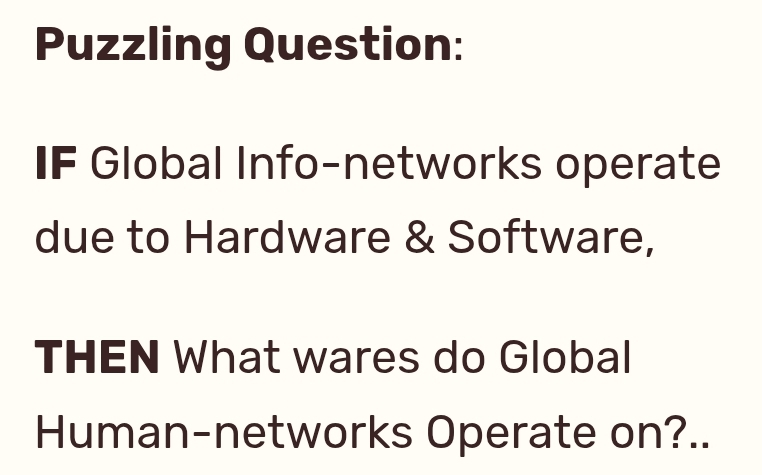
IF Global Info-networks operate due to Hardware & Software,
THEN What wares do Global Human-networks Operate on?..
its Biowares (Body), Mindwares (Brain) & Civicwares (Brotherhoods).
Civicware represents a paradigm shift in how we conceptualize societal software—extending the logic of digital UI/UX (User Interface/User Experience) to the human realm of groups, families, communities, and nations. Just as software governs the interactions of devices and networks,
“Civicware” serves as the foundational “source code” for human systems, from intimate home environments to expansive homelands. It underpins CI/CX (Civilizational Interface/Citizens’ Experience), enabling seamless, equitable, and resilient civic engagements rooted in constitutional principles, rational discourse, and shared human values.
Building on this, G’OS (Group2Global Operating Systems) introduces GI/GX (Group Interface/Group Experience) as the next evolutionary layer. GI/GX scales CI/CX by focusing on peer-driven, collaborative ecosystems that address “globolocal” challenges—issues that transcend borders yet demand localized solutions, such as mental health crises, hyperreligiosity-fueled conflicts, and alienation from rationality. Inspired by initiatives like Project Sagar (to Scientify, Secularize & Speechify the Society), G’OS designs safe spaces for all Citizens, skeptics, agnostics, humanists, atheists, and rationalists, fostering empowerment through good resourceful peer groups (GRP). It transforms unsecularity and division—evident in millennia-old Indo-Asian and Middle Eastern tensions—into unified, evidence-based group dynamics. In essence, G’OS is the operating system for a “Mission Scientific Nations 2030,” where groups operate like optimized networks: adaptive, inclusive, and geared toward hope for Citizens, children and families in 2026 and beyond.
10 Universal Principles of GI/GX Design
These principles draw from the globolocal ethos in the provided discussions—addressing mental health needs (e.g., 1 in 3 Citizens seeking SocioMental support), the perils of hyperreligiosity and unsecularity, and the promise of Project Sagar for rational, secular safe spaces. They provide a blueprint for designing GI/GX systems that empower groups while mirroring constitutional governance as Civicware’s core code. Principles are structured for clarity: Principle, Description, and Application to G’OS. # Principle Description Application to G’OS
1 Secular Neutrality Interfaces must separate religious dogma from group decision-making to prevent bias and conflict. Ensures G’OS platforms prioritize evidence over faith, creating safe spaces for diverse beliefs as in Project Sagar.
2 Rational Evidence-Basing All group experiences grounded in verifiable data and scientific inquiry, combating alienation from rationality. Deploys analytics in G’OS for fact-checked discussions, empowering children and families against misinformation.
3 Inclusivity for the Marginalized Design for skeptics, agnostics, humanists, and at-risk groups (e.g., those needing mental health support). G’OS features peer-matching for underrepresented voices, addressing 1-in-3 mental health gaps globolocally.
4 Empathetic Mental Health Integration Embed professional support mechanisms to foster emotional resilience amid societal stresses. G’OS alerts and connects users to resources, turning hyperreligiosity-induced wars into healing dialogues.
5 Globolocal Scalability Principles apply universally yet adapt to local contexts, from homes to homelands. G’OS modules scale from family networks to international coalitions, solving “same game, different names” issues.
6 Transparency in Dynamics Open-source group processes to build trust, akin to constitutional “source code.” G’OS dashboards reveal decision flows, rooting civicware in accountable governance.
7 Collaborative Peer Empowerment Leverage GRP (Good Resourceful Peer Groups) for collective upliftment and innovation. G’OS facilitates 2Empower-style networks, turning isolation into resourceful alliances.
8 Adaptive Specification Clearly define roles and norms while allowing evolution to societal changes. Project Sagar-inspired specs in G’OS evolve with user feedback, specifying secular paths forward.
9 Resilience Against Division Proactively counter unsecularity and 2000-year-old conflict patterns through unifying experiences. G’OS simulations model peace-building, applying Indo-Asian lessons to global civicware.
10 Sustainable Hope-Oriented Outcomes Prioritize long-term well-being, offering hope to future generations like Indian children in 2026. G’OS metrics track progress toward Scientific Nations 2030, ensuring enduring group vitality.
Top 10 Academic References
These references were selected for their relevance to civic technology design, principles of societal interfaces, secularism in group dynamics, rationality in human systems, and mental health integration in civic tech. They provide foundational support for GI/GX as an extension of CI/CX.
- Corbett, E., & Le Dantec, C. (2021). Designing civic technology with trust. Proceedings of the 2021 CHI Conference on Human Factors in Computing Systems.
- May, A., & Ross, T. (2018). The design of civic technology: Factors that influence public participation and impact. Ergonomics, 61(2), 214-225.
- Graeff, E. (2016). Making drones civic: Values and design principles for civic technology. International Conference on Communities and Technologies.
- Nah, S., & Yamamoto, M. (2017). Civic technology and community building: Interaction effects between integrated connectedness to a storytelling network and Internet/mobile uses on civic participation. Journal of Computer-Mediated Communication, 22(2), 179-195.
- Clarke, G., Jennings, M., & Shaw, T. (Eds.). (2007). Development, civil society and faith-based organizations: Bridging the sacred and the secular. Springer.
- Mehregan, A. (2017). Secular cultural policy in Islamic countries: Desirability and feasibility. International Journal of Cultural Policy, 23(1), 17-35.
- Bussu, S., Senabre Hidalgo, E., & Schulbaum, O. (2023). Make (digital) space for and with the young: Arts-inspired co-design of civic tech for youth mental health policies. Proceedings of the 2023 CHI Conference on Human Factors in Computing Systems.
- Stephens-Reicher, J., et al. (2011). Reaching the hard-to-reach: How information communication technologies can reach young people at greater risk of mental health difficulties. Early Intervention in Psychiatry, 5(s1), 28-33.
- Rumbul, R. (2015). ICT and citizen efficacy: The role of civic technology in facilitating government accountability and citizen confidence. In ICT for Promoting Human Development and Protecting the Environment (pp. 155-169). Springer.
- Afzalan, N., & Hackathorn, R. (2014). Do or do not, there is no try: User-centered design, medical Internet research, and the complete dearth of pre-publication models for validating e-health artifacts. BMC Medical Informatics and Decision Making, 14(1), 1-10. (Focus on civic tech resilience and policy impact).
*#Global-Society 2Scientify D’SELF & Gen_Nxt*: Join Scientific Mitras with this link..
https://chat.whatsapp.com/DCQ5If3f8FuDy3JVJaBq8L
 GRP_VCare2Dare