Ahimsa Paramo Dharma, Jeeva-Rakshana Dharmo Karma.. If Non-violence is a virtue, then protecting all life is religious activity.
An “Indo-Ethican” philosophy blends the modern global movement of ethical living with the deep-rooted spiritual and philosophical traditions of the Indian subcontinent—specifically the concepts of Ahimsa (non-violence), Asteya (non-stealing), and Dharma (righteous duty).
The following is a manifesto for a life that honors both the Earth and the ancient wisdom of the East.
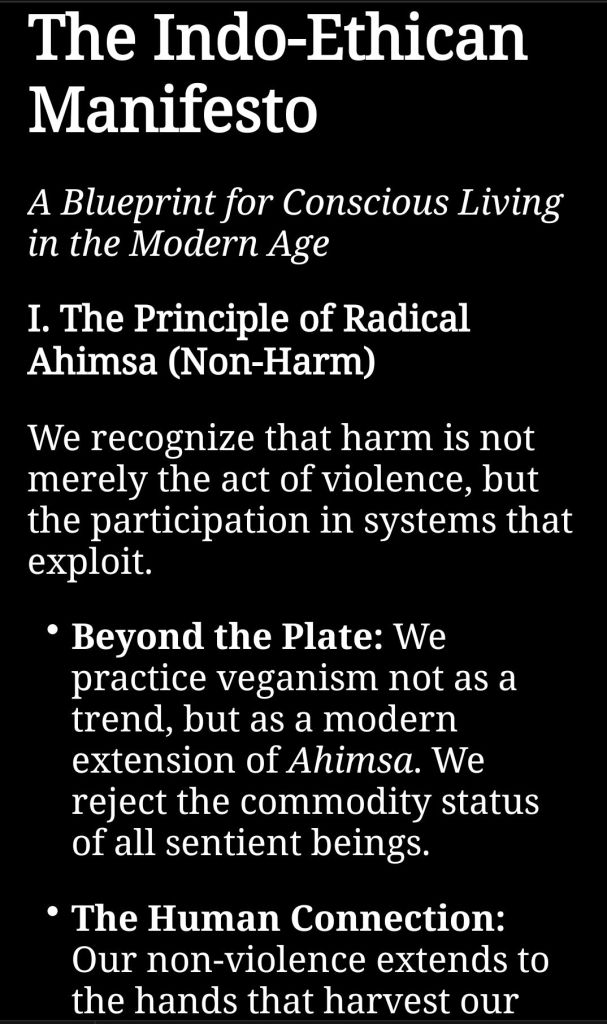
The Indo-Ethican Manifesto
A Blueprint for Conscious Living in the Modern Age
I. The Principle of Radical Ahimsa (Non-Harm)
We recognize that harm is not merely the act of violence, but the participation in systems that exploit.
- Beyond the Plate: We practice veganism not as a trend, but as a modern extension of Ahimsa. We reject the commodity status of all sentient beings.
- The Human Connection: Our non-violence extends to the hands that harvest our food and stitch our clothes. If a product is “cruelty-free” for animals but made through the exploitation of human labor, it is not Ethican.
II. The Vow of Asteya (Non-Stealing)
In a world of overconsumption, taking more than one needs is a form of stealing from future generations and the Earth.
- Minimalism as Devotion: We choose “enough” over “more.” We reject the “throwaway culture” of fast fashion and planned obsolescence.
- Resource Honor: We treat water, soil, and air as sacred trusts, not assets to be depleted. To pollute is to steal from the collective well-being.
III. Radical Localism & Swadeshi
Inspired by the concept of Swadeshi (self-sufficiency), we prioritize the local over the global to reduce our carbon footprint and support our immediate communities.
- Ancestral Wisdom: We look to traditional Indian practices—such as composting, using natural cleansers (neem, reetha), and seasonal eating—as high-tech solutions for a low-impact life.
- The Artisan Over the Assembly Line: We support the weaver, the potter, and the farmer. We value the “soul” of an object over the convenience of a mass-produced one.
IV. Purity of Intent (Manas)
Ethical living is not a performance; it is an internal discipline.
- Mindful Consumption: Before every purchase, we ask: Who suffered for this? Who benefits from this? Is this necessary?
- Digital Ethics: We extend our ethics to the digital realm, practicing “digital Ahimsa” by refusing to engage in online hate, misinformation, or the consumption of data-extractive platforms that harm mental health.
V. Dharma (The Duty of Care)
We do not live ethically to be “pure,” but to fulfill our Dharma—our duty to the interconnected web of life.
- Stewardship: We are not masters of the Earth, but its gardeners.
- Advocacy: To see an injustice and remain silent is a breach of Ethican duty. We speak for the voiceless—the animals, the exploited workers, and the ecosystem itself.
“The world has enough for everyone’s need, but not for everyone’s greed.” — The foundational spark of Indo-Ethican thought.
Would you like me to expand on how an Indo-Ethican might approach specific modern challenges, like electronics or urban travel?
While these three terms overlap significantly, they represent a progression from a dietary choice to a specific philosophy, and finally to a comprehensive moral system.
Here is the breakdown of the nuances between them.
1. Vegan (The Broad Term)
In modern usage, “vegan” is often used as a catch-all term, but it is frequently divided into two sub-categories: Dietary and Lifestyle.
- Focus: Primarily what a person consumes.
- Motivation: Can be varied (health, environment, or trend-following).
- The Difference: A “dietary vegan” (or plant-based eater) avoids animal products in their food but might still wear leather, use wool blankets, or buy cosmetics tested on animals.1
2. Ethical Vegan (The Philosophical Belief)
This is the original definition of veganism as established by The Vegan Society.2 In many countries (like the UK), it is legally recognized as a protected “philosophical belief.”3+1
- Focus: The rejection of the commodity status of animals.4
- Motivation: Moral opposition to animal exploitation and suffering.5
- The Difference: Unlike a dietary vegan, an ethical vegan extends their choices to every aspect of life.6 They will not buy leather, silk, or wool; they avoid zoos and circuses; and they ensure their soap and makeup are “cruelty-free.”7 For them, the diet is a consequence of their ethics, not just a health choice.+1
3. Ethican (The Holistic Lifestyle)
“Ethican” is a newer, broader term (often associated with the “Ethical Living” movement) that incorporates veganism but expands it to include human rights, social justice, and environmentalism.
- Focus: Universal ethics across all forms of consumption and behavior.
- Motivation: A desire to minimize harm to all sentient beings (humans included) and the planet.8
- The Difference: An Ethican might argue that a vegan product made in a sweatshop is “unethical,” even if it’s animal-free. Their lifestyle involves:
- Labor Rights: Avoiding brands that use child labor or unfair wages.
- Sustainability: Reducing plastic, zero-waste living, and minimalist consumption.
- Daily Living: Choices regarding banking (divesting from fossil fuels), travel, and even interpersonal interactions based on a “do no harm” (Ahimsa) ideology.
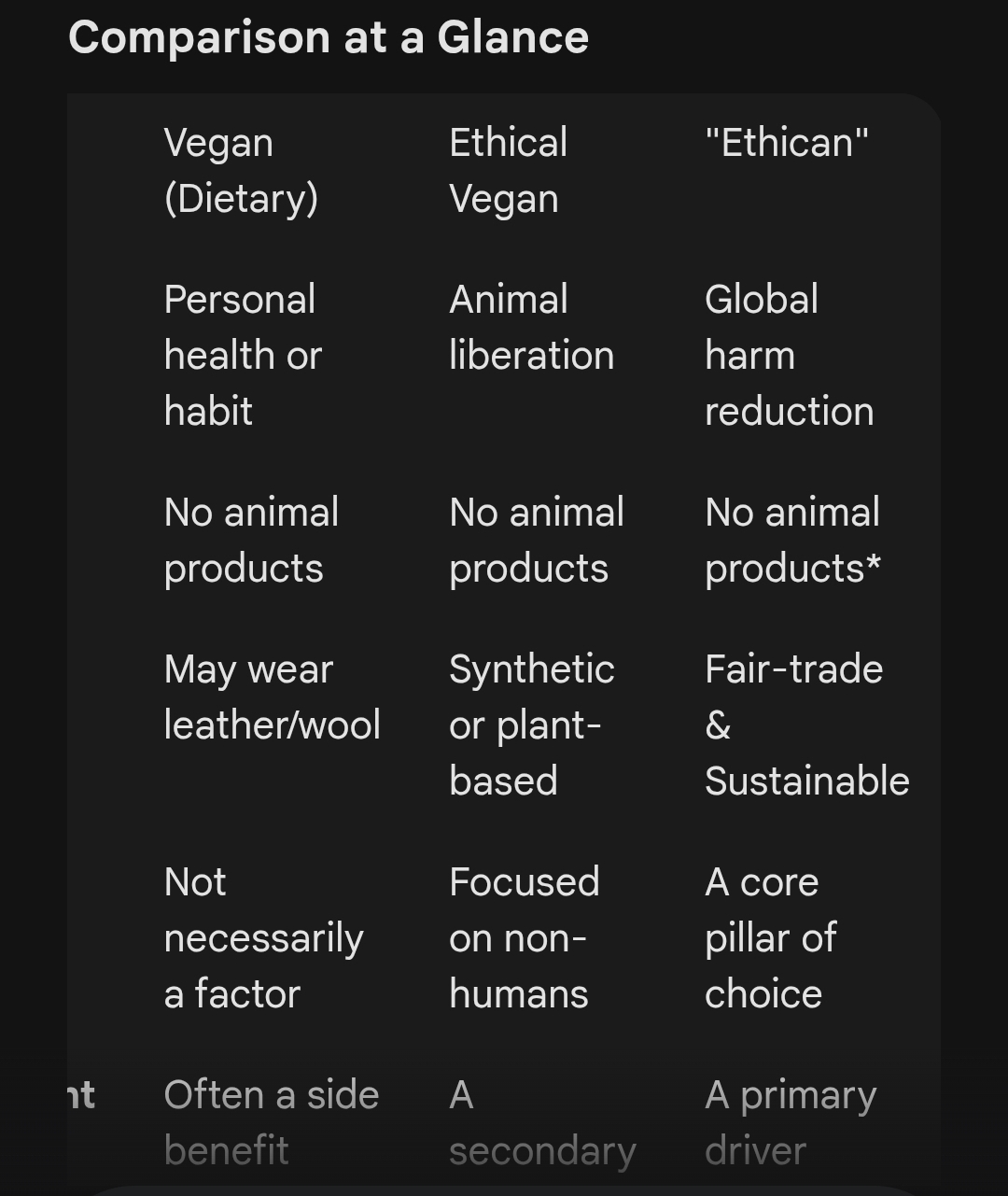
Comparison at a Glance
Feature
Vegan (Dietary) Ethical Vegan
“Ethican”
Primary Goal Personal health or habitAnimal liberation Global harm reduction
DietNo animal productsNo animal productsNo animal products*
ClothingMay wear leather/woolSynthetic or plant-basedFair-trade & Sustainable
Human RightsNot necessarily a factorFocused on non-humansA core pillar of choice
Environment Often a side benefit A secondary concern A primary driver
*Note: While most Ethicans are vegan, some rare “Ethical Omnivores” use this label to describe a diet of only hunted or locally farmed food, though in modern discourse, an “Ethican” usually implies a vegan baseline.
Ethicists & Moralists 4Humanity *EmpEthical-India2030*
*GrpAIM:* Ethics’ Awareness & Ideate@Fellowship of Moral-Spacers. *Group4neEthical2030*
*#TrendEthics & EndCorruption*
*GroupSharing:* Ethics & Moral-literacy/resrch.
Dedicated2 Aristotle-Ethics, Thiruvalluvar(Needhi) & Indian Constitutional Ethics..(Article 51.A).
*Niyatic-Space4 nEthic-Mitras*
D: Lets Improve Corruption Perversion Index of from 40(2022) to 70/100 by 2030. & CPI Rank from 93 to 20th.
Hpy_MoralMondays.
*Humanities_Grp4 Ethical-Inquiry neEthic_Mitras Space4 Indian_Ethics & Morality:*
https://chat.whatsapp.com/JBUMcGNzyug8Jfm3khKyK3
 GRP_VCare2Dare