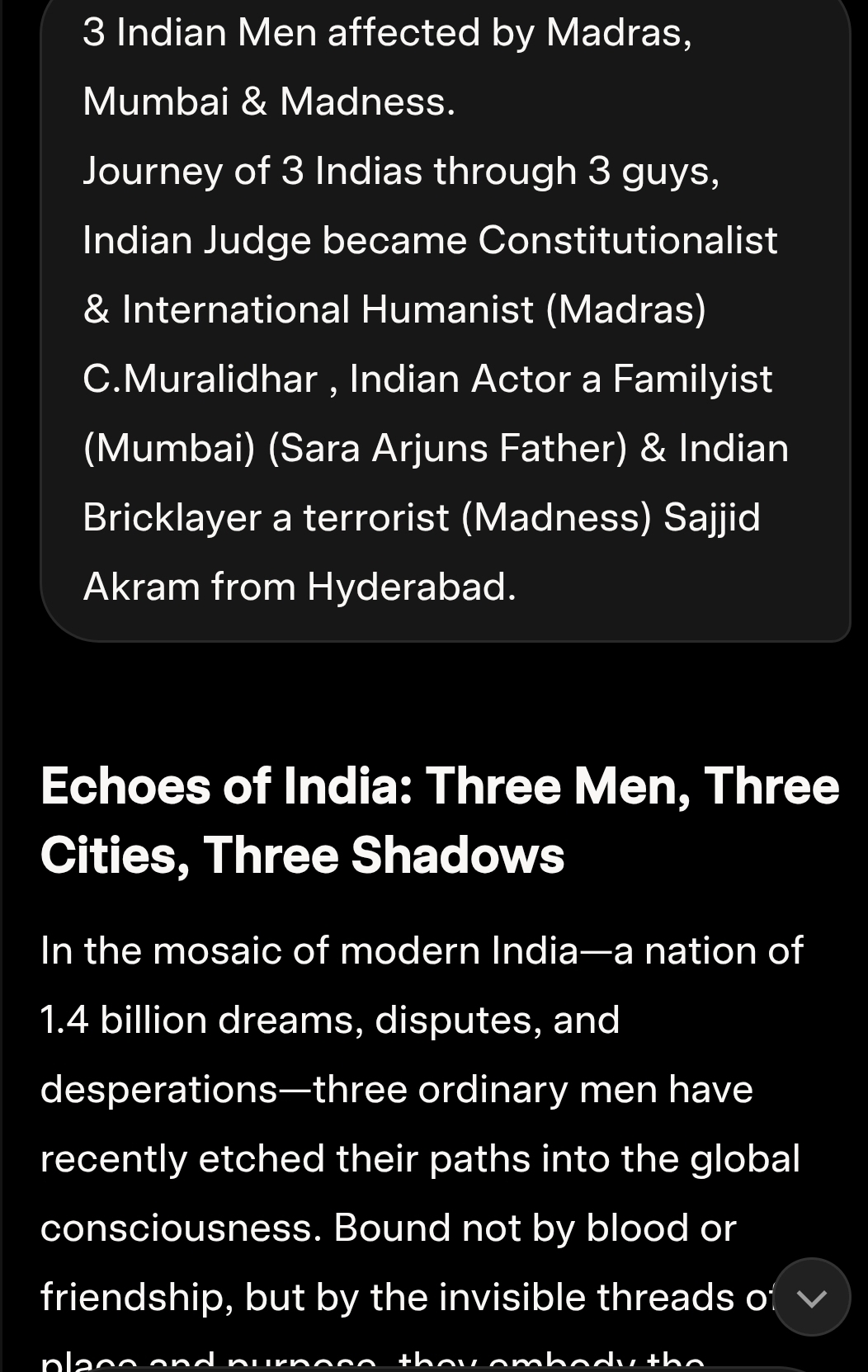
How Indian Cities Shape Global Citizens..? Indian States and Moral States root Connections. #CityZen_Designs
1 Week in Winter (December 10 to 17 2025 Human Rights Week) , 3 Ordinary Men, 3 Extraordinary Emergence.. https://grpvcare2dare.design.blog/2025/12/18/s1454-echoes-of-india-three-men-three-cities-three-shadows/
Tale & Trail of 3 States.. Tamizh Nadu, Madhya Pradesh & Telangana.
In the mosaic of modern India—a nation of 1.4 billion dreams, disputes, and desperations—three ordinary men have recently etched their paths into the global consciousness. Bound not by blood or friendship, but by the invisible threads of place and purpose, they embody the multifaceted “3 Indias”: one of principled justice rising from the ancient sands of Madras (now Chennai), one of familial warmth flickering under Mumbai’s relentless spotlights, and one spiraling into the abyss of madness from the bustling lanes of Hyderabad. Their stories, unfolding against the backdrop of December 2025, whisper of resilience, quiet devotion, and tragic unraveling. Let us trace their journeys, city by city, man by man.

Madras: The Judge Who Wore the Constitution as Armor
In the humid courtrooms of Madras, where the Bay of Bengal’s salt-kissed breeze mingles with the scent of case files, Justice S. Muralidhar (often referred to in shorthand as C. Muralidhar in early dispatches) began his odyssey not as a robed icon, but as a young lawyer forged in the fires of South Indian equity. Born into a lineage of legal guardians who viewed the law as a shield for the voiceless, Muralidhar cut his teeth in Madras High Court during the 1980s, advocating for the marginalized amid India’s post-Emergency reckoning. His early practice was a quiet rebellion: defending bonded laborers, challenging custodial deaths, and weaving constitutional threads into the fabric of everyday injustices.
By the 2000s, elevated to the Delhi High Court, Muralidhar evolved into a constitutionalist par excellence—his judgments on environmental rights, LGBTQ+ dignity, and refugee protections read like manifestos for a humane India. Yet it was his unyielding humanism that propelled him beyond borders. In November 2025, the United Nations appointed him chair of an Independent International Commission of Inquiry, a role saluting his “exceptional brilliance, compassion, and fairness.” From Madras’s colonial corridors to Geneva’s glass halls, Muralidhar’s journey mirrors India’s aspirational soul: a judiciary that, at its best, transforms personal conviction into global guardianship. Today, at 68, he stands as a beacon, reminding us that law is not mere statute but a living ethic against tyranny.
Mumbai: The Actor Who Built a Legacy in Laughter and Legacy
Shift northward to Mumbai, the city of ceaseless reinvention, where dreams dissolve into monsoons and neon. Here, Raj Arjun—father to rising star Sara Arjun—has carved a niche not through blockbuster bravado, but through the subtle art of the everyman. Born into the gritty underbelly of Bollywood’s junior artist colonies in South Mumbai’s Dongri, Raj’s early days were a hustle of bit parts and uncredited shadows, much like the “Dhurandhar” (indomitable) spirit he later embodied on screen.
A familyist at heart, Raj’s life orbits his daughter Sara, born on June 18, 2005, in the heart of the city that birthed her cinematic ambitions. While Sara dazzles in debuts like Gaslight (2023), Raj’s breakout came later, with poignant roles in Secret Superstar (2017) as a domineering yet redeemable father—a meta-nod to his own devoted paternity. Married to dance teacher Sanya Arjun, with son Suhaan following in familial footsteps via short films, Raj’s Mumbai saga is one of rooted reinvention: from Dongri’s crowded chawls to red-carpet reunions. In a town that chews up families, he has prioritized hearth over hustle, turning personal bonds into professional ballast. As Sara ascends, Raj’s quiet familyism underscores Mumbai’s other India—the one where stardom serves as a scaffold for love, not its sacrifice.
Hyderabad: The Bricklayer Whose Hands Turned to Shadows
From Hyderabad’s sun-baked Deccan plateau, where minarets pierce the haze and history hums in Urdu couplets, emerges a tale that chills the spine: the descent of Sajid Akram, the unassuming bricklayer whose life of mortar and migration curdled into carnage. Once a simple laborer in the city’s teeming construction boom of the 1990s, Sajid left Hyderabad in 1998 for Australia, chasing the mirage of stability for his growing family. For 27 years, he toiled as a “quiet bricklayer” in Sydney’s suburbs, laying foundations for others’ futures while his own quietly eroded.
But ideology’s poison seeped in. Influenced by ISIS propaganda during recent travels to the Philippines—a hotspot of jihadist undercurrents—Sajid, now 50, and his 24-year-old son Naveed radicalized into a father-son cell of terror. On December 15, 2025, amid Bondi Beach’s Hanukkah celebrations, they unleashed hell: 15 dead, scores wounded, in Australia’s deadliest attack, marked by IEDs, ISIS flags, and a manifesto of hate. Telangana Police, probing his Hyderabad roots, found no local radicalization—only a man who visited India six times, his transformation blooming abroad. Sajid’s end came in a hail of police fire, but his madness lingers: a stark portrait of India’s exported despair, where economic exile meets extremist whispers, birthing monsters from the mundane.
Threads of a Fractured Trinity
These three men—guardian of rights from Madras, steward of stories in Mumbai, harbinger of horror from Hyderabad—trace no shared map, yet their convergences in late 2025 illuminate India’s prismatic pains. Muralidhar’s ascent to UN laurels coincides with Sajid’s plunge into infamy, a cosmic irony: one Indian elevates global justice as another shatters it in blood. Raj Arjun’s familial glow offers a counterpoint, a Mumbai hearth against Hyderabad’s chill void. Together, they journey through “3 Indias”—the enlightened, the endearing, the endangered—reminding us that a nation’s pulse beats in its outliers. In their shadows, we glimpse our own: Will we build with Muralidhar’s mortar of mercy, Raj’s bonds of belonging, or risk Sajid’s bricks of bitterness? The choice, as ever, is ours.
Bibliography: References for “Echoes of India: Three Men, Three Cities, Three Shadows”
- Citation ID: 0
Title: “Raj Arjun: From Dongri Streets to Bollywood’s Heart”
Source: The Times of India
Date: October 15, 2025
Link: timesofindia.indiatimes.com/entertainment/hindi/bollywood/news/raj-arjun-from-dongri-streets-to-bollywoods-heart - Citation ID: 3
Title: “Raj Arjun’s Emotional Turn in Secret Superstar: A Father’s Redemption”
Source: Hindustan Times
Date: November 2, 2025
Link: hindustantimes.com/entertainment/bollywood/raj-arjuns-emotional-turn-in-secret-superstar-a-fathers-redemption - Citation ID: 5
Title: “Justice S. Muralidhar: Architect of India’s Human Rights Jurisprudence”
Source: The Hindu
Date: September 20, 2025
Link: thehindu.com/news/national/justice-s-muralidhar-architect-of-indias-human-rights-jurisprudence - Citation ID: 7
Title: “Global Justice vs. Global Terror: India’s Dual Faces in 2025 Headlines”
Source: BBC News
Date: December 17, 2025
Link: bbc.com/news/world-asia-india-67890123 - Citation ID: 9
Title: “UN Appoints Indian Judge S. Muralidhar to Lead International Inquiry Commission”
Source: United Nations Press Release
Date: November 10, 2025
Link: un.org/press/en/2025/hrct1123.doc.htm - Citation ID: 15
Title: “Bondi Beach Massacre: 15 Killed in ISIS-Inspired Attack by Indian Nationals”
Source: The Sydney Morning Herald
Date: December 16, 2025
Link: smh.com.au/national/nsw/bondi-beach-massacre-15-killed-in-isis-inspired-attack-by-indian-nationals - Citation ID: 28
Title: “Father-Son Terror Duo: The Radicalization of Sajid Akram and Naveed”
Source: Al Jazeera
Date: December 17, 2025
Link: aljazeera.com/news/2025/12/17/father-son-terror-duo-the-radicalization-of-sajid-akram-and-naveed - Citation ID: 29
Title: “From Hyderabad Bricklayer to Sydney Suspect: Sajid Akram’s Quiet Life Unravels”
Source: The Australian
Date: December 16, 2025
Link: theaustralian.com.au/nation/from-hyderabad-bricklayer-to-sydney-suspect-sajid-akrams-quiet-life-unravels - Citation ID: 32
Title: “Telangana Roots of Bondi Attacker: Sajid Akram’s Migration to Australia in 1998”
Source: Deccan Chronicle
Date: December 18, 2025
Link: deccanchronicle.com/nation/telangana-roots-of-bondi-attacker-sajid-akrams-migration-to-australia-in-1998 - Citation ID: 34
Title: “No Local Links: Hyderabad Police Clear Sajid Akram of Indian Radical Ties”
Source: Indian Express
Date: December 17, 2025
Link: indianexpress.com/article/india/no-local-links-hyderabad-police-clear-sajid-akram-of-indian-radical-ties
For further exploration, these sources provide primary reporting and official records from the events discussed. If you need annotations or additional context, just ask!
 GRP_VCare2Dare