Light of Bondi(Aus) Massacre by Radical Islamists Mass Shooters.
Home Affairs minister Tony Burke said on Monday. The elder Akram arrived on a student visa, and later transferred to a partner visa in 2001.
Indian authorities confirmed Tuesday that Sajid Akram was originally from the southern Indian city of Hyderabad, Father-Son had Radicalization Training from Phillipines.
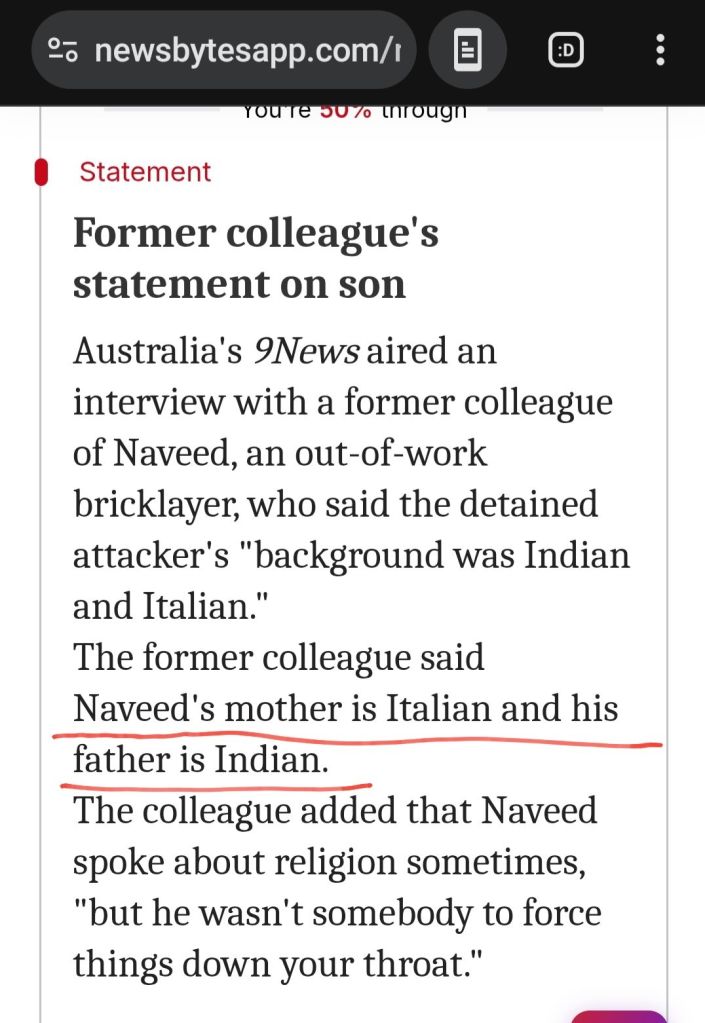
Italian Mother and Indian Father ??.. Parental-Radicalization. https://www.newsbytesapp.com/news/world/driven-by-is-ideology-details-emerge-about-bondi-beach-shooters/story
Studying Interreligious Conflicts: A Historical and Sociological Overview
Indigenous & Indivisive
Interreligious conflicts—clashes between adherents of different faiths—have shaped human history, often serving as proxies for power struggles, resource competition, and identity formation. These conflicts are not merely theological but deeply intertwined with socio-political dynamics, where religions act as “brands” in a competitive marketplace of beliefs. Drawing from historical records and sociological analyses, such disputes frequently pit emerging, structured faiths against entrenched, fragmented traditions. Centralized religions (e.g., those with hierarchical institutions like a unified clergy or doctrinal authority) often emerge as “disruptors,” challenging the decentralized “old guard” (e.g., polytheistic or animistic systems lacking a single authority). This pattern is evident in conquests, persecutions, and cultural erasures, where the victors impose monopoly-like control to consolidate loyalty and resources.
Key patterns from historical studies:
- Theological Exclusivism vs. Pluralism: Centralized faiths often promote “one true path” doctrines (e.g., monotheism’s rejection of idols), framing rivals as idolatrous or demonic. Decentralized ancient religions, like Roman paganism or pre-Islamic Arabian polytheism, tolerated syncretism but lacked unified defense mechanisms, making them vulnerable.
- Political Instrumentalization: Rulers exploit religion for legitimacy. In autocracies, decentralized faiths resist co-option, leading to instability, while centralized ones align with state power for domination.
- Economic Dimensions: Religions function as “firms” in a market, per rational choice theory. Monopolies stifle innovation but ensure compliance; competition fosters vitality but sparks conflict.
- Modern Echoes: Sectarianism in the Middle East (e.g., Sunni-Shiite divides) or evangelical incursions into indigenous Latin American faiths show ongoing “market share” battles, often amplified by globalization.
Historical Examples of Centralized “Newcomers” vs. Decentralized Ancients
Interreligious violence peaks when a centralized faith gains imperial backing, ruthlessly dismantling decentralized rivals to eliminate competition. Below is a table of pivotal cases: Era/Region New Centralized Religion Ancient Decentralized Target Nature of Attack Outcome/Monopoly Achieved
Roman Empire (1st-4th CE) Early Christianity (emerging hierarchy via bishops/councils) Pagan polytheism (temple cults, emperor worship—fragmented local rites) Initial persecutions by pagans; reversal post-Constantine (Edict of Thessalonica, 380 CE: Christianity state religion; temple destructions, idol bans) Christian monopoly in Europe; paganism marginalized as “superstition.”
Arabian Peninsula (7th CE) Islam (centralized under Muhammad’s caliphate, unified Quran/sharia) Pre-Islamic polytheism (tribal idols like Hubal—decentralized, no central authority) Conquest of Mecca (630 CE): Kaaba cleansed of 360 idols; forced conversions, execution of poets mocking the faith Rapid Islamic monopoly across Arabia; polytheism & Jewism eradicated as “jahiliyyah” (ignorance).
Medieval Europe (4th-11th CE) Medieval Christianity (papal/Vatican centralization) Germanic/Norse paganism (decentralized clans, oral myths, no unified scripture) Charlemagne’s Saxon Wars (772-804 CE): Forced baptisms, Irminsul pillar destruction; Inquisition-like purges Christian dominance in Holy Roman Empire; pagan survivals demonized as witchcraft.
Mesoamerica (16th CE) Spanish Catholicism (centralized Inquisition, papal bulls) Aztec/Maya polytheism (city-state priesthoods, ritual sacrifices—decentralized alliances) Conquest (1519-1521 CE): Temple razings (e.g., Templo Mayor), auto-da-fé burnings of codices; syncretism enforced but core rites banned Catholic monopoly in colonies; indigenous faiths underground or hybridized.
Modern Africa (19th-20th CE) Colonial Protestantism/Islam (missionary hierarchies, state-backed) Indigenous animism (village shamans, ancestor cults—highly decentralized) Scramble for Africa: Missionary schools demonizing “fetishism”; iconoclasm (e.g., Congo Free State crucifixions of resisters) Religious monopolies via education/land grabs; ancient rites labeled “primitive.”
These cases illustrate a ruthless pattern: Centralized faiths, backed by military/state power, deploy iconoclasm (destroying symbols), forced conversions, and narrative reframing (e.g., old gods as demons) to capture “market share.” Decentralized systems, lacking a “CEO” or unified doctrine, fragment under assault, accelerating their decline.
Theorizing the Dynamics: The “Theocratic Cartel Theory” of Religious Monopoly
Building on religious economies theory (which views faiths as suppliers in a belief market, where monopolies suppress competition but breed complacency), I propose the Theocratic Cartel Theory (TCT): Emerging centralized religions function as “cartels”—oligopolistic entities colluding (via doctrine, hierarchy, and alliances) to monopolize the global “soul market” for ideological, economic, and political domination. Unlike benign market competition, these cartels ruthlessly target “old guard” decentralized religions as existential threats, employing asymmetric warfare to eliminate rivals and consolidate control.
Core Tenets of TCT
- Cartel Formation and Centralization as a Survival Strategy: Ancient decentralized religions (e.g., polytheisms) thrive in pluralistic “free markets” through niche adaptation and low barriers to entry (local rituals, no orthodoxy). New centralized faiths arise in crises (e.g., Roman decay birthing Christianity; tribal feuds spawning Islam), forging hierarchies (popes, caliphs) for efficiency. This “vertical integration” enables scalable proselytism, doctrinal enforcement, and resource pooling (tithes, conquest spoils), mirroring corporate monopolies.
- Ruthless Attacks on the Old Guard for Market Domination: Decentralized faiths represent “disruptive competition”—their fluidity allows syncretism, diluting the cartel’s exclusivity. To attain monopoly, new religions launch “predatory campaigns”:
- Ideological Sabotage: Reframe ancients as “barbaric” or “satanic” (e.g., Christian demonization of Norse gods).
- Material Destruction: Iconoclasm erases competitors’ “intellectual property” (temples, texts), preventing revival.
- Coercive Acquisition: Forced conversions and state edicts create “hostile takeovers,” absorbing adherents en masse.
This mirrors antitrust violations: Cartels crush independents to hike “prices” (devotion, compliance) without rivalry.
- Global Monopoly Imperative: In a “globalizing market” (empires, trade routes), cartels expand transnationally, viewing decentralization as a contagion risk. Success metrics: Convert 80%+ populations, control education/narratives, and suppress pluralism (e.g., post-Reformation Europe’s religious wars enforcing Catholic/Protestant duopoly). Decentralized holdouts (e.g., surviving pagan enclaves) are tolerated only as “reservations” until fully assimilated.
- Internal Vulnerabilities and Cycles: Monopolies stagnate (e.g., medieval Church corruption sparking Reformation), birthing new cartels (Protestant sects) that repeat the cycle against the old. Decentralized faiths, though resilient locally, lack scale for counter-domination, perpetuating their marginalization.
Empirical Support and Predictive Power
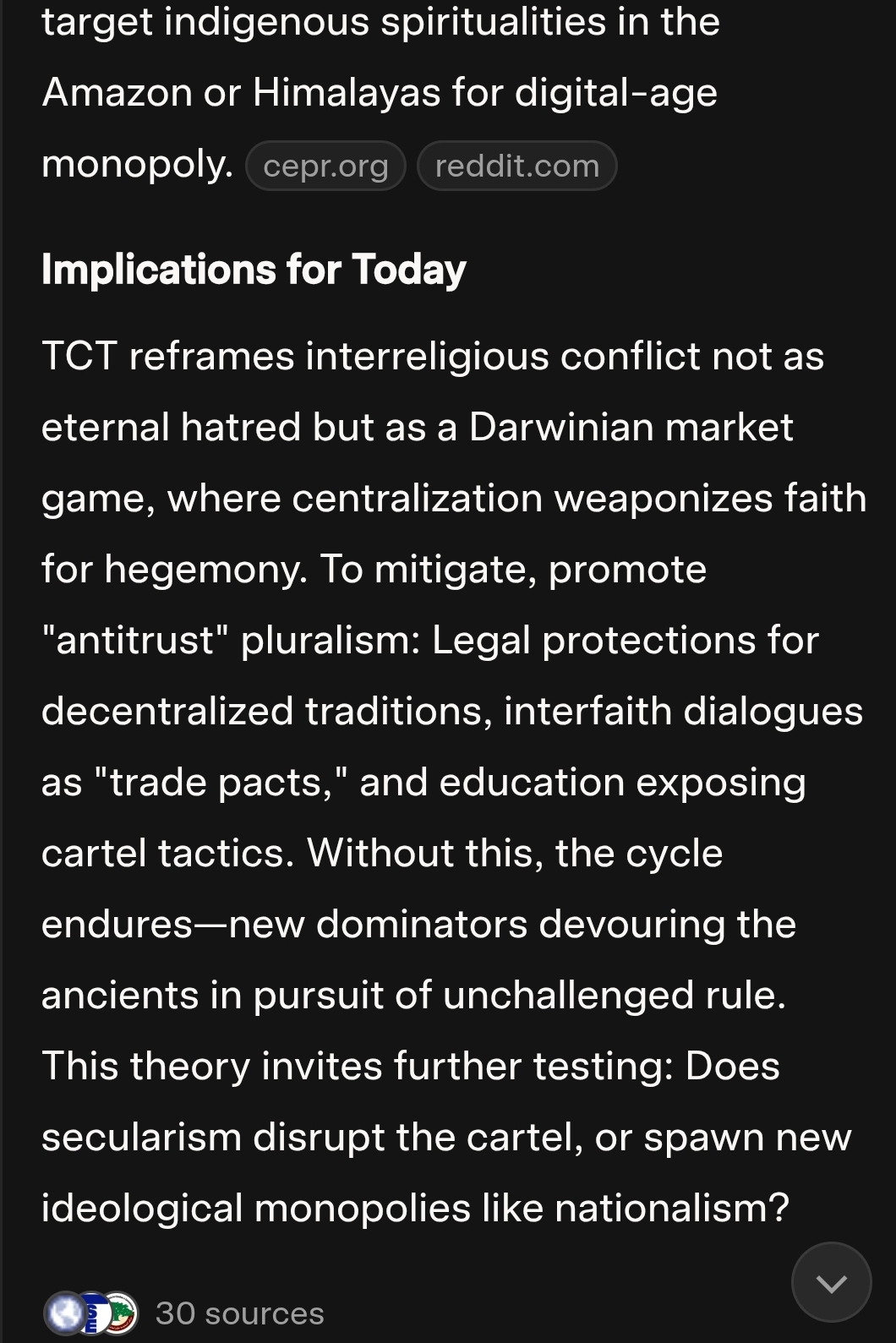
TCT aligns with data: Centralized religions correlate with autocratic stability but explosive conflicts when challenged (e.g., Islam’s decentralization fostering sectarianism vs. Christianity’s papal unity). Predictively, in 21st-century “markets” (e.g., online radicalization), neo-centralized movements (e.g., Salafi networks) may target indigenous spiritualities in the Amazon or Himalayas for digital-age monopoly.
Implications for Today
TCT reframes interreligious conflict not as eternal hatred but as a Darwinian market game, where centralization weaponizes faith for hegemony. To mitigate, promote “antitrust” pluralism: Legal protections for decentralized traditions, interfaith dialogues as “trade pacts,” and education exposing cartel tactics. Without this, the cycle endures—new dominators devouring the ancients in pursuit of unchallenged rule. This theory invites further testing: Does secularism disrupt the cartel, or spawn new ideological monopolies like nationalism?
 GRP_VCare2Dare