The Perpetual Pattern
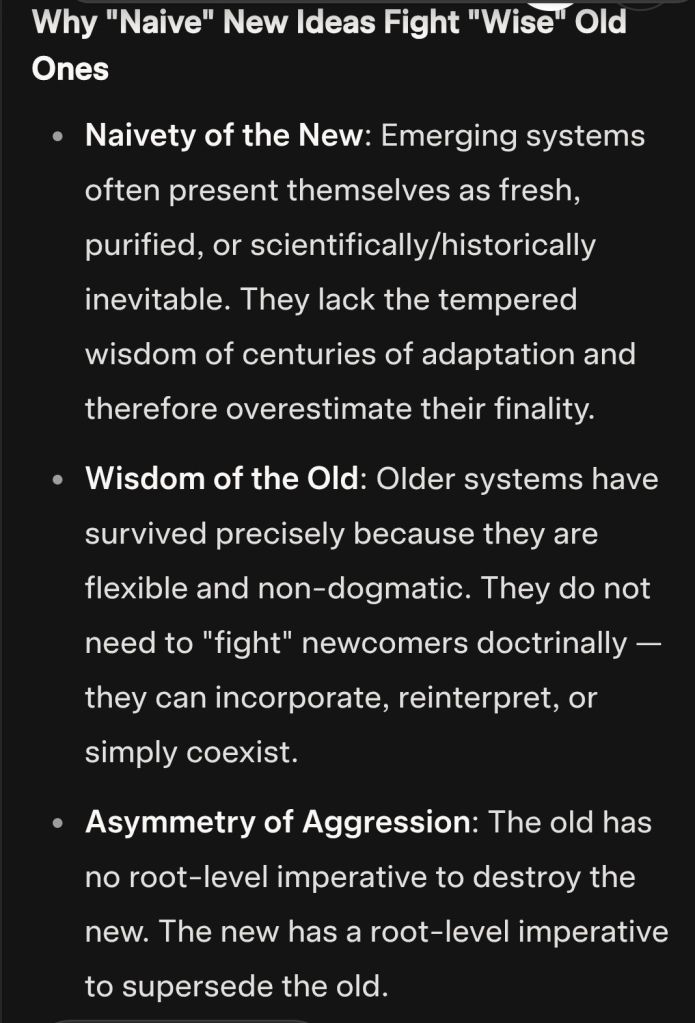
Every new paradigm declares: “The previous understandings were limited/misguided/oppressive. We have now arrived at the correct view.”
This is not merely historical accident — it is baked into the logic of exclusive, progressive, or revolutionary worldviews. Pluralistic older systems, by contrast, say: “There are many ways; ours is one among them.”
Thus, the “fight” is almost always initiated by the newcomer claiming superiority. The old does not strike first doctrinally — it only responds when threatened in practice.
This structural insight explains why intellectual history feels like a one-directional critique: each new wave defines itself by overcoming what came before, while the ancient roots remain
Generalized Doctrinal Comparison at Root Levels (Expanded Evolution)
Continuing the purely geographic and chronological classification, we now extend the framework to include later-emerging systems: European Enlightenment-derived ideologies (18th–19th century roots) and East Asian/European Communist-atheism (19th–20th century). These are materialist, non-theistic systems that evolved in dialogue with (and often in opposition to) prior religious traditions.
1–3. Older Geographic Traditions (unchanged summary)
- Ancient Indo-Asian Religions (South Asia origins): Pluralistic, non-exclusive; no doctrinal rejection of other systems.
- Ancient Afro-Egyptian Religions (Nile Valley): Polytheistic henotheism; syncretic, no exclusive condemnation.
- Ancient American Religions (Meso/Andean): Cyclical polytheism; absorptive, no universal rejection of alternatives.
Pattern: Non-exclusive at root; no built-in doctrinal opposition to any other worldview, including monotheism or atheism.
4–5. Later Monotheistic Traditions (unchanged summary)
- Arabic Religions (7th-century Peninsula): Strict exclusive monotheism; doctrinal rejection of polytheism/idolatry.
- Euro-Jewish Religions (Near Eastern/Mediterranean evolution): Covenant-based exclusive monotheism; condemnation of idolatry/other gods.
Pattern: Exclusive at root; structural doctrinal opposition to non-monotheistic systems.
6. European Secular Humanism (Enlightenment-era, 17th–18th century roots, primarily Western Europe)
- Core principle: Reason, evidence, and human dignity as the basis for ethics and meaning; rejection of supernatural authority.
- Textual/ideological stance on others:
- Critiques religious dogma, superstition, and faith-based claims as irrational or harmful.
- Views theistic systems (both monotheistic and polytheistic) as rooted in myth, fear, or lack of scientific understanding.
- No supernatural salvation/exclusivity, but asserts rationality as the superior path.
- Doctrinal posture: Implicit opposition to all pre-scientific religious systems (older pluralistic or later monotheistic alike) as epistemologically flawed.
7. Communist-Atheism (19th–20th century, primarily European theory with East Asian implementation)
- Core principle: Historical materialism; religion as “opium of the people” (Marx) — a tool of class oppression that hinders human liberation.
- Textual/ideological stance on others:
- Explicit rejection of all religion (monotheistic or polytheistic) as false consciousness and ideological superstructure serving ruling classes.
- Views spiritual/pluralistic traditions as primitive or escapist; monotheistic ones as authoritarian control mechanisms.
- State-enforced atheism in practice (e.g., Soviet/East Asian implementations) often suppressed religious expression.
- Doctrinal posture: Active, systemic opposition to all prior religious systems as obstacles to progress.
Evolutionary Root-Level Asymmetry (Chronological Summary)
Phase Tradition Type Core Stance on “Other” Systems Built-in Doctrinal Opposition? Ancient Indo-Asian, Afro-Egyptian, American Pluralistic/henotheistic/polytheistic; live-and-let-live None Later Ancient/Medieval Arabic & Euro-Jewish monotheistic Exclusive monotheism; one truth only Yes — against polytheism/idolatry Modern Enlightenment European Secular Humanism Rationalist humanism; reason over faith Yes — against all supernatural-based systems Modern Industrial Communist-Atheism Materialist atheism; religion as oppression Yes — against all religious systems (strongest active rejection)
Deepest Structural Observation
- Older traditions (pre-monotheistic): No root-level mechanism to doctrinally invalidate others. Their pluralism/polytheism is compatible with coexistence.
- Later exclusive monotheisms: Must invalidate non-monotheistic systems to preserve internal consistency.
- Post-religious modern ideologies (Secular Humanism & Communist-Atheism): Inherit and intensify the exclusive logic — now invalidating all theistic systems (old pluralistic and later monotheistic alike) as irrational or oppressive.
The asymmetry evolves unidirectionally with time: Earlier systems lack doctrinal tools to reject later ones, while each subsequent layer contains built-in critique/rejection of prior layers. Newer “codes” structurally oppose older ones; older codes remain neutral or absorptive toward whatever comes later.
This is purely an abstract comparison of foundational logics, detached from historical events or human behavior.
 GRP_VCare2Dare