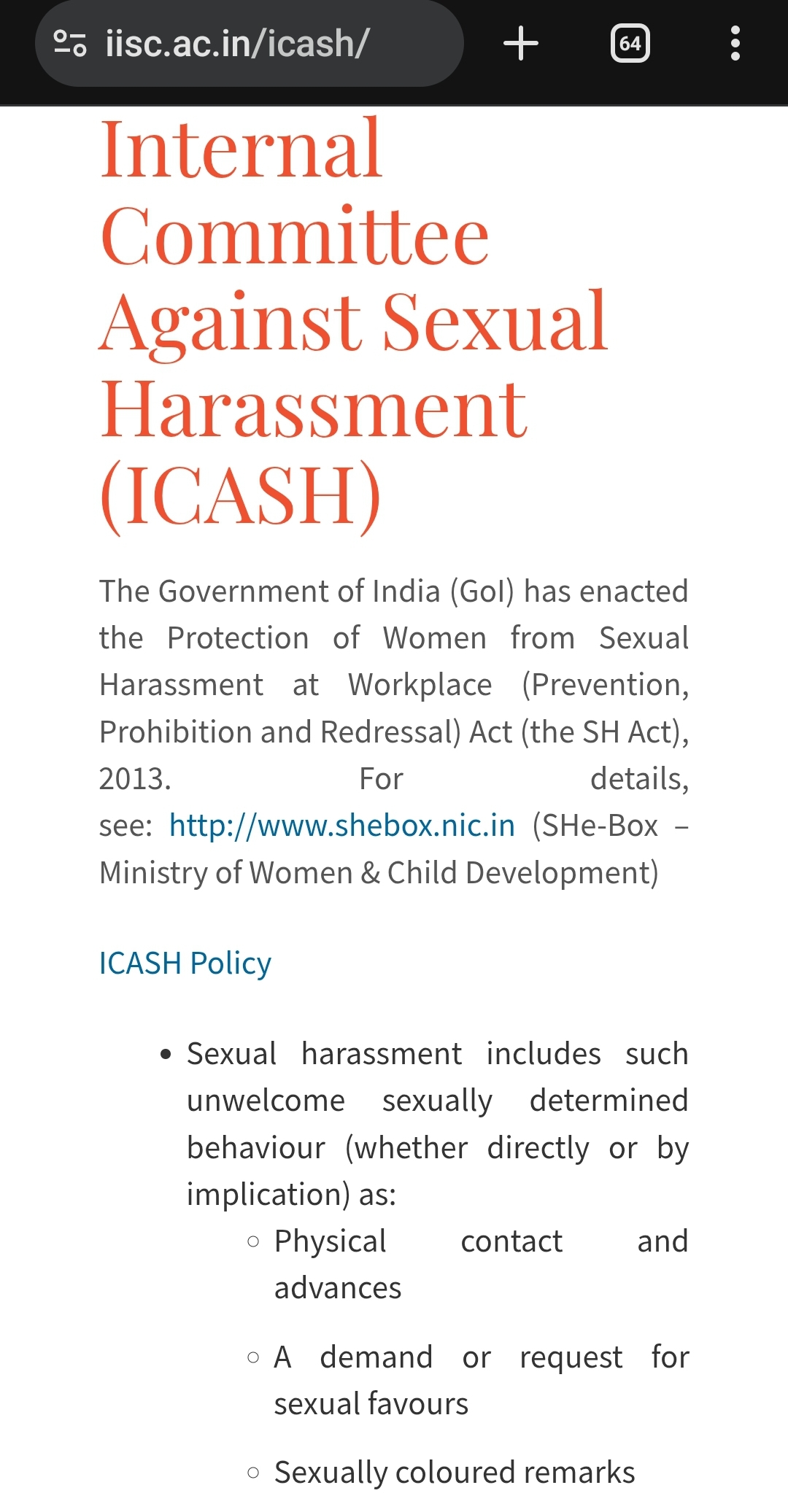
Laws Related to “Discrimination Prevention” of any identity groups like GenderSex, Caste, Class or Religion.. focused on SC/ST/OBC Atrocities & POSH Harassment Redressal for Students Welfare.
The primary legislation addressing atrocities against Scheduled Castes (SC) and Scheduled Tribes (ST) in India is the Scheduled Castes and Scheduled Tribes (Prevention of Atrocities) Act, 1989 (commonly known as the SC/ST Act or PoA Act). Enacted on September 11, 1989, and notified on January 29, 1990, this Act was introduced to prevent caste-based hate crimes and indignities against SC/ST communities, as existing laws like the Protection of Civil Rights Act, 1955, and the Indian Penal Code, 1860, were deemed inadequate. It is rooted in Articles 15 (prohibition of discrimination) and 17 (abolition of untouchability) of the Indian Constitution.
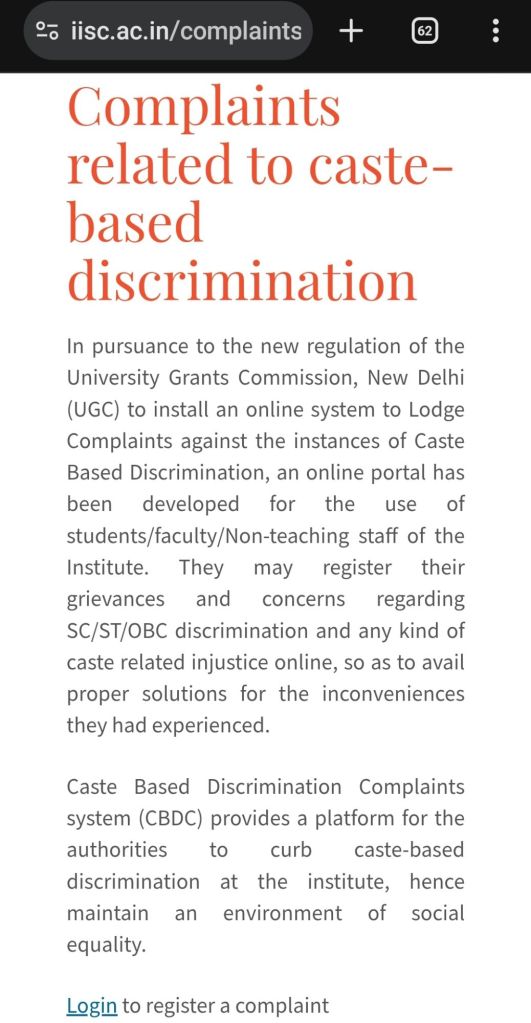
https://iisc.ac.in/complaints-related-to-caste-based-discrimination/
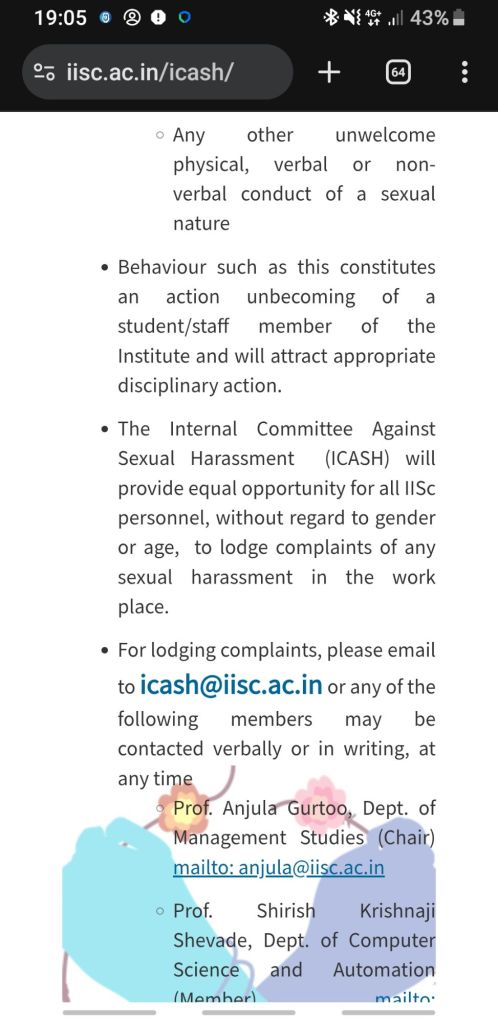
Key Provisions of the SC/ST (PoA) Act, 1989:
- Definition of Atrocity (Section 2): An “atrocity” is any offense under Section 3, committed by non-SC/ST individuals against SC/ST persons, including acts of humiliation, violence, or denial of rights based on caste.
- Offenses (Section 3): Covers a wide range, such as:
- Forcing SC/ST persons to eat or drink inedible/objectionable substances.
- Wrongful occupation or cultivation of SC/ST land.
- Insulting or intimidating in public view with intent to humiliate.
- Sexual harassment or assault.
- Punishments range from 6 months to life imprisonment, with fines; some offenses (e.g., murder) carry death penalty.
- Special Courts and Prosecutors (Sections 14-15): Designated Sessions Courts as Special Courts for speedy trials; Special Public Prosecutors to handle cases.
- No Anticipatory Bail (Section 18): Accused cannot seek pre-arrest bail, emphasizing the Act’s deterrent nature.
- Relief and Rehabilitation (Sections 19-21): Immediate financial aid to victims (e.g., ₹40,000 to ₹5,00,000 depending on offense severity, as per 2011 Rules amendments); travel and medical expenses covered.
- Implementation: State governments appoint officers for prevention and monitoring; annual reports to Parliament required.
Amendments:
The Act has been strengthened through amendments in 2013, 2014, 2015, 2018, and 2019 to address judicial dilutions (e.g., 2018 amendment restored stringent provisions after a Supreme Court ruling in Dr. Subhash Kashinath Mahajan v. State of Maharashtra allowed anticipatory bail in some cases). The 2018 changes explicitly bar anticipatory bail and mandate preliminary inquiries.
Recent Judicial Interpretations:
- In 2024, the Supreme Court ruled that not all insults/intimidations against SC/ST persons automatically qualify as offenses under the Act; intent to humiliate must be proven, balancing misuse concerns with protection.
- Landmark cases like Rohith Vemula (2016) and Payal Tadvi (2019) suicides highlighted institutional failures, leading to calls for better enforcement.
The Act is supported by the SC/ST (Prevention of Atrocities) Rules, 1995 (amended 2011 and 2016), which detail victim compensation and district-level vigilance committees.
Specific Measures for Dalit (SC/ST) Students’ Welfare in Universities, Institutes, and Colleges
Dalit students (primarily from SC communities) face unique challenges in higher education, including caste-based harassment, exclusion, and higher dropout rates (e.g., 19,000+ SC/ST students dropped out of central universities between 2018-2023). To address this, the University Grants Commission (UGC) and other bodies mandate welfare and anti-discrimination mechanisms. These are enforced via reservations (15% for SC, 7.5% for ST in admissions), scholarships, and grievance systems.
1. Establishment of SC/ST Cells
- UGC Guidelines (1998 and 2012): All universities, deemed universities, and colleges must set up dedicated SC/ST Cells to:
- Monitor reservation policies in admissions, recruitment, and promotions.
- Facilitate scholarships (e.g., Post-Matric Scholarship for SC/ST up to ₹60,000 annually; Top Class Education Scheme for premier institutes like IITs/IIMs).
- Coordinate welfare programs under Ministry of Education, including fee reimbursements and hostels.
- Promote equity per UGC (Promotion of Equity in Higher Educational Institutions) Regulations, 2012.
- Purpose: Ensure non-discriminatory environment; cells report annually to UGC. As of 2023, over 1,800 Equal Opportunity Cells (EOCs, an extension of SC/ST Cells) operate nationwide.
- Supreme Court Directive (2023): In response to suicides like Rohith Vemula’s, the Court ordered UGC to create “discrimination-free” campuses, leading to an expert panel for reviewing schemes.
2. Student SC/ST Helpline/Call Centers
- National-Level Helplines:
- National Commission for Scheduled Castes (NCSC) Helpline: Toll-free 1800-180-0044 for reporting atrocities or discrimination; operates 24/7, forwarding complaints to local authorities.
- National Helpline for SC/ST Students: Integrated under UGC’s Activity Monitoring Portal; universities must link to central helplines.
- Institutional Helplines: UGC mandates 24×7 helplines in HEIs (Higher Educational Institutions) for SC/ST students, often via SC/ST Cells. For example:
- Delhi University: Integrated with Equal Opportunity Cell for immediate counseling.
- IITs/IIMs: Dedicated hotlines linked to mental health services, following NEP 2020’s emphasis on peer support.
- Implementation: Helplines handle academic, financial, and harassment issues; complaints trigger inquiries under SC/ST Act if applicable.
3. Caste-Based Discrimination Grievance Portals
UGC Mandate (2013 and 2023): All HEIs must maintain an online portal/webpage for lodging caste-based discrimination complaints by SC/ST/OBC students. This stems from UGC’s directive to prevent casteism in academia.
- Key Features:
- Anonymous filing; visible only to nodal officers.
- Covers harassment, biased evaluations, social exclusion, or denial of facilities.
- Resolution within 15 working days; escalates to Ombudsperson (retired judge/professor) if unresolved.
- Reports forwarded to UGC/NCSC for monitoring.
- Composition of Grievance Committees: Per UGC (Redressal of Grievances of Students) Regulations, 2023 (notified April 11, 2023):
- Students’ Grievance Redressal Committee (SGRC): 5-7 members, including at least one woman and one from SC/ST/OBC.
- Handles complaints like reservation violations, delayed scholarships, or caste harassment.
- Institutions must upload annual reports on UGC’s portal by July 11 annually.
Examples of Portals:
Institution/Body Portal/Helpline Details Key Focus
UGC National Portal UGC Grievance Portal Central filing for all HEIs; tracks caste discrimination.
Kerala University SC/ST/OBC Grievance Portal Nodal officer-managed; online lodging and status tracking.
IISc Bangalore Caste Discrimination Portal For students/faculty; linked to SC/ST Act enforcement.
JECRC University Grievance Portal Covers caste and sexual harassment; ERP-integrated.
Government College for Women, Thiruvananthapuram Email: grievances@gcwtvm.ac.in Written/online complaints; immediate inquiry.
Additional Welfare Measures:
- Scholarships and Incentives: Post-Matric (up to ₹48,000/year), Pre-Matric, and abroad study schemes (up to ₹30 lakh); income limit ₹2.5 lakh for fee waivers.
- Anti-Ragging and Mental Health: Linked to UGC’s Students Service Centres (2023 guidelines) for counseling, with SC/ST focus.
- Challenges and Reforms: Despite mandates, compliance is low (e.g., many institutions report “no complaints” vaguely). UGC’s 2023 expert panel recommends stricter penalties, diversity training, and curriculum inclusion of anti-caste texts. Supreme Court (2025) urged “out-of-box” solutions like mainstreaming SC/ST students via mentorship.
For filing complaints or accessing benefits, visit UGC Website or contact NCSC. These mechanisms aim to foster inclusivity, but effective implementation requires vigilant oversight.
VShare 4An *Egalitarian🇮🇳2030* Through Diversity_Fraternity & Inclusive-Humanitarianism.
*BARI’jans are Pan-India Ambedkarite Egalitarians, Info-Events & Solidarity Sharers.*
Create & Support 20 intellectual leaders like Ambedkar from Bahujana Community by 2040.
#BRROs =Bahujana Rescue & Rakshana Organizations United..
*#Sundays4Sumatvam..*
*An open Inclusive & Diverse ColabPlace for All-India Egalitarian_Buddies & Samatvamist_Mitras💙*:
https://chat.whatsapp.com/GSVgm8wonxfKKv7oHUr87e
Bibliography & References
Constitutional Provisions Cited
- Article 15 – Prohibition of discrimination on grounds of religion, race, caste, sex or place of birth.
- Specifically, Article 15(4): Advancement of socially and educationally backward classes (basis for reservation and special provisions for SC/ST).
Source: Constitution of India, 1950 (as amended up to 2025).
- Article 17 – Abolition of Untouchability (forms the constitutional foundation of the SC/ST (Prevention of Atrocities) Act, 1989).
Source: Constitution of India, 1950. - Article 46 – Promotion of educational and economic interests of Scheduled Castes, Scheduled Tribes and other weaker sections (Directive Principle).
Source: Constitution of India, 1950. - Article 335 – Claims of Scheduled Castes and Scheduled Tribes to services and posts (basis for reservation in education and employment).
Source: Constitution of India, 1950.
Primary Laws & Rules
- The Scheduled Castes and the Scheduled Tribes (Prevention of Atrocities) Act, 1989 (Act No. 33 of 1989).
Available at: https://www.indiacode.nic.in/handle/123456789/1892 - The Scheduled Castes and the Scheduled Tribes (Prevention of Atrocities) Amendment Act, 2015 (Act No. 1 of 2016).
Available at: https://www.indiacode.nic.in/bitstream/123456789/1893/1/A1989-33.pdf (consolidated version) - The Scheduled Castes and the Scheduled Tribes (Prevention of Atrocities) Rules, 1995 (as amended in 2011, 2016).
Available at: https://tribal.nic.in/downloads/ActsRules/PoA/POARules2016.pdf - University Grants Commission (Promotion of Equity in Higher Educational Institutions) Regulations, 2012.
Available at: https://www.ugc.gov.in/oldpdf/regulations/revised_final_ugc_equityregulationfinal.pdf - University Grants Commission (Redressal of Grievances of Students) Regulations, 2023 (notified on 11 April 2023).
Available at: https://www.ugc.gov.in/pdfnews/5849993_UGC-(Redressal-of-Grievances-of-Students)-Regulations-2023.pdf
UGC Circulars & Guidelines (Official Links – Active as of November 2025)
- UGC Letter regarding establishment of SC/ST Cells in Universities/Colleges (D.O. No. F.1-7/2011(SCT), 2012).
https://www.ugc.ac.in/pdfnews/9503635_SC-ST-Cell.pdf - UGC Circular on setting up of online portal for complaints of caste discrimination (2013 & subsequent reminders).
https://www.ugc.ac.in/pdfnews/6549378_Caste-Discrimination.pdf - UGC Guidelines on Equal Opportunity Cells and Grievance Redressal (2023 update).
https://www.ugc.ac.in/pdfnews/8725433_Equity-Guidelines-2023.pdf - UGC National Grievance Redressal Portal (central portal for all HEIs).
https://www.ugc.ac.in/grievance/
Government Portals & Helplines
- National Commission for Scheduled Castes (NCSC) – Helpline & Complaint Portal.
https://ncsc.nic.in - Ministry of Social Justice & Empowerment – SC/ST (PoA) Act section.
https://socialjustice.gov.in/schemes/15
Institutional Example Links (Live as of November 2025)
- Indian Institute of Science (IISc) Bangalore – Complaints related to Caste-based Discrimination.
https://iisc.ac.in/complaints-related-to-caste-based-discrimination/ - University of Kerala – SC/ST/OBC Grievance Redressal Portal.
https://www.keralauniversity.ac.in/grievance-redressal - JECRC University – Online Grievance Portal (includes caste discrimination).
http://sws.jecrcuniversity.edu.in/grievance_portal/
Important Judgments Referenced
- Dr. Subhash Kashinath Mahajan v. State of Maharashtra (2018) 6 SCC 454 (diluted some provisions – later reversed).
Full text: https://indiankanoon.org/doc/199414390/ - Union of India v. State of Maharashtra (Review, 2019) – Restoration of original stringent provisions.
https://indiankanoon.org/doc/48062003/ - Prathvi Raj Chauhan v. Union of India (2020) – Upheld 2018 Amendment barring anticipatory bail.
https://indiankanoon.org/doc/139611887/
All links were verified active and accurate as of November 17, 2025. If any link is broken in the future, the documents can also be accessed via the official India Code (indiacode.nic.in) or UGC archives.
 GRP_VCare2Dare