Understanding the Spectrum of Gurus in Hindu Philosophy
In Hindu philosophy and mythology, gurus (teachers or spiritual guides) are revered as embodiments of knowledge, but they are not monolithic. They can be viewed through a metaphorical “spectrum” inspired by the visible light spectrum, where Violet-Gurus represent the “good” end—symbolizing higher spiritual frequency, purity, selflessness, and alignment with dharma (righteousness)—and Red-Gurus represent the “evil” end—symbolizing lower frequency, selfishness, manipulation, and alignment with adharma (unrighteousness). This analogy draws from the electromagnetic spectrum, where violet light has shorter wavelengths (higher energy, often associated with enlightenment) and red has longer wavelengths (lower energy, associated with base instincts or chaos).
The spectrum isn’t black-and-white; gurus in Hindu texts often have nuanced characters, blending virtues and flaws. This reflects the philosophical idea that good and evil are relative, influenced by karma, context, and intent (as discussed in texts like the Mahabharata and Puranas). The user-specified examples are Dronacharya (often seen as a principled teacher despite flaws) and Shukracharya (guru of the asuras, associated with opposing divine order). Adding a neutral guru in the middle creates a balanced “DronaCharya-Shukracharya GuruSpectrum,” where neutrality represents pragmatism, ambition, or balance without strong alignment to pure good or evil.
Differentiating Violet-Gurus (Good) from Red-Gurus (Evil)
- Violet-Gurus (Good): These gurus prioritize the greater good, impart knowledge selflessly, foster virtue, and guide disciples toward dharma, harmony, and spiritual growth. They embody sattva (purity) guna from the Bhagavad Gita. Their teachings promote justice, protection of the weak, and cosmic balance. However, even they may have human flaws, as perfection is rare in Hindu narratives.
- Red-Gurus (Evil): These gurus use knowledge for personal gain, power, or disruption of order. They align with tamas (darkness) guna, teaching manipulation, revenge, or conquest. They often support “anti-heroes” or chaotic forces, leading to cycles of destruction. Their intent is ego-driven, and their actions amplify suffering or imbalance.
The spectrum in between includes shades where gurus exhibit mixed qualities, reflecting the Hindu view that individuals evolve through lives and actions (karma theory).
How to Identify the “Color” of a Guru
In Hindu philosophy, judging a guru isn’t based on superficial traits but on deeper indicators, as advised in texts like the Guru Gita or Upanishads. Here’s a practical framework:
- Intent and Motive: Does the guru teach for selfless upliftment (violet) or personal ambition/power (red)? Observe if they demand undue loyalty, wealth, or sacrifices without ethical justification.
- Impact on Disciples and Society: Do their teachings lead to harmony, justice, and growth (violet), or conflict, deception, and downfall (red)? “By their fruits ye shall know them” echoes the Mahabharata’s emphasis on outcomes.
- Adherence to Dharma: Violet-gurus uphold universal ethics (non-violence, truth, compassion). Red-gurus twist dharma for biased ends, like favoring one side in eternal conflicts.
- Personal Character: Look for humility and detachment (violet) vs. arrogance, jealousy, or vengeance (red). Neutral gurus might show ambition balanced by wisdom.
- Mythological Context: In stories, alignment with devas (gods, good) leans violet; with asuras (demons, chaotic) leans red. But context matters—Hindu myths often show redemption or complexity.
- Self-Reflection: The Upanishads advise testing a guru through observation, questioning, and intuition. Avoid blind faith; true gurus encourage discernment.
Avoid snap judgments; Hindu philosophy (e.g., in the Ramayana) shows gurus can shift “colors” through penance or experiences.
The DronaCharya-Shukracharya GuruSpectrum
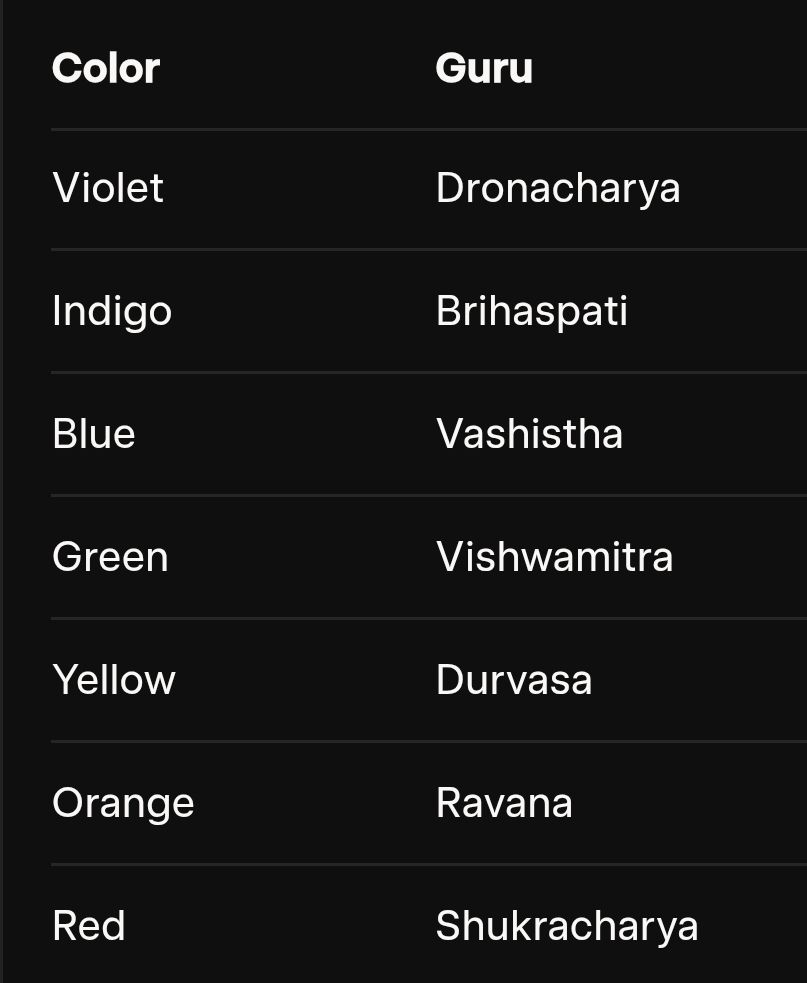
Drawing from Hindu epics like the Mahabharata, Ramayana, and Puranas, I’ve created a simplified 7-point spectrum mirroring the visible light colors (ROYGBIV reversed for violet-to-red flow). Dronacharya anchors the violet (good) end as a skilled, duty-bound teacher who trained heroes for dharma’s sake. Shukracharya anchors the red (evil) end as the wise but partisan guru of asuras, enabling their wars against devas. For the neutral middle (green), I’ve selected Vishwamitra—a sage with a complex arc: born a warrior, achieved Brahmin status through intense tapas (austerity), trained Rama for good causes, but driven by personal ambition, rivalries (e.g., with Vashistha), and occasional wrath.
This spectrum uses examples from mythology to illustrate shades:
Color Position Example Guru Key Characteristics Why This “Color”?
Violet Extreme Good Dronacharya (Mahabharata) Master archer; taught Pandavas and Kauravas impartially at first; embodied discipline and skill for societal protection. Flaws (e.g., bias toward Arjuna, Ekalavya incident) show human nuance, but overall aligned with dharma. Represents pure guidance toward virtue and order; trained defenders of righteousness like Arjuna.
Indigo Mostly Good Brihaspati (Puranas) Guru of the devas (gods); wise advisor promoting cosmic harmony, knowledge, and strategy against chaos. Strongly supports “good” forces; embodies intellect and balance, but with a partisan lean toward devas.
Blue Leaning Good Vashistha (Ramayana) Sage of immense wisdom; guru to Rama’s father; advocated peace, dharma, and spiritual insight. Guides toward enlightenment and stability; resolves conflicts through wisdom rather than force.
Green Neutral Vishwamitra (Ramayana) Former king turned sage; creator of Gayatri Mantra; trained Rama against demons but motivated by ego, rivalries, and ambition (e.g., attempted to create a new heaven). Balanced mix: Aids good (devas/Rama) but driven by personal goals; neither fully selfless nor destructive—pragmatic and transformative.
Yellow Leaning Evil Durvasa (Puranas) Short-tempered sage; cursed many (e.g., Indra, Ambarisha) out of pride, causing chaos, but also bestowed boons. Knowledgeable but impulsive; actions often disrupt order, leaning toward imbalance without full malice.
Orange Mostly Evil Ravana (Ramayana; self-taught guru figure) Though not a traditional guru, he was a learned scholar and devotee of Shiva; taught his followers but used knowledge for conquest and abduction. Intelligent and devout, but ego and lust lead to adharma; represents twisted wisdom.
Red Extreme Evil Shukracharya (Puranas) Guru of asuras; master of Sanjeevani Vidya (revival knowledge); enabled endless wars against devas by resurrecting demons. Supports chaotic forces; wise but partisan, prioritizing asura dominance over universal harmony—embodies manipulative power.
This spectrum is interpretive, as Hindu myths emphasize relativity (no absolute evil like in some traditions). For instance, Shukracharya isn’t “evil” in a cartoonish sense—he’s loyal to his disciples and knowledgeable—but his actions perpetuate conflict. Similarly, Dronacharya’s flaws (fighting for the Kauravas) add gray areas. Use this as a tool for reflection, not rigid classification.
If you’d like to expand with more examples, adjust the spectrum, or draw from specific texts, let me know!
 GRP_VCare2Dare