Useful tool to guage the relative “Genders-Quality Positions” of Citizens on a Spectrum from Tonic to Toxic Gender Identity & Ideology. #Gend
Understanding the Gender-Quality Matrix: A Visual Exploration
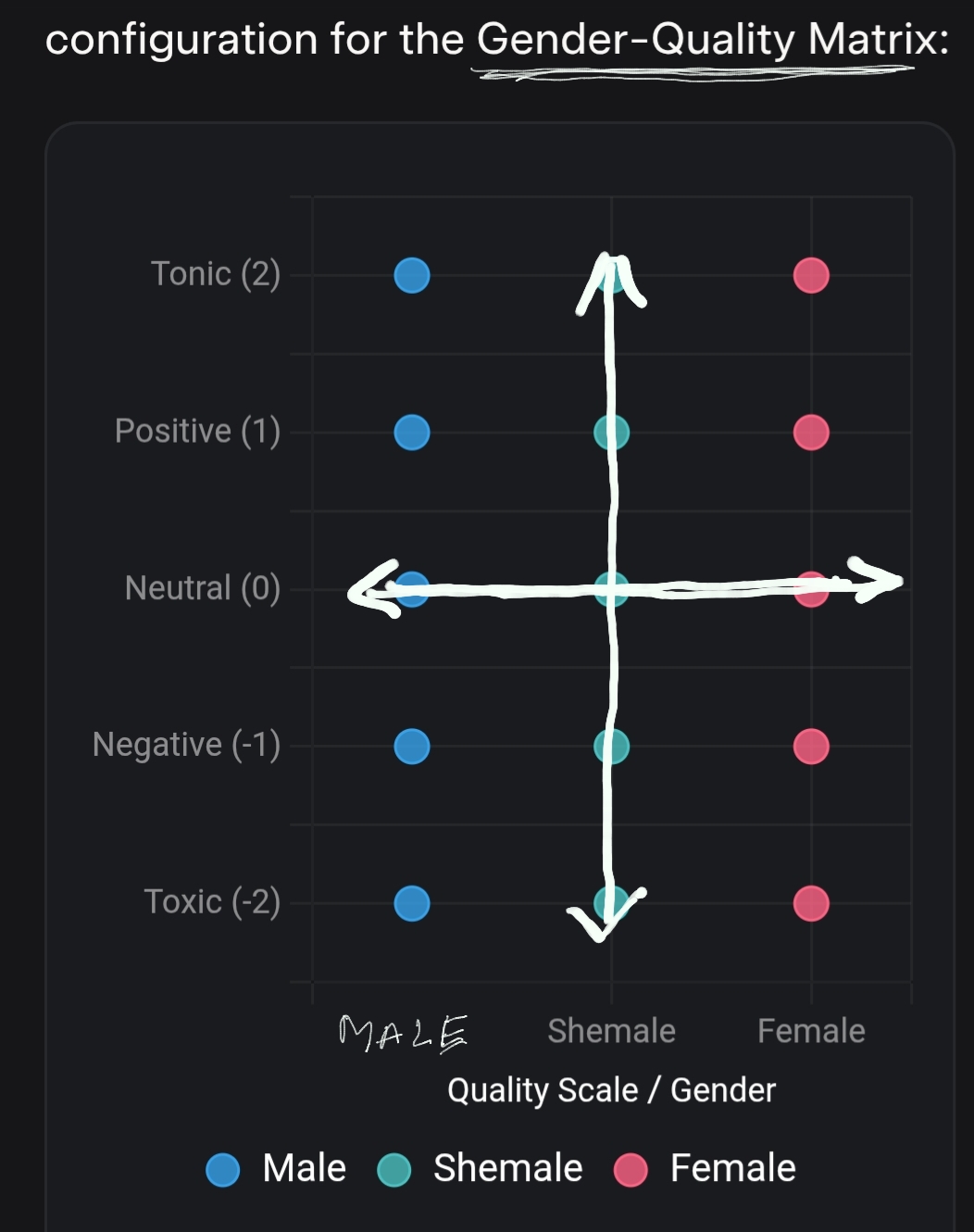
The Gender-Quality Matrix is a conceptual framework that maps gender expressions (Male, Mixd’Gender, Female) against a spectrum of qualities, ranging from highly constructive (Tonic) to highly destructive (Toxic). Visualized as a scatter chart, this matrix provides a clear and intuitive way to understand how different gender expressions manifest across five quality scales: Tonic (+2), Positive (+1), Neutral (0), Negative (-1), and Toxic (-2). In this blog, we’ll explore the matrix, its structure, and the qualities associated with each gender-scale combination, with a focus on Tonic Masculinity in the top-left quadrant and Toxic Femininity in the bottom-right quadrant.
The Structure of the Matrix
The Gender-Quality Matrix is plotted on a two-dimensional scatter chart:
- X-Axis (Gender): Represents three gender expressions—Male, Shemale (a term used here to denote a blend of gender traits), and Female. These are positioned at x=0 (Male), x=1 (Shemale), and x=2 (Female).
- Y-Axis (Quality Scale): Represents five levels of quality, from most constructive to most destructive:
- Tonic (+2): Highly empowering and constructive traits.
- Positive (+1): Beneficial and supportive traits.
- Neutral (0): Balanced, everyday traits.
- Negative (-1): Harmful but not extreme traits.
- Toxic (-2): Highly destructive and damaging traits.
- Data Points: Each point on the chart represents a unique gender-quality combination, labeled with specific traits (e.g., “Tonic Masculinity: Protective leadership, Emotional resilience”).
The chart uses distinct colors for each gender:
- Male: Blue
- Shemale: Teal
- Female: Pink
Hovering over a point (in an interactive version) reveals detailed descriptions of the qualities, making the chart both informative and engaging.
Purpose of the Matrix
The Gender-Quality Matrix serves to:
- Visualize Gender Dynamics: It illustrates how gender expressions can manifest in both positive and negative ways, challenging stereotypes by showing a spectrum of behaviors.
- Highlight Extremes: Tonic Masculinity (top-left, x=0, y=2) and Toxic Femininity (bottom-right, x=2, y=-2) anchor the chart, representing the most constructive and destructive expressions, respectively.
- Promote Understanding: By categorizing traits across genders and scales, the matrix fosters a nuanced discussion about gender roles and their impact.
The Gender-Quality Combinations
Below is a detailed breakdown of each gender-quality combination, as plotted in the scatter chart.
Male (x=0)
- Tonic (+2): Tonic Masculinity
- Protective leadership: Guiding others with strength and care.
- Emotional resilience: Maintaining composure under stress.
- Providing security: Creating a safe environment for others.
- Honorable assertiveness: Standing firm with integrity.
- Positive (+1):
- Confident decision-making: Making clear, thoughtful choices.
- Supportive mentorship: Guiding others toward success.
- Courageous initiative: Taking bold, constructive actions.
- Reliable accountability: Being dependable and responsible.
- Neutral (0):
- Practical problem-solving: Addressing issues logically.
- Independent routine: Managing daily tasks autonomously.
- Steady companionship: Offering consistent support.
- Rational decision-making: Basing choices on reason.
- Negative (-1):
- Stubborn rigidity: Refusing to adapt or compromise.
- Emotional detachment: Withdrawing from emotional connection.
- Overbearing control: Dominating others unnecessarily.
- Reckless impulsiveness: Acting without considering consequences.
- Toxic (-2):
- Aggressive dominance: Using force to control others.
- Emotional suppression: Repressing feelings to appear “strong.”
- Entitlement and control: Demanding authority without merit.
- Reckless risk-taking: Endangering others through careless actions.
Shemale (x=1)
- Tonic (+2): Tonic Androgyny
- Balanced empathy: Combining compassion with strength.
- Fluid self-expression: Authentically blending gender traits.
- Inclusive harmony: Fostering unity across diverse groups.
- Adaptive confidence: Navigating challenges with versatility.
- Positive (+1):
- Empathetic versatility: Understanding diverse perspectives.
- Creative self-expression: Innovating through unique identity.
- Community bridge-building: Connecting people across differences.
- Resilient adaptability: Thriving in changing environments.
- Neutral (0):
- Versatile adaptability: Adjusting to various social contexts.
- Neutral social navigation: Interacting without bias.
- Balanced self-care: Prioritizing personal well-being.
- Everyday fluidity: Moving seamlessly between roles.
- Negative (-1):
- Indecisive ambiguity: Struggling to commit to decisions.
- Emotional inconsistency: Fluctuating moods that confuse others.
- Boundary neglect: Failing to set or respect limits.
- Attention-seeking behavior: Craving validation disruptively.
- Toxic (-2):
- Identity confusion weaponized: Using ambiguity to manipulate.
- Manipulative ambiguity: Exploiting unclear intentions.
- Inconsistent boundaries: Creating unstable relationships.
- Performative instability: Acting out for attention.
Female (x=2)
- Tonic (+2): Tonic Femininity
- Nurturing care: Providing emotional and physical support.
- Intuitive wisdom: Understanding situations deeply.
- Collaborative support: Working harmoniously with others.
- Graceful vulnerability: Embracing openness with strength.
- Positive (+1):
- Compassionate leadership: Guiding with empathy and care.
- Emotional intelligence: Reading and responding to emotions.
- Encouraging collaboration: Fostering teamwork and inclusion.
- Warm inclusivity: Creating welcoming environments.
- Neutral (0):
- Relational harmony: Maintaining balanced relationships.
- Expressive communication: Sharing thoughts clearly.
- Empathetic listening: Understanding others’ perspectives.
- Adaptive nurturing: Supporting others flexibly.
- Negative (-1):
- Overly dependent: Relying excessively on others.
- Passive resistance: Avoiding direct confrontation unproductively.
- Emotional manipulation: Influencing others through guilt.
- Indirect aggression: Using subtle tactics to harm.
- Toxic (-2): Toxic Femininity
- Passive-aggressive manipulation: Controlling through indirect means.
- Relational sabotage: Undermining relationships deliberately.
- Emotional blackmail: Using emotions to coerce others.
- Gossipy undermining: Spreading rumors to harm reputations.
Visualizing the Matrix
The scatter chart places each of these combinations on a grid:
- Top-Left (Tonic Masculinity): Male at Tonic (x=0, y=2) represents the pinnacle of constructive male traits, emphasizing leadership and resilience.
- Bottom-Right (Toxic Femininity): Female at Toxic (x=2, y=-2) highlights the most destructive female traits, such as manipulation and sabotage.
- Other Points: Fill the spectrum, showing how each gender can express qualities ranging from empowering to harmful.
The chart’s design ensures clarity:
- Colors differentiate genders (Blue for Male, Teal for Shemale, Pink for Female).
- Labels provide concise descriptions of key traits when hovered over (in interactive versions).
- Axes are scaled to emphasize the progression from Tonic to Toxic, with clear tick marks for each quality level.
How to Use the Matrix
This matrix can be used for:
- Self-Reflection: Individuals can identify where their behaviors fall on the quality scale and strive for more tonic or positive traits.
- Education: It provides a framework for discussing gender dynamics without resorting to stereotypes, showing that all genders can exhibit a range of behaviors.
- Conflict Resolution: Understanding toxic traits (e.g., aggressive dominance or passive-aggressive manipulation) can help address harmful patterns in relationships.
Creating Your Own Visualization
To recreate the Gender-Quality Matrix as a scatter chart:
- Use a JavaScript library like Chart.js.
- Define the datasets for Male, Shemale, and Female, mapping each to their respective x and y coordinates.
- Customize the axes to label genders (Male, Shemale, Female) and quality scales (Tonic to Toxic).
- Add tooltips to display detailed trait descriptions.
For a PDF version:
- Render the chart in a browser using an HTML canvas.
- Use the browser’s “Print to PDF” function, selecting landscape mode.
- Alternatively, use tools like html2pdf.js to export the chart directly to PDF.
Conclusion
The Gender-Quality Matrix offers a powerful visual tool to explore the interplay of gender and behavior. By mapping qualities across a spectrum, it challenges simplistic views of gender roles and highlights the potential for both constructive and destructive expressions. Whether you’re analyzing personal growth or facilitating discussions on gender dynamics, this matrix provides a nuanced and visually engaging framework.
Note: To generate the chart or PDF, refer to the Chart.js configuration provided separately or use an online editor like CodePen to visualize it interactively.
 GRP_VCare2Dare