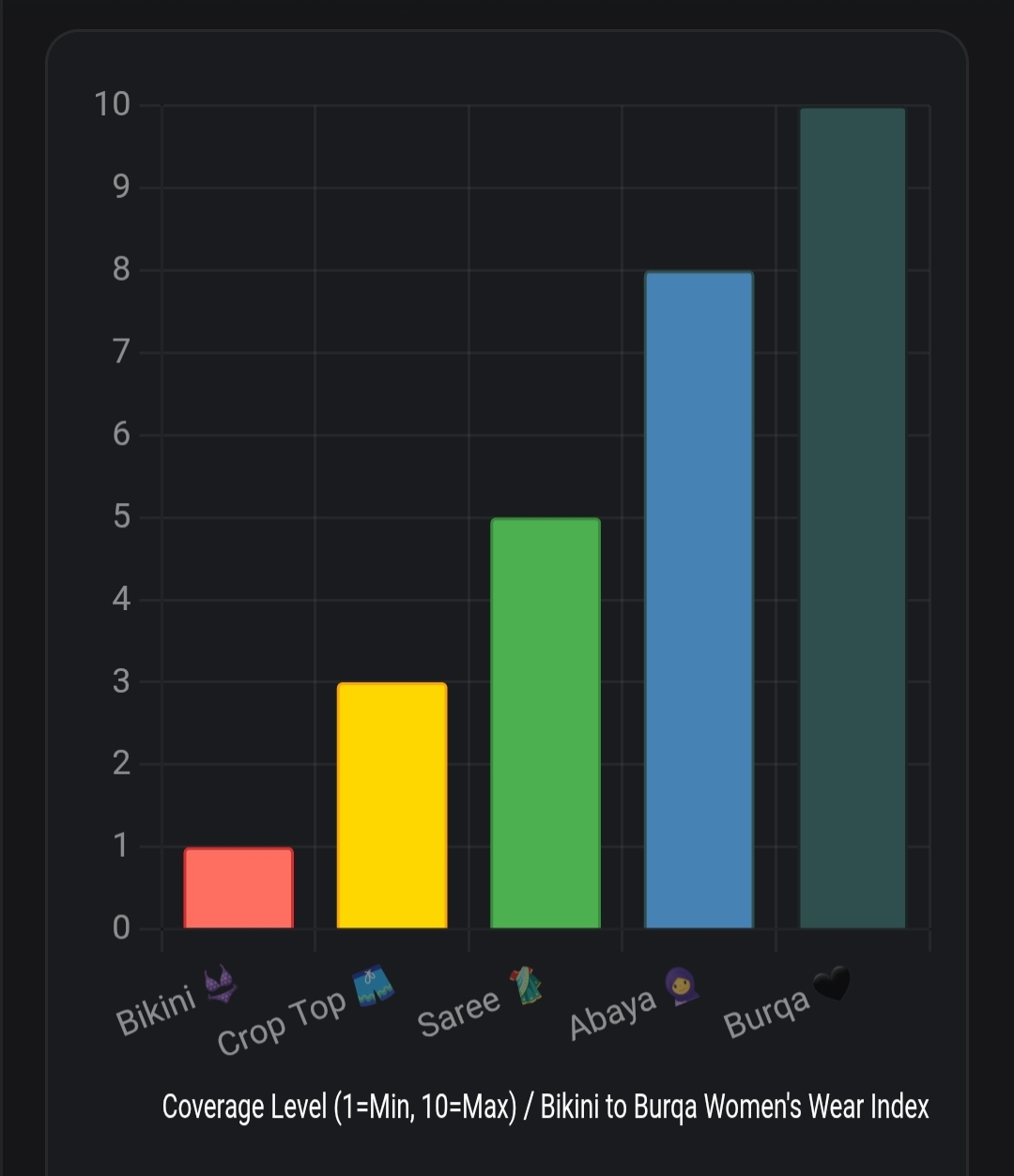
The Bikini to Burqa Womens Wear Index (B2BWW Index) is a conceptual framework to categorize dress codes for women based on the degree of skin and hair exposure. It places attire on a spectrum from minimal coverage to maximum coverage, reflecting cultural, social, or regional dressing norms. This index can be used to broadly characterize the predominant dress styles for women in a city or nation, acknowledging that individual choices vary widely.
On the left is 1. Extreme Radical Individual Liberalists or Naturists (Nudists-Tribalists) eg. Andaman and Rio Carnival Brazil & Indian Jain Monks (Naga Sadhus). Unevolved Genderity of Individualists.
on the Right Extreme Radical Collective Conservatives global_Religionists or Clothists (Nuns & Hijabbed nations like Iran). Toxic Genderity of Authoritarianism/Totalitarianism.
in Centre is Moderate Centerist Nations. that are Balanced Tonic Genderity Utilitarianism.
Index Spectrum
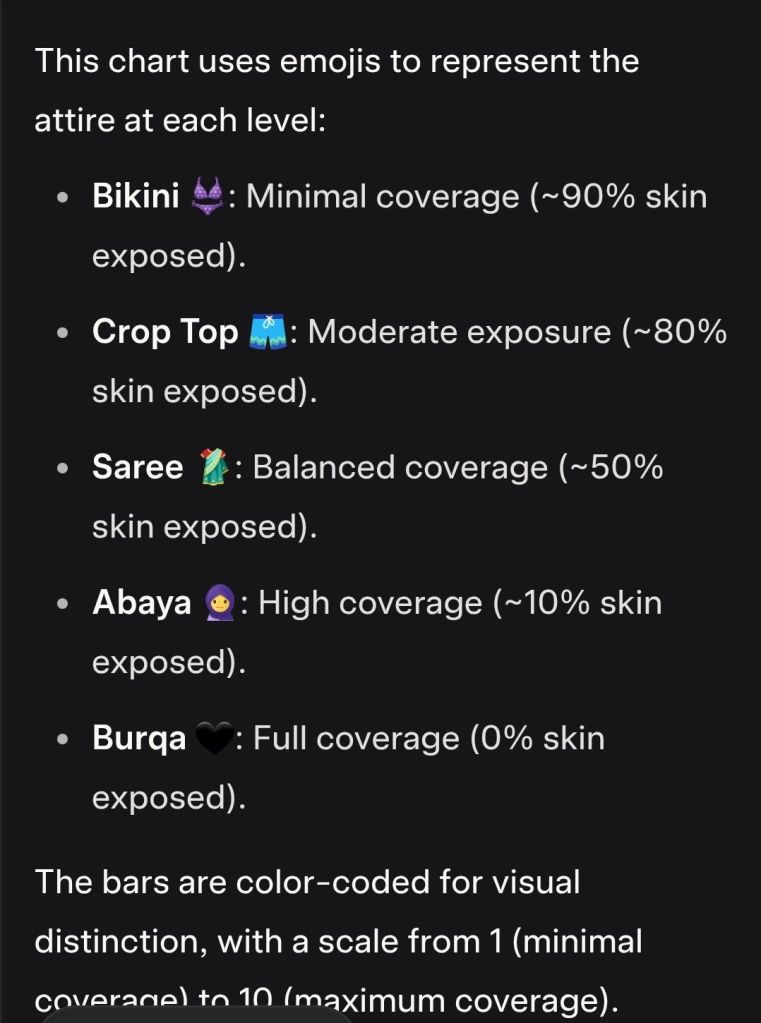
The BBSB Index ranges from 1 (minimal coverage, maximum exposure) to 10 (maximum coverage, minimal exposure). Below is the spectrum with examples of attire, their approximate coverage levels, and descriptions.
- Bikini (Level 1)
- Description: Minimal coverage, typically exposing most of the body, including torso, arms, legs, and hair. Common in beach or resort settings.
- Skin Exposure: ~90-95% (torso, arms, legs exposed).
- Hair Exposure: Fully exposed.
- Cultural Context: Often seen in liberal, warm-climate regions or tourist-heavy areas (e.g., Goa, India; Miami, USA).
- Crop Top and Shorts/Skirt (Level 2)
- Description: Exposes midriff, arms, and legs. Popular in urban, youth-centric settings.
- Skin Exposure: ~80-85% (midriff, arms, legs exposed).
- Hair Exposure: Fully exposed.
- Cultural Context: Common in metropolitan cities with liberal fashion norms (e.g., Mumbai, Los Angeles).
- Short Dress/Mini Skirt (Level 3)
- Description: Covers torso but exposes legs and arms. Often fashionable in urban settings.
- Skin Exposure: ~70-80% (arms, upper legs exposed).
- Hair Exposure: Fully exposed.
- Cultural Context: Seen in cosmopolitan areas (e.g., Delhi, London).
- Knee-Length Dress/Salwar Kameez (Level 4)
- Description: Covers torso and upper legs, may expose lower legs and arms. Includes modern dresses or traditional outfits like salwar kameez with short sleeves.
- Skin Exposure: ~50-60% (lower legs, arms exposed).
- Hair Exposure: Fully exposed.
- Cultural Context: Common in semi-conservative urban settings (e.g., Bangalore, Dubai).
- Bandhani-Saree/Lehenga (Level 5)
- Description: Traditional Indian attire like a saree or lehenga, often exposing midriff but covering most of the body. May include a dupatta for additional coverage.
- Skin Exposure: ~40-50% (midriff, sometimes arms exposed).
- Hair Exposure: Fully exposed or partially covered with dupatta.
- Cultural Context: Widespread in India, especially during cultural or festive events (e.g., Jaipur, Ahmedabad).
- Maxi Dress/Anarkali Suit (Level 6)
- Description: Covers torso, arms, and legs fully, but form-fitting or with minimal exposure (e.g., neckline). Includes floor-length Anarkali suits.
- Skin Exposure: ~20-30% (neck, hands exposed).
- Hair Exposure: Fully exposed or loosely covered.
- Cultural Context: Common in conservative urban areas (e.g., Lucknow, Istanbul).
- Churidar with Long Dupatta (Level 7)
- Description: Full-body coverage with long-sleeved kameez, churidar, and a dupatta covering hair or shoulders.
- Skin Exposure: ~10-20% (face, hands exposed).
- Hair Exposure: Partially or fully covered with dupatta.
- Cultural Context: Prevalent in traditional or semi-conservative regions (e.g., Punjab, parts of Pakistan).
- Abaya/Jilbab (Level 8)
- Description: Loose, full-body covering attire, often with a headscarf covering hair and neck. Face remains exposed.
- Skin Exposure: ~5-10% (face, hands exposed).
- Hair Exposure: Fully covered.
- Cultural Context: Common in conservative regions (e.g., Riyadh, Tehran).
- Hijab with Niqab (Level 9)
- Description: Covers entire body and hair, with only eyes visible. Includes niqab paired with abaya or similar attire.
- Skin Exposure: ~2-5% (eyes exposed).
- Hair Exposure: Fully covered.
- Cultural Context: Seen in highly conservative areas (e.g., parts of Saudi Arabia, Afghanistan).
- Burqa (Level 10)
- Description: Complete coverage, including a mesh over the eyes to allow vision. No skin or hair exposed.
- Skin Exposure: 0% (no skin visible).
- Hair Exposure: Fully covered.
- Cultural Context: Prevalent in extremely conservative regions (e.g., parts of Afghanistan, rural Yemen).
Application to Cities/Nations
The BBSB Index can be applied to characterize the predominant dress code for women in a city or nation based on cultural norms, climate, and social expectations. Below are examples of where certain cities might fall on the spectrum, based on general observations:
- Level 1-2 (Bikini to Crop Top/Shorts): Cities like Miami (USA), Rio de Janeiro (Brazil), or Goa (India during tourist season) where beachwear or casual, revealing clothing is common in specific contexts.
- Level 3-4 (Short Dress to Knee-Length Dress/Salwar): Urban centers like Mumbai (India), New York (USA), or London (UK), where modern and semi-traditional attire with moderate coverage is prevalent.
- Level 5-6 (Bandhani-Saree to Maxi Dress/Anarkali): Cities like Jaipur (India), Dhaka (Bangladesh), or Istanbul (Turkey), where traditional attire with moderate coverage dominates.
- Level 7-8 (Churidar to Abaya): Regions like Lahore (Pakistan), Dubai (UAE), or Cairo (Egypt), where conservative attire with headscarves is common.
- Level 9-10 (Hijab with Niqab to Burqa): Cities like Kabul (Afghanistan) or Riyadh (Saudi Arabia), where full-coverage attire is culturally or legally enforced.
Notes
- Cultural Sensitivity: The index is a descriptive tool and does not imply judgment on any dress style. Individual choices vary, and the index reflects general trends.
- Context Matters: Dress codes depend on context (e.g., urban vs. rural, festive vs. daily wear, climate). For example, a city like Mumbai may span Levels 2-6 depending on the setting.
- Dynamic Nature: Dress norms evolve with globalization, fashion trends, and socio-political changes, so a city’s position on the index may shift over time.
This index provides a framework to understand and compare dress codes globally, respecting the diversity of cultural expressions.
 GRP_VCare2Dare