Your marriage not only depends 50% on the Marital_laws in the Nation & 50% on your in_laws in the Commotions & Out-laws in the Compilations.
The user’s query posits an insightful perspective on marital success: that it hinges not on material wealth or assets (“properties owned”) by the spouses or their parents, but rather on the character traits (“properties in character”) of the four key individuals involved—the bride, groom, and their respective parents. Below, I’ll examine this claim by drawing on empirical research to substantiate it, while also offering refinements to enhance its nuance and applicability.
Proving the Claim
Research on marital success consistently emphasizes interpersonal dynamics, personality compatibility, and relational skills over material factors. While financial stability can play a supportive role, studies show it’s often secondary to character-driven elements like communication, empathy, and conflict resolution. Similarly, the involvement of parents (or in-laws post-marriage) is highlighted as influential, particularly through their attitudes and behaviors toward the couple.
1. Character Traits of the Spouses as Primary Predictors
Numerous studies identify personality and behavioral traits as foundational to long-term marital satisfaction and stability. For instance:
- Couples with high conscientiousness (e.g., reliability, self-discipline) report greater marital satisfaction, while high neuroticism (e.g., emotional instability) correlates with lower satisfaction.
- Key traits like kindness, humility, resilience, and humor are linked to sustained relationships, with kindness emerging as the top predictor of stability in multiple analyses.
- Positive within-couple personality concordance—such as both partners exhibiting agreeableness or emotional stability—predicts higher marital quality, whereas mismatches in traits like openness or extraversion can lead to friction.
- Broader accounts from self-described happy couples highlight factors like commitment, communication, intimacy, and mutual respect as essential, all of which stem from character rather than external resources. These findings align with longitudinal models, such as those from John Gottman’s research, which predict marital outcomes with over 80% accuracy based on observable character-driven behaviors like “turning toward” one another during bids for attention and effective conflict management.
2. Role of Parents’ (or In-Laws’) Character
The character and involvement of parents significantly influence marital outcomes, often through ongoing support or conflict. Discord with in-laws is prospectively linked to declines in marital success over time, while positive relationships provide emotional buffering and reduce divorce risk. For example:
- Early positive bonds with mothers-in-law predict stronger in-law relationships later, fostering marital harmony.
- Couples who agree on handling in-law issues (e.g., boundaries, expectations) experience higher satisfaction and better therapy outcomes.
- Supportive in-laws contribute to a “kin network” that enhances stability, whereas intrusive or critical behaviors exacerbate stress. This supports the query’s inclusion of parents’ character, as their traits (e.g., respectfulness, adaptability) can either reinforce or undermine the couple’s bond.
3. Material Wealth as Secondary or Non-Determinative
Contrary to the query’s emphasis, wealth does correlate with marital stability in some contexts—higher income individuals are more likely to marry and stay married, and wealth shocks can boost marriage rates for men. However, this is not a direct causal dependency; instead, financial factors often interact with character:
- Financial stress negatively impacts satisfaction, but its effects are moderated by communication and relational skills—couples with strong character traits handle money issues better.
- Lower-income couples don’t inherently have less satisfying marriages; trajectories depend more on how they navigate stressors.
- Jointly managed wealth boosts life satisfaction, but only when aligned with shared values and behaviors. Overall, while wealth provides a buffer against external pressures, it’s not the core driver—character traits outperform it in predictive models.
Improving the Claim
The original statement is compelling but can be refined for greater precision and practicality:
- Add Nuance on Interdependence: Marital success depends on the compatibility and interplay of character traits among the four people, not just their individual qualities. For example, shared values (e.g., spirituality, commitment) amplify positive outcomes. A revised version: “Marital success is primarily dependent on the compatible character traits of the bride, groom, and their parents, rather than on material assets.”
- Incorporate Actionable Assessment: To evaluate these “properties,” premarital tools like the PREPARE inventory can predict success by assessing traits such as emotional health, adaptability, and family-of-origin influences.
- Acknowledge Cultural Contexts: In collectivist cultures, parents’ roles are amplified, so emphasize building kin networks early.
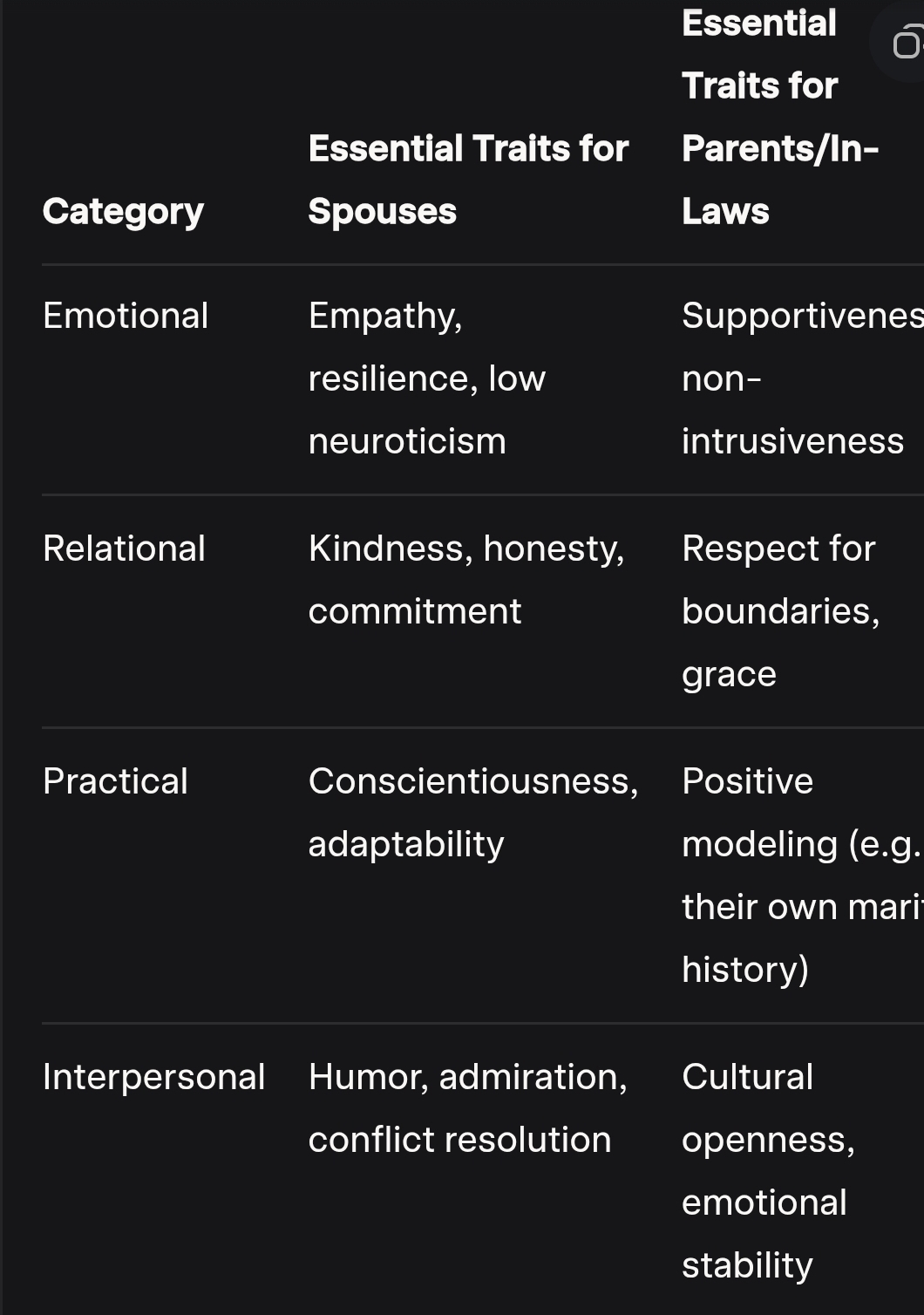
- Key Traits to Prioritize: Based on research, focus on these for the spouses and parents:
Category Essential Traits for Spouses Essential Traits for Parents/In-Laws Emotional Empathy, resilience, low neuroticism Supportiveness, non-intrusiveness Relational Kindness, honesty, commitment Respect for boundaries, grace Practical Conscientiousness, adaptability Positive modeling (e.g., their own marital history) Interpersonal Humor, admiration, conflict resolution Cultural openness, emotional stability
By prioritizing these, couples can foster resilience against challenges, including financial ones. If you’d like to dive deeper into specific studies or personal applications, let me know!
 GRP_VCare2Dare