#NarcsAreSharks
Era of self-obsession reigns supreme, “narcification“—the pervasive infiltration of narcissistic traits into everyday behavior—has become a silent epidemic ravaging Indian society. Narcissism, characterized by an inflated sense of self-importance, a deep need for excessive attention, manipulation, and a lack of empathy, mirrors the ancient Hindu depictions of Asuras and Asuris: demonic beings driven by ego, greed, and destructive impulses that lead to chaos and downfall. Just as Asuras like Ravana or Hiranyakashipu prioritized their desires over familial harmony, leading to epic destruction, modern narcification is tearing apart Indian families. This phenomenon affects both nari (women) and nara (men), transforming them into contemporary Asuris and Asuras who deceive, aggress, and dismantle the very bonds they should nurture. Substantiated by recent cases and societal analyses, this article explores how narcissism manifests as deception and violence, substantiated by real-world examples.
The Narcification of Indian Nari and Nara: Emerging as Asuri and Asuras
The Rise of Narcification in Indian Society
Narcissistic Personality Disorder (NPD) and its tendencies are increasingly linked to cultural and social pressures in India, where hierarchical family structures, societal expectations, and even social media amplify self-centered behaviors. Research indicates that narcissism thrives in unequal, stress-laden societies like India’s, marked by historical invasions, poverty, and rigid hierarchies. For instance, Indian family dynamics often enable narcissists, with parents wielding unchecked power over children and spouses, fostering a cycle of abuse. Social media exacerbates this, correlating with narcissistic traits among adolescents, where excessive use (over 6 hours daily for half of surveyed Indian teens) promotes self-obsession and lack of empathy. This “narcification” destroys families by turning individuals into manipulators who prioritize personal gratification over collective well-being, much like Asuras who wage war against divine order for selfish gains.
Indian Nari as Asuri: Women as Aggressors and Deceivers
Contrary to the idealized image of the self-sacrificing Indian woman, narcification has empowered some nari to embody Asuri traits—deceptive, vengeful, and destructive. These women, driven by narcissistic needs for control and validation, orchestrate betrayals that shatter families. A stark example is Meenakshamma, a 56-year-old grandmother from Karnataka’s Chikkamagaluru district, who conspired with her 33-year-old lover, Pradeep, to murder her 60-year-old husband, Subramanya. Disguising her grief while masterminding the strangulation and dismemberment, Meenakshamma’s affair-fueled plot exemplifies narcissistic deception, using a false missing person’s report to cover her tracks. Her actions, rooted in a four-year illicit relationship discovered by her husband, highlight how unchecked ego leads to familial annihilation.
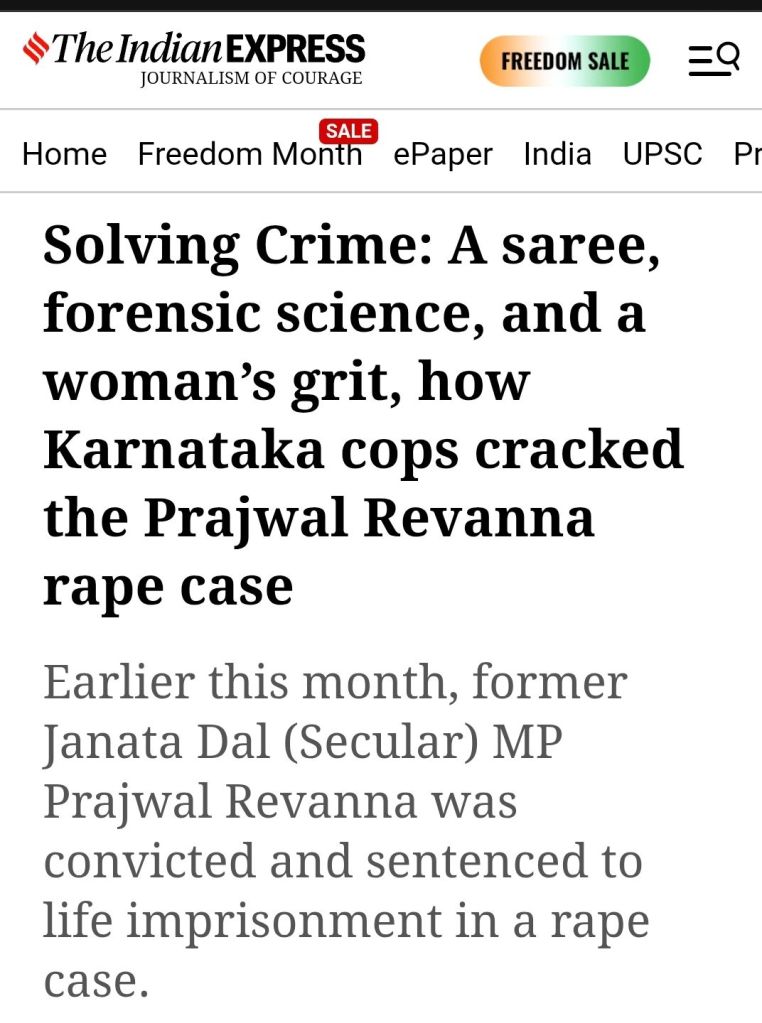
Similarly, in the Atul Subhash case, Nikita Singhania allegedly harassed her husband through false complaints of abuse and exorbitant demands (Rs 3 crore), driving the Bengaluru techie to suicide in December 2024. Singhania, along with her mother Nisha and brother Anurag, faced abetment charges, portraying a narcissistic family unit that manipulated legal systems for personal gain. This deception echoes Asuri figures like Putana, who feigned care to poison others.
Recent cases abound: In Ganderbal, Kashmir, a 22-year-old woman killed her 14-year-old sister in a fit of rage during an altercation, hitting her with a rod and staging the scene. In Jaipur, Santosh and her lover Rishi Srivastava murdered her husband Manoj Kumar Raigar, drawing inspiration from crime shows like CID to execute their plot. Delhi’s Soniya, 34, and boyfriend Rohit killed her husband and dumped his body in a drain, evading capture for a year. In Indore, newlywed Sonam Raghuvanshi orchestrated her husband Raja Raghuvanshi’s murder during their honeymoon, hiring hitmen for Rs 20 lakh with her boyfriend’s aid. A 23-year-old from Mathura plotted her husband’s murder amid marital disputes, while in Varanasi, a woman hired six killers for her spouse. Gwalior’s Pooja Jatav attempted to kill her first husband before murdering her mother-in-law. In Assam, a woman, her daughter, and accomplices killed her husband, faking a robbery. These incidents reveal a pattern: narcissistic women deceiving through affairs, false narratives, and violence, embodying Asuri destruction that prioritizes self over sacred family ties.
Indian Nara as Asura: Men as Enablers and Perpetrators
Narcification equally afflicts nara, turning men into Asuras who wield power manipulatively, often in familial or societal contexts. Indian culture’s patriarchal structures amplify this, with narcissistic fathers controlling households through emotional abuse and secrecy. Reddit discussions highlight narcissistic Indian fathers as dismissive, neglectful, and rage-filled, enabled by societal privilege. In one account, a father’s narcissism led to constant maternal distress, mirroring Asura-like tyranny over dependents.
Men also deceive and aggress: The high-profile case of Vikash Yadav, a former Indian intelligence officer, charged in 2024 for plotting the murder of Sikh separatist Gurpatwant Singh Pannun in the US, exemplifies narcissistic overreach for power and control. Though international, it reflects how Indian men in authority can embody Asura traits, conspiring across borders. Domestically, narcissistic men often enable or perpetrate family abuse, as seen in broader patterns where male privilege fosters manipulation. Quora users note narcissism’s prevalence among Indian males, linked to controlling upbringings, leading to disrespectful marriages and deceptive behaviors.
The Familial Devastation and Path Forward
Narcification’s toll is evident: families fractured by suicide, murder, and abuse. Children of narcissists inherit trauma, becoming people-pleasers or perpetuators, breaking the cycle requires boundaries and therapy. Petitions demand recognizing narcissistic abuse as criminal, highlighting its invisibility yet profound impact. As in Hindu lore, where devas triumph over Asuras through righteousness, Indian society must combat narcification via awareness, mental health support, and rejecting enabling hierarchies. Only then can nari and nara reclaim their divine potential, fostering harmony over havoc.
Citizens’ Charter on De-Narcification: Empowering Individuals and Communities to Foster Empathy and Harmony
Preamble
In an age where self-obsession, manipulation, and lack of empathy—collectively termed “narcification”—threaten the fabric of families, communities, and society at large, this Citizens’ Charter serves as a voluntary commitment for individuals, families, educators, and community leaders in India and beyond. Drawing from ancient wisdom that warns against Asura-like traits of ego and destruction, and informed by modern psychology, this charter aims to promote “de-narcification”: the active process of cultivating self-awareness, empathy, accountability, and collective well-being. By adopting this charter, citizens pledge to counteract narcissistic tendencies within themselves and society, building resilient relationships and a harmonious nation.
This charter is actionable, providing clear, practical steps categorized into personal, familial, communal, and societal levels. It emphasizes prevention, education, and intervention, with measurable commitments and mechanisms for accountability. All citizens are encouraged to sign, share, and implement it, adapting it to local contexts while upholding universal values of respect and compassion.
Core Principles
- Self-Awareness as the Foundation: Recognize that narcification begins with unchecked ego; commit to introspection to identify and address personal narcissistic traits.
- Empathy and Compassion as Antidotes: Prioritize understanding others’ perspectives to dismantle self-centered behaviors.
- Accountability and Transparency: Hold oneself and others responsible for actions that harm relationships or society.
- Education and Prevention: Equip future generations with tools to resist narcification through awareness programs.
- Inclusivity and Non-Discrimination: Ensure de-narcification efforts benefit all, regardless of gender, age, caste, or background, rejecting any form of exploitation.
Actionable Commitments
Personal Level: Building Inner Resilience
- Daily Self-Reflection: Dedicate 10-15 minutes daily to journaling or meditation, asking: “How did my actions today affect others? Did I prioritize my needs over empathy?” Track progress weekly and seek feedback from trusted peers.
- Limit Social Media Exposure: Restrict usage to 1-2 hours daily; curate feeds to promote positive, empathetic content. Use apps or timers to enforce this, and reflect on how online validation influences self-perception.
- Cultivate Gratitude and Humility: Maintain a gratitude journal noting three acts of kindness received or given each day. Practice humility by acknowledging mistakes publicly when appropriate, fostering vulnerability over defensiveness.
- Seek Professional Help if Needed: If exhibiting signs of narcissism (e.g., constant need for admiration, manipulation), consult a mental health professional within one month of recognition. Resources like NIMHANS helplines or local counselors should be utilized.
Familial Level: Strengthening Bonds
- Promote Open Communication: Hold weekly family meetings (15-30 minutes) to discuss feelings without judgment. Ban interruptions and encourage active listening techniques, such as paraphrasing what others say.
- Set Boundaries Against Manipulation: Educate family members on red flags of narcissistic behavior (e.g., gaslighting, blame-shifting) via shared readings or videos. Collectively agree on consequences, like timeouts or counseling, for violations.
- Model Empathy for Children: Parents and elders commit to demonstrating empathetic responses in daily interactions. Integrate stories from epics like Ramayana (e.g., Rama’s selflessness) into family discussions to contrast with Asura traits.
- Address Intergenerational Trauma: Identify and break cycles of narcissistic parenting (e.g., conditional love) by attending family therapy sessions quarterly if issues arise.
Communal Level: Fostering Supportive Networks
- Community Awareness Workshops: Organize or participate in monthly workshops on de-narcification, covering topics like emotional intelligence. Collaborate with local NGOs, schools, or panchayats to reach at least 50 participants per session.
- Peer Support Groups: Form or join groups (e.g., via WhatsApp or in-person) for sharing experiences of overcoming narcissistic tendencies. Commit to confidentiality and non-judgmental support, meeting bi-weekly.
- Advocate for Mental Health Resources: Petition local authorities for free counseling services in community centers. Track progress by following up quarterly and publicizing successes on social platforms.
- Challenge Cultural Enablers: In community forums, discuss how societal pressures (e.g., dowry demands, hierarchical family structures) fuel narcification, proposing alternatives like equal partnerships.
Societal Level: Driving Systemic Change
- Media and Policy Advocacy: Write letters or petitions to media outlets and policymakers demanding balanced portrayals that discourage narcissism (e.g., less glorification of “alpha” behaviors). Aim for one action per quarter, using platforms like Change.org.
- Educational Integration: Push for inclusion of empathy training in school curricula by contacting education boards. Volunteer to conduct sessions in local schools, targeting adolescents vulnerable to social media influences.
- Legal and Ethical Standards: Support laws recognizing narcissistic abuse (e.g., emotional coercion) as grounds for intervention in domestic cases. Educate through awareness campaigns, distributing pamphlets or hosting webinars.
- Corporate and Professional Ethics: In workplaces, advocate for anti-narcissism policies like leadership training on empathy. Employees commit to reporting manipulative behaviors anonymously.
Standards of Implementation and Monitoring
- Timeline for Adoption: Signatories commit to implementing at least three personal actions within the first month and one from each level within six months.
- Measurement of Progress: Use self-assessment tools (e.g., online narcissism quizzes from reputable sources like Psychology Today) quarterly. Communities can maintain shared logs of workshops and outcomes.
- Transparency: Publicly share annual progress reports on social media or community boards, inviting feedback to refine efforts.
Grievance Redress and Support Mechanisms
- Internal Resolution: For personal or familial disputes arising from de-narcification efforts, seek mediation from neutral family elders or professionals within 48 hours.
- External Support: Escalate to helplines like India’s National Mental Health Helpline (1-800-599-0019) or women’s/men’s support groups. Communities should establish local ombudsmen for charter-related grievances.
- Feedback Loop: Provide anonymous feedback on the charter’s effectiveness via a dedicated email or form, reviewed annually to update the document.
- Courtesy and Value: All interactions under this charter must embody respect, ensuring no one feels shamed for past behaviors but empowered for change.
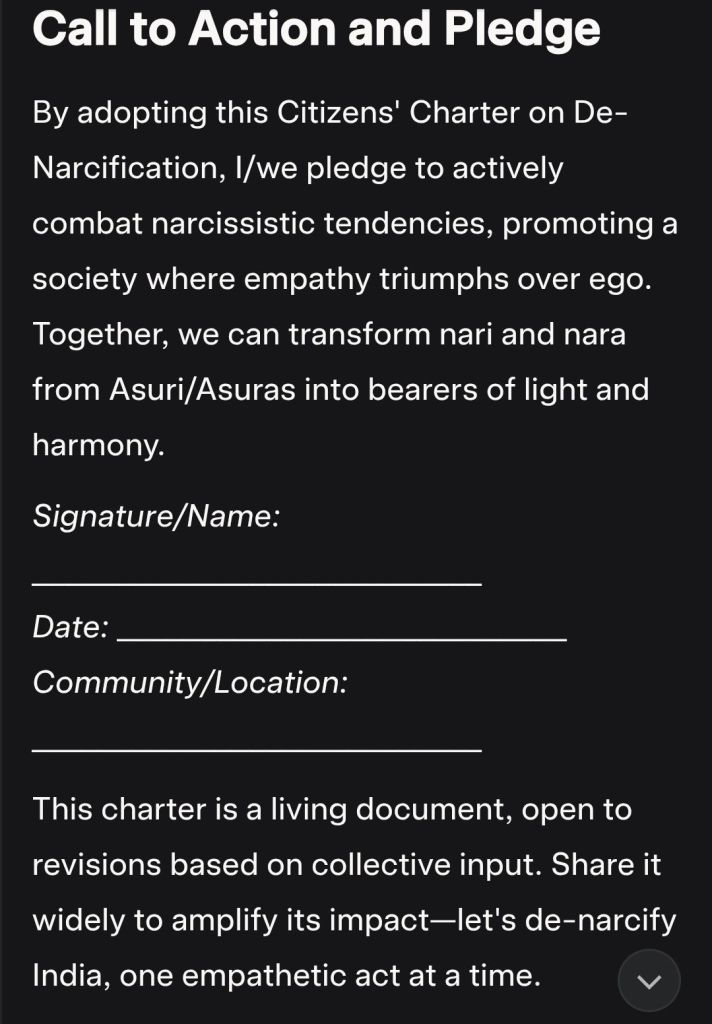
Call to Action and Pledge
By adopting this Citizens’ Charter on De-Narcification, I/we pledge to actively combat narcissistic tendencies, promoting a society where empathy triumphs over ego. Together, we can transform nari and nara from Asuri/Asuras into bearers of light and harmony.
Signature/Name: _______________
Date: _______________
Community/Location: _______________
This charter is a living document, open to revisions based on collective input. Share it widely to amplify its impact—let’s de-narcify India, one empathetic act at a time.

 GRP_VCare2Dare