Importance of the questions (What, Why, How, etc.) and determining the best sequence for rational questioning.
Part 1: Repeating the Poem
“I Keep Six Honest Serving Men,” which is closely related to these questions. Here’s the poem for reference:
I Keep Six Honest Serving Men by Rudyard Kipling
I keep six honest serving-men (They taught me all I knew); Their names are What and Why and When And How and Where and Who. I send them over land and sea, I send them east and west; But after they have worked for me, I give them all a rest.
I let them rest from nine till five, For I am busy then, As well as breakfast, lunch, and tea, For they are hungry men. But different folk have different views; I know a person small— She keeps ten million serving-men, Who get no rest at all!
She sends ’em abroad on her own affairs, From the second she opens her eyes— One million Hows, two million Wheres, And seven million Whys!
If this isn’t the poem you meant, it’s possible you’re referring to a different piece or a mnemonic like the “Five Ws and How” used in journalism or inquiry (Who, What, Where, When, Why, How). Since you asked to “repeat the poem,” but no exact match exists, I’ll assume this is the closest fit unless you meant a specific, less-known work. If you have more details (e.g., specific lines or context), please share, and I can refine the response.
Part 2: Analyzing the Importance of Questions and Their Sequence
Now, let’s evaluate which question—What, Why, How, or another—is most important and determine the best sequence for rational questioning.
Which Question Is Most Important?
The importance of a question depends on the context of the inquiry, but generally, each serves a distinct purpose in rational thinking:
- What: Identifies the subject, event, or issue (e.g., “What happened?”). It’s foundational because it defines the scope of the inquiry. Without knowing “what,” other questions lack focus.
- Why: Explores the reason, cause, or purpose (e.g., “Why did it happen?”). It’s critical for understanding motivations or root causes, making it essential for problem-solving or decision-making.
- How: Examines the process or method (e.g., “How did it happen?”). It’s key for understanding mechanisms or planning actions.
- Who: Identifies the people or entities involved (e.g., “Who is responsible?”). It’s vital when agency or accountability is central.
- Where: Specifies the location or context (e.g., “Where did it occur?”). It provides spatial grounding.
- When: Determines the timing (e.g., “When did it happen?”). It’s crucial for sequencing events.
Determining Importance: In rational questioning, Why is often considered the most important because it uncovers purpose, intent, or causation, which are critical for deep understanding and addressing root issues. For example, in problem-solving (e.g., a project failure), knowing “why” it failed (e.g., poor planning) is more actionable than just knowing “what” failed (e.g., the project). The “5 Whys” technique, used in fields like engineering and business, emphasizes this by repeatedly asking “Why” to drill down to root causes. However, What is a close contender, as it sets the stage for all other questions—without defining the issue, “Why” lacks direction.
Best Sequence for Rational Questioning
For rational, systematic inquiry, the sequence of questions matters to build a logical understanding. Based on principles from journalism, critical thinking, and problem-solving frameworks (e.g., the scientific method or investigative reporting), the optimal sequence is:
- What: Define the issue or event. This establishes the subject of inquiry (e.g., “What is the problem?”).
- Who: Identify the people or entities involved. This clarifies agency and stakeholders (e.g., “Who is affected or responsible?”).
- Where: Determine the location or context. This grounds the issue spatially (e.g., “Where is this happening?”).
- When: Establish the timing. This provides a temporal framework (e.g., “When did it occur?”).
- Why: Investigate the cause or purpose. This uncovers motivations or root issues (e.g., “Why is this happening?”).
- How: Explore the process or mechanism. This informs solutions or next steps (e.g., “How can we address it?”).
Why This Sequence?
- Starting with What ensures clarity on the issue before diving into details. Asking “Why” too early risks assumptions without a clear subject.
- Who, Where, When provide context (people, place, time), creating a factual foundation.
- Why comes next to analyze causes, leveraging the context from earlier questions.
- How concludes by focusing on solutions or processes, building on the understanding of causes.
This sequence aligns with structured inquiry methods, like journalism’s Five Ws and How or the scientific method (observe, question, hypothesize, test). For example, in investigating a news event (e.g., a fire), you’d first ask, “What happened?” (a fire broke out), then “Who was involved?” (firefighters, residents), “Where?” (a downtown building), “When?” (last night), “Why?” (faulty wiring), and “How?” (how it spread or was contained).
Exceptions and Flexibility
The sequence can vary based on context:
- In creative problem-solving, Why might come earlier to focus on purpose (e.g., “Why do we need this solution?”).
- In technical analysis, How might precede Why to understand mechanics first (e.g., “How does this system fail?”).
- If a specific question is urgent (e.g., “Who did this?” in a crime), it may take priority.
Final Answer
Poem: Kipling’s poem, it’s repeated above (“I Keep Six Honest Serving Men”). If you meant another poem, please clarify with specific details.
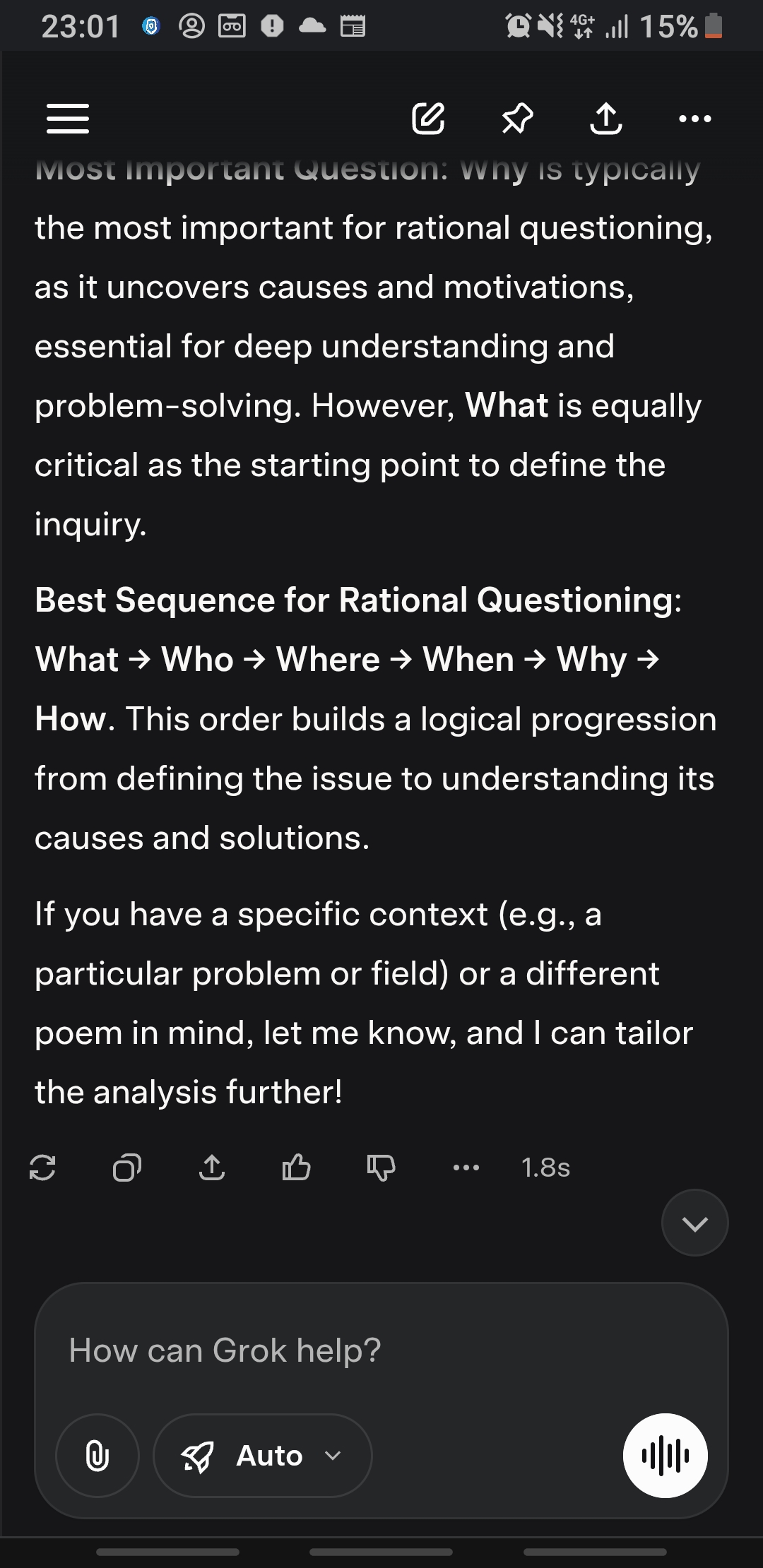
Most Important Question: Why is typically the most important for rational questioning, as it uncovers causes and motivations, essential for deep understanding and problem-solving. However, What is equally critical as the starting point to define the inquiry.
Best Sequence for Rational Questioning: What → Who → Where → When → Why → How. This order builds a logical progression from defining the issue to understanding its causes and solutions.
If you have a specific context (e.g., a particular problem or field) or a different poem in mind, let me know, and I can tailor the analysis further!
 GRP_VCare2Dare