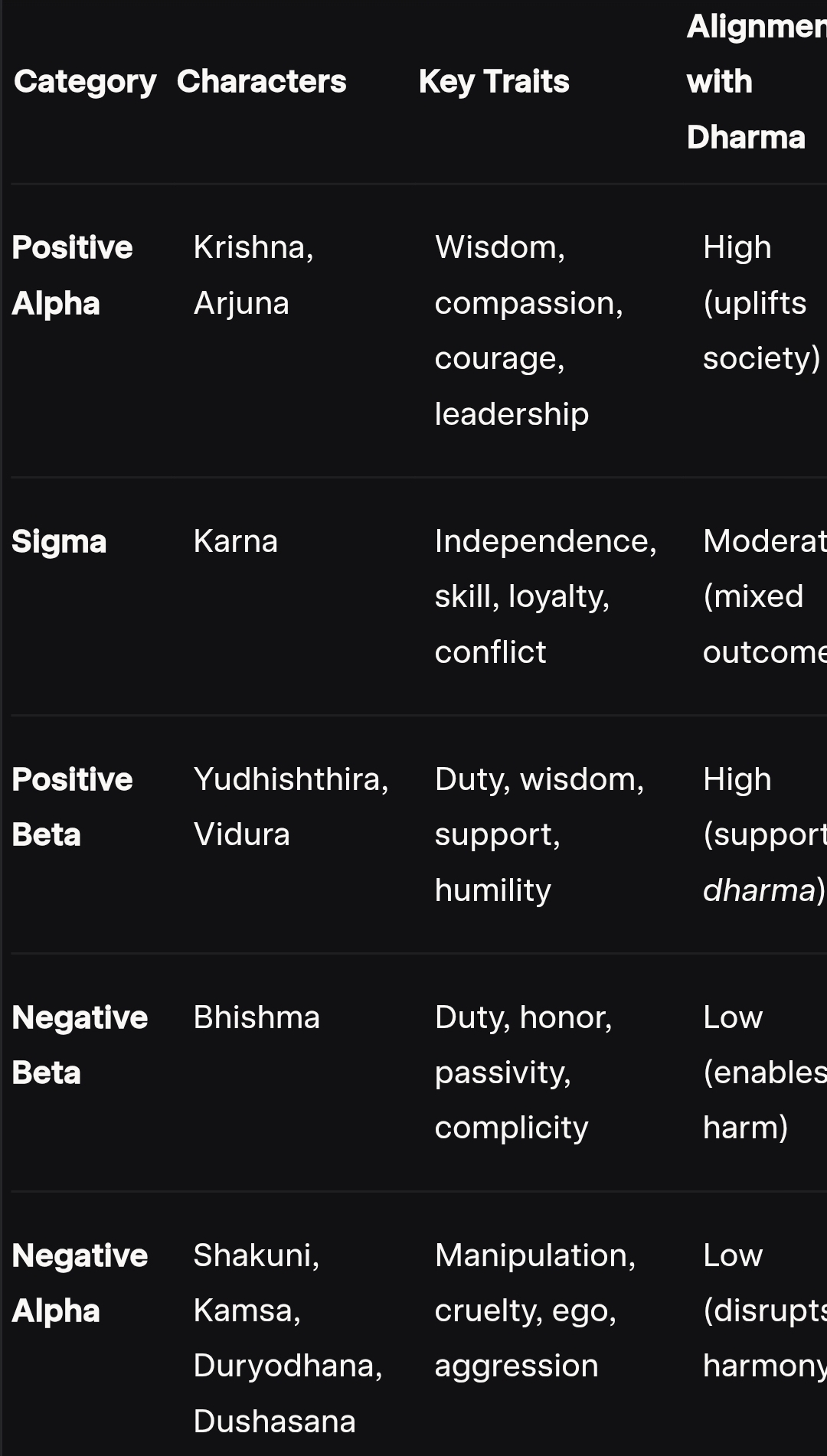
Indian Masculinities Spectrum based on Krishna, Karna, Shakuni, and Kamsa, with additional characters from Indian mythology, we can categorize them along a continuum from Positive Alpha (exemplifying virtuous, uplifting masculinity) to Beta (neutral or supportive traits, often lacking dominance but not necessarily negative) to Negative Alpha (destructive, ego-driven masculinity). This spectrum will draw from the Mahabharata and related texts, analyzing each character’s traits in the context of masculinity, with Krishna as the ideal of tonic masculinity and others reflecting varying degrees of positive, neutral, or toxic genderity. Additional characters like Arjuna, Bhishma, Duryodhana, and Dushasana will be included to enrich the spectrum.
Spectrum of Indian Masculinities: Krishna, Karna, Shakuni, Kamsa, and Others
The concept of masculinity in Indian mythology, particularly in the Mahabharata, offers a rich tapestry of archetypes ranging from virtuous leadership to destructive egoism. This spectrum categorizes key characters—Krishna, Karna, Shakuni, Kamsa, Arjuna, Bhishma, Duryodhana, and Dushasana—along a continuum of Positive Alpha (tonic masculinity that uplifts society), Beta (supportive or neutral traits, often lacking dominance), and Negative Alpha (toxic masculinity driven by ego, power, or malice). Each character’s portrayal reflects distinct facets of masculinity, grounded in their actions, motivations, and alignment with dharma (righteous duty).
Positive Alpha: Tonic Masculinity
Positive Alpha masculinity embodies strength, wisdom, compassion, and humility, aligning with dharma to foster harmony and justice. These characters lead with purpose, prioritize collective good, and balance power with empathy.
- Krishna:
- Traits: Wise, compassionate, strategic, humble, protective. As the king of Dwaraka, protector of Draupadi and the gopis, and Arjuna’s charioteer in the Bhagavad Gita, Krishna exemplifies tonic masculinity. His acronym K.R.I.S.H.N.A (King, Rakshak, Integrator, Sarathi, Helper, Negotiator, Achiever) captures his versatile leadership—guiding with wisdom, protecting the vulnerable, and uniting kins without ego.
- Example: Krishna’s selfless guidance in the Kurukshetra war and miraculous protection of Draupadi’s dignity showcase a masculinity that uplifts without dominating.
- Why Positive Alpha: Krishna integrates strength with emotional intelligence, acting for dharma rather than personal gain, making him the ideal of Indian masculinity.
- Arjuna:
- Traits: Courageous, skilled, introspective, devoted. As a warrior and Krishna’s disciple, Arjuna embodies a disciplined masculinity that seeks guidance and balances martial prowess with moral reflection, as seen in his Gita dialogue.
- Example: His hesitation to fight in Kurukshetra, followed by his acceptance of dharma under Krishna’s counsel, reflects a masculinity open to growth and ethical action.
- Why Positive Alpha: Arjuna’s strength, combined with his willingness to learn and uphold justice, aligns him closely with Krishna, though he relies on guidance, placing him slightly below Krishna’s self-assured leadership.
Beta: Supportive or Neutral Masculinity
Beta masculinity is characterized by supportive, non-dominant, or morally ambiguous traits. These characters may lack the assertive leadership of Alphas but are not inherently destructive, often playing crucial roles in the narrative.
- Karna:
- Traits: Loyal, generous, skilled, conflicted. Karna’s exceptional archery and loyalty to Duryodhana reflect strength, but his allegiance to the Kauravas and personal bitterness (due to his low-born status) limit his leadership. His generosity, like giving away his armor, shows nobility, but his choices often align with personal honor over dharma.
- Example: Karna’s refusal to abandon Duryodhana, despite knowing the Kauravas’ moral failings, reflects loyalty but also a lack of broader vision.
- Why Beta: Karna’s masculinity is admirable yet flawed; his internal conflicts and loyalty-driven decisions prevent him from fully embodying Positive Alpha traits, placing him in a supportive, neutral role.
- Bhishma:
- Traits: Dutiful, honorable, restrained, tragic. Bhishma’s vow of celibacy and loyalty to Hastinapur make him a pillar of duty, but his inability to intervene decisively against the Kauravas’ injustices (e.g., Draupadi’s disrobing) reflects passivity.
- Example: His silence during Draupadi’s humiliation shows a masculinity bound by oath over moral action, limiting his impact.
- Why Beta: Bhishma’s strength and wisdom are undercut by his rigid adherence to vows, making him a supportive figure who lacks the transformative leadership of a Positive Alpha.
Negative Alpha: Toxic Masculinity
Negative Alpha masculinity is marked by ego, aggression, manipulation, or cruelty, leading to destruction and disharmony. These characters misuse power, prioritize self-interest, and deviate from dharma.
- Shakuni:
- Traits: Manipulative, cunning, vengeful. Shakuni’s scheming, particularly orchestrating the dice game that leads to the Pandavas’ exile, reflects a calculating masculinity driven by revenge (stemming from his family’s grievances against the Kuru dynasty).
- Example: His rigging of the dice game to humiliate the Pandavas shows a destructive intellect that undermines fairness and harmony.
- Why Negative Alpha: Shakuni’s cunning dominance, devoid of compassion or justice, makes him a toxic figure whose masculinity manipulates rather than uplifts.
- Kamsa:
- Traits: Tyrannical, paranoid, cruel. Kamsa’s murder of newborns and oppressive rule in Mathura, driven by fear of a prophecy, epitomize a hyper-masculine obsession with control and power.
- Example: His attempts to kill Krishna, including sending demons like Puttana, reflect a destructive aggression that harms the innocent.
- Why Negative Alpha: Kamsa’s brute force and paranoia contrast starkly with Krishna’s strategic courage, embodying a toxic masculinity that destroys rather than protects.
- Duryodhana:
- Traits: Ambitious, prideful, envious. Duryodhana’s refusal to share power with the Pandavas and his role in instigating the Kurukshetra war stem from greed and a need for dominance.
- Example: His complicity in Draupadi’s disrobing and relentless pursuit of power show a masculinity rooted in entitlement.
- Why Negative Alpha: Duryodhana’s aggressive leadership, driven by ego rather than dharma, makes him a quintessential toxic Alpha.
- Dushasana:
- Traits: Cruel, subservient, exploitative. Dushasana’s attempt to disrobe Draupadi in the Kuru court is a stark display of toxic masculinity, reducing a woman to an object to assert power.
- Example: His actions in the dice game, following Duryodhana’s orders, reflect a lack of moral agency combined with brutal aggression.
- Why Negative Alpha: Dushasana’s cruelty and blind loyalty to his brother’s toxic agenda amplify his destructive masculinity.
The Spectrum Visualized
Key Traits Alignment with Dharma
Positive Alpha Krishna, Arjuna Wisdom, compassion, courage, humility High (uplifts society)
Beta Karna, Bhishma Loyalty, duty, skill, but conflicted/passive Moderate (mixed outcomes)
Negative Alpha Shakuni, Kamsa, Duryodhana, Dushasana Manipulation, cruelty, ego, aggression Low (disrupts harmony)
Cultural Context and Relevance
In the Indian context, masculinity is often framed through purushartha (dharma, artha, kama, moksha), where ideal manhood balances duty, prosperity, desire, and liberation. Krishna and Arjuna embody this holistic ideal, modeling a masculinity that integrates strength with empathy and action with reflection. Karna and Bhishma, while admirable, fall short due to personal conflicts or passivity, reflecting a Beta role that supports but doesn’t lead. Shakuni, Kamsa, Duryodhana, and Dushasana, conversely, represent toxic deviations—Negative Alphas whose ego-driven actions cause suffering.
This spectrum offers a framework for modern Indian masculinity, encouraging men to aspire to Krishna’s tonic qualities—leadership with compassion, strength with humility—while avoiding the pitfalls of ego, cruelty, or manipulation seen in Negative Alphas. By studying these archetypes, we can foster a masculinity that aligns with dharma, promoting harmony in personal and societal contexts.
 GRP_VCare2Dare