Adding Real-Life Cases to Toxic Bro & Sis Pairs: Atul Subhash and Sushant Singh Rajput.
Sibling Narc-Nexus Vs Empath-Nextus.
Building on the mythological examples of toxic sibling pairs (Simhika & Hiranyakashipu, Ravana & Shurpanakha) with their “Narc-Nexus” (interpreting “Narc” as a blend of narcissistic traits like ego-driven manipulation and, where relevant, narcotics involvement), we can draw parallels to modern real-life cases. The user-requested additions—Atul Subhash (noting the common spelling variation from “Athul”) and Sushant Singh Rajput—highlight alleged toxic brother-sister dynamics involving harassment, manipulation, exploitation, and in one case, a direct narcotics link. These cases, rooted in high-profile suicides in India, underscore themes of power imbalances, family enabling, and systemic issues like legal misuse or substance abuse, mirroring the destructive ambition and complicity in the ancient stories.
Unlike the positive pairs (Krishna-Draupadi, Rama-Urmila), which emphasize selflessness and support, these real-world examples reflect alleged enabling of harm, often leading to tragic outcomes. Below, I analyze each case, focusing on the “bro-sis” nexus and its toxic elements, based on publicly reported details.
1. Atul Subhash Case: Nikita Singhania & Anurag Singhania (Sister-Brother Pair as Alleged Enablers)
- Background: Atul Subhash, a 34-year-old Bengaluru-based software engineer, died by suicide on December 9, 2024, leaving behind a 24-page suicide note and an 81-minute video. In these, he accused his estranged wife, Nikita Singhania, her mother Nisha Singhania, and her brother Anurag Singhania of relentless harassment, filing multiple false cases (including under India’s dowry laws like Section 498A), demanding exorbitant sums (e.g., ₹3 crore for settlement), and emotional blackmail. Atul claimed this drove him to despair, describing himself as treated like an “ATM” and criticizing judicial bias. His family, including brother Bikas Modi, corroborated these claims, noting 9-10 false cases filed against Atul and his parents. Nikita, Nisha, and Anurag were arrested on December 15, 2024, for abetment to suicide, though bail proceedings and custody battles over Atul’s young son continue as of early 2025.
- Toxic Dynamics & Narc-Nexus: The “bro-sis” pair here is Nikita (sister) and Anurag (brother), accused of collaborating in a narcissistic nexus of control and exploitation. Atul’s note detailed how Nikita filed complaints with Anurag’s alleged support, using family ties to amplify pressure—echoing Simhika’s complicity in Hiranyakashipu’s tyrannical schemes or Shurpanakha’s incitement of Ravana’s vengeance. This reflects narcissistic traits: entitlement to financial gains, manipulation of legal systems (e.g., dowry laws often criticized for misuse), and disregard for the victim’s mental health. No direct narcotics involvement, but the “narc” aspect aligns with alleged self-centered abuse, where the siblings reportedly enabled each other’s actions for personal benefit, leading to Atul’s isolation and suicide. Men’s rights activists have cited this case to highlight gender-biased laws, amplifying the debate on toxic family enmeshment.
- Outcome & Parallels: The arrests and ongoing Supreme Court involvement (e.g., denying custody to Atul’s mother, calling her a “stranger” to the child) underscore systemic failures, similar to the mythological downfall of toxic pairs through divine justice. Atul’s brother Bikas has been vocal, contrasting with the accused siblings’ alleged unity in harm.
2. Sushant Singh Rajput Case: Multiple Bro-Sis Layers (Rhea & Showik Chakraborty; Sushant & His Sisters)
- Background: Bollywood actor Sushant Singh Rajput died by suicide on June 14, 2020, sparking investigations into abetment, nepotism, mental health, and drugs. Key angles include his girlfriend Rhea Chakraborty and her brother Showik, arrested by the Narcotics Control Bureau (NCB) for procuring and supplying drugs (e.g., marijuana) to Sushant. Showik admitted to obtaining drugs on Rhea’s instructions, who allegedly paid for them. Separately, allegations surfaced about Sushant’s own family: his sister Priyanka Singh was accused by Rhea of prescribing psychotropic drugs (e.g., Clonazepam) without valid authorization, potentially exacerbating his condition. Sushant had four sisters (including Priyanka and Shweta Singh Kirti), who were supportive post-death but faced scrutiny for family dynamics.
- Toxic Dynamics & Narc-Nexus:
- Rhea & Showik (Sister-Brother Pair): This duo represents a direct “narc nexus” involving narcotics. Showik procured drugs through contacts, with Rhea allegedly facilitating for Sushant, enabling his dependency amid mental health struggles. This mirrors Shurpanakha’s role in fueling Ravana’s destructive path—complicity in vice for personal or relational gain. Narcissistic elements include alleged manipulation of Sushant’s vulnerabilities for control or financial benefit (e.g., CBI probes into money siphoning).
- Sushant & His Sisters (Brother-Sister Pairs): Allegations point to a toxic enabling dynamic, where sisters like Priyanka provided unauthorized medications, potentially worsening his depression (diagnosed since 2013). This reflects narcissistic family patterns: over-involvement masking control, similar to Hiranyakashipu’s arrogance harming his kin. Post-death, sisters like Shweta advocated for justice, but critics highlighted family pressures contributing to isolation.
- Outcome & Parallels: Rhea and Showik were charged under NDPS Act but later bailed; CBI closed the abetment probe in 2025, giving Rhea a clean chit. The case exposed Bollywood’s underbelly, akin to mythological tales where toxic enablers face reckoning (e.g., Ravana’s fall). It blends narcotics with narcissistic family ties, amplifying public discourse on mental health and accountability.
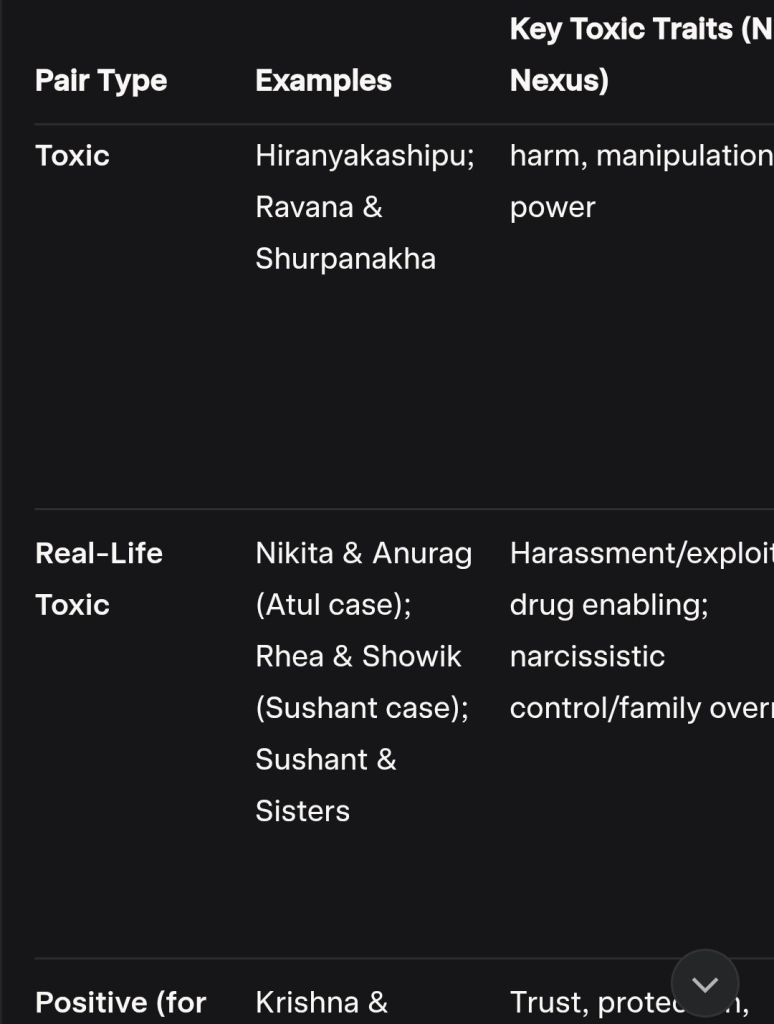
Comparison Table: Mythological vs. Real-Life Toxic Bro & Sis Pairs
Pair Type Examples Key Toxic Traits (Narc-Nexus) Consequences Parallels to Positive Pairs Mythological Toxic Simhika & Hiranyakashipu; Ravana & Shurpanakha Arrogance, complicity in harm, manipulation for power Downfall via divine intervention (e.g., fire, war) Lacks selflessness of Krishna-Draupadi (protection) or Rama-Urmila (sacrifice) Real-Life Toxic Nikita & Anurag (Atul case); Rhea & Showik (Sushant case); Sushant & Sisters Harassment/exploitation; drug enabling; narcissistic control/family overreach Suicide, arrests, legal battles; public scrutiny Contrasts with supportive bonds—e.g., no mutual faith or duty, only alleged self-interest Positive (for Contrast) Krishna & Draupadi; Rama & Urmila Trust, protection, sacrifice Triumph and harmony Emphasizes dharma over destruction, absent in toxic cases
Critical Analysis
These additions shift from mythology to contemporary India, where “Narc-Nexus” evolves: narcissistic abuse in Atul’s case (legal/financial manipulation) and literal narcotics in Sushant’s (drug procurement amid family enabling). Both highlight how sibling bonds can turn toxic when rooted in entitlement or vice, often exacerbated by societal issues like biased laws or celebrity pressures. Unlike the epics’ moral resolutions, real-life outcomes involve ongoing debates (e.g., dowry law reforms post-Atul; mental health awareness post-Sushant). This framing aligns with the original post’s vision of “IndiaVisions2030,” critiquing destructive dynamics for societal reflection.
If you’d like deeper dives (e.g., browsing specific articles, analyzing videos, or a visual chart), expansions on other cases, or edits to this analysis, let me know!
 GRP_VCare2Dare