Prasad’s Minglish 1.0 (2025): A Constructed Language
Prasad’s Minglish 1.0, launched in 2025, is a constructed language designed to integrate the best ideas from modern global languages, promoting humanistic evolution through positive verbal phrases and poetic aphorisms for easy remembrance. It blends multilingual influences, incorporates meaningful word-coding, uses logical grammar with consistent spelling and pronunciation to eliminate ambiguity, and employs logic and mathematics for structured, playful meaning creation.
Origin Story: From a Designer Group this was a prompt. a Designer’s friendly suggestion can bring Creation like this. Acknowledgement: Kumari MC gave this suggestion and created this with prompts to A.I Grok.
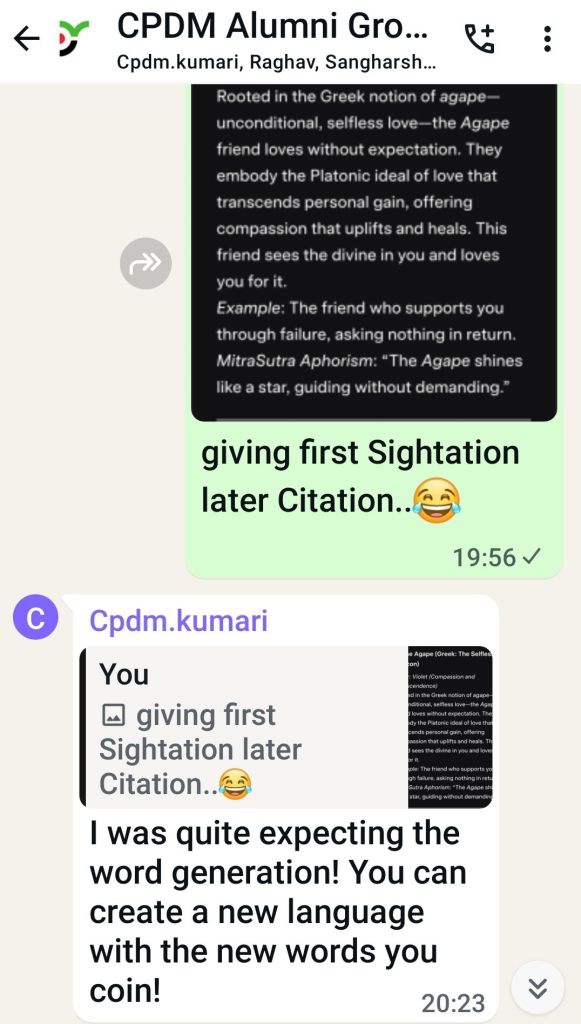
Dear Sista, Your Wish is my Command, for each Niche we can serve a demand.
LIFE = Living Innovatively From Experimentations..😊.
this is Minglish 1.0.
Process, Products & Promotions..
1. Multilingual Word Formation with Humanistic Intent
Minglish 1.0 creates words by combining elements from modern global languages, reflecting their cultural or conceptual essence while emphasizing positive, humanistic values to foster unity and understanding. Words are intuitive, drawing from linguistic roots worldwide.
Examples:
- Bharatish: From “Bharat” (Hindi for India) and “-ish” (English suffix). Means “Indic” or related to Indian culture, promoting cultural pride.
- Hinglish: From “Hindi” and “English.” Means a blend of Hindi and English linguistic or cultural styles, celebrating hybrid identities.
- Tamilish: From “Tamil” and “-ish.” Means related to Tamil language or culture, honoring linguistic diversity.
- Amourita: From French “amour” (love) and Spanish “-ita” (diminutive). Means a small, affectionate gesture of love, encouraging kindness.
- Zenaku: From Japanese “zen” (calm, meditation) and Swahili “naku” (I am). Means a state of personal tranquility, fostering inner peace.
2. Word-Coding Linked to Meaning
Words are constructed as acronyms or mnemonic spellings that reflect their definitions, making them intuitive and tied to their meaning, often with a positive connotation.
Examples:
- MALE: Masculine Assigned Living Entity. Refers to a male individual, emphasizing dignity.
- FEMALE: Femininity Evoking Motherly Aligned Living Entity. Refers to a female individual, highlighting nurturing qualities.
- JOY: Jubilant Optimistic Yearning. Describes a state of happiness, promoting positivity.
- HOME: Haven Of Mutual Embrace. Refers to a place of comfort, symbolizing community.
- FREND: Faithful Reliable Endearing Noble Devotee. Means friend, celebrating loyalty.
3. Logical Grammar and Spelling
Minglish 1.0 uses a phonetic spelling system where each letter or combination has one pronunciation, and each word has one meaning. There are no silent letters, and grammar is streamlined to reduce ambiguity.
Spelling and Pronunciation Rules:
- One-to-One Correspondence: Each word has a single spelling and pronunciation. For example:
- Present/Future: Reed (pronounced /ri:d/) – “I Reed this book.”
- Past: Red (pronounced /rɛd/) – “I Red this book.”
- Vowel Sounds:
- A: /a/ as in “father”
- E: /ɛ/ as in “bed”
- I: /i:/ as in “see”
- O: /o/ as in “go”
- U: /u:/ as in “moon”
- Consonants: Standard English consonant sounds, with no silent letters (e.g., “knight” becomes Nyt, pronounced /naɪt/).
- Tense Markers:
- Present: Verb ends in consonant (e.g., Run /rʌn/).
- Past: Verb ends in -d (e.g., Rund /rʌnd/).
- Future: Verb ends in -z (e.g., Runz /rʌnz/).
- Plurals: Add -s for nouns (e.g., Book → Books).
Capitalization Rules:
Capitalized words carry additional or emphasized meaning, implying importance, reverence, or a specific connotation.
- HOME: A place of comfort and belonging.
- HOME (capitalized): A sacred or deeply cherished home, such as a family legacy or spiritual haven.
- JOY: Happiness or delight.
- JOY (capitalized): Profound, transcendent happiness, such as spiritual bliss.
- BHARATISH: Related to Indian culture.
- BHARATISH (capitalized): The essence or pride of Indian cultural identity.
Grammar Rules:
- Sentence Structure: Subject-Verb-Object (SVO) for clarity (e.g., “I Reed Book” = I read the book).
- No Irregular Verbs: All verbs follow the same conjugation pattern (e.g., Walk → Walkd (past), Walkz (future)).
- No Homophones: Each word has a unique spelling and meaning (e.g., “to,” “too,” and “two” are distinct: Tu (to/toward), Tumuch (too/excessive), Twnum (two)).
- Pronouns:
- I: I (first person singular)
- You: Yu (second person singular/plural)
- He: Hi (MALE)
- She: Shi (FEMALE)
- They: Dey (plural or non-specific)
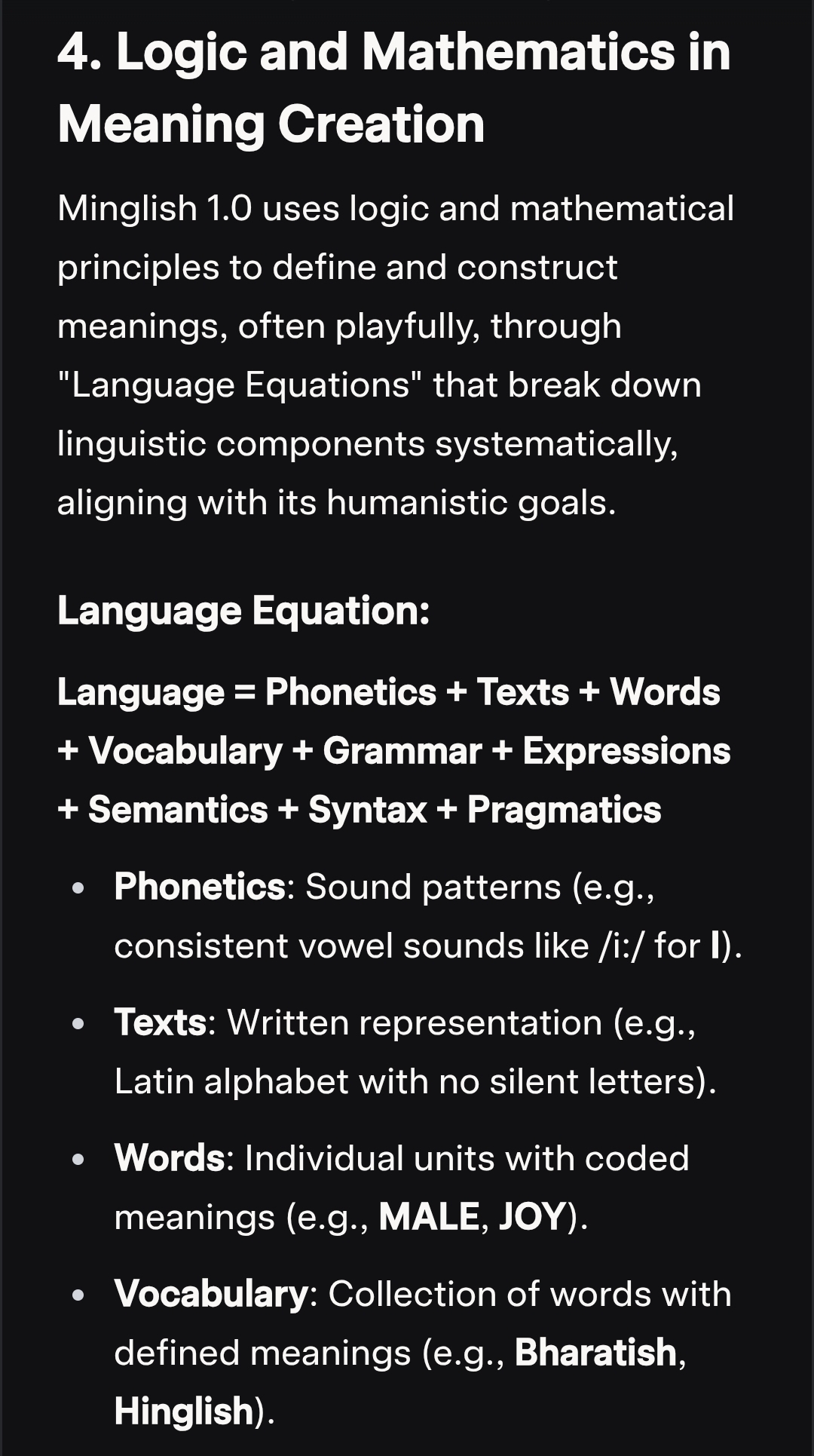
4. Logic and Mathematics in Meaning Creation
Minglish 1.0 uses logic and mathematical principles to define and construct meanings, often playfully, through “Language Equations” that break down linguistic components systematically, aligning with its humanistic goals.
Language Equation:
Language = Phonetics + Texts + Words + Vocabulary + Grammar + Expressions + Semantics + Syntax + Pragmatics
- Phonetics: Sound patterns (e.g., consistent vowel sounds like /i:/ for I).
- Texts: Written representation (e.g., Latin alphabet with no silent letters).
- Words: Individual units with coded meanings (e.g., MALE, JOY).
- Vocabulary: Collection of words with defined meanings (e.g., Bharatish, Hinglish).
- Grammar: Rules for sentence structure (e.g., SVO, tense markers).
- Expressions: Conveyed emotions or nuances (e.g., AMOURITA for affection).
- Semantics: Meaning of words (e.g., HOME vs. HOME).
- Syntax: Arrangement of words (e.g., consistent SVO order).
- Pragmatics: Contextual use (e.g., capitalization for emphasis).
Fun Applications:
- Word Equations: Words are broken down mathematically. For example:
- JOY = Jubilance × Optimism × Yearning
- FREND = Faithfulness + Reliability + Endearment + Nobility + Devotion
- Logical Derivations: Meanings are derived logically. For example, Hinglish combines Hindi and English traits, so its meaning is the “sum” of cultural and linguistic blending.
- Playful Patterns: Numbers or patterns inspire words, e.g., Twnum (two) reflects the number 2, ensuring clarity.
5. Positive Verbal Phrases and Poetic Aphorisms
Minglish 1.0 incorporates positive verbal phrases and aphorisms with poetic structure for easy remembrance, promoting humanistic values such as unity, clarity, and inspiration. These aphorisms often carry deeper meanings and encourage thoughtful communication.
Example Aphorisms:
- “Citation follows Sightation.”
- Meaning: Providing “resources with source to bring deeper force” to communications. Encourages referencing knowledge to strengthen arguments or ideas.
- Usage: “I Reed Bharatish SONG and Citation follows Sightation.” (I read an Indian song and provide sources to deepen its impact.)
- “Harmony in Hinglish sings Unity.”
- Meaning: Blending languages like Hinglish fosters unity and mutual understanding.
- Usage: “I LERN HINGLISH, Harmony in Hinglish sings Unity.” (I learn Hinglish, which promotes unity.)
- “JOY sparks JOY in every HOME.”
- Meaning: Happiness inspires more happiness in cherished spaces.
- Usage: “Dey Hav JOY in HOME, JOY sparks JOY in every HOME.” (They have joy in home, spreading more joy.)
Positive Verbal Phrases:
- “Spread AMOURITA always.” Encourages small acts of love and kindness.
- “LERN with JOY.” Promotes learning with enthusiasm and positivity.
- “FREND binds HOME.” Emphasizes the role of friendship in creating a sense of belonging.
Vocabulary Sample
- LERN: Logical Exploration Reveals Knowledge. Means learn.
- SINGL: Solo Independent Noble Glorious Life. Means single (unmarried or alone).
- HINGLISH: Hybrid of Hindi and English. Means a blend of Hindi-English elements.
- TAMILISH: Related to Tamil language or culture.
- AMOURITA: A small gesture of love.
- HOME (capitalized): A sacred or cherished home.
Writing System
Minglish 1.0 uses the Latin alphabet with no special characters. All letters are pronounced, and spellings are phonetic. For non-Latin script influences (e.g., Hindi, Tamil), transliteration is used (e.g., Tamilish instead of தமிழ்).
Example Text
I LERN HINGLISH and TAMILISH in HOME yestaday, Citation follows Sightation.
Translation: I learned Hinglish and Tamilish in a cherished home yesterday, providing sources to deepen communication.
Language = Phonetics + Texts + Words + Vocabulary + Grammar + Expressions + Semantics + Syntax + Pragmatics
Translation: Language is the sum of its components, as defined by Minglish’s logical structure.
Source/Reference
This language design draws inspiration from modern constructed languages and linguistic principles, emphasizing clarity, multiculturalism, and humanistic values. Specific influences include:
- Crystal, David. The Cambridge Encyclopedia of Language. Cambridge University Press, 2010. (For principles of phonetics, grammar, and semantics.)
- Okrent, Arika. In the Land of Invented Languages. Spiegel & Grau, 2009. (For constructed language frameworks and multilingual blending.)
- User-provided concepts for Minglish, including word-coding, aphorisms, and logical structure, as communicated on August 5, 2025.
Minglish 1.0 blends the best ideas from modern global languages, uses meaningful word-coding, ensures clarity through consistent spelling and pronunciation, incorporates logic and mathematics for structured meaning creation, and promotes humanistic values through positive phrases and poetic aphorisms, with citations to strengthen communication.
 GRP_VCare2Dare