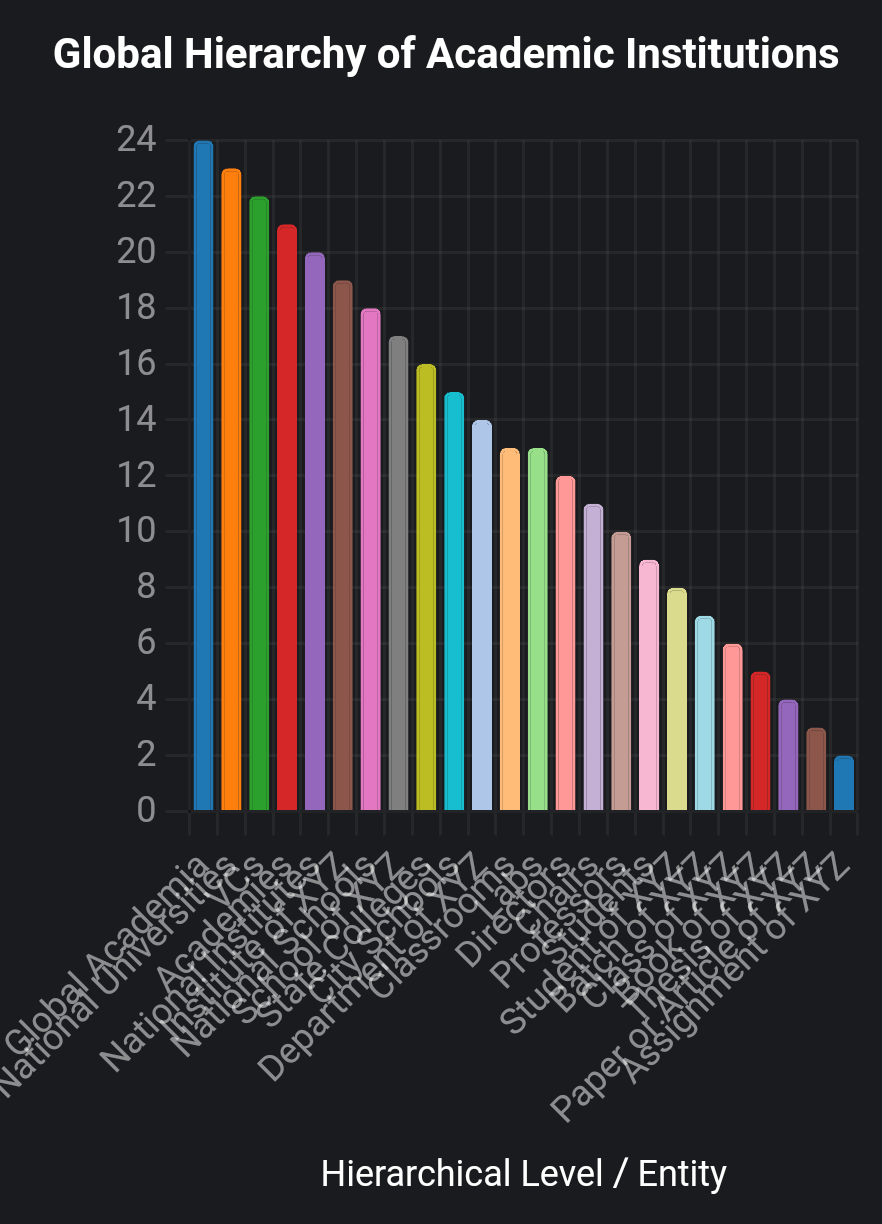
To address your request for a globally relevant hierarchy of academic institutions with a revised title, “Universal Hierarchy of Academic Entities”, and the inclusion of speculative entities such as Earth-University, Extraterrestrial-University, and Interplanetary Universities (Earth-Mars University), I will create an updated Chart.js bar chart. This chart will incorporate these new entities alongside the previously included ones: Global Academia, International Collaborative Universities, National Universities, Vice-Chancellors (VCs), Academies, National Institutes, Institute of XYZ, National Schools, School of XYZ, State Colleges, City Schools, Department of XYZ, Classrooms, Labs, Directors, Chairs, Professors, Students, Student of XYZ, Batch of XYZ, Class of XYZ, Book of XYZ, Thesis of XYZ, Paper or Article of XYZ, and Assignment of XYZ. The chart will reflect a universal academic hierarchy, including speculative extraterrestrial and interplanetary institutions to align with the futuristic vision implied by your request, while maintaining relevance to existing institutions like Oxford and Harvard.
Explanation of the Hierarchy
- Global Academia: The collective global academic ecosystem (e.g., UNESCO, QS/THE rankings), now extended to a universal context.
- Earth-University: A hypothetical top-tier entity representing the unified academic system of Earth, overseeing all terrestrial institutions.
- Extraterrestrial-University: A speculative entity representing academic institutions beyond Earth, potentially on other celestial bodies (e.g., lunar or Martian research stations).
- Interplanetary Universities (Earth-Mars University): Hypothetical institutions spanning multiple planets (e.g., a joint Earth-Mars university), facilitating interplanetary academic collaboration.
- International Collaborative Universities: Cross-national institutions (e.g., NYU Shanghai, Yale-NUS College).
- National Universities: Comprehensive institutions (e.g., Harvard, Oxford, NUS).
- Vice-Chancellors (VCs): Top administrative leaders (e.g., Oxford’s Vice-Chancellor).
- Academies: Prestigious academic societies (e.g., Royal Society).
- National Institutes: Specialized institutions (e.g., MIT, IISc).
- Institute of XYZ: Field-specific institutes (e.g., Institute of Physics at Oxford).
- National Schools: Broad disciplinary units (e.g., Harvard Medical School).
- School of XYZ: Specific schools (e.g., School of Engineering at Stanford).
- State Colleges: Regionally governed institutions (e.g., UC-affiliated colleges).
- City Schools: Localized institutions (e.g., community colleges).
- Department of XYZ: Discipline-specific units (e.g., Department of Chemistry at Harvard).
- Classrooms: Teaching units for course delivery.
- Labs: Research units within departments/centers.
- Directors: Leaders of institutes/schools/centers (e.g., Director of MIT’s Media Lab).
- Chairs: Heads of departments or endowed positions (e.g., Chair of Physics at Oxford).
- Professors: Faculty for teaching and research.
- Students: General student body.
- Student of XYZ: Students in specific programs (e.g., Student of Computer Science at IISc).
- Batch of XYZ: Student cohorts by year (e.g., Batch of 2025 at IIM Ahmedabad).
- Class of XYZ: Course-specific cohorts (e.g., Class of Quantum Mechanics at MIT).
- Book of XYZ: Academic books (e.g., Book of Astrophysics by a Harvard professor).
- Thesis of XYZ: Student research theses (e.g., Thesis of AI at Tsinghua).
- Paper or Article of XYZ: Scholarly publications (e.g., Paper of Biotechnology from NUS).
- Assignment of XYZ: Student tasks (e.g., Assignment of Data Science at Oxford).
Chart Design
The bar chart will display entities on the x-axis and their hierarchical level on the y-axis (higher values indicate greater authority/scope). The new entities (Earth-University, Extraterrestrial-University, Interplanetary Universities) are placed at the top, above International Collaborative Universities, to reflect their speculative, universal scope. Distinct colors ensure readability, with a compact layout to accommodate the 28 entities.
Notes on the Chart
- Hierarchical Levels:
- Global Academia (28): Top level, encompassing global and universal oversight (e.g., UNESCO, hypothetical galactic academic bodies).
- Earth-University (27): Hypothetical unified academic system for Earth, overseeing all terrestrial institutions.
- Extraterrestrial-University (26): Speculative institutions on non-Earth celestial bodies (e.g., lunar or Martian universities).
- Interplanetary Universities (25): Hypothetical cross-planetary institutions (e.g., Earth-Mars University).
- International Collaborative Universities (24): Cross-national institutions (e.g., NYU Shanghai).
- National Universities (23): Comprehensive institutions (e.g., Harvard, Oxford).
- VCs (22): Leaders like Harvard’s President.
- Academies (21): Prestigious societies (e.g., Royal Society).
- National Institutes (20): Specialized institutions (e.g., MIT, IISc).
- Institute of XYZ (19): Field-specific institutes (e.g., Institute of Physics at Oxford).
- National Schools (18): Broad units (e.g., Harvard Medical School).
- School of XYZ (17): Specific schools (e.g., School of Engineering at Stanford).
- State Colleges (16): Regionally governed (e.g., UC-affiliated colleges).
- City Schools (15): Localized institutions (e.g., community colleges).
- Department of XYZ (14): Discipline-specific units (e.g., Department of Chemistry at Harvard).
- Classrooms/Labs (13): Teaching and research units, at the same level.
- Directors (12): Leaders of institutes/schools (e.g., Director of IIT Delhi’s AI Centre).
- Chairs (11): Departmental heads (e.g., Chair of Physics at Oxford).
- Professors (10): Faculty for teaching and research.
- Students (9): General student body.
- Student of XYZ (8): Students in specific programs (e.g., Student of Computer Science at IISc).
- Batch of XYZ (7): Student cohorts by year (e.g., Batch of 2025 at IIM Ahmedabad).
- Class of XYZ (6): Course-specific cohorts (e.g., Class of Quantum Mechanics at MIT).
- Book of XYZ (5): Academic books (e.g., Book of Astrophysics by a Harvard professor).
- Thesis of XYZ (4): Student research theses (e.g., Thesis of AI at Tsinghua).
- Paper or Article of XYZ (3): Scholarly publications (e.g., Paper of Biotechnology from NUS).
- Assignment of XYZ (2): Student tasks (e.g., Assignment of Data Science at Oxford).
- Colors: New colors (#ff4500, #00b7eb, #ff1493) are added for Earth-University, Extraterrestrial-University, and Interplanetary Universities to distinguish their speculative nature. Some colors are reused for lower-level entities but chosen for visual clarity.
- Design: X-axis labels are rotated 45 degrees for readability with 28 entities. The y-axis uses a step size of 1 to show hierarchical differences.
Examples in Context
- Earth-University: Hypothetical unified Earth academic system, coordinating global institutions like Harvard.
- Extraterrestrial-University: Speculative lunar or Martian universities, potentially led by space agencies or private entities like xAI.
- Interplanetary Universities: Earth-Mars University, a joint institution for interplanetary research and education.
- Other Entities: As per previous examples, e.g., Harvard (National Universities), IISc (National Institutes), NYU Shanghai (International Collaborative Universities).
Connection to Previous Discussion
This chart extends the earlier analysis of why Indian institutes (e.g., IISc, IITs) struggle to compete with global peers like Harvard and Oxford. The speculative entities (Earth-University, Extraterrestrial-University, Interplanetary Universities) align with the discussion on linguistic and structural barriers, as their hypothetical nature assumes overcoming such limitations through universal collaboration. Indian institutes, as Institute of XYZ, remain domain-specific, limiting their scope compared to National Universities or International Collaborative Universities.
If you need a different visualization (e.g., a tree diagram, though not supported by Chart.js), specific examples for speculative entities, or additional data (e.g., futuristic academic trends), let me know!
 GRP_VCare2Dare