Let Our Collective Truths Set us Free Collectively!!
From 3 Blind HuMen (Dark B/W Bluepillers) to 2 Aware-Huemen (Colored-Seers Reality RedPillers).
From Intellectual-Travesty to Intellectual-Honesty.
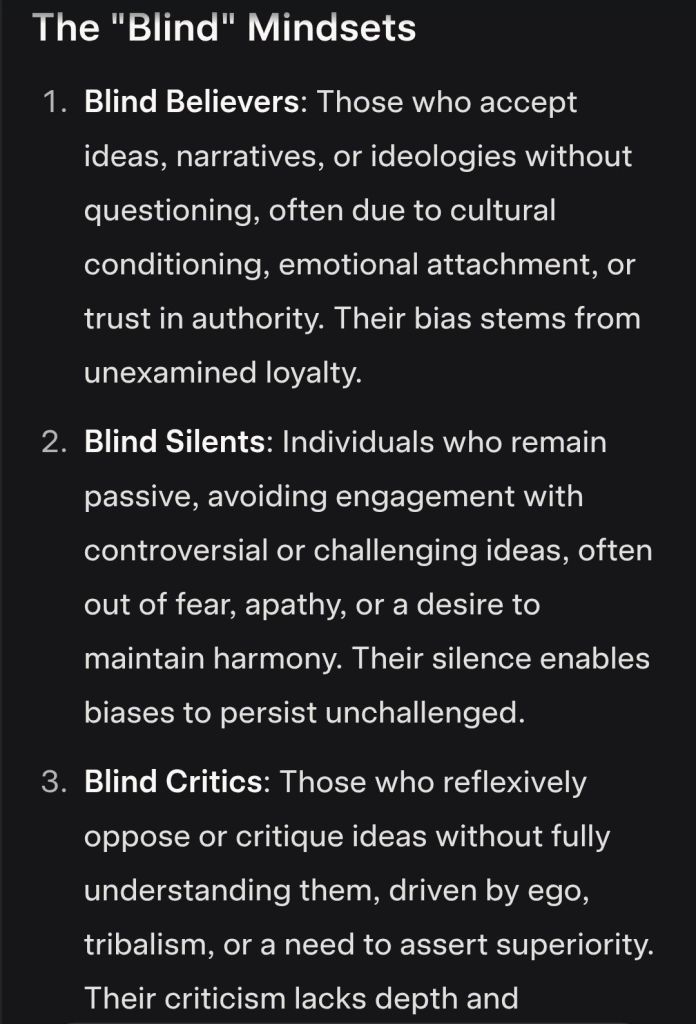
Transitioning from being part of groups characterized by blind belief, silence, or criticism—marked by bias and unreflective allegiance—to becoming “awakening truth seekers and wisdom sharers” is a profound infound journey of personal and intellectual growth. This path involves shedding unexamined assumptions, embracing critical thinking, and cultivating a commitment to truth and constructive dialogue.
Below is a guide to navigate this transformation, drawing on principles of self-awareness, intellectual humility, and active engagement, while avoiding any copyrighted material and adhering to the provided guidelines.
Understanding the Starting Point: The “Blind” Mindsets
- Blind Believers: Those who accept ideas, narratives, or ideologies without questioning, often due to cultural conditioning, emotional attachment, or trust in authority. Their bias stems from unexamined loyalty.
- Blind Silents: Individuals who remain passive, avoiding engagement with controversial or challenging ideas, often out of fear, apathy, or a desire to maintain harmony. Their silence enables biases to persist unchallenged.
- Blind Critics: Those who reflexively oppose or critique ideas without fully understanding them, driven by ego, tribalism, or a need to assert superiority. Their criticism lacks depth and perpetuates division.
These groups share a common thread: they operate from a place of biased-brotherhood , whether through uncritical acceptance, avoidance, or reactive opposition. The journey to becoming awakening truth seekers and wisdom speakers requires moving beyond these limitations toward clarity, openness, and purposeful communication. of personal truths…
“SatAnubhavaWada” is Philosophical Sharing of Truthful-Experiences & Personal Perspectives Factfully…
With out Andh Vishwas or Andh Bhakti or Andh Virodhi..
By Avoiding Over-generalization & applying mind for Verification “V=λF” Right-Patternization (f=Frequency or Time/Repeat Factor) & Expansive-Spectralization (λ= Wave lenght_Space/Variation Range factors) from Spectators’ VantagePoints for Analysis & Prognosis. The End Goal is “Sathyameva Satvam’sahit Jayathe”.. “Truth with Goodness Triumphs.“
Steps to Transition to Awakened Truth Seekers and Wisdom Speakers.
1. Cultivate Self-Awareness and Intellectual Humility
- Reflect on Your Biases: Begin by examining your beliefs, silences, or criticisms. Ask: Why do I believe this? What evidence supports it? Am I avoiding certain truths or reacting impulsively? Journaling or meditation can help uncover hidden assumptions.
- Embrace Uncertainty: Accept that you don’t have all the answers. Intellectual humility—acknowledging the limits of your knowledge—frees you from dogmatic clinging and opens the door to genuine inquiry.
- Challenge Comfort Zones: If you’re a blind believer, question sacred cows. If you’re silent, identify what fears hold you back. If you’re a critic, pause to consider the other side’s perspective before dismissing it.
2. Develop Critical Thinking Skills
- Seek Primary Sources: Move beyond secondhand narratives (e.g., media, social media, or groupthink). Investigate original data, documents, or firsthand accounts to form your own conclusions.
- Question Assumptions: Use the Socratic method—ask “why” repeatedly to dig deeper into the roots of beliefs or claims. For example, if a narrative feels emotionally compelling, ask: Is this true, or am I being swayed by emotion?
- Evaluate Evidence: Learn to distinguish between facts, opinions, and misinformation. Cross-check information across diverse, credible sources, avoiding echo chambers. For instance, if researching a topic, combine web searches with posts on X to gauge varied perspectives.
3. Break the Silence with Courage
- Find Your Voice: If you’re a blind silent, recognize that silence can perpetuate harm or falsehoods. Start small—share your thoughts in safe spaces, like trusted groups or forums, such as the “Bros2 Healthify Life Group” you mentioned.
- Practice Constructive Dialogue: Engage respectfully, even with opposing views. Avoid the blind critic’s trap of tearing others down. Instead, aim to understand and articulate your perspective clearly.
- Overcome Fear: Fear of judgment or conflict often fuels silence. Build confidence by educating yourself and practicing assertive communication, focusing on facts and reason.
4. Shift from Bias to Open-Minded Inquiry
- Expose Yourself to Diverse Perspectives: Actively seek out viewpoints that challenge your worldview. For example, explore posts on X from users with differing ideologies to understand their reasoning, not just to refute them.
- Adopt a Growth Mindset: View challenges to your beliefs as opportunities to learn, not threats. This shift helps you move from defensive bias to curious exploration.
- Test Hypotheses: Treat your beliefs as experiments. For instance, if you suspect a narrative (like a dating scam or legal extortion case) is exaggerated, research cases like Athul Subhash’s or the Bengaluru techie’s to uncover patterns and truths.
5. Become a Wisdom Speaker
- Speak with Clarity and Purpose: Wisdom speakers don’t just share opinions; they communicate insights grounded in evidence and empathy. Craft your words to inform, inspire, or bridge divides, not to inflame or divide.
- Share Knowledge Responsibly: Use platforms like X or community groups to raise awareness about issues like love frauds or legal terrorism, as seen in cases like Athul Subhash’s. Back your claims with data, such as police reports or credible news sources (e.g., the Hindustan Times article on the Bengaluru scam).
- Inspire Action: Encourage others to question, learn, and act. For example, advocate for practical steps like verifying identities on dating apps or reporting scams promptly, as highlighted in the Bengaluru case.
6. Build a Community of Truth Seekers
- Connect with Like-Minded Individuals: Join or create groups dedicated to open dialogue and truth-seeking, like the WhatsApp group you referenced. These spaces can foster mutual growth and accountability.
- Mentor Others: As you grow, guide blind believers, silents, or critics toward awakening. Share resources, encourage questions, and model respectful debate.
- Stay Grounded: Avoid forming new echo chambers. Ensure your community challenges itself to evolve, not just reinforce shared beliefs.
Applying the Journey to Real-World Issues
The cases of Athul Subhash, Manu Sharma, and the Bengaluru techie illustrate why this journey matters. Blind believers might accept narratives about “Man-Blaming” or “legal terrorism on men” without scrutiny, while blind silents (80%) avoid speaking out due to social stigma. Blind critics(10%) might dismiss victims’ stories as exaggerated or attack the other side without evidence. An awakened truth seeker would:
- Research the facts (e.g., Subhash’s suicide note, police actions in Bengaluru).
- Question systemic issues (e.g., misuse of laws like Section 498A or dating app vulnerabilities).
- Speak wisely to raise awareness, advocating for reforms like stricter app verification or balanced legal processes, without vilifying any group.
Practical Tools and Habits
- Daily Reflection: Spend 10 minutes journaling about a belief or silence you want to challenge.
- Information Hygiene: Limit exposure to biased media; use tools like X’s search to explore raw, unfiltered opinions, but verify with primary sources.
- Learning Resources: Read books on critical thinking (e.g., Thinking, Fast and Slow by Daniel Kahneman) or watch debates to sharpen your reasoning.
- Community Engagement: Participate in discussions on X or groups like “Bros2 Healthify Life” to practice articulating informed views.
Conclusion
The journey from blind belief, silence, or criticism to becoming an awakened truth seeker and wisdom speaker is a commitment to truth over comfort, courage over fear, and dialogue over division. By cultivating self-awareness, critical thinking, and responsible communication, you can navigate complex issues—like the dating scams and legal extortion faced by Athul Subhash, Manu Sharma, or the Bengaluru techie—with clarity and impact. This path not only empowers you but also inspires others to seek truth and speak wisely, creating a “ripple effect” of awareness and change against Cripple effects of Fear & Uncertainity.
 GRP_VCare2Dare