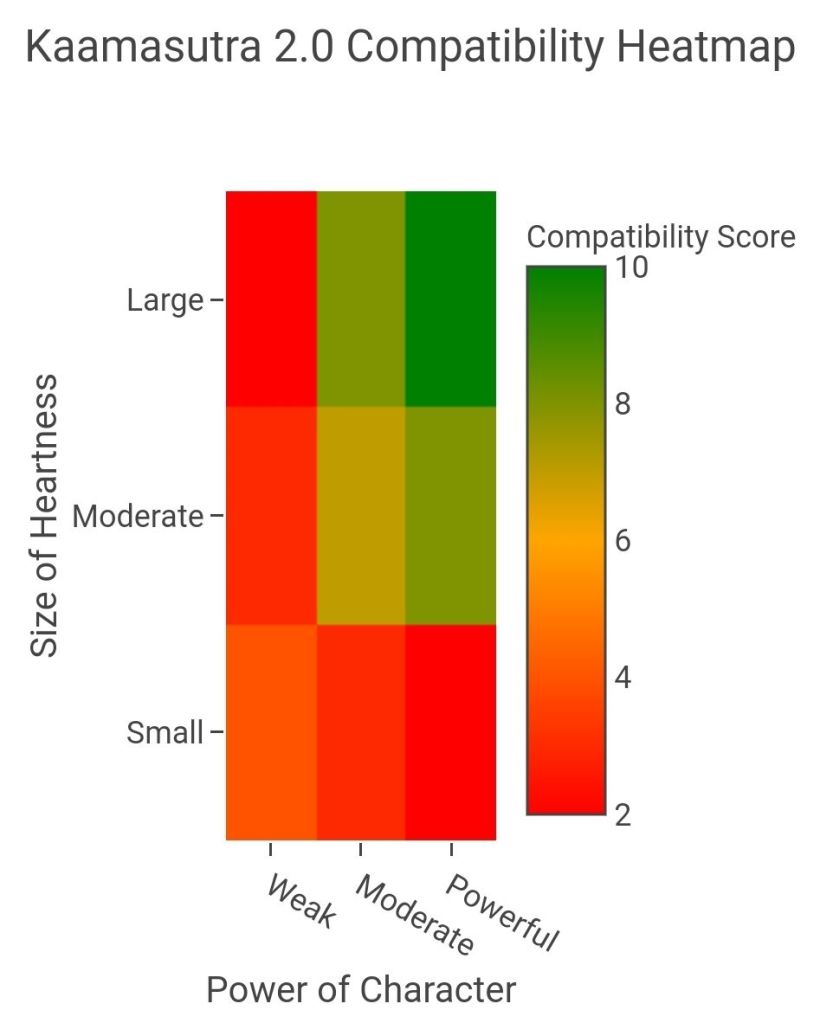
Its not Size of Body parts that matters in marriage, but its sizing of character that matters more. personality matters before sexuality.
Physical Kama Sutra vs. Ethical Kaamasutra 2.0
The traditional Physical Kama Sutra, attributed to Vātsyāyana, is a historical text from ancient India (circa 400 BCE–200 CE) that emphasizes the art of physical love, detailing sexual positions, techniques, and compatibility based on bodily attributes like genital size (small, medium, large). It views intimacy as a mechanical and sensory experience, rooted in physical pleasure and alignment, reflecting the societal norms of its time where physicality was a primary measure of compatibility. In contrast, the modern Ethical Kaamasutra 2.0 reimagines this framework, prioritizing emotional depth (“size of heartness”) and moral strength (“power of character”) over physical metrics. It advocates for a rational, heart-centered approach to intimacy, where mutual respect, empathy, and shared values define a lasting bond, aligning with contemporary understandings of love.
Physical Kama Sutra
- Focus: Physical compatibility, with an emphasis on body size and sexual techniques to maximize pleasure.
- Approach: Suggests pairings like small-small or large-large for physical harmony, often ignoring emotional or ethical dimensions.
- Limitation: Reduces intimacy to a transactional act, potentially overlooking emotional fulfillment or moral alignment.
Ethical Kaamasutra 2.0
- Focus: Emotional compatibility, measured by the “size of heartness” (capacity for love and empathy) and “power of character” (integrity and resilience).
- Approach: Proposes that true intimacy thrives when partners share deep emotional connections and strong moral values, transcending physical constraints.
- Advantage: Offers a sustainable model for relationships, emphasizing trust and mutual growth over mere physicality.
Examples of Pairs and Historical Couples
1. Gandhi and Kasturba Gandhi
- Physical Kama Sutra Perspective: Little is documented about their physical intimacy, but the traditional lens might assume compatibility based on physical traits alone. Their early marriage at age 13 suggests a focus on physical union, typical of arranged matches in 19th-century India.
- Ethical Kaamasutra 2.0 Perspective: Their 62-year partnership (1883–1944) exemplifies large heartness and powerful character. Kasturba supported Gandhi’s nonviolent resistance, sharing his moral vision despite personal sacrifices (e.g., imprisonment). Their bond grew through mutual empathy and resilience, not just physicality, making them a model of ethical compatibility (score: ~9).
- Real Example: Kasturba’s steadfast support during Gandhi’s Salt March (1930) reflects a heart-centered alliance.
2. Romeo and Juliet (Shakespearean Fiction)
- Physical Kama Sutra Perspective: Their brief, passionate encounters suggest a focus on physical desire, with compatibility assumed from youthful vigor and attraction, aligning with the text’s emphasis on sensory pleasure.
- Ethical Kaamasutra 2.0 Perspective: Their love, though intense, lacks mature character—impulsiveness and lack of communication lead to tragedy. Small heartness (emotional immaturity) and weak character (rash decisions) result in low compatibility (score: ~2), highlighting the need for ethical depth beyond physical passion.
- Real Example: Their fictional demise mirrors historical young lovers whose physical focus led to ruin, like the Capulet-Montague feud’s real-world echoes.
3. Heer and Ranjha (Punjabi Folklore)
- Physical Kama Sutra Perspective: Their story emphasizes physical longing, with Ranjha’s pursuit of Heer driven by desire, fitting the physical compatibility narrative of the Kama Sutra.
- Ethical Kaamasutra 2.0 Perspective: Their love transcends physical barriers, rooted in large heartness (unwavering devotion) and moderate character (Ranjha’s resilience, Heer’s loyalty despite societal pressure). Their tragic end (forced separation and death) suggests a score of ~7, limited by external constraints rather than internal discord.
- Real Example: The 18th-century tale by Waris Shah reflects real Punjab lovers defying caste, prioritizing heart over body.
4. Salim and Anarkali (Mughal Legend)
- Physical Kama Sutra Perspective: Their romance hinges on physical attraction, with Salim (Prince Jahangir) drawn to Anarkali’s beauty, suggesting a focus on bodily compatibility.
- Ethical Kaamasutra 2.0 Perspective: Their love showcases large heartness (sacrificial devotion) but weak character (rebellion without resolution), leading to separation and Anarkali’s rumored entombment. Compatibility is ~4, as emotional depth is undermined by lack of moral strength against authority.
- Real Example: The 16th-century legend, possibly inspired by Jahangir’s court, mirrors real forbidden loves under Mughal rule.
5. Titanic Pair (Jack and Rose, Fictional)
- Physical Kama Sutra Perspective: Their brief physical intimacy on the Titanic (1997 film) aligns with the Kama Sutra’s focus on passionate encounters, driven by physical attraction across class lines.
- Ethical Kaamasutra 2.0 Perspective: Rose’s large heartness (choosing love over duty) and Jack’s moderate character (selfless sacrifice) yield a compatibility of ~8. Their bond thrives on emotional depth, not just physicality, despite the tragedy.
- Real Example: Reflects historical class-crossing romances, like steerage passengers’ love stories during the 1912 sinking.
6. Angelina Jolie and Brad Pitt
- Physical Kama Sutra Perspective: Their high-profile romance (2004–2016) might be seen as compatible due to physical allure and shared screen chemistry (e.g., Mr. & Mrs. Smith).
- Ethical Kaamasutra 2.0 Perspective: Initially, large heartness (adoption of children, philanthropy) and powerful character (resilience in fame) suggested high compatibility (~8). However, their 2016 divorce, amid reports of emotional strain, indicates a drop to ~5, reflecting challenges in sustaining character strength under pressure.
- Real Example: Their public journey mirrors modern celebrity couples balancing love, family, and personal growth.
Conclusion
The Physical Kama Sutra’s body-centric approach, while innovative historically, falls short in capturing the complexity of love. The Ethical Kaamasutra 2.0, with its focus on heartness and character, better explains the success or failure of these pairs. Historical couples like Gandhi-Kasturba and fictional ones like Jack-Rose demonstrate that emotional and moral alignment—beyond physicality—defines enduring intimacy.
 GRP_VCare2Dare