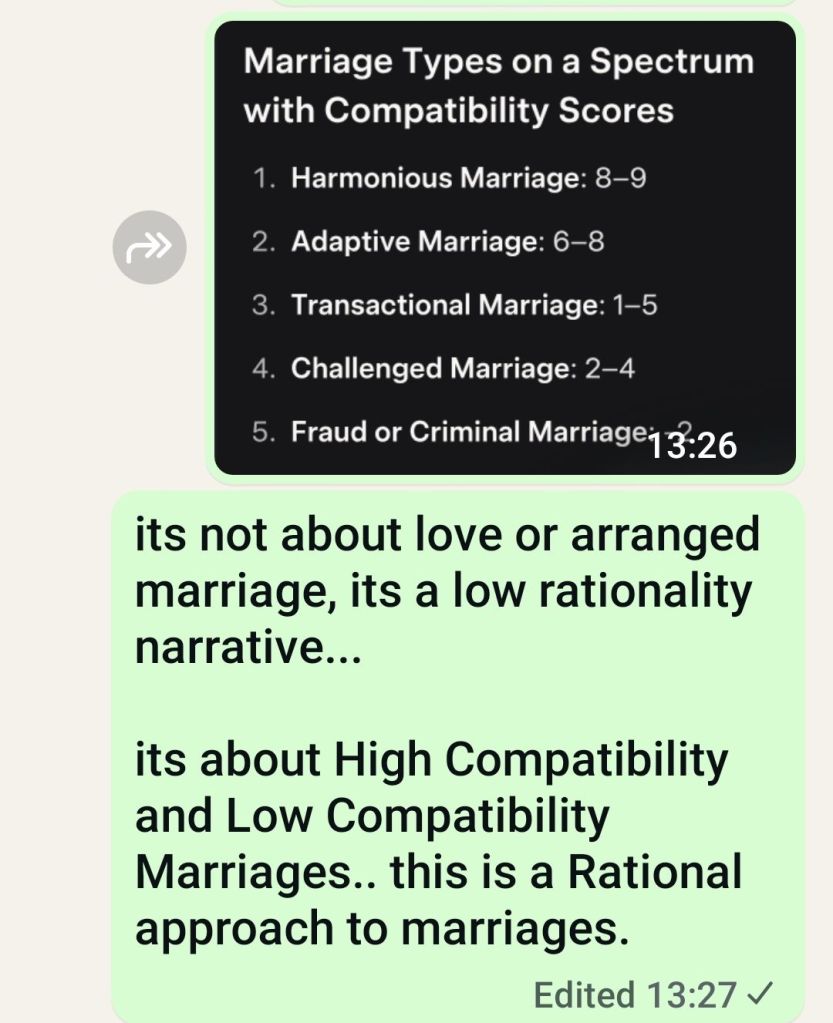
Science Based Marital Compatibility testing needs served here..
Love & Sex maybe between Personality & Body Types,
Relations & Marriages are between Community & Broody Tribes.
Testing Which Marriage Type Is Yours?
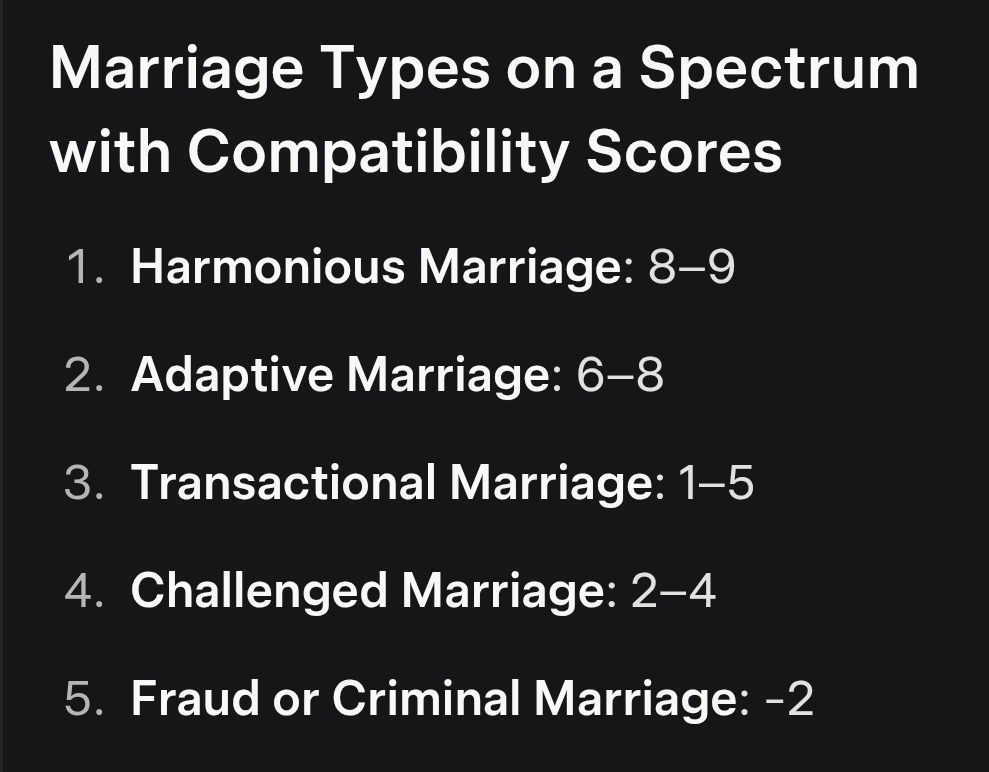
To determine which marriage type— HATCH-Making.. 1. Harmonious, Adaptive, Transactional, Challenged, or Hardcore Fraud or Criminal—best describes your relationship, you can assess your marriage based on the behaviors of both spouses across three dimensions: Honey (emotional/physical intimacy), Money (financial resources), and Progeny (children/legacy).
These dimensions align with the Spousal Matrix, which categorizes spouses as Type 1 (Giver), Type 2 (Sharer), Type 3 (Taker), Type 4 (Balanced Hybrid), Type 5 (Independent), or Type 6 (Faker-Fcuker). By evaluating your and your spouse’s behaviors and compatibility, you can identify your marriage type on the spectrum, which ranges from high compatibility (Harmonious, 8–9) to extremely low (Fraud or Criminal, -2).
Step 1: Assess Spousal Behaviors
Reflect on how you and your spouse approach Honey, Money, and Progeny:
- Honey: Does one or both of you give affection freely (Giver), seek mutual intimacy (Sharer), prioritize personal needs (Taker), adapt flexibly (Hybrid), maintain autonomy (Independent), or use deceit (Faker-Fcuker)?
- Money: Are finances shared generously, equitably, controlled selfishly, negotiated flexibly, kept separate, or manipulated fraudulently?
- Progeny: Do you collaborate on parenting/legacy, prioritize one partner’s goals, adapt to each other, remain disengaged, or exploit family dynamics?
Assign each spouse a type based on dominant behaviors. For example, if you give generously in all dimensions, you’re likely Type 1 (Giver); if your spouse manipulates finances and affection, they may be Type 6 (Faker-Fcuker).
Step 2: Evaluate Compatibility
Compare your spousal types to the marriage categories:
- Harmonious (8–9): Both are Givers or Sharers (e.g., Type 1 & Type 1), with mutual support in all dimensions. Look for strong emotional connection, shared finances, and aligned parenting.
- Adaptive (6–8): One or both are Hybrids (e.g., Type 2 & Type 4), balancing differences through flexibility. Expect negotiation in finances or parenting but overall stability.
- Transactional (1–5): Both prioritize self-interest (e.g., Type 3 & Type 3) or tolerate minimal trust (Type 6 & Type 6). Intimacy and resources are conditional, with clear boundaries.
- Challenged (2–4): Mismatched behaviors (e.g., Type 1 & Type 3), causing imbalance. One spouse may feel unreciprocated or overburdened.
- Fraud or Criminal (-2): Involves a Faker-Fcuker (Type 6) with a Giver or Sharer (e.g., Type 1 & Type 6), marked by deception, financial fraud, or manipulation of family roles.
Step 3: Self-Reflection and Discussion
Answer these questions:
- Do you both feel valued and supported in intimacy, finances, and family goals? (Points to Harmonious or Adaptive)
- Are interactions often negotiated or self-focused? (Suggests Transactional)
- Is there frequent conflict or unmet needs? (Indicates Challenged)
- Are there signs of deceit, financial exploitation, or manipulation? (Flags Fraud or Criminal)
Discuss with your Friend or relative You Trust or spouse to confirm perceptions, as misalignment in how you view each other’s behaviors can reveal issues.
For example, if you see yourself as a Sharer but your spouse feels you’re a Taker, you may lean toward Challenged.
Step 4: Match to the Spectrum
Using your spousal types and observations, match your marriage to the category with the corresponding compatibility score. For instance, a Giver-Faker-Fcuker pairing (-2) indicates a Fraud or Criminal Marriage, while a Sharer-Sharer pairing (9) suggests Harmonious. If unsure, consider seeking a counselor to clarify dynamics, especially for Challenged or Fraud or Criminal types.
Note: This assessment is qualitative. For precision, revisit the heatmap (artifact ID: ea28435d-c22c-4684-be00-f9ff51956216) for compatibility scores of specific pairings.
If you suspect a Fraud or Criminal Marriage, prioritize legal or professional support to address deception or harm.
To categorize marriages based on the spousal pairings from the Spousal Matrix (Type 1: Giver, Type 2: Sharer, Type 3: Taker, Type 4: Balanced Hybrid, Type 5: Independent), we can simplify the framework by grouping marriages into categories defined by the compatibility and dynamics of these pairings. Each marriage type reflects the interaction of the spouses’ behaviors (Giving, Sharing, or Taking) across Honey (intimacy), Money (finances), and Progeny (children/legacy). Using the compatibility scores from the heatmap (ranging from 0 to 10), I’ll define simplified marriage categories based on common patterns, focusing on high, moderate, and low compatibility pairings. The categories will be concise, capturing the essence of the relationship dynamics.
Marriage Categories
Based on the Spousal Matrix and compatibility scores, marriages are grouped into four simplified categories. These reflect the dominant interaction patterns, with examples of spousal pairings and their typical outcomes in Honey, Money, and Progeny.
- Harmonious Marriage
- Description: Both spouses contribute selflessly or equitably, fostering mutual support and balance across Honey, Money, and Progeny.
- Spousal Pairings: Type 1 & Type 1 (Giver-Giver, score: 9), Type 2 & Type 2 (Sharer-Sharer, score: 9), Type 1 & Type 2 (Giver-Sharer, score: 8), Type 4 & Type 4 (Hybrid-Hybrid, score: 8).
- Dynamics:
- Honey: High emotional and physical intimacy due to mutual giving or sharing.
- Money: Financial decisions are collaborative or generous, minimizing conflicts.
- Progeny: Shared or nurturing approach to parenting/legacy, aligning goals.
- Compatibility: High (8-9). These marriages thrive on reciprocity or adaptability, leading to stability and satisfaction.
- Example: A Giver-Giver couple where both prioritize each other’s emotional needs and share financial burdens equally, raising children collaboratively.
- Adaptive Marriage
- Description: One or both spouses are flexible, adapting to the other’s behavior to maintain balance, though minor tensions may arise in specific dimensions.
- Spousal Pairings: Type 1 & Type 4 (Giver-Hybrid, score: 7), Type 2 & Type 4 (Sharer-Hybrid, score: 8), Type 4 & Type 5 (Hybrid-Independent, score: 6).
- Dynamics:
- Honey: Flexible partner adjusts to giving or sharing tendencies, maintaining moderate to high intimacy.
- Money: Negotiated financial arrangements, often equitable but requiring communication.
- Progeny: Parenting/legacy roles vary, with the Hybrid adjusting to partner’s approach.
- Compatibility: Moderate to high (6-8). Success depends on the Hybrid’s adaptability or mutual willingness to compromise.
- Example: A Sharer-Hybrid couple where the Sharer seeks mutual finances, and the Hybrid adapts by contributing equitably while allowing some autonomy in parenting.
- Transactional Marriage
- Description: Both spouses prioritize self-interest or accept a give-and-take dynamic, leading to a functional but less emotionally connected marriage.
- Spousal Pairings: Type 3 & Type 3 (Taker-Taker, score: 5), Type 3 & Type 4 (Taker-Hybrid, score: 4).
- Dynamics:
- Honey: Intimacy is often conditional, based on mutual benefit or negotiation.
- Money: Financial control or division is a focus, with potential for disputes unless boundaries are clear.
- Progeny: Children/legacy may serve individual goals, requiring explicit agreements.
- Compatibility: Moderate (4-5). Works if both accept transactional terms, but lacks deep emotional alignment.
- Example: A Taker-Taker couple where both agree to separate finances and prioritize personal goals, with clear terms for parenting responsibilities.
- Challenged Marriage
- Description: Significant mismatch in behaviors leads to conflict or imbalance, with one spouse’s needs often unmet across dimensions.
- Spousal Pairings: Type 1 & Type 3 (Giver-Taker, score: 2), Type 2 & Type 3 (Sharer-Taker, score: 3), Type 1 & Type 5 (Giver-Independent, score: 3), Type 2 & Type 5 (Sharer-Independent, score: 4), Type 3 & Type 5 (Taker-Independent, score: 3).
- Dynamics:
- Honey: Imbalance (e.g., Giver’s intimacy unreciprocated by Taker or Independent).
- Money: Conflicts over unequal contributions or control (e.g., Taker dominates, Independent withdraws).
- Progeny: Misaligned parenting/legacy goals, with one spouse overburdened or disengaged.
- Compatibility: Low (2-4). Requires significant effort, communication, or external support to avoid dysfunction.
- Example: A Giver-Taker marriage where the Giver sacrifices financially and emotionally, but the Taker prioritizes personal needs, leading to resentment.
Notes
- Simplification: The four categories (Harmonious, Adaptive, Transactional, Challenged) consolidate the 15 unique pairings (from a 5×5 matrix, excluding duplicates) into meaningful groups based on compatibility scores and behavioral alignment. This avoids listing all pairings individually while capturing key dynamics.
- Assumptions: Compatibility scores from the heatmap guide categorization, with high (8-9), moderate (4-7), and low (2-3) ranges shaping the groups. Pairings with similar dynamics (e.g., Giver-Giver and Sharer-Sharer) are grouped for simplicity.
- No Numerical Data for Chart: Since the user didn’t request a new chart and no new numerical data was provided beyond the heatmap scores, I didn’t generate a new visualization. The existing heatmap (artifact ID: 170246b3-c1eb-4b1b-82a4-fcc1e2317b8c) already illustrates compatibility.
- Customization: If you want a chart (e.g., bar chart comparing category compatibility) or more categories (e.g., splitting Adaptive into subtypes), please specify or provide data.
If you’d like a visual representation of these marriage categories, further refinement of pairings, or additional details, let me know!
*#Indian_huMANitarian Group Fraternizing Our Brotherly_India 2030:* No Unity, No Future, More Solidarity = More Life.
*Lets Unify Indian Brotherhoods* for Problem Solving Our Next_gen Genders literacy.
Our MM-Grp Mission is 4Genders_Justice, Social_Harmony & Neo Indian_SaferFamilies 4.0.
*All Genders’ Wellness & Bros’ Healthify Group:*
https://chat.whatsapp.com/KecJokbFlP4F0azMaCyeyA
 GRP_VCare2Dare