Post Dedicated to my Parents (Dr.Gajendran & Dr.Gowri) who are Made for each other, Both are TYPE1 Spouses.
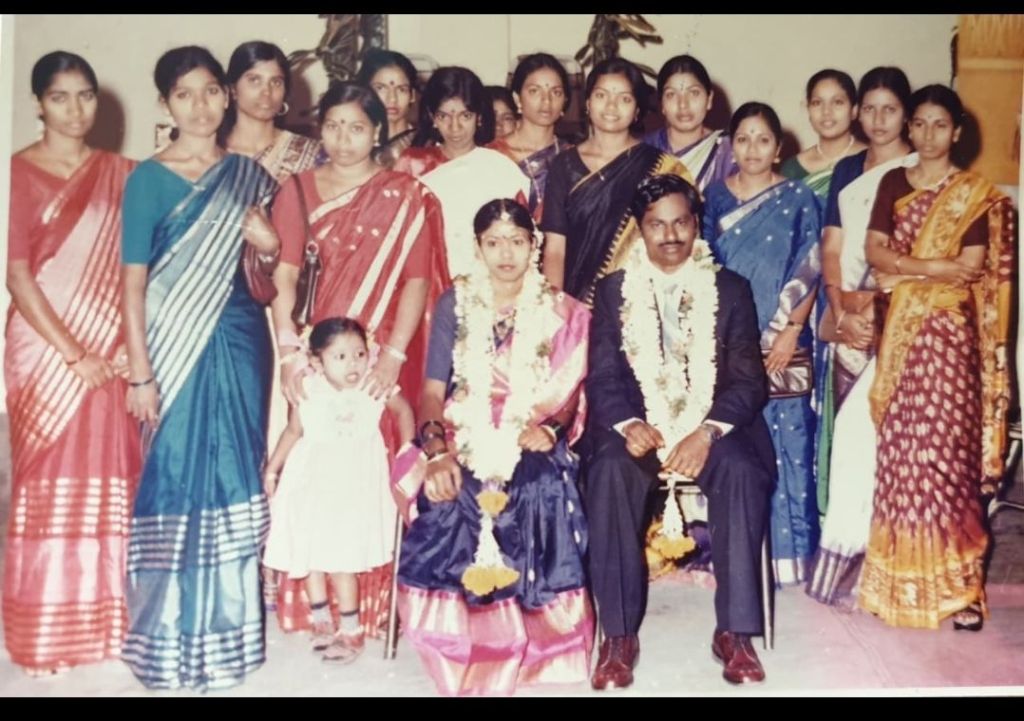
Do Note how “Brides of Same Saree frock together”.. Lines on the left, plain in centre & Dots on the right. its subtle segregation.. organic event..
Their Marriage Survives 40+ years as I understand “they are also MAID for each Other” Serving their spouse & life unconditionally.
To define a “Spousal Matrix” based on the variability of compatibility in terms of Giving, Sharing, or Taking across three dimensions—Honey (Marital Juices/Benefits, interpreted as emotional/physical intimacy), Money (Marital Money/Property, interpreted as financial resources), and Progeny (Marital Outcomes/Children, interpreted as reproductive or legacy outcomes)—we can construct a framework that categorizes spouse types from Type 1 to Type X. Each type reflects a distinct pattern of behavior in these dimensions, influencing marital compatibility. Since “Type X” suggests an open-ended range, I’ll define a reasonable set of types (e.g., Type 1 to Type 5) based on logical combinations, keeping the response concise yet comprehensive.
Spousal Matrix Framework
Each spouse type is defined by their dominant behavior (Giving, Sharing, or Taking) in the three dimensions: Honey, Money, and Progeny. Compatibility varies based on how these behaviors align or conflict between spouses. Below, I describe five hypothetical types, assuming each type leans toward a consistent behavior across dimensions for simplicity, with variations to capture nuances.
- Type 1: The Giver
- Honey: Freely gives emotional and physical intimacy, prioritizing partner’s needs.
- Money: Generously contributes to marital finances, often sacrificing personal financial goals.
- Progeny: Invests heavily in children or legacy outcomes, nurturing family growth.
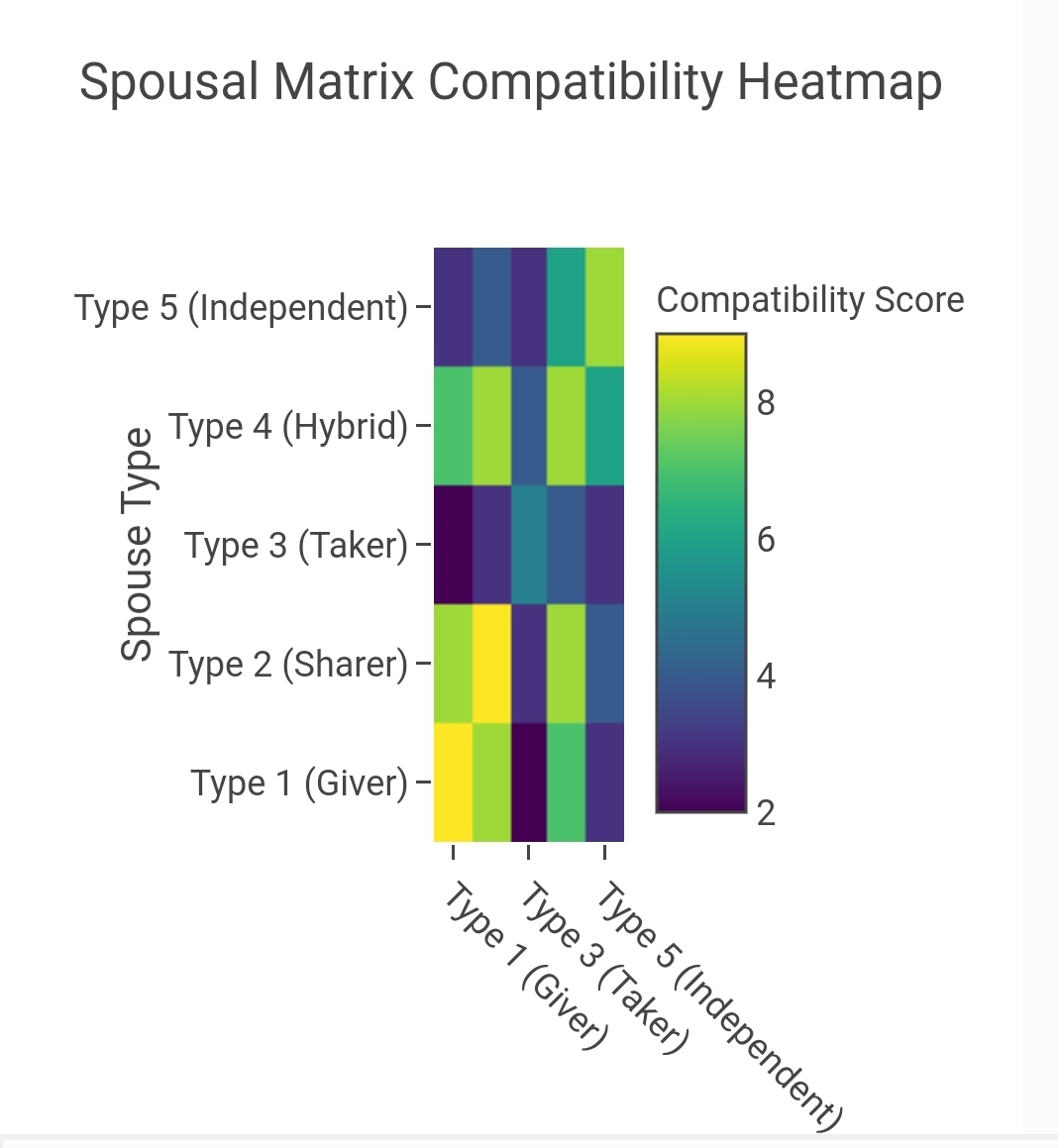
- Compatibility: Best with Type 1 (mutual giving fosters harmony) or Type 2 (complements sharing). Conflicts with Type 3 (Taker exploits Giver’s generosity).
- Type 2: The Sharer
- Honey: Seeks mutual emotional and physical connection, valuing reciprocity.
- Money: Advocates for shared financial responsibilities, like joint accounts or equitable contributions.
- Progeny: Promotes collaborative parenting or legacy-building, balancing both partners’ visions.
- Compatibility: Highly compatible with Type 1 (appreciates giving) or Type 2 (mutual sharing aligns). May struggle with Type 3 (Taker disrupts balance).
- Type 3: The Taker
- Honey: Prioritizes own emotional/physical needs, often demanding without reciprocating.
- Money: Seeks to control or benefit disproportionately from marital resources.
- Progeny: Focuses on personal legacy or uses children to meet own needs, not partner’s.
- Compatibility: Poor with Type 1 (exploitative dynamic) or Type 2 (unbalanced reciprocity). May align with another Type 3 if both accept transactional terms.
- Type 4: The Balanced Hybrid
- Honey: Adapts between giving and sharing based on partner’s needs and context.
- Money: Balances personal and shared financial goals, open to negotiation.
- Progeny: Flexible in parenting/legacy roles, adjusting to partner’s contributions.
- Compatibility: Versatile, works well with Types 1, 2, or 4. Struggles with Type 3 unless boundaries are firm.
- Type 5: The Independent
- Honey: Maintains emotional/physical autonomy, giving or taking minimally.
- Money: Prefers separate finances, contributing only what’s necessary.
- Progeny: Limited focus on children/legacy, prioritizing personal goals.
- Compatibility: Best with Type 5 (mutual independence) or Type 4 (flexible enough to adapt). Clashes with Type 1 (Giver feels unreciprocated) or Type 3 (competing self-interests).
Compatibility Dynamics
- High Compatibility: Occurs when behaviors align (e.g., Giver-Giver, Sharer-Sharer) or complement (e.g., Giver-Sharer, Balanced Hybrid with most types).
- Low Compatibility: Arises from mismatched expectations (e.g., Giver-Taker, Sharer-Taker, Independent-Giver).
- Mitigation: Couples can improve compatibility through communication, setting boundaries, or aligning goals in specific dimensions (e.g., agreeing on shared Money management despite differing Honey approaches).
Notes
- Assumptions: I assumed “Honey” refers to intimacy (emotional/physical), “Money” to financial resources, and “Progeny” to children or legacy. If different meanings were intended, please clarify.
- Variability: Real spouses may not fit neatly into one type, as behaviors can vary by dimension (e.g., Giver in Honey, Taker in Money). The matrix simplifies for clarity.
- Type X: Interpreted as an open-ended range; I defined five types to balance detail and brevity. More types could be added (e.g., extreme or mixed behaviors).
- No Data for Chart: Since no numerical data was provided, I didn’t generate a chart. If you want a visual (e.g., compatibility matrix), please provide specific data or confirm.
Spousal HeatMap: https://grok.com/share/bGVnYWN5_d0397fae-90ab-4fad-b9c3-8ef5495b989e
 GRP_VCare2Dare