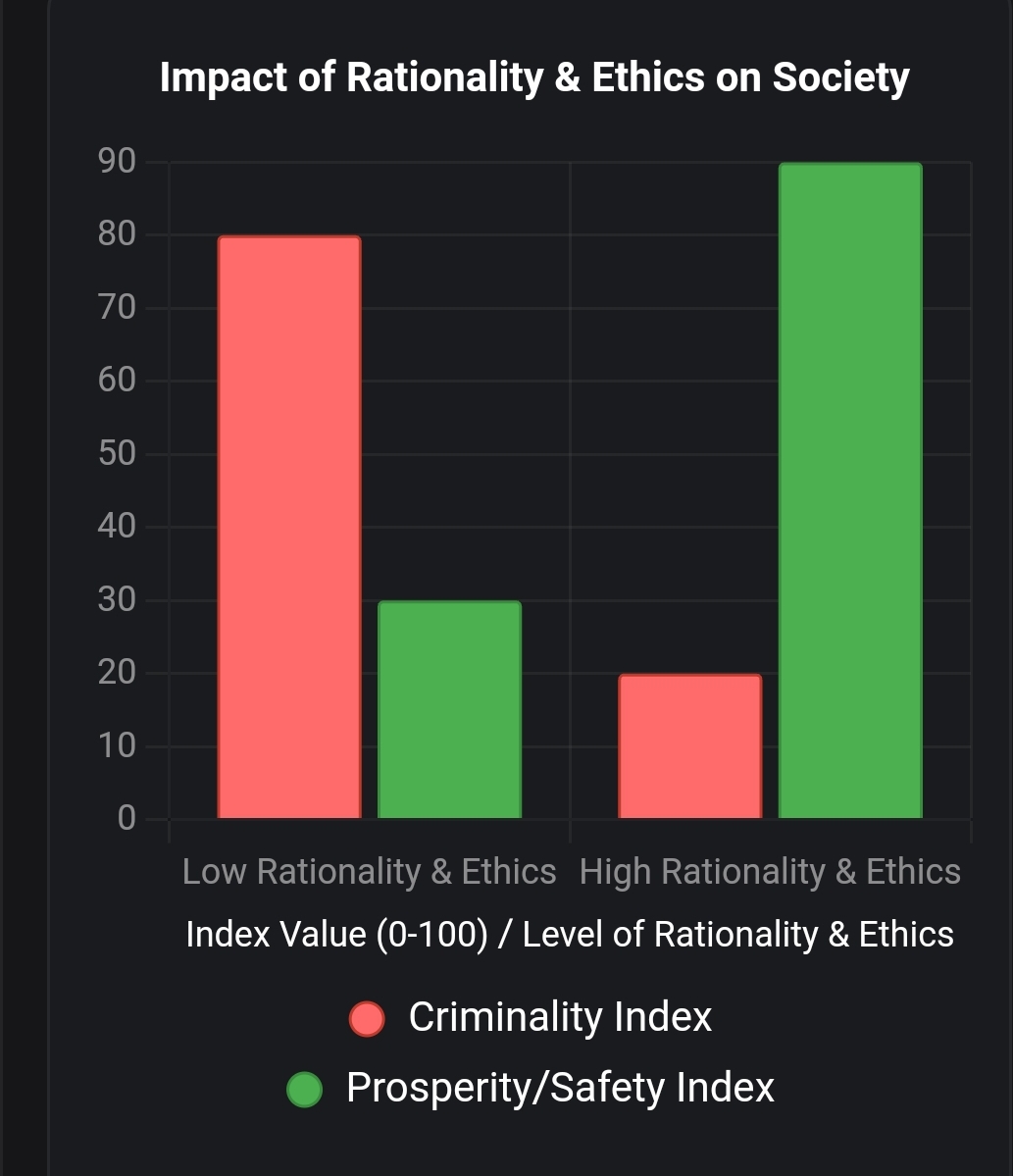
Our Inquiry across ideologies suggests a relationship between rationality, ethics, criminality, and societal outcomes.
Let’s break it down:
- Low Rationality and Ethics → Higher Criminality and Idiocy: This implies that when individuals or societies lack clear reasoning (rationality) and moral principles (ethics), they are more likely to engage in criminal behavior (Deviant) &/or act foolishly (Negligient). This aligns with observations that impulsive, irrational decisions or a lack of ethical grounding can lead to harmful actions, as seen in studies on crime correlates like poor impulse control or weak social norms.
- Higher Rationality + Deeper Ethics → Safety + Prosperity: Conversely, when rational thinking (e.g., evidence-based decision-making) and strong ethical frameworks (e.g., respect for others’ rights) are prevalent, societies tend to be safer and more prosperous. Historical examples like stable governance in societies with strong legal and ethical systems (e.g., post-WWII economic booms in nations with robust institutions) support this. Data from the World Bank shows that countries with higher rule of law and lower corruption indices (proxies for ethics and rationality) often have higher GDP per capita and lower crime rates.
The vice versa suggests a spectrum: as rationality and ethics increase, criminality and irrational behavior decrease, and vice versa.
Improving rationality and ethics in individuals and peer groups is a multifaceted process that involves cultivating critical thinking, fostering moral awareness, and creating environments that reinforce these traits. Below, I outline practical, evidence-based strategies for individuals and groups, keeping the response concise yet comprehensive.
For Individuals
- Enhance Rationality:
- Practice Critical Thinking: Engage in exercises like analyzing arguments in articles or books. Question assumptions and evaluate evidence. Resources like Coursera offer free critical thinking courses.
- Learn Formal Logic: Study basic logic (e.g., syllogisms, fallacies) to improve reasoning. Books like Thinking, Fast and Slow by Daniel Kahneman explain cognitive biases.
- Seek Diverse Perspectives: Read or discuss ideas from varied sources (e.g., X posts, academic papers) to challenge your worldview and reduce bias.
- Reflect Regularly: Use journaling to assess decisions and identify irrational patterns. Apps like Notion can help structure reflections.
- Develop Ethics:
- Study Ethical Frameworks: Learn about utilitarianism, deontology, or virtue ethics through accessible texts like Ethics for the Real World by Ronald Howard.
- Practice Empathy: Engage in active listening and perspective-taking exercises, such as role-playing scenarios, to understand others’ values.
- Adopt a Code of Conduct: Define personal values (e.g., honesty, fairness) and hold yourself accountable. Tools like habit trackers can reinforce ethical behavior.
- Seek Role Models: Follow individuals on platforms like X who demonstrate ethical behavior, and analyze their decision-making.
For Peer Groups
- Foster Rational Group Dynamics:
- Encourage Open Dialogue: Create safe spaces for debate where all ideas are scrutinized, not personal identities. Use structured formats like Socratic seminars.
- Train in Group Decision-Making: Teach methods like the Delphi technique to reduce groupthink and improve collective reasoning.
- Use Evidence-Based Tools: Implement decision-making frameworks like SWOT analysis or cost-benefit analysis in group discussions.
- Build Ethical Group Norms:
- Establish Shared Values: Collaboratively define a group code of ethics, emphasizing fairness, respect, and accountability.
- Reward Ethical Behavior: Recognize and reinforce actions that align with group values, e.g., through public acknowledgment or small rewards.
- Address Unethical Actions: Use restorative justice practices, like mediated discussions, to correct behavior without shaming, fostering learning instead.
- Create Supportive Environments:
- Model Leadership: Leaders should exemplify rational and ethical behavior, as peers often emulate those in charge.
- Provide Training: Organize workshops on ethics (e.g., via local universities or online platforms like edX) and rational thinking (e.g., problem-solving skills).
- Leverage Peer Influence: Encourage group members to hold each other accountable through constructive feedback loops.
Practical Tips for Both
- Engage with Communities: Join or form groups (online or offline) focused on rational discourse or ethical growth, like philosophy clubs or civic organizations.
- Use Technology: Apps like Clearer Thinking or ethical dilemma simulators can gamify learning. Follow X accounts discussing rationality (e.g., cognitive science researchers) or ethics (e.g., philosophers).
- Measure Progress: Periodically assess rationality (e.g., via self-tests on sites like ClearerThinking.org) and ethical growth (e.g., through peer feedback).
Evidence and Context
Research shows 1. “Rationality” (Science) improves with education and practice (e.g., Stanovich’s work on rational thinking).
2. “Ethical behavior”(Civics) is shaped by social norms and role models (Bandura’s social learning theory).
Posts on X often highlight real-world applications, like community initiatives promoting ethical leadership, which you can explore for inspiration.
If you’d like specific examples, tools, or a chart to visualize progress in rationality and ethics, let me know!
 GRP_VCare2Dare