Quantifying the contributions of Indian freedom fighters to the independence movement in terms of percentages is inherently subjective, as their roles varied in scope, impact, and context. Historical contributions are not easily reducible to precise numbers due to overlapping efforts, differing strategies (e.g., non-violence vs. revolution), and the absence of objective metrics. However,
We can provide an approximate distribution of influence based on the three-point criteria established earlier—mass mobilization, strategic impact, and sustainability/legacy—while acknowledging the limitations of such an exercise. The percentages reflect relative influence within the independence movement (1857–1947), grounded in historical analysis of their reach, outcomes, and lasting impact.
Methodology and Caveats
- Criteria Weighting: I assign equal weight to mass mobilization, strategic impact, and sustainability/legacy for consistency, though their importance varied by context. For example, Gandhi’s mass mobilization outweighs others, while Bose’s strategic impact was unique.
- Historical Scope: Contributions are assessed within the broader independence movement, considering both immediate and long-term effects.
- Limitations: Percentages are estimates, not precise measures, as contributions were interdependent (e.g., Gandhi’s movements amplified Bose’s revolutionary pressure). The sum is capped at 100% for the top 10, assuming they collectively represent the core of the leadership.
- Data Basis: I rely on historical accounts of their actions, scale of influence (e.g., number of people mobilized, events triggered), and their role in shaping India’s independence.
Quantified Contributions of Top 10 Indian Freedom Fighters
Below is an estimated percentage distribution for the top 10 freedom fighters, based on their contributions to Indian independence, with brief justifications tied to the criteria.
- Mohandas Karamchand Gandhi (30%)
- Justification: Gandhi’s leadership in mass movements like Non-Cooperation (1920–22), Civil Disobedience (1930–34), and Quit India (1942) mobilized millions across India, with events like the Salt March (1930) involving tens of thousands directly and inspiring millions. His non-violent strategy gained global attention, pressuring Britain diplomatically (e.g., Gandhi-Irwin Pact, 1931). His philosophy of Satyagraha and Swadeshi shaped India’s national identity and inspired global anti-colonial movements. His broad reach and sustained impact justify the highest share.
- Breakdown: Mass Mobilization (40%), Strategic Impact (30%), Sustainability/Legacy (20%).
- Jawaharlal Nehru (20%)
- Justification: Nehru’s role as Congress president (1929, 1936–37) and his socialist rhetoric mobilized urban intellectuals, youth, and workers. His diplomatic efforts internationalized the struggle, and his negotiations in the 1940s shaped the transition to independence. As India’s first Prime Minister, his vision of a secular, democratic India had lasting impact. His influence was significant but less grassroots than Gandhi’s, warranting a lower percentage.
- Breakdown: Mass Mobilization (15%), Strategic Impact (25%), Sustainability/Legacy (20%).
- Subhas Chandra Bose (15%)
- Justification: Bose’s formation of the Indian National Army (INA, 1942) and its campaigns (1944–45) mobilized thousands of Indian soldiers and civilians in Southeast Asia. The INA trials (1945) and the 1946 Royal Indian Navy Mutiny, inspired by Bose, significantly weakened British control. His revolutionary approach complemented Gandhi’s non-violence, but his exile and death in 1945 limited his direct role in the final phase, justifying a slightly lower share.
- Breakdown: Mass Mobilization (10%), Strategic Impact (20%), Sustainability/Legacy (15%).
- Bhagat Singh (10%)
- Justification: Bhagat Singh’s revolutionary acts, like the 1929 Assembly bombing and the killing of a British officer (1928), inspired urban youth and radicals. His execution at age 23 made him a martyr, amplifying anti-British sentiment, particularly in Punjab. His socialist writings influenced future generations, but his short career and limited mass reach constrain his share.
- Breakdown: Mass Mobilization (5%), Strategic Impact (10%), Sustainability/Legacy (15%).
- Sardar Vallabhbhai Patel (8%)
- Justification: Patel’s leadership in the Bardoli Satyagraha (1928) mobilized peasants, and his organizational skills strengthened Congress’s grassroots network. His role in integrating princely states post-1947 was critical for India’s unity, but his contributions were more significant in nation-building than in the active struggle, limiting his percentage.
- Breakdown: Mass Mobilization (5%), Strategic Impact (10%), Sustainability/Legacy (10%).
- Bal Gangadhar Tilak (6%)
- Justification: Tilak’s “Swaraj is my birthright” slogan and use of festivals like Ganesh Chaturthi mobilized early nationalists in Maharashtra. His newspapers (Kesari, Maratha) spread nationalist ideas, but his regional focus and imprisonment (1908–14) limited his nationwide impact compared to later leaders.
- Breakdown: Mass Mobilization (10%), Strategic Impact (5%), Sustainability/Legacy (5%).
- Lala Lajpat Rai (4%)
- Justification: Rai mobilized Punjabis through education and journalism, and his death after a 1928 lathi charge inspired revolutionaries like Bhagat Singh. His regional influence and martyrdom were significant but less transformative than top-tier leaders, justifying a smaller share.
- Breakdown: Mass Mobilization (5%), Strategic Impact (5%), Sustainability/Legacy (3%).
- Rani Lakshmibai (3%)
- Justification: Her leadership in the 1857 Revolt mobilized local forces in Jhansi, and her bravery became a symbol of resistance. However, the revolt’s failure and its early timing (pre-Congress era) limit her direct impact on 1947 independence, though her legacy inspired later generations.
- Breakdown: Mass Mobilization (3%), Strategic Impact (3%), Sustainability/Legacy (3%).
- Maulana Abul Kalam Azad (2%)
- Justification: Azad’s journal Al-Hilal and Congress leadership rallied Muslim support for a united India, countering communal divisions. His role in negotiations and post-independence education policy was significant, but his mass mobilization was less extensive than Gandhi’s or Nehru’s.
- Breakdown: Mass Mobilization (2%), Strategic Impact (3%), Sustainability/Legacy (2%).
- Mangal Pandey (2%)
- Justification: Pandey’s 1857 rebellion sparked the Sepoy Mutiny, a foundational anti-colonial event. His martyrdom inspired later revolutionaries, but his brief role and the revolt’s limited scope reduce his overall contribution to the broader movement.
- Breakdown: Mass Mobilization (2%), Strategic Impact (2%), Sustainability/Legacy (2%).
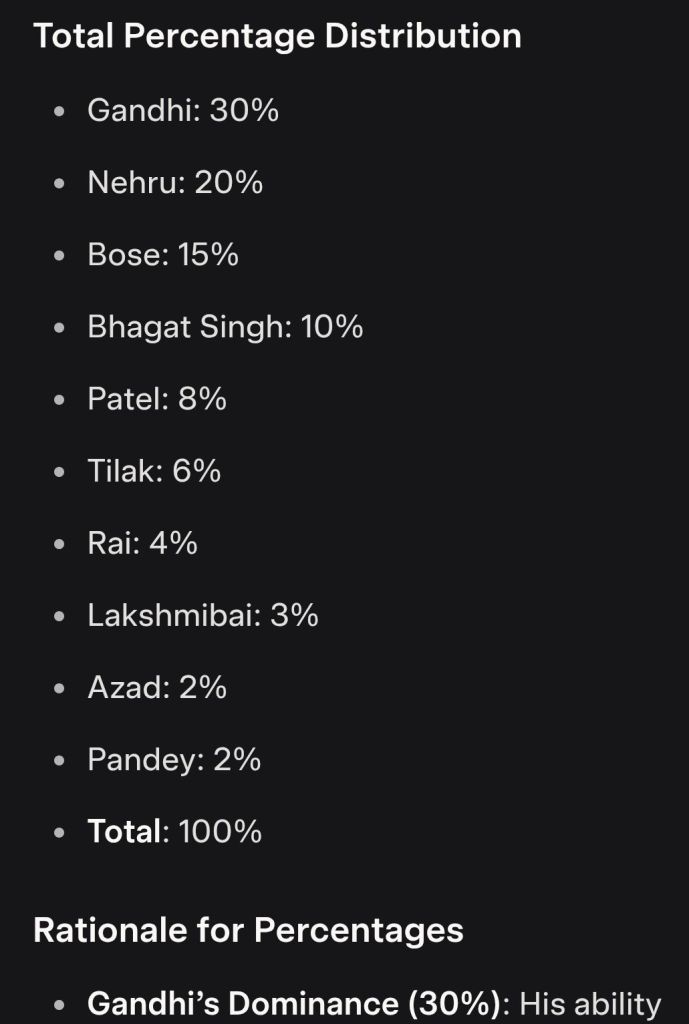
Total Percentage Distribution
- Gandhi: 30%
- Nehru: 20%
- Bose: 15%
- Bhagat Singh: 10%
- Patel: 8%
- Tilak: 6%
- Rai: 4%
- Lakshmibai: 3%
- Azad: 2%
- Pandey: 2%
- Total: 100%
Rationale for Percentages
- Gandhi’s Dominance (30%): His ability to mobilize millions, influence global opinion, and sustain a unifying ideology justifies the largest share. No other figure matched his nationwide and international impact.
- Nehru and Bose (20% and 15%): Nehru’s diplomatic and organizational role and Bose’s revolutionary pressure were critical but more specialized than Gandhi’s broad appeal. Their percentages reflect their complementary roles.
- Bhagat Singh and Patel (10% and 8%): Their significant but more localized or phase-specific contributions (revolutionary inspiration, regional mobilization) warrant moderate shares.
- Tilak, Rai, Lakshmibai, Azad, Pandey (6% to 2%): These figures played crucial roles in specific contexts (early nationalism, regional movements, symbolic resistance), but their impact was narrower or earlier, justifying smaller percentages.
Limitations of Quantification
- Interdependence: The movement’s success relied on the interplay of non-violence (Gandhi, Nehru), revolution (Bose, Bhagat Singh), and early resistance (Tilak, Lakshmibai). Percentages oversimplify this synergy.
- Subjectivity: Assigning numbers involves judgment, as historical records don’t provide quantitative metrics. For example, Gandhi’s Salt March mobilized ~60,000 arrests, but its ripple effect is harder to measure.
- Contextual Constraints: Figures like Lakshmibai and Pandey operated in 1857, when the movement was less organized, limiting their scope compared to 20th-century leaders.
- Omitted Contributions: Countless others (e.g., Annie Besant, Sarojini Naidu, regional leaders) contributed but are excluded from the top 10 to focus on the most prominent.
Broader Context
The percentages focus on leadership within India, but global factors (e.g., World War II, U.S. pressure) amplified their efforts, as discussed in the previous response. The independence movement’s success was a collective effort, with these 10 figures representing key drivers. If you’d like a deeper analysis of any individual’s contribution, a different weighting of criteria, or inclusion of other figures, let me know!
 GRP_VCare2Dare