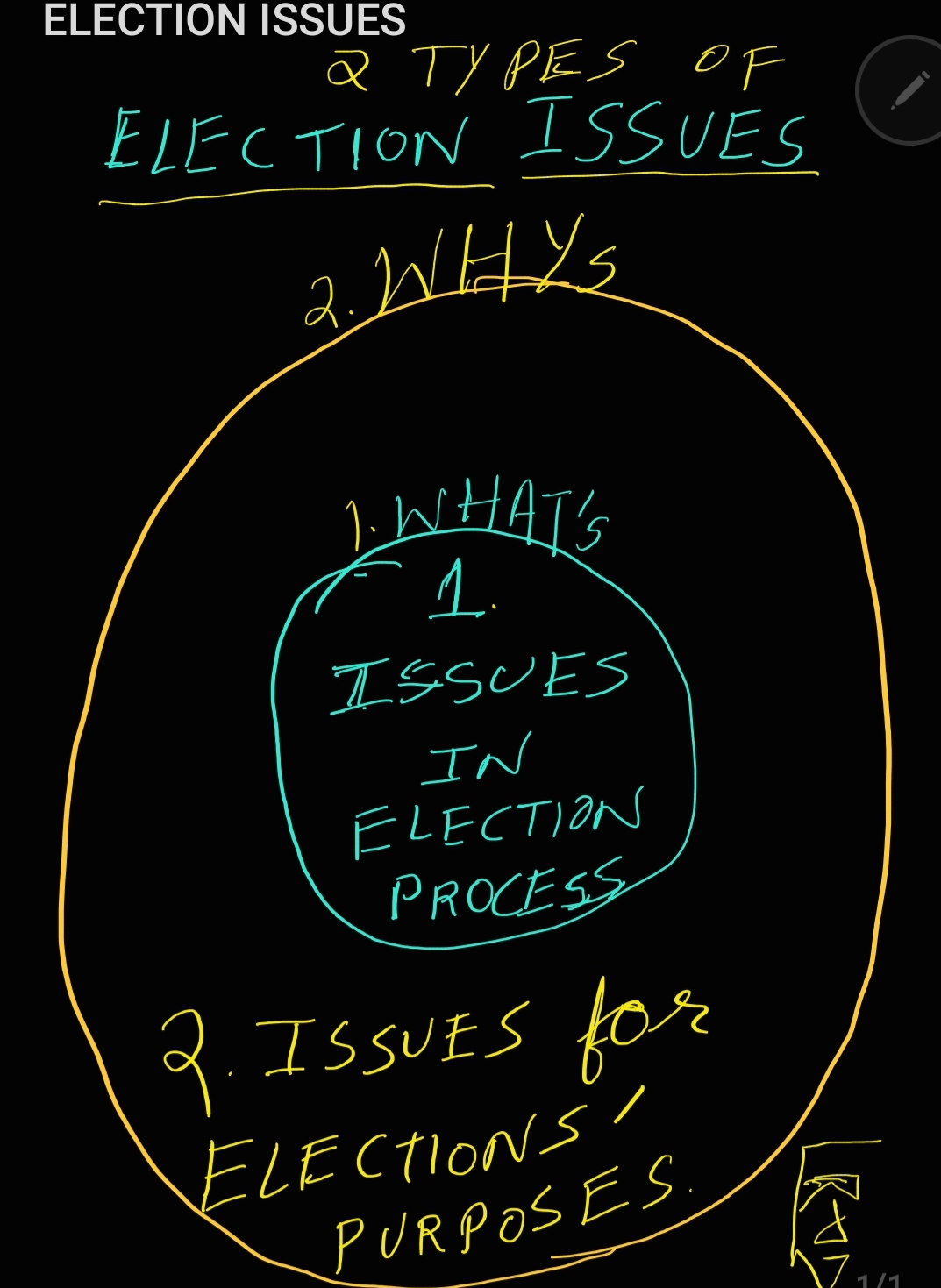
Election Issues Types..
Elections are a cornerstone of democratic systems, but they face distinct challenges that can be categorized into two types:
1. election-issues in the election process (Meta-Issue within) and “What Qs”: What are loopholes of EVMs?, What Needs to be Improved for Secure voting?.. its problems in “The Internal Mechanics of Elections.”
2. election-issues of/for the election’s purpose.(Politico-Social issues around elections). “Whys Qs“: Why are biases of gender, religion, castes, langauge etc in politics, Why Nepotistic candidates family wins and others loose elections. Its the “External Dynamics impacting with elections”.
Eg. “Mobile Phone Issues” Analogy…
1. is the meta-Issues in the phone like cracked screen, battery heating, over storage..etc
2. are related-Issues of due to the phone phone cyber crimes, hacking, data theft, Phone addiction..etc..
These types address different aspects of elections, from their execution to their broader objectives. Below is an explanation of each type.
1. Issues in the Election Process
These issues relate to the mechanics, administration, and conduct of elections, focusing on ensuring fairness, transparency, and efficiency in how elections are carried out. Problems in this category can undermine the integrity of the electoral system and public trust in the results.
- Voter Access and Suppression: Barriers such as strict voter ID requirements, limited polling locations, or long wait times can disproportionately affect marginalized groups. For example, a 2020 Brennan Center report noted that voter purges in the U.S. impacted minority voters at higher rates, raising concerns about equitable access.
- Election Integrity: Risks like voter fraud, tampering, or errors in vote counting (e.g., issues with electronic voting machines or mail-in ballots) can erode confidence. In 2016 and 2020, U.S. elections faced scrutiny over potential cybersecurity breaches.
- Logistical Challenges: Problems such as insufficient ballots, untrained poll workers, or delays in reporting results can disrupt the process. For instance, long lines in key U.S. swing states during the 2020 election highlighted logistical shortcomings.
- Cybersecurity Threats: Hacking attempts on voter databases or election infrastructure pose significant risks. Reports from the U.S. Cybersecurity and Infrastructure Security Agency (CISA) in 2020 emphasized the need for robust election security.
- Disinformation: False information about voting dates, locations, or procedures can mislead voters. Social media platforms, including X, have been cited as vectors for such misinformation, affecting voter turnout.
- Legal Disputes: Challenges to election rules, such as gerrymandering or changes to voting laws, often lead to lawsuits. For example, redistricting battles in the U.S. have been contentious, with courts intervening in states like North Carolina in 2022.
Addressing these issues requires robust electoral oversight, technological safeguards, and policies to ensure accessibility and transparency.
2. Issues of/for the Election’s Purpose
These issues pertain to the substantive goals and outcomes of elections, focusing on why elections are held and what they aim to achieve. They reflect the broader political, social, and economic priorities that drive voter participation and candidate platforms.
- Policy Priorities: Elections often center on key issues like healthcare, economic inequality, climate change, or immigration. For instance, X posts from the 2024 U.S. election cycle highlighted inflation and border security as dominant voter concerns.
- Representation: Elections aim to ensure elected officials reflect the will of the people. Debates over diversity, inclusion, or proportional representation are common. For example, India’s reservation system for certain castes in elections addresses representation concerns.
- Accountability: Voters expect elected officials to fulfill campaign promises and address issues like corruption or governance failures. Lack of accountability can lead to voter disillusionment, as seen in global protests over unfulfilled political pledges.
- Ideological Polarization: Divisions over social, cultural, or economic values—such as free speech versus misinformation or individual rights versus collective policies—shape election narratives. This was evident in the 2024 U.S. presidential debates, where cultural issues like education policy sparked heated discussions.
- Democratic Legitimacy: Elections serve to reinforce trust in democratic systems. When voters feel their concerns (e.g., economic hardship or social justice) are ignored, turnout and legitimacy suffer. For example, low voter turnout in some European elections has been linked to distrust in institutions.
These issues shape the election’s role in addressing societal needs and ensuring governance aligns with public priorities.
Intersection of the Two Types
While distinct, these issues can overlap. For example, voter suppression (a process issue) can distort representation (a purpose issue) by disenfranchising certain groups, skewing the election’s ability to reflect the public’s will. Similarly, disinformation campaigns (process) can manipulate voter focus on key policy issues like the economy (purpose), affecting outcomes.
Conclusion
Understanding the distinction between issues in the election process and issues of/for the election’s purpose is critical for strengthening democratic systems. Process issues demand technical and logistical solutions to ensure fairness, while purpose issues require addressing voter priorities and societal challenges. Both are essential for elections to fulfill their role as a pillar of democracy.
 GRP_VCare2Dare