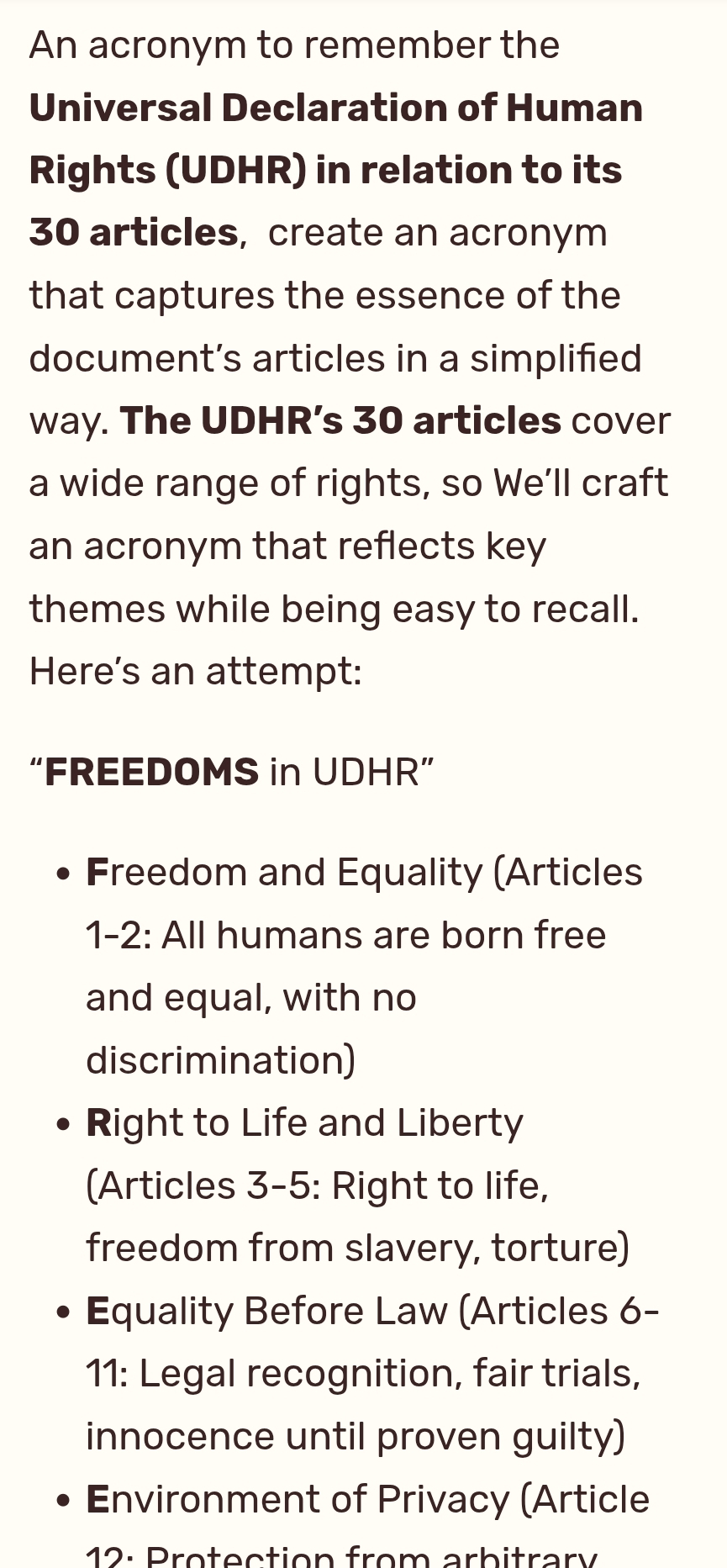
An acronym to remember the Universal Declaration of Human Rights (UDHR) in relation to its 30 articles, create an acronym that captures the essence of the document’s articles in a simplified way. The UDHR’s 30 articles cover a wide range of rights, so We’ll craft an acronym that reflects key themes while being easy to recall. Here’s an attempt:
“FREEDOMS in UDHR”
- Freedom and Equality (Articles 1-2: All humans are born free and equal, with no discrimination)
- Right to Life and Liberty (Articles 3-5: Right to life, freedom from slavery, torture)
- Equality Before Law (Articles 6-11: Legal recognition, fair trials, innocence until proven guilty)
- Environment of Privacy (Article 12: Protection from arbitrary interference with privacy)
- Dignity in Movement (Articles 13-15: Freedom of movement, right to nationality, asylum)
- Ownership and Family (Articles 16-17: Right to marry, own property)
- Mind and Belief (Articles 18-20: Freedom of thought, religion, expression, assembly)
- Social Rights (Articles 21-27: Right to democracy, work, education, cultural life, social security)
This acronym, FREEDOMS, summarizes the core themes of the UDHR’s 30 articles, which span equality, legal protections, personal freedoms, and social/economic rights. Articles 28-30 (global order, community duties, and inalienable rights) are less explicitly captured but are implied in the broader concept of a free and fair world.
- Born free and equal
- Freedom from discrimination
- Right to life, liberty, security
- Freedom from slavery
- Freedom from torture
- Recognition as a person before the law
- Equality before the law
- Right to legal remedy
- Freedom from arbitrary arrest
- Right to a fair trial
- Presumption of innocence
- Right to privacy
- Freedom of movement
- Right to asylum
- Right to nationality
- Right to marry and found a family
- Right to own property
- Freedom of religion or belief
- Freedom of opinion and expression
- Freedom of assembly and association
- Right to participate in government
- Right to social security
- Right to work and fair pay
- Right to rest and leisure
- Right to adequate standard of living
- Right to education
- Right to cultural, artistic, scientific life
- Right to a free and fair world
- Duty to community
- Rights are inalienable
Credits to Grok.. A.I and AP UI..
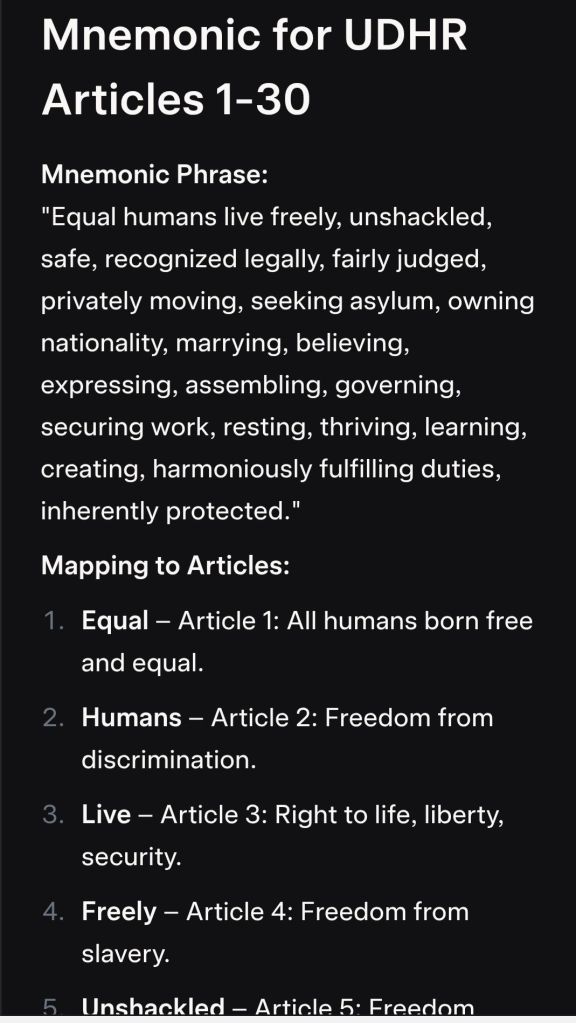
To create a mnemonic for remembering all 30 articles of the Universal Declaration of Human Rights (UDHR), I’ll craft a memorable phrase where each word or segment corresponds to the essence of each article. Given the complexity of covering 30 distinct rights, the mnemonic will use a sentence or story-like structure with keywords that evoke the core idea of each article, making it easier to recall. Below is the mnemonic, followed by a mapping to the articles.
Mnemonic for UDHR Articles 1-30
Mnemonic Phrase:
“Equal humans live freely, unshackled, safe, recognized legally, fairly judged, privately moving, seeking asylum, owning nationality, marrying, believing, expressing, assembling, governing, securing work, resting, thriving, learning, creating, harmoniously fulfilling duties, inherently protected.”
Mapping to Articles:
- Equal – Article 1: All humans born free and equal.
- Humans – Article 2: Freedom from discrimination.
- Live – Article 3: Right to life, liberty, security.
- Freely – Article 4: Freedom from slavery.
- Unshackled – Article 5: Freedom from torture.
- Safe – Article 6: Recognition as a person before the law.
- Recognized – Article 7: Equality before the law.
- Legally – Article 8: Right to legal remedy.
- Fairly – Article 9: Freedom from arbitrary arrest.
- Judged – Article 10: Right to a fair trial.
- Privately – Article 11: Presumption of innocence.
- Moving – Article 12: Right to privacy.
- Seeking – Article 13: Freedom of movement.
- Asylum – Article 14: Right to asylum.
- Owning – Article 15: Right to nationality.
- Nationality – Article 16: Right to marry and found a family.
- Marrying – Article 17: Right to own property.
- Believing – Article 18: Freedom of religion or belief.
- Expressing – Article 19: Freedom of opinion and expression.
- Assembling – Article 20: Freedom of assembly and association.
- Governing – Article 21: Right to participate in government.
- Securing – Article 22: Right to social security.
- Work – Article 23: Right to work and fair pay.
- Resting – Article 24: Right to rest and leisure.
- Thriving – Article 25: Right to adequate standard of living.
- Learning – Article 26: Right to education.
- Creating – Article 27: Right to cultural, artistic, scientific life.
- Harmoniously – Article 28: Right to a free and fair world.
- Fulfilling – Article 29: Duty to community.
- Inherently – Article 30: Rights are inalienable.
How to Use:
Recite the mnemonic phrase as a flowing sentence or story. Each keyword triggers recall of the corresponding article’s core right. For example, “Equal” reminds you of Article 1 (born free and equal), “Humans” for Article 2 (no discrimination), and so on. Practice by associating each word with its article to strengthen memory.
 GRP_VCare2Dare