“Arrogance” Blinds both eyes of Intelligence(IQ) & Tolerance(EQ) & leads to Ignorance. more “Citizens’ Awaraness-Arrogance” in Nation.
While Rational Acceptance increases Tolerance+Intelligence leading to Benevolence. Constitutional Awareness-Activism in Nation.
Social Solutions to bring more Equity & Tolerance (Reduce Inequality & Intolerance) is Equal Equitable Education & Healthcare for all Citizens.
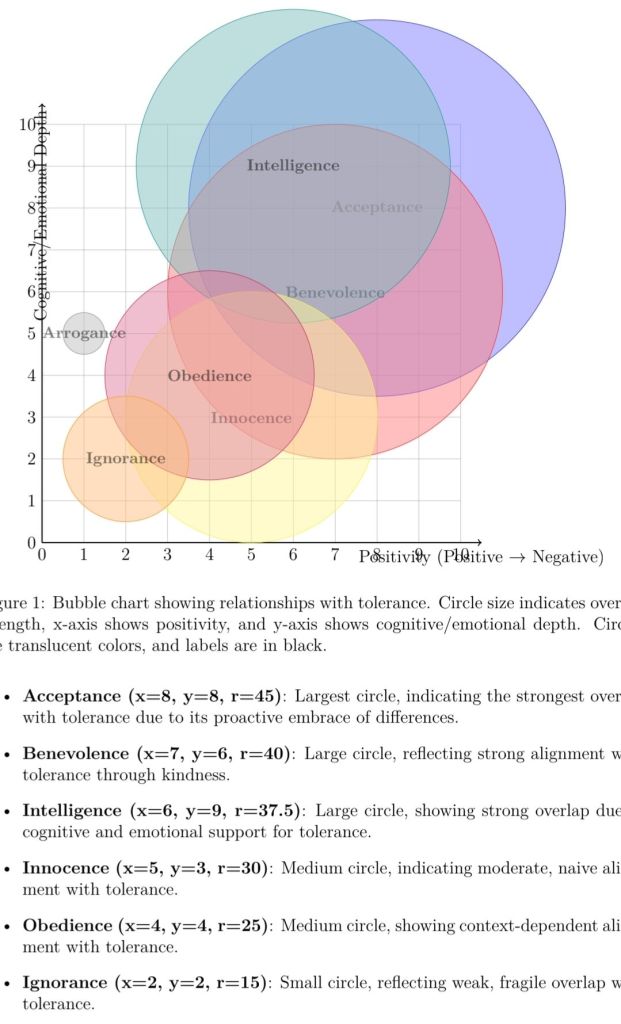
Tolerance
To extend the analysis of tolerance by including acceptance and intelligence as additional factors, I’ll incorporate these into the radar chart visualization, updating the set theory framework to account for their relationships with tolerance and the previously discussed concepts (innocence, ignorance, arrogance, benevolence, obedience). The goal is to visualize the strength of overlap between tolerance and all these factors, maintaining the same methodology as before.
Step 1: Defining the New Factors as Sets
- Acceptance (C): The set of attitudes and behaviors involving embracing or approving of differences in beliefs, identities, or behaviors without judgment. Acceptance is closely related to tolerance but often implies a deeper, more positive endorsement rather than mere endurance.
- Intelligence (N): The set of cognitive abilities involving reasoning, problem-solving, and understanding complex ideas. In this context, intelligence includes emotional and social intelligence, which influence how one processes and responds to differences.
These are added to the existing sets: Tolerance (T), Innocence (I), Ignorance (G), Arrogance (A), Benevolence (B), and Obedience (O), within the universal set U (all possible human attitudes, behaviors, or states of mind).
Step 2: Set Theory Analysis for New Factors
1. Tolerance and Acceptance (T ∩ C):
- Intersection: Acceptance and tolerance have a significant overlap, as both involve positive engagement with differences. Acceptance is often seen as a stronger form of tolerance, implying not just enduring but embracing diversity. For example, accepting someone’s cultural practices goes beyond tolerating them.
- Difference: Tolerance without acceptance (T − C) includes grudging or pragmatic tolerance (e.g., enduring differences due to social pressure). Acceptance without tolerance (C − T) is rare but might occur in performative acceptance without genuine endurance of discomfort.
- Complement: The complement of acceptance (C’, rejection or indifference) is largely incompatible with tolerance, as rejection often fuels intolerance.
2. Tolerance and Intelligence (T ∩ N):
- Intersection: Intelligence supports tolerance by enabling understanding of diverse perspectives and critical reflection on biases. Emotional intelligence, in particular, fosters empathy, which aligns with tolerance. For example, an intelligent person might tolerate differing opinions by reasoning through their validity.
- Difference: Tolerance without intelligence (T − N) can occur in simplistic or instinctive forms (e.g., tolerance due to social norms rather than understanding). Intelligence without tolerance (N − T) might manifest as intellectual arrogance, where knowledge leads to dismissal of others’ views.
- Complement: The complement of intelligence (N’, lack of reasoning or understanding) overlaps with ignorance but can still coexist with tolerance if driven by other factors like benevolence or innocence.
3. Interactions with Other Concepts:
- Acceptance and Benevolence (C ∩ B): Strong overlap, as both involve positive, goodwill-driven engagement with others.
- Intelligence and Ignorance (N ∩ G): Mutually exclusive, as intelligence implies knowledge, while ignorance is its absence. However, intelligence can coexist with arrogance if knowledge fosters superiority (N ∩ A).
- Acceptance and Innocence (C ∩ I): Similar to tolerance, acceptance can stem from innocent, non-judgmental attitudes but may lack depth without experience.
- Intelligence and Obedience (N ∩ O): Intelligence can inform obedience (e.g., following rules after reasoning) but may also lead to questioning authority, reducing blind obedience.
Step 3: Updated Radar Chart
The radar chart now includes acceptance and intelligence alongside the original factors. The values (0–100) represent the estimated strength of overlap with tolerance, based on the set theory analysis:
- Acceptance (C): Very high overlap (90), as acceptance is a deeper form of tolerance.
- Intelligence (N): High overlap (75), as cognitive and emotional intelligence support tolerance through understanding and empathy.
- Benevolence (B): High overlap (80), as before, due to shared kindness.
- Innocence (I): Moderate overlap (60), unchanged, reflecting naive alignment.
- Obedience (O): Moderate overlap (50), unchanged, context-dependent.
- Ignorance (G): Low overlap (30), unchanged, fragile alignment.
- Arrogance (A): Very low overlap (10), unchanged, as it undermines tolerance.
{ "type": "radar", "data": { "labels": ["Acceptance", "Intelligence", "Benevolence", "Innocence", "Obedience", "Ignorance", "Arrogance"], "datasets": [{ "label": "Overlap with Tolerance", "data": [90, 75, 80, 60, 50, 30, 10], "backgroundColor": "rgba(54, 162, 235, 0.2)", "borderColor": "#36A2EB", "pointBackgroundColor": "#36A2EB", "pointBorderColor": "#fff", "pointHoverBackgroundColor": "#fff", "pointHoverBorderColor": "#36A2EB" }] }, "options": { "scales": { "r": { "angleLines": { "color": "#666" }, "grid": { "color": "#666" }, "pointLabels": { "color": "#333" }, "ticks": { "color": "#333", "backdropColor": "transparent" }, "min": 0, "max": 100 } }, "plugins": { "legend": { "labels": { "color": "#333" } } } } }
Interpretation
- Acceptance has the strongest overlap with tolerance, reflecting its role as a proactive, positive form of tolerance.
- Intelligence and benevolence are close seconds, highlighting their roles in fostering informed and kind tolerance.
- Innocence and obedience remain moderately aligned, context-dependent as before.
- Ignorance and arrogance show minimal overlap, as they often undermine true tolerance.
- The chart visually emphasizes that tolerance is most strongly supported by acceptance, intelligence, and benevolence, while ignorance and arrogance are least aligned.
If you’d like to:
- Explore specific intersections (e.g., T ∩ C ∩ N)?
- Add more factors to the analysis?
- Use a different visualization (e.g., bar chart)?
- Incorporate real-world examples via external data?
Please let me know your preference!
Being Blindly Tolerant or Tyrant to citizens both are Issues..
As a nation we need to find the Balance to be Tolerant to Citizens & Indian Constitutionalists and Tyrants to the *Anti-Constitutionalists.* eg.. Taslima Nasreen and Sheikh Haseena is a Tolerant Bangladeshi, who India has provided shelter.. Even Dalai Lama and Tibetan are Tolerant Refugees.. there needs to be system of testing Constituonism.
Ex Paki Adnan Sami is now an Indian Constitutionalist (Allegiance ro Indian Constitution) where as Kasab was an Anti-Constitutionalist.
https://grpvcare2dare.design.blog/2025/06/12/1067-more-tolerant-india-or-less-tyrant-indians/
 GRP_VCare2Dare