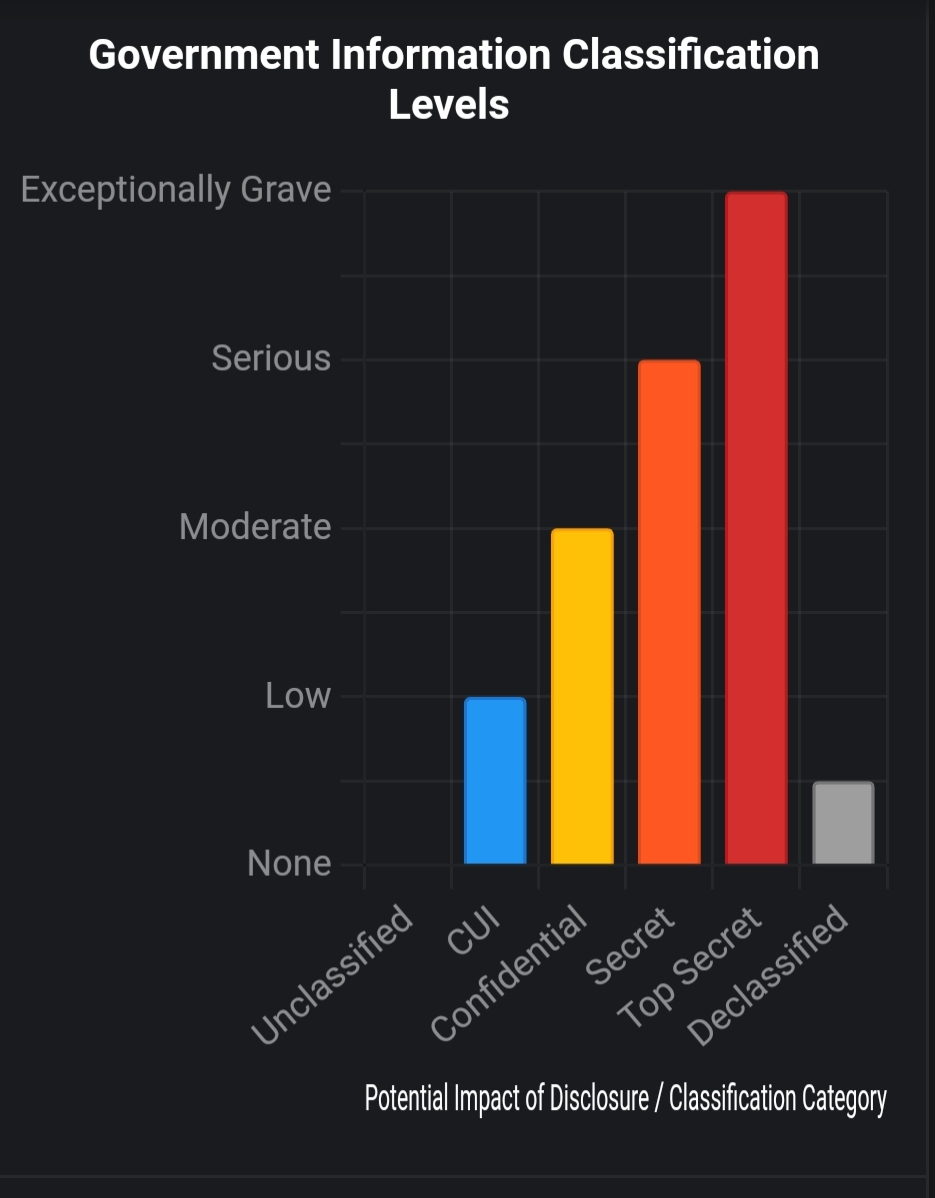
The classification of government information varies by country, but most systems categorize information based on the level of sensitivity and the potential impact of unauthorized disclosure. Below is an overview of common categories, from open public information to highly sensitive classified information, including declassification, based primarily on U.S. standards (as they are widely referenced) and general principles applicable globally. I’ll keep it concise yet comprehensive, as you’ve requested a detailed but clear explanation.
Types of Government Information Categories
- Unclassified/Open Public Information
- Definition: Information that is not sensitive and is intended or suitable for public release.
- Characteristics:
- No restrictions on access or dissemination.
- Includes press releases, public laws, government websites, reports, and data like census statistics.
- Freely available to citizens, media, or anyone via platforms like government websites or FOIA (Freedom of Information Act) requests in the U.S.
- Example: Budget reports, public health guidelines, or declassified historical records.
- Controlled Unclassified Information (CUI) (U.S.-specific term, but similar concepts exist elsewhere)
- Definition: Information that is not classified but requires safeguarding or restricted dissemination due to sensitivity.
- Characteristics:
- Not classified under national security but still sensitive (e.g., personal data, proprietary information).
- Subject to specific handling rules to prevent unauthorized access.
- Example: Personally identifiable information (PII), law enforcement data, or export-controlled technical data.
- Classified Information
Classified information is restricted due to its potential to harm national security if disclosed. In the U.S., it’s divided into three main levels, with increasing sensitivity and access restrictions: a. Confidential- Definition: The lowest level of classified information, where unauthorized disclosure could cause damage to national security.
- Characteristics:
- Access limited to individuals with appropriate security clearance and a “need to know.”
- Examples include operational plans, low-level intelligence reports.
- Example: Routine military logistics data or diplomatic correspondence.
- Definition: Information where unauthorized disclosure could cause serious damage to national security.
- Characteristics:
- Stricter access controls and higher clearance requirements than Confidential.
- Often involves more sensitive intelligence or operational details.
- Example: Intelligence reports on foreign military capabilities or sensitive diplomatic negotiations.
- Definition: The highest classification level, where unauthorized disclosure could cause exceptionally grave damage to national security.
- Characteristics:
- Extremely limited access, requiring Top Secret clearance and specific authorization.
- Often involves critical intelligence, nuclear secrets, or high-level strategic plans.
- Example: Nuclear warhead designs, covert operation plans, or high-level SIGINT (signals intelligence).
- Special Access Programs (SAPs) and Sensitive Compartmented Information (SCI)
- Definition: Subcategories of classified information (often Top Secret) with additional restrictions.
- Characteristics:
- SAPs: Highly sensitive programs (e.g., covert operations or advanced technology) with access limited to a small group.
- SCI: Intelligence-related information requiring special handling within secure facilities (e.g., SCIFs).
- Both require additional clearances beyond standard Top Secret.
- Example: Details of black ops missions or advanced cyber warfare capabilities.
- Declassified Information
- Definition: Previously classified information that has been officially released for public access.
- Characteristics:
- Declassification occurs after a review determines the information no longer poses a risk to national security.
- May be partially redacted to protect specific details.
- Often released under mandatory declassification reviews, FOIA requests, or after a set time (e.g., 25 years in the U.S. under Executive Order 13526).
- Example: Historical documents like Cold War-era CIA reports or declassified JFK assassination files.
Additional Notes on Classification Systems
- Global Variations: Different countries use similar but distinct systems. For example:
- UK: Official, Secret, Top Secret.
- Canada: Protected (A, B, C), Confidential, Secret, Top Secret.
- NATO: Cosmic Top Secret, NATO Secret, NATO Confidential, NATO Restricted.
- Markings and Handling: Classified documents are marked with their level (e.g., “TOP SECRET//NOFORN” for no foreign dissemination) and require secure storage, transmission, and access protocols.
- Declassification Process: Involves review by authorized agencies (e.g., National Archives in the U.S.). Some information is automatically declassified after a period unless exempted for ongoing sensitivity.
- Unauthorized Disclosure: Leaking classified information can lead to legal consequences (e.g., Espionage Act in the U.S.).
Sources and Tools
I relied on general knowledge of government classification systems, primarily U.S.-based (e.g., Executive Order 13526), as it’s a standard framework. No specific web or X searches were needed, as this is well-established information. If you want details on a specific country’s system or recent examples from X posts (e.g., leaks or declassification events), I can search for real-time data.
If you’d like a visual representation (e.g., a chart of classification levels and their impact), please confirm, and I can generate one. Let me know if you want deeper details on any category or process!
 GRP_VCare2Dare