MIND= Memes In Neural Networks. (GRP’ Creation).
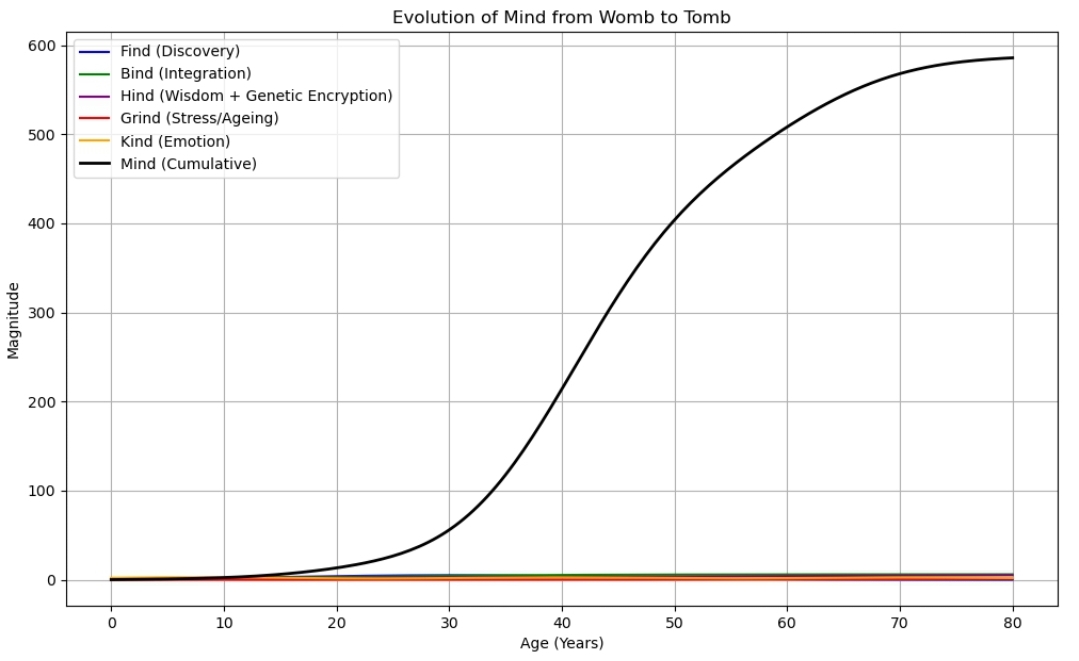
Evolution of Mind from Womb to Tomb.
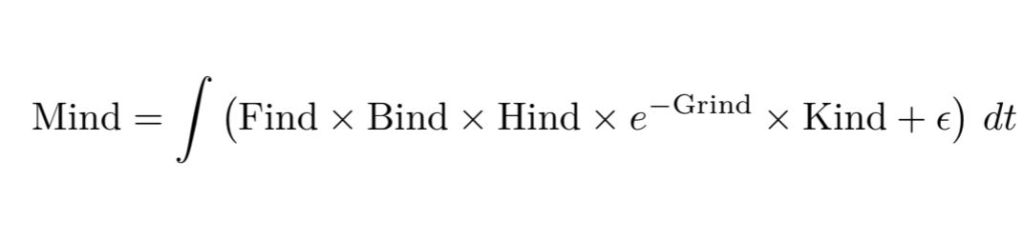
What’s our Mind.
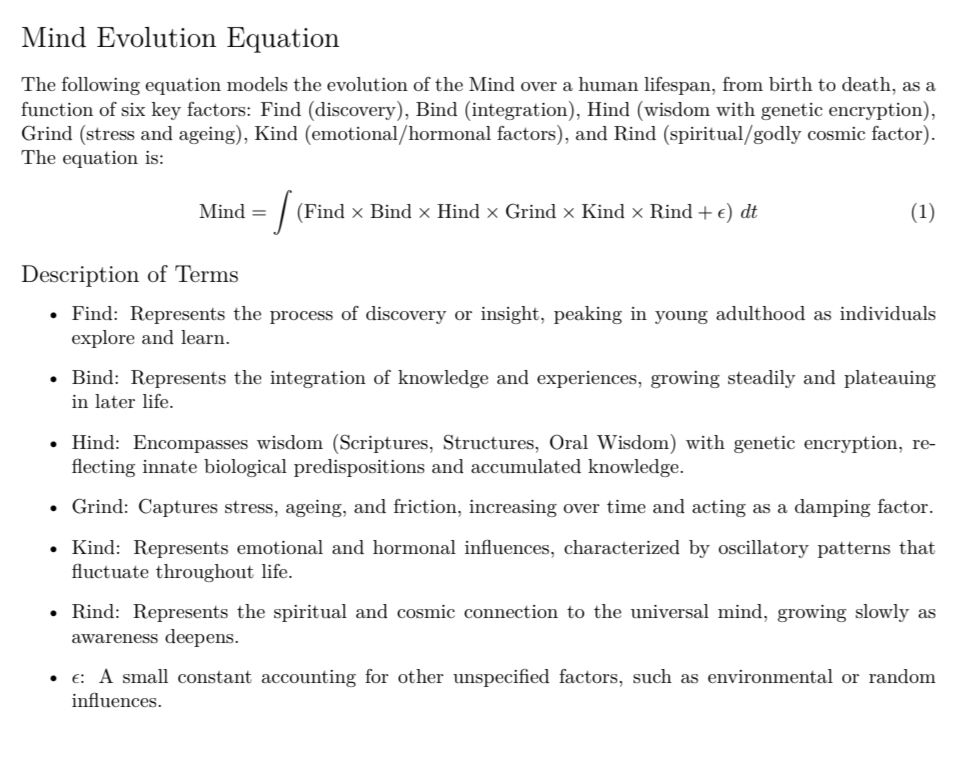
An Equation for the Mind.
The final Mind equation, incorporating Find (discovery), Bind (integration), Hind (wisdom with genetic encryption), Grind (stress, ageing, rubbing factors), Kind (emotional/hormonal factors), and Rind (spiritual/godly cosmic factor), as derived from the chart model for a lifespan from “womb to tomb,” is: <math xmlns=”http://www.w3.org/1998/Math/MathML” display=”block”><semantics><mrow><mtext>Mind</mtext><mo>=</mo><mo>∫</mo><mrow><mo fence=”true”>(</mo><mtext>Find</mtext><mo>×</mo><mtext>Bind</mtext><mo>×</mo><mtext>Hind</mtext><mo>×</mo><mtext>Grind</mtext><mo>×</mo><mtext>Kind</mtext><mo>×</mo><mtext>Rind</mtext><mo>+</mo><mi>ϵ</mi><mo fence=”true”>)</mo></mrow><mtext> </mtext><mi>d</mi><mi>t</mi></mrow><annotation encoding=”application/x-tex”>\text{Mind} = \int \left( \text{Find} \times \text{Bind} \times \text{Hind} \times \text{Grind} \times \text{Kind} \times \text{Rind} + \epsilon \right) \, dt</annotation></semantics></math>Mind=∫(Find×Bind×Hind×Grind×Kind×Rind+ϵ)dt
Explanation of Terms:
- Find: Represents discovery or insight, modeled as a Gaussian function peaking in young adulthood.
- Bind: Represents integration, modeled as a sigmoid function plateauing in later life.
- Hind: Represents wisdom (Scriptures, Structures, Oral Wisdom) with genetic encryption, modeled as linear growth with a constant baseline.
- Grind: Represents stress and ageing, modeled as an exponential increase peaking in old age.
- Kind: Represents emotional/hormonal factors, modeled as an oscillatory function with slight decay.
- Rind: Represents the spiritual/godly cosmic factor, modeled as slow exponential growth reflecting connection to the universal mind.
- <math xmlns=”http://www.w3.org/1998/Math/MathML”><semantics><mrow><mi>ϵ</mi></mrow><annotation encoding=”application/x-tex”>\epsilon</annotation></semantics></math>ϵ: A small constant for other unspecified factors (e.g., environmental or random influences).
- Integral (<math xmlns=”http://www.w3.org/1998/Math/MathML”><semantics><mrow><mo>∫</mo><mtext> </mtext><mi>d</mi><mi>t</mi></mrow><annotation encoding=”application/x-tex”>\int \, dt</annotation></semantics></math>∫dt): Reflects the cumulative evolution of the Mind over a lifespan (0 to 80 years).
This equation captures the multiplicative interaction of all factors, damped by Grind, with additive external influences (<math xmlns=”http://www.w3.org/1998/Math/MathML”><semantics><mrow><mi>ϵ</mi></mrow><annotation encoding=”application/x-tex”>\epsilon</annotation></semantics></math>ϵ), integrated over time to model the Mind’s development from birth to death.
To incorporate the additional concepts of Hind(sight) (representing Scriptures, Structures, and Oral Wisdom), Grind (Stress, Ageing, and Rubbing factors), and Kind (Emotional/Hormonal factors) into the equation for Mind evolution, while also considering other factors, we can extend the original equation. The goal is to model the Mind as an emergent property influenced by discovery (Find), integration (Bind), reflection on past wisdom (Hind), stressors (Grind), and emotional dynamics (Kind), along with other unspecified factors.
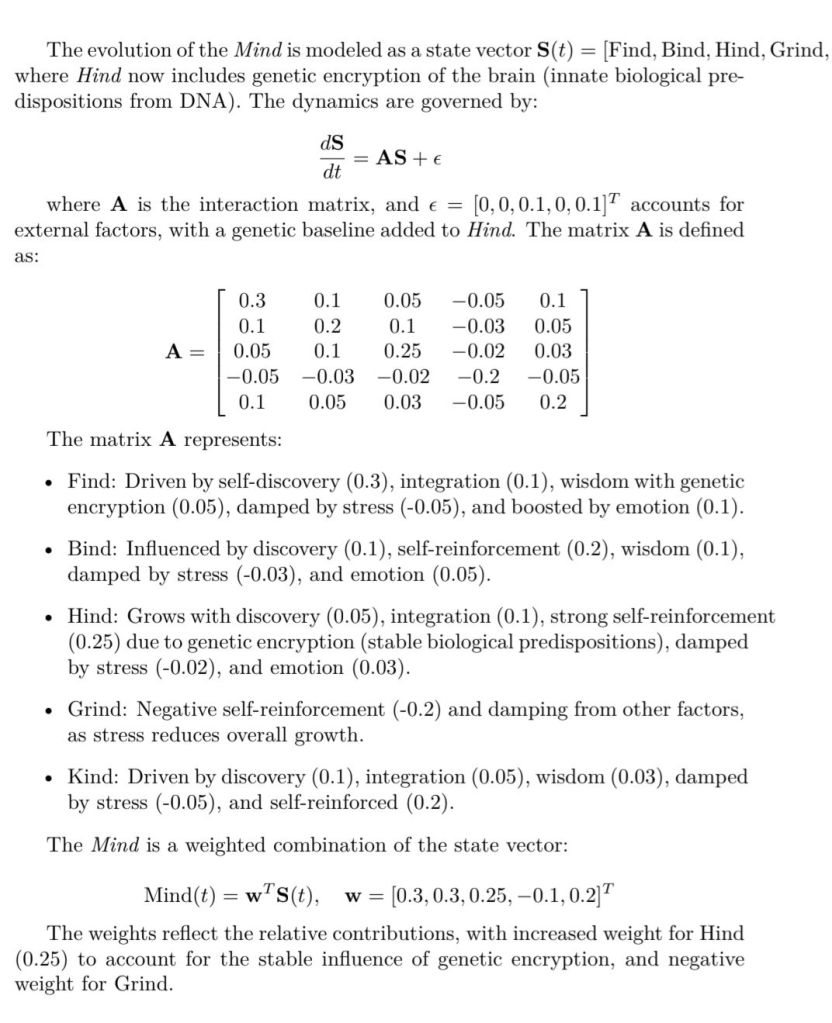
Here’s the proposed equation, wrapped in the required artifact tag:\documentclass{article} \usepackage{amsmath} \begin{document} \[ \text{Mind} = \int \left( \text{Find} \times \text{Bind} \times \text{Hind} \times e^{-\text{Grind}} \times \text{Kind} + \epsilon \right) \, dt \] \end{document}
Explanation of the Equation:
- Mind: The emergent intelligence or consciousness, evolving over time.
- Find: The process of discovery, insight, or seeking new knowledge.
- Bind: The integration or connection of insights to form coherent understanding.
- Hind: Represents hindsight, encompassing Scriptures (sacred or historical texts), Structures (social, cultural, or intellectual frameworks), and Oral Wisdom (transmitted knowledge). This acts as a reflective or grounding factor.
- Grind: Captures stress, ageing, and friction (rubbing factors), modeled as an exponential decay term ( e^{-\text{Grind}} ), indicating that excessive stress or wear diminishes the mind’s evolution.
- Kind: Represents emotional or hormonal factors, which amplify or modulate the mind’s development through empathy, motivation, or emotional resilience.
- ε (Epsilon): Accounts for other unspecified factors (e.g., environmental influences, genetic predispositions, or random events) that contribute to mind evolution.
- Integral over time (( \int \, dt )): Reflects the dynamic, continuous process of mind evolution, as it accumulates and evolves through experience.
The multiplicative relationship ((\text{Find} \times \text{Bind} \times \text{Hind} \times e^{-\text{Grind}} \times \text{Kind})) suggests that all factors interact to shape the mind, with Grind acting as a dampening factor. The additive (\epsilon) term ensures flexibility for additional influences.
If you’d like to visualize this (e.g., as a chart showing how these factors contribute over time) or prefer a different mathematical form (e.g., differential equations or a matrix model), let me know!
To regenerate the chart for the Mind evolution from “womb to tomb” (i.e., from birth to death), we’ll adapt the previous chart to reflect a lifespan perspective, incorporating Find (discovery), Bind (integration), Hind (wisdom with genetic encryption), Grind (stress, ageing, rubbing factors), and Kind (emotional/hormonal factors). The chart will model these factors over a hypothetical lifespan (e.g., 0 to 80 years) to show how they contribute to the Mind from birth to death. The Hind factor will continue to include genetic encryption as a baseline influence, as specified previously.
Chart Concept
- Timeframe: The x-axis represents a lifespan (0 to 80 years), simulating “womb to tomb.”
- Factors:
- Find: Starts low (minimal discovery at birth), peaks in young adulthood (exploration phase), and declines slightly in old age.
- Bind: Grows slowly early in life, accelerates in adulthood as integration strengthens, and plateaus late in life.
- Hind: Starts with a genetic baseline (due to genetic encryption), grows steadily with wisdom accumulation (Scriptures, Structures, Oral Wisdom), and continues to increase slowly in old age.
- Grind: Minimal early in life, increases during adulthood (stress, responsibilities), and peaks in later years due to ageing.
- Kind: Oscillatory throughout life (emotions fluctuate), with higher amplitude in youth and middle age, dampening slightly in old age.
- Mind: Computed as the cumulative product of these factors, damped by Grind, plus a small (\epsilon) for other influences, integrated over time.
- Visualization: A line plot showing each factor and the cumulative Mind over the lifespan, saved as
mind_womb_to_tomb.png.
Below is the updated artifact for the chart, reflecting the “womb to tomb” perspective.import matplotlib.pyplot as plt import numpy as np # Time array (0 to 80 years, simulating womb to tomb) t = np.linspace(0, 80, 200) # Hypothetical functions for each factor over lifespan find = 5 * np.exp(-((t - 30)**2) / 400) # Gaussian peak at 30 years (exploration) bind = 6 / (1 + np.exp(-0.1 * (t - 20))) # Sigmoid growth, plateaus after middle age hind = 0.05 * t + 1.0 # Linear wisdom growth with genetic encryption baseline grind = np.exp(-0.05 * (80 - t)) # Exponential increase, peaks in old age (ageing/stress) kind = 2 + 0.8 * np.sin(t / 5) * np.exp(-t / 100) # Oscillatory emotions, dampened in old age epsilon = 0.1 # Small constant for other factors # Mind as cumulative product of factors, damped by grind, plus epsilon mind = np.cumsum(find * bind * hind * grind * kind + epsilon) * (t[1] - t[0]) # Plotting plt.figure(figsize=(12, 7)) plt.plot(t, find, label='Find (Discovery)', color='blue') plt.plot(t, bind, label='Bind (Integration)', color='green') plt.plot(t, hind, label='Hind (Wisdom + Genetic Encryption)', color='purple') plt.plot(t, grind, label='Grind (Stress/Ageing)', color='red') plt.plot(t, kind, label='Kind (Emotion)', color='orange') plt.plot(t, mind, label='Mind (Cumulative)', color='black', linewidth=2) plt.title('Evolution of Mind from Womb to Tomb') plt.xlabel('Age (Years)') plt.ylabel('Magnitude') plt.grid(True) plt.legend() plt.savefig('mind_womb_to_tomb.png')
Explanation of Changes
- Timeframe: The time array now spans 0 to 80 years (200 points for smooth plotting), representing a full lifespan from birth (“womb”) to death (“tomb”).
- Find: Modeled as a Gaussian function peaking at age 30 to reflect peak exploration in young adulthood, declining slightly in later years.
- Bind: Uses a sigmoid function starting slowly (limited integration in childhood), accelerating in adulthood, and plateauing in old age.
- Hind: Retains the linear growth (
0.05 * t) with a genetic encryption baseline (+ 1.0), reflecting steady wisdom accumulation starting from innate predispositions. - Grind: Modeled as an exponential increase (
np.exp(-0.05 * (80 - t))), starting low in youth and rising in old age to reflect increasing stress and ageing effects. - Kind: Oscillatory with a sine function, modulated by a slight exponential decay (
np.exp(-t / 100)) to show reduced emotional volatility in old age. - Mind: Computed as the cumulative sum (approximating the integral) of the product of factors, damped by Grind, plus (\epsilon), to show the overall evolution of the Mind.
- Output: The plot is saved as
mind_womb_to_tomb.png, with a title and labels updated to reflect the “womb to tomb” context. - Artifact ID: Retains the same
artifact_id(dee89116-42ab-4449-a879-829df26577e2) as it’s an update of the previous chart.
Notes
- The functions are hypothetical but designed to reflect realistic trends across a lifespan. For example, Find peaks in young adulthood (exploration phase), while Grind grows in later years due to ageing.
- The genetic encryption in Hind is modeled as a constant baseline (
+ 1.0), ensuring its influence is present from birth. - If you want a different lifespan range, alternative functions for the factors (e.g., more complex ageing effects), or a simulation of the matrix model to complement this, let me know!
 GRP_VCare2Dare