Analyzing the psychology of nations based on their actions and impact on neighbors is a complex task, as it involves interpreting collective behavior through a psychological lens typically applied to individuals. However, we can adapt concepts like empathy (concern for others, cooperative actions) and narcissism (self-interest, exploitation, disregard for others’ welfare) to nations by examining their foreign policies, economic interactions, cultural influence, and historical behavior toward neighbors. I’ll place the five nations identified as the “Pancha Pandavas” (India, Nepal, Bhutan, Thailand, Sri Lanka) and the “Karna” candidate (Israel) on a spectrum from Most Empathic (helping neighbors with minimal self-interest) to Most Narcissistic (serving self at neighbors’ expense). I’ll also consider other global powers (e.g., US, Russia, China) for context, focusing on actions impacting neighbors. The analysis will avoid speculative assumptions and rely on historical and recent evidence, with an artifact summarizing the spectrum.
Framework for Analysis
- Empathy in Nations: Reflected in actions like providing aid, supporting neighbors’ sovereignty, fostering mutual prosperity, resolving conflicts peacefully, and promoting cultural coexistence. Empathic nations prioritize regional stability and collective welfare.
- Narcissism in Nations: Seen in actions like territorial aggression, economic exploitation, cultural imposition, or destabilizing neighbors for self-interest. Narcissistic nations prioritize their own power, resources, or influence at others’ expense.
- Spectrum: Nations are placed based on their net impact on neighbors, considering:
- Aid and Cooperation: Humanitarian aid, trade benefits, or diplomatic support.
- Conflict and Exploitation: Military aggression, economic coercion, or resource extraction.
- Cultural Impact: Respect for neighbors’ identities vs. imposition of own values.
- Historical and Recent Actions: Balancing past behavior with current policies.
Analysis of Nations
- Bhutan
- Actions and Impact on Neighbors:
- Empathic Actions: Bhutan maintains peaceful relations with India and Nepal, its primary neighbors. It shares hydropower with India, supporting mutual economic benefits (e.g., India funds 70% of Bhutan’s hydropower projects, which supply 70% of India’s imported electricity from Bhutan). Bhutan’s Gross National Happiness (GNH) philosophy promotes environmental conservation, benefiting regional ecosystems (e.g., carbon-negative status helps Himalayan neighbors). It resolved border disputes with India (e.g., Doklam, 2017) diplomatically, avoiding escalation.
- Narcissistic Actions: Minimal. Bhutan’s small size limits its ability to exploit neighbors. However, its expulsion of ethnic Nepali Lhotshampa in the 1990s (leading to 100,000 refugees in Nepal) was a rare self-serving act, driven by cultural homogeneity concerns, though it was resolved with international help.
- Net Impact: Highly empathic. Bhutan’s policies prioritize regional harmony, with the Lhotshampa issue as an outlier mitigated by its small scale and resolution.
- Spectrum Placement: Most Empathic. Bhutan’s cooperative, low-conflict approach and environmental focus make it a regional stabilizer.
- Nepal
- Actions and Impact on Neighbors:
- Empathic Actions: Nepal maintains peaceful ties with India and China, its main neighbors. It hosts Tibetan refugees (over 20,000), showing humanitarian commitment despite Chinese pressure. Nepal’s cultural ties with India (shared Hindu-Buddhist heritage) foster soft power through pilgrimage sites (e.g., Lumbini, Pashupatinath). It participates in SAARC for regional cooperation, though progress is slow.
- Narcissistic Actions: Limited. Nepal’s 2015 constitution sparked tensions with India over Madhesi rights (ethnic group with Indian ties), leading to a perceived Indian blockade (2015–2016), though Nepal’s role was reactive. Its landlocked status limits aggressive actions, but occasional border disputes with India (e.g., Kalapani, Lipulekh) reflect self-interest over territorial claims.
- Net Impact: Empathic. Nepal’s small size and neutral stance minimize harm, with minor tensions reflecting survival needs rather than exploitation.
- Spectrum Placement: Highly Empathic. Nepal’s refugee support and cultural openness outweigh minor disputes.
- Thailand
- Actions and Impact on Neighbors:
- Empathic Actions: Thailand supports ASEAN neighbors through trade and cultural exchange (e.g., hosting ASEAN summits). It provides refuge to Myanmar’s displaced (over 90,000 in camps along the border) and cooperates on Mekong River management with Laos, Cambodia, and Vietnam. Thailand’s Buddhist diplomacy fosters ties with Laos and Cambodia.
- Narcissistic Actions: Historical territorial disputes with Cambodia (e.g., Preah Vihear Temple, 2008–2011 clashes) show self-interest. Thailand’s economic dominance in the Mekong region (e.g., exploiting Lao hydropower or fishing rights) sometimes prioritizes national gain. Its treatment of Myanmar refugees has faced criticism for inadequate conditions and deportations.
- Net Impact: Moderately empathic. Thailand’s regional cooperation is significant, but disputes and economic leverage tilt it toward self-interest compared to Bhutan or Nepal.
- Spectrum Placement: Moderately Empathic. Thailand balances cooperation with occasional self-serving actions.
- Sri Lanka
- Actions and Impact on Neighbors:
- Empathic Actions: Sri Lanka engages in Indian Ocean regional cooperation (e.g., IORA) and shares cultural ties with India (Tamil and Buddhist heritage). It provided aid to Maldives during water crises (e.g., 2014 desalination support). Post-civil war (2009), Sri Lanka has sought reconciliation with India to counterbalance Chinese influence.
- Narcissistic Actions: The civil war (1983–2009) against Tamil Tigers strained relations with India, as Tamil militancy was partly fueled by India’s Tamil population. Sri Lanka’s alignment with China (e.g., Hambantota Port lease, 2017) has raised India’s security concerns, reflecting self-interest. Fishing disputes with India (e.g., Tamil Nadu fishermen arrests) persist.
- Net Impact: Mixed. Sri Lanka’s regional cooperation is offset by actions that destabilize India, its primary neighbor, though these are often driven by economic survival.
- Spectrum Placement: Moderately Narcissistic. Sri Lanka’s self-preservation (e.g., Chinese debt deals) sometimes harms neighbors, though not aggressively.
- India
- Actions and Impact on Neighbors:
- Empathic Actions: India provides significant aid to neighbors (e.g., $1.6 billion to Nepal post-2015 earthquake, $500 million to Maldives for infrastructure). It supports Bhutan’s hydropower and security (e.g., Doklam standoff support, 2017). India’s “Neighborhood First” policy and SAARC leadership promote regional stability. It hosts Tibetan refugees and supports Sri Lanka’s post-war recovery.
- Narcissistic Actions: India’s regional dominance can appear overbearing. The 2015 Nepal blockade (perceived, if not official) harmed Nepal’s economy. Border disputes with Pakistan (Kashmir), China (Ladakh), and Nepal (Kalapani) reflect territorial self-interest. India’s influence over Maldives and Sri Lanka (e.g., pressuring Sri Lanka against Chinese deals) prioritizes strategic control.
- Net Impact: Mixed, leaning empathic. India’s aid and cultural ties are substantial, but its size and power lead to actions perceived as hegemonic by smaller neighbors.
- Spectrum Placement: Slightly Empathic. India’s cooperative efforts outweigh narcissistic tendencies, but its regional dominance creates tensions.
- Israel (Karna)
- Actions and Impact on Neighbors:
- Empathic Actions: Israel shares technology (e.g., drip irrigation) with Jordan and Egypt under peace agreements (1994, 1979). It provides humanitarian aid during crises (e.g., medical support to Syrians during civil war). Cultural exchanges (e.g., academic collaborations) exist, though limited.
- Narcissistic Actions: Israel’s actions in Palestine (e.g., West Bank settlements, Gaza blockades) severely impact neighbors, prioritizing security over Palestinian welfare. Military operations (e.g., Lebanon 2006, Syria airstrikes) destabilize the region. Its alignment with the US often disregards Arab neighbors’ concerns.
- Net Impact: Strongly narcissistic. Israel’s security-driven policies harm neighbors’ stability, outweighing limited cooperative efforts.
- Spectrum Placement: Highly Narcissistic. Israel’s actions prioritize self-preservation at significant cost to neighbors.
Contextual Global Powers (for Spectrum Calibration)
- United States:
- Actions: Provides aid (e.g., $3 billion to Egypt annually) but intervenes militarily (e.g., Iraq 2003, Syria), destabilizing neighbors. Economic sanctions (e.g., Iran) prioritize US interests.
- Impact: Highly narcissistic, exploiting Middle Eastern resources and influence.
- Placement: Most Narcissistic.
- Russia:
- Actions: Supports allies (e.g., Syria’s Assad regime) but annexes territory (e.g., Crimea 2014) and pressures neighbors (e.g., Ukraine, Georgia).
- Impact: Narcissistic, prioritizing geopolitical dominance.
- Placement: Highly Narcissistic.
- China:
- Actions: Offers Belt and Road aid (e.g., Sri Lanka’s Hambantota) but imposes debt traps. South China Sea claims harm neighbors (e.g., Vietnam, Philippines).
- Impact: Narcissistic, exploiting economic leverage.
- Placement: Highly Narcissistic.
Spectrum Placement
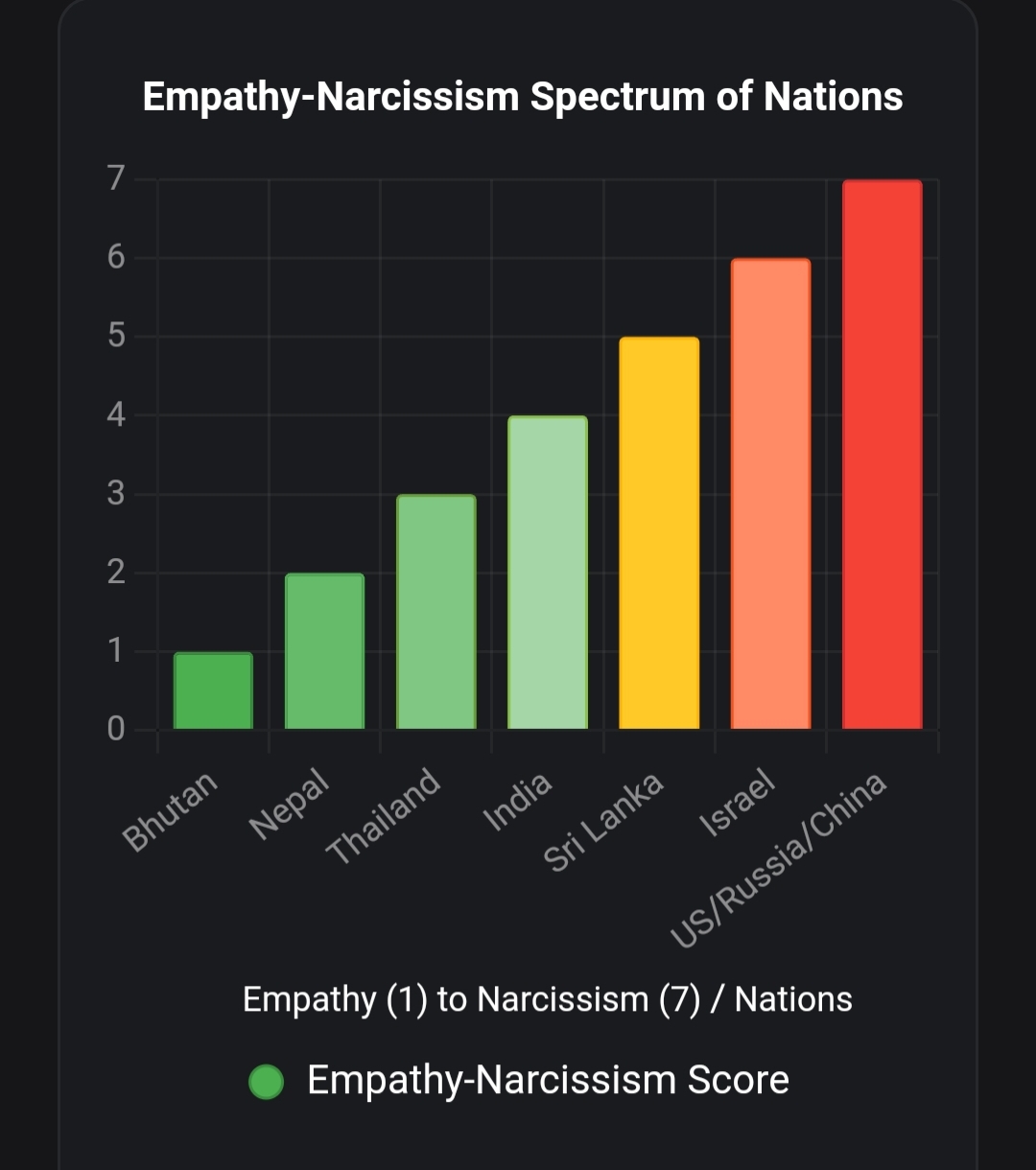
- Most Empathic: Bhutan (cooperative, minimal harm, environmental focus).
- Highly Empathic: Nepal (peaceful, refugee support, minor disputes).
- Moderately Empathic: Thailand (ASEAN cooperation, but economic leverage and disputes).
- Slightly Empathic: India (significant aid, but hegemonic tendencies).
- Moderately Narcissistic: Sri Lanka (self-preservation harms India, limited cooperation).
- Highly Narcissistic: Israel (security policies destabilize neighbors).
- Most Narcissistic: US, Russia, China (global exploitation, aggression).
Artifact: Empathy-Narcissism Spectrum
Empathy-Narcissism Spectrum of Nations
Based on actions and impact on neighbors, nations are placed from Most Empathic (helping with minimal self-interest) to Most Narcissistic (serving self at others’ expense).
- Most Empathic: Bhutan
- Hydropower sharing with India, carbon-negative status, peaceful border resolutions (e.g., Doklam 2017). Minor Lhotshampa expulsion (1990s) resolved.
- Highly Empathic: Nepal
- Hosts Tibetan refugees, cultural ties with India, SAARC participation. Minor border disputes (e.g., Kalapani) reflect survival needs.
- Moderately Empathic: Thailand
- ASEAN cooperation, Myanmar refugee aid, Mekong management. Disputes (e.g., Preah Vihear) and economic dominance in Laos/Cambodia.
- Slightly Empathic: India
- Aid to Nepal, Bhutan, Maldives; SAARC leadership. Blockade (Nepal 2015) and border disputes (Pakistan, China) show hegemonic tendencies.
- Moderately Narcissistic: Sri Lanka
- IORA cooperation, aid to Maldives. Civil war and Chinese alignment (Hambantota) strain India; fishing disputes persist.
- Highly Narcissistic: Israel
- Tech sharing with Jordan/Egypt. Settlements, Gaza blockade, and military actions (Lebanon, Syria) harm neighbors.
- Most Narcissistic: US, Russia, China
- US: Iraq invasion, Iran sanctions. Russia: Crimea annexation, Ukraine war. China: South China Sea claims, debt traps.
Chart Visualization
To illustrate the spectrum, here’s a bar chart showing the relative empathy-narcissism scores of the analyzed nations, with scores estimated based on their actions (1 = Most Empathic, 7 = Most Narcissistic).{ "type": "bar", "data": { "labels": ["Bhutan", "Nepal", "Thailand", "India", "Sri Lanka", "Israel", "US/Russia/China"], "datasets": [{ "label": "Empathy-Narcissism Score", "data": [1, 2, 3, 4, 5, 6, 7], "backgroundColor": ["#4CAF50", "#66BB6A", "#81C784", "#A5D6A7", "#FFCA28", "#FF8A65", "#F44336"], "borderColor": ["#388E3C", "#4CAF50", "#689F38", "#8BC34A", "#FFB300", "#F4511E", "#D32F2F"], "borderWidth": 1 }] }, "options": { "scales": { "y": { "beginAtZero": true, "max": 7, "title": { "display": true, "text": "Empathy (1) to Narcissism (7)" } }, "x": { "title": { "display": true, "text": "Nations" } } }, "plugins": { "title": { "display": true, "text": "Empathy-Narcissism Spectrum of Nations" } } } }
Notes
- The spectrum is a simplification, as nations’ actions vary by context and era. Historical actions (e.g., Bhutan’s Lhotshampa issue) are weighed against recent policies.
- Israel’s narcissistic placement reflects its regional impact, not its domestic policies or global contributions (e.g., tech innovation).
- Global powers (US, Russia, China) are grouped for brevity but could be differentiated further (e.g., China’s economic coercion vs. Russia’s military aggression).
- If you’d like a deeper analysis of specific actions, additional nations (e.g., South Korea, Indonesia), or a search for recent X/web sources, let me know!
 GRP_VCare2Dare