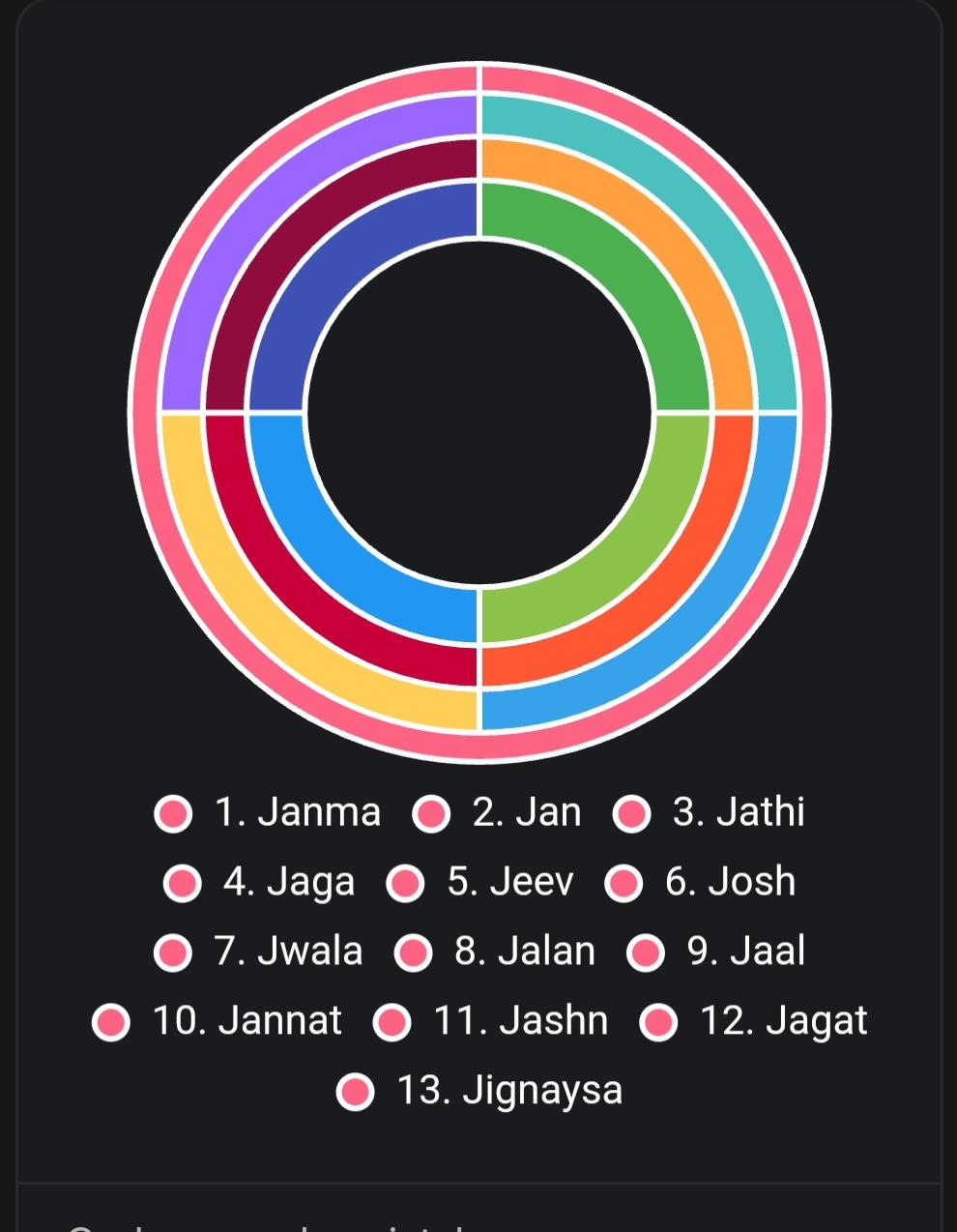
Jeeva, Janarogyam, Jagaran.
Jeev_Hitha cha Jagat_Hitham!! Personal_Wellness With World Wellness..
Below is the updated Jeevan Framework, incorporating Jeev (individual soul/life), Jagat (world/universe), and Jaganatha (universal principle) alongside the existing components: Jan, Josh, Janma, Jathi, Jalan, Jannat, Jwala, Jaal, Jaga, Jagaran, Jashn, and Jignaysa. Each term is defined, its role in life is explained, and its connection to the journey from Janma (birth) to Jignaysa (inquiry) and Jagaran (awakening) is clarified. The framework remains rooted in Indian philosophical and cultural ethos, presenting a holistic model of human existence that integrates individual, universal, and spiritual dimensions.
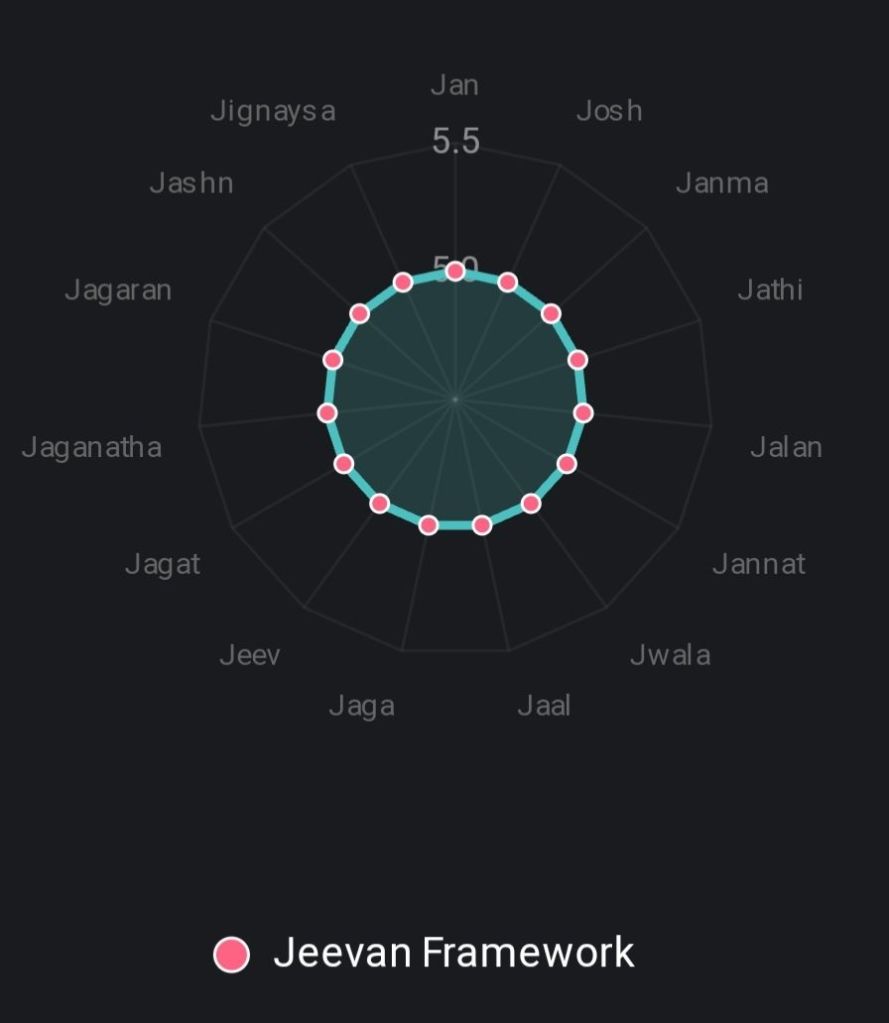
Jeevan Framework: Components and Their Relation to Life
- Jan (People/Community)
- Meaning: Jan represents the collective—family, community, or society—forming the social fabric of life.
- Relation to Life: Jan provides belonging, support, and shared values, shaping interactions and growth from birth onward.
- Connection to Jignaysa & Jagaran: Jan sparks Jignaysa through shared wisdom and cultural narratives. Collective experiences foster Jagaran, revealing interconnectedness within the universal order.
- Josh (Energy/Enthusiasm)
- Meaning: Josh is the vitality and enthusiasm driving action and ambition.
- Relation to Life: Josh fuels pursuits across life stages, from childhood curiosity to adult endeavors, enabling resilience and goal achievement.
- Connection to Jignaysa & Jagaran: Josh powers Jignaysa by sustaining curiosity and supports Jagaran by providing energy for sustained inquiry and awakening.
- Janma (Birth)
- Meaning: Janma signifies the moment of birth, the entry into physical existence.
- Relation to Life: Janma is the starting point of the individual’s journey, the foundation for all experiences—physical, emotional, and spiritual.
- Connection to Jignaysa & Jagaran: Birth initiates Jignaysa, as life’s unfolding prompts questions about purpose. Reflecting on Janma’s role within Jagat (the world) leads to Jagaran, an awakening to existence’s deeper meaning.
- Jathi (Identity/Lineage)
- Meaning: Jathi encompasses personal and cultural identity, including family, heritage, or societal roles.
- Relation to Life: Jathi shapes self-perception and responsibilities, providing continuity and context within the broader Jagat.
- Connection to Jignaysa & Jagaran: Jathi prompts Jignaysa by encouraging questions about roots and purpose. Transcending limiting aspects of Jathi aligns with Jagaran, fostering a universal identity under Jaganatha.
- Jalan (Flow/Movement)
- Meaning: Jalan symbolizes the flow of life, like water, representing change and adaptability.
- Relation to Life: Life is a continuous flow of experiences, requiring adaptability to navigate challenges and embrace growth.
- Connection to Jignaysa & Jagaran: Jalan fuels Jignaysa through new experiences and supports Jagaran by revealing life’s impermanence, aligning with the universal flow of Jaganatha.
- Jannat (Paradise/Bliss)
- Meaning: Jannat represents moments of bliss, harmony, or spiritual fulfillment.
- Relation to Life: Jannat reflects the pursuit of inner peace and joy, experienced through love, nature, or spiritual connection, offering glimpses of the divine.
- Connection to Jignaysa & Jagaran: Jannat inspires Jignaysa about true happiness and catalyzes Jagaran, as blissful moments reflect Jaganatha’s universal harmony.
- Jwala (Flame/Passion)
- Meaning: Jwala signifies the inner fire or passion driving commitment, creativity, or transformation.
- Relation to Life: Jwala ignites purpose, fueling pursuits that transform the Jeev (individual soul) within the Jagat (world).
- Connection to Jignaysa & Jagaran: Jwala intensifies Jignaysa, driving deeper exploration of truth, and fuels Jagaran, as passionate pursuit aligns with Jaganatha’s universal principle.
- Jaal (Trap/Net)
- Meaning: Jaal represents entanglements like desires, attachments, or societal pressures that hinder growth.
- Relation to Life: Jaal symbolizes challenges and illusions (e.g., materialism, ego) that ensnare the Jeev, obstructing its path to fulfillment.
- Connection to Jignaysa & Jagaran: Jaal prompts Jignaysa by forcing questions about limitations. Overcoming Jaal aligns the Jeev with Jaganatha, enabling Jagaran.
- Jaga (Place)
- Meaning: Jaga refers to the physical, emotional, or spiritual “place” one occupies, encompassing environment or inner state.
- Relation to Life: Jaga grounds the Jeev in its surroundings, shaping experiences within the Jagat through context—home, nature, or consciousness.
- Connection to Jignaysa & Jagaran: Jaga sparks Jignaysa about how environment influences purpose. A meaningful Jaga supports Jagaran, aligning the Jeev with Jaganatha’s universal order.
- Jeev (Individual Soul/Life)
- Meaning: Jeev represents the individual soul or life force, the unique consciousness that experiences existence.
- Relation to Life: Jeev is the core of personal experience, the entity that navigates life’s journey within the Jagat, driven by its unique purpose and connection to Jaganatha.
- Connection to Jignaysa & Jagaran: Jeev drives Jignaysa, as the soul’s innate curiosity seeks its role in the universe. Its journey culminates in Jagaran, realizing its unity with Jaganatha.
- Jagat (World/Universe)
- Meaning: Jagat signifies the world or universe, the cosmic stage where life unfolds.
- Relation to Life: Jagat is the broader context in which the Jeev exists, encompassing nature, society, and cosmic order, shaping all experiences.
- Connection to Jignaysa & Jagaran: Jagat prompts Jignaysa about the Jeev’s place in the cosmos. Understanding Jagat’s interconnectedness leads to Jagaran, aligning with Jaganatha’s universal principle.
- Jaganatha (Universal Principle)
- Meaning: Jaganatha represents the universal principle or cosmic order, the underlying truth or divine force governing existence (akin to concepts like Brahman or cosmic harmony).
- Relation to Life: Jaganatha is the guiding force that unifies all aspects of life, providing purpose and coherence to the Jeev’s journey within the Jagat.
- Connection to Jignaysa & Jagaran: Jaganatha inspires Jignaysa, as the Jeev seeks to understand the universal truth. Jagaran is the realization of Jaganatha’s presence, uniting the individual with the cosmic whole.
- Jagaran (Awakening)
- Meaning: Jagaran is the state of spiritual or intellectual awakening, a heightened awareness of self and the universe.
- Relation to Life: Jagaran marks a transformative phase where the Jeev transcends mundane concerns, realizing its unity with Jagat and Jaganatha.
- Connection to Jignaysa & Jagaran: Jagaran is the culmination of Jignaysa, where inquiry unveils the Jeev’s connection to Jaganatha, integrating all components into awakening.
- Jashn (Celebration)
- Meaning: Jashn embodies joy, gratitude, and celebration of life’s moments.
- Relation to Life: Jashn balances challenges with joy, celebrating milestones and connections within the Jagat, reflecting Jaganatha’s harmony.
- Connection to Jignaysa & Jagaran: Jashn inspires Jignaysa about true happiness and catalyzes Jagaran, as gratitude aligns the Jeev with Jaganatha.
- Jignaysa (Inquiry/Curiosity)
- Meaning: Jignaysa is the pursuit of knowledge, truth, and understanding through questioning.
- Relation to Life: Jignaysa drives the Jeev’s growth, from childhood curiosity to philosophical quests, seeking meaning within the Jagat and Jaganatha.
- Connection to Jignaysa & Jagaran: Jignaysa is the framework’s engine, fueling all components and leading to Jagaran, as inquiry reveals the Jeev’s unity with Jaganatha.
Integration of the Framework
The Jeevan Framework portrays life as a journey of the Jeev (individual soul) from Janma (birth) to Jagaran (awakening) within the Jagat (world), guided by Jignaysa (inquiry) and aligned with Jaganatha (universal principle). The components interrelate as follows:
- Janma initiates the Jeev’s journey, embedding it in Jan (community), Jathi (identity), and Jaga (place) within the Jagat.
- Josh, Jwala, Jalan, and Jaal drive energy, passion, flow, and challenges, shaping the Jeev’s path.
- Jannat and Jashn offer bliss and celebration, balancing inquiry with joy.
- Jeev, Jagat, and Jaganatha provide the individual, universal, and cosmic context, guiding Jignaysa toward Jagaran.
- Jignaysa weaves through all, culminating in Jagaran, where the Jeev realizes its unity with Jaganatha.
Visualizing the Framework
Imagine a circular model:
- Center: Janma, the origin of the Jeev.
- Inner Ring: Jan, Jathi, Jaga, and Jeev, providing social, personal, contextual, and individual foundations.
- Middle Ring: Josh, Jwala, Jalan, and Jaal, driving energy, passion, flow, and challenges.
- Outer Ring: Jannat, Jashn, Jagat, and Jignaysa, balancing bliss, celebration, cosmic context, and inquiry.
- Culmination: Jagaran, guided by Jaganatha, integrating all into awakening.
If you’d like a chart (e.g., a circular diagram or radar chart) to visualize this, please confirm, and I can generate one.
Jeevan Framework: A Holistic Model of Life
Overview
The Jeevan Framework outlines the journey of the Jeev (individual soul) from Janma (birth) to Jagaran (awakening) within the Jagat (world), driven by Jignaysa (inquiry) and aligned with Jaganatha (universal principle). It integrates fifteen components, each beginning with “J,” rooted in Indian philosophical ethos.
Components
- Jan (People/Community)
- The collective providing belonging and support.
- Sparks inquiry through shared wisdom, fostering awakening.
- Josh (Energy/Enthusiasm)
- Vitality driving action and growth.
- Fuels inquiry and sustains energy for awakening.
- Janma (Birth)
- The starting point of the Jeev’s journey.
- Initiates inquiry and reflection on existence.
- Jathi (Identity/Lineage)
- Personal and cultural identity shaping self-perception.
- Prompts questions about roots, aligning with universal awakening.
- Jalan (Flow/Movement)
- The flow of life, embracing change and adaptability.
- Fuels inquiry through experiences, revealing impermanence.
- Jannat (Paradise/Bliss)
- Moments of harmony and spiritual fulfillment.
- Inspires inquiry into happiness, catalyzing awakening.
- Jwala (Flame/Passion)
- The inner fire driving purpose and transformation.
- Intensifies inquiry and fuels awakening.
- Jaal (Trap/Net)
- Entanglements like desires or societal pressures.
- Prompts inquiry into limitations, enabling liberation for awakening.
- Jaga (Place)
- The physical, emotional, or spiritual context.
- Sparks inquiry into environment’s influence, aligning with awakening.
- Jeev (Individual Soul/Life)
- The unique consciousness navigating existence.
- Drives inquiry into purpose, culminating in awakening.
- Jagat (World/Universe)
- The cosmic stage where life unfolds.
- Prompts inquiry into the Jeev’s place, leading to awakening.
- Jaganatha (Universal Principle)
- The cosmic order governing existence.
- Inspires inquiry into universal truth, guiding awakening.
- Jagaran (Awakening)
- Spiritual and intellectual awakening to life’s purpose.
- The culmination of inquiry, uniting Jeev with Jaganatha.
- Jashn (Celebration)
- Joy and gratitude for life’s moments.
- Sparks inquiry into happiness, opening pathways to awakening.
- Jignaysa (Inquiry/Curiosity)
- The pursuit of knowledge and truth.
- Drives all components, leading to awakening through questioning.
Integration
- Janma initiates the Jeev’s journey in Jan, Jathi, Jaga, Jagat, and Jaganatha.
- Josh, Jwala, Jalan, and Jaal navigate energy, passion, flow, and challenges.
- Jannat and Jashn balance inquiry with joy.
- Jeev, Jagat, and Jaganatha guide Jignaysa toward Jagaran.
Conclusion
The Jeevan Framework offers a holistic guide to the Jeev’s journey from birth to awakening, emphasizing inquiry within the cosmic order of Jaganatha. Each component interlocks to create a meaningful, interconnected path.
Conclusion
The updated Jeevan Framework incorporates Jeev, Jagat, and Jaganatha, enriching the model with the individual soul, the universal context, and the cosmic principle. It traces the Jeev’s journey from Janma to Jagaran, driven by Jignaysa and aligned with Jaganatha. Let me know if you’d like to refine specific components, add others, or visualize the framework further (e.g., with a chart)!
 GRP_VCare2Dare