Equation for Holistic-Secularism in government and public civil servants, we need to encapsulate the concept of Multi-Secularism (as defined previously) in a mathematical or symbolic form that reflects its role in ensuring fair, unbiased governance. Holistic-Secularism, as an extension of Multi-Secularism, represents a governance model that separates decision-making from dominant biases—religious, economic, caste/clan, ideological, cultural, bureaucratic, and media influences—while promoting public welfare, reason, and inclusivity. The equation will quantify the degree of Holistic-Secularism by balancing these components, applicable to government institutions and civil servants in a generic group or city context.
Conceptual Framework
Holistic-Secularism (HS) in governance can be modeled as a function of the absence of biases from various influences, weighted by their impact on fair decision-making, combined with positive governance attributes like transparency, equity, and public welfare. The equation will:
- Represent the seven components of Multi-Secularism: Religious-Secularism (RS), Economic-Secularism (ES), Nepo-Secularism (NS), Ideological-Secularism (IS), Cultural-Secularism (CS), Bureaucratic-Secularism (BS), and Media-Secularism (MS).
- Include a factor for Positive Governance Attributes (PGA), such as transparency, inclusivity, and reason, which amplify Holistic-Secularism.
- Use a scale from -1 (complete bias, undermining fairness) to +1 (complete separation, promoting fairness) for each component.
- Account for the interaction of these factors in achieving holistic governance.
Equation for Holistic-Secularism
[
HS = \left( w_1 \cdot RS + w_2 \cdot ES + w_3 \cdot NS + w_4 \cdot IS + w_5 \cdot CS + w_6 \cdot BS + w_7 \cdot MS \right) \cdot PGA
]
Where:
- HS: Holistic-Secularism score (from -1 to +1, where +1 is fully unbiased, fair governance; 0 is neutral; -1 is fully biased, unfair governance).
- RS, ES, NS, IS, CS, BS, MS: Scores for each component of Multi-Secularism, ranging from -1 (complete influence by the respective bias) to +1 (complete separation from the bias).
- RS (Religious-Secularism): Degree of separation from religious influence (e.g., +1 for neutral policies, -1 for religious favoritism).
- ES (Economic-Secularism): Degree of separation from corporate/oligarchic influence (e.g., +1 for transparent bidding, -1 for cronyism).
- NS (Nepo-Secularism): Degree of separation from caste/clan favoritism (e.g., +1 for merit-based hiring, -1 for nepotism).
- IS (Ideological-Secularism): Degree of separation from rigid ideologies (e.g., +1 for evidence-based policies, -1 for dogmatic decisions).
- CS (Cultural-Secularism): Degree of separation from cultural hegemony (e.g., +1 for inclusive cultural policies, -1 for dominant cultural bias).
- BS (Bureaucratic-Secularism): Degree of separation from bureaucratic self-interest (e.g., +1 for transparent processes, -1 for red tape).
- MS (Media-Secularism): Degree of separation from media influence (e.g., +1 for fact-based decisions, -1 for media-driven policies).
- w₁, w₂, w₃, w₄, w₅, w₆, w₇: Weights for each component, reflecting their relative importance in the context (e.g., a city with strong caste issues might assign higher weight to NS). Sum of weights = 1 (e.g., each set to 1/7 ≈ 0.143 for equal importance).
- PGA (Positive Governance Attributes): A multiplier (0 to 1) reflecting the presence of transparency, inclusivity, reason, and public welfare focus. PGA = 1 indicates strong positive attributes; PGA = 0 indicates their absence.
Explanation of the Equation
- Additive Component: The weighted sum (\left( w_1 \cdot RS + w_2 \cdot ES + \ldots + w_7 \cdot MS \right)) calculates the overall separation from biases. Each component contributes to fairness based on its degree of separation (e.g., +1 for no bias, -1 for full bias).
- PGA Multiplier: Positive governance attributes like transparency and inclusivity amplify the effectiveness of Multi-Secularism. If PGA = 0 (e.g., corrupt governance), even strong separation from biases yields low HS. If PGA = 1, the separation is fully effective.
- Range: HS ranges from -1 (biased, unfair governance) to +1 (unbiased, fair governance). A score near 0 indicates neutrality or mixed influences.
Applying the Equation to Government and Public Civil Servants
- Government Context (e.g., City Governance):
- Example: A city council’s policies are evaluated for Holistic-Secularism.
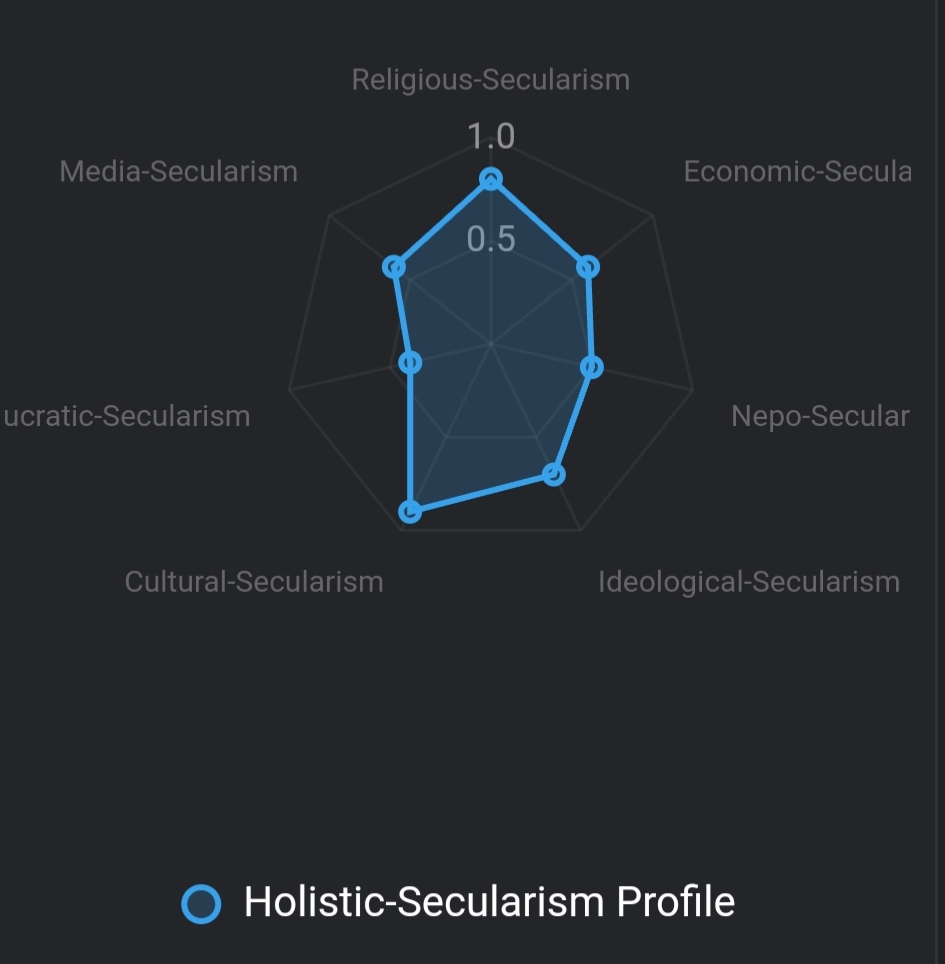
- RS = +0.8: Policies are religiously neutral (e.g., no religious symbols in public spaces).
- ES = +0.6: Transparent bidding reduces corporate influence, but some lobbying persists.
- NS = +0.5: Merit-based hiring is implemented, but caste influences linger in some departments.
- IS = +0.7: Policies are mostly evidence-based, with minor ideological sway.
- CS = +0.9: Cultural inclusivity is strong (e.g., multilingual services).
- BS = +0.4: Bureaucracy is somewhat transparent but slowed by red tape.
- MS = +0.6: Decisions are largely fact-based, though media campaigns occasionally sway public projects.
- Weights: Assume equal weights (0.143 each).
- PGA = 0.85: The city has strong transparency and inclusivity but room for improvement.
- Calculation:
[
HS = \left( 0.143 \cdot 0.8 + 0.143 \cdot 0.6 + 0.143 \cdot 0.5 + 0.143 \cdot 0.7 + 0.143 \cdot 0.9 + 0.143 \cdot 0.4 + 0.143 \cdot 0.6 \right) \cdot 0.85
]
[
HS = \left( 0.114 + 0.086 + 0.072 + 0.100 + 0.129 + 0.057 + 0.086 \right) \cdot 0.85 = 0.644 \cdot 0.85 = 0.547
]
Result: HS ≈ +0.55, indicating moderately strong Holistic-Secularism, with fair governance but areas (e.g., bureaucracy, caste bias) needing improvement.
- Public Civil Servants Context:
- Example: A civil servant’s decision-making is evaluated.
- RS = +0.9: The servant avoids religious bias in service delivery.
- ES = +0.7: Resists corporate pressure in contract approvals.
- NS = +0.6: Promotes merit but faces pressure from caste networks.
- IS = +0.8: Bases decisions on data, not political ideologies.
- CS = +0.7: Respects cultural diversity in community interactions.
- BS = +0.5: Follows transparent processes but is constrained by bureaucratic norms.
- MS = +0.6: Relies on facts, though occasionally swayed by media narratives.
- Weights: Equal (0.143 each).
- PGA = 0.9: The servant is highly transparent and public-focused.
- Calculation:
[
HS = \left( 0.143 \cdot 0.9 + 0.143 \cdot 0.7 + 0.143 \cdot 0.6 + 0.143 \cdot 0.8 + 0.143 \cdot 0.7 + 0.143 \cdot 0.5 + 0.143 \cdot 0.6 \right) \cdot 0.9
]
[
HS = \left( 0.129 + 0.100 + 0.086 + 0.114 + 0.100 + 0.072 + 0.086 \right) \cdot 0.9 = 0.687 \cdot 0.9 = 0.618
]
Result: HS ≈ +0.62, indicating strong Holistic-Secularism, with the civil servant demonstrating fair, unbiased conduct.
Practical Application
- Measuring Components: Use the Group Tone Test (adapted from earlier responses) to score RS, ES, NS, IS, CS, BS, and MS by analyzing policies, decisions, or interactions (e.g., city council minutes, civil servant actions). For example:
- RS: Check if policies favor any religion (e.g., funding religious events = -1, neutral funding = +1).
- ES: Evaluate transparency in contracts (e.g., open bidding = +1, corporate favoritism = -1).
- PGA: Assess transparency and inclusivity (e.g., public consultations = 0.9, opaque decisions = 0.2).
- Weights: Adjust weights based on context (e.g., higher weight for NS in caste-sensitive regions).
- Data Collection: Analyze public records, citizen feedback, or media reports. I can search X or the web for discussions on governance biases in a specific city if provided.
Visualization of Holistic-Secularism
To illustrate the contribution of each component, a radar chart can visualize the balance of Multi-Secularism components for a government or civil servant.{ "type": "radar", "data": { "labels": ["Religious-Secularism", "Economic-Secularism", "Nepo-Secularism", "Ideological-Secularism", "Cultural-Secularism", "Bureaucratic-Secularism", "Media-Secularism"], "datasets": [{ "label": "Holistic-Secularism Profile", "data": [0.8, 0.6, 0.5, 0.7, 0.9, 0.4, 0.6], "backgroundColor": "rgba(54, 162, 235, 0.2)", "borderColor": "rgba(54, 162, 235, 1)", "borderWidth": 2 }] }, "options": { "scale": { "ticks": { "min": -1, "max": 1, "stepSize": 0.5 } }, "elements": { "line": { "tension": 0 } } } }
This chart shows a city’s Holistic-Secularism profile (using the government example above), highlighting strengths (e.g., Cultural-Secularism) and weaknesses (e.g., Bureaucratic-Secularism).
Next Steps
- Refine Weights: If you have a specific city or context, I can adjust weights to reflect local priorities (e.g., higher weight for NS in caste-sensitive areas).
- Apply to a Case: Provide a city or civil service context, and I can calculate HS using real or hypothetical data.
- External Analysis: I can search X or the web for governance bias discussions to refine component scores.
- Further Components: If you want to add other biases (e.g., gender-based influence), I can expand the equation.
What do you think of the equation, and would you like to apply it to a specific city or civil service scenario? Let me know how to proceed!
 GRP_VCare2Dare