The task of creating a “Rationality Ratings of Religions” (RRR) and analyzing religions on a scale from most rational-secular to least rational-secular is complex and sensitive, as it involves subjective judgments about belief systems that are deeply personal and culturally significant. The user’s prior queries, which focus on India’s secular identity, Ambedkar’s influences, and geopolitical tensions (e.g., “Chinakistan,” OIC biases), suggest an interest in evaluating religions in the context of their alignment with rationalism and secularism, particularly as they relate to India’s democratic framework. I will approach this systematically, defining criteria for “rationality” and “secularism,” analyzing major world religions, and presenting the findings in a structured artifact. The analysis will be evidence-based, respectful, and grounded in philosophical and historical context, avoiding bias or derogation.
Defining Rationality and Secularism
For the RRR, I define the terms as follows:
- Rationality: The extent to which a religion emphasizes reason, empirical evidence, and critical inquiry over dogmatic belief, supernatural claims, or unprovable assertions. Rationality includes openness to questioning doctrines, compatibility with scientific principles, and flexibility in adapting to modern ethical standards.
- Secularism: The degree to which a religion supports or is compatible with a separation of religious authority from state governance, promotes pluralism, and accommodates diverse beliefs without enforcing theocratic rule. Secularism also considers the religion’s stance on individual freedoms and universal human rights.
Criteria for RRR
To rate religions, I use the following criteria, scored on a 1–10 scale for each:
- Emphasis on Reason (Rationality): Does the religion prioritize logical inquiry, skepticism, or evidence-based beliefs? (e.g., rejection of superstition, openness to reinterpretation).
- Compatibility with Science (Rationality): How well does the religion align with scientific discoveries, such as evolution or cosmology?
- Adaptability (Rationality): Can the religion evolve its doctrines in response to modern ethical or social changes (e.g., gender equality, human rights)?
- Separation of Church and State (Secularism): Does the religion advocate or tolerate a secular state, or does it promote theocracy?
- Pluralism and Tolerance (Secularism): Does the religion encourage coexistence with other faiths and respect for individual beliefs?
- Individual Autonomy (Secularism): Does the religion support personal freedom, including the right to question or leave the faith?
Each criterion is scored based on historical texts, contemporary practices, and scholarly analyses, acknowledging that religions are diverse and vary by sect or region. The total score (out of 60) determines the ranking from most to least rational-secular.
Major Religions Analyzed
I focus on the world’s major religions with significant global adherents, covering Christianity, Islam, Hinduism, Buddhism, Judaism, Sikhism, Jainism, and secular humanism (included as a non-theistic belief system for comparison, given its rational-secular alignment). Other religions (e.g., Zoroastrianism, Shinto) are excluded due to smaller global impact but can be analyzed upon request.
Methodology
- Data Sources: Religious texts (e.g., Bible, Quran, Vedas), historical practices, contemporary interpretations (e.g., Vatican II, Ambedkar’s Navayana Buddhism), and scholarly works.
- Scoring: Each religion is scored based on its dominant global practices and texts, acknowledging internal diversity (e.g., Sunni vs. Shia Islam, Theravada vs. Mahayana Buddhism). Scores reflect a balanced assessment, not absolute truths.
- Context: The user’s interest in India informs the analysis, with attention to how religions interact with India’s secular democracy and geopolitical challenges (e.g., OIC’s Islamic focus, Ambedkar’s Buddhist rationalism).
RRR Analysis
Below is the artifact containing the Rationality Ratings of Religions, followed by a summary and discussion.
Rationality Ratings of Religions (RRR)
This analysis ranks major world religions and secular humanism on a scale of rationality and secularism, based on six criteria: Emphasis on Reason, Compatibility with Science, Adaptability, Separation of Church and State, Pluralism and Tolerance, and Individual Autonomy. Each criterion is scored from 1 (low) to 10 (high), with a maximum total of 60. The rankings reflect global practices and texts, acknowledging diversity within each religion.
1. Secular Humanism
- Description: A non-theistic belief system emphasizing reason, ethics, and human welfare without reliance on supernatural claims. Prominent in Western societies and among global intellectuals.
- Scores:
- Emphasis on Reason: 10 (Prioritizes critical thinking, skepticism, and evidence-based ethics).
- Compatibility with Science: 10 (Fully embraces scientific methods, e.g., evolution, cosmology).
- Adaptability: 9 (Evolves with new ethical insights, e.g., gender equality, though sometimes dogmatic about secularism).
- Separation of Church and State: 10 (Advocates strict secular governance, e.g., U.S. First Amendment principles).
- Pluralism and Tolerance: 8 (Supports diverse beliefs but can be critical of religious dogmas).
- Individual Autonomy: 10 (Champions personal freedom, including freedom from religion).
- Total: 57/60
- Analysis: Secular humanism ranks highest due to its rejection of supernatural claims and alignment with scientific rationalism. Its secular ethos supports pluralistic governance, making it a benchmark for rational-secular ideals. In India, it aligns with Ambedkar’s rationalist principles but lacks widespread adherence.
2. Jainism
- Description: An Indian religion with 4–5 million adherents, emphasizing non-violence (ahimsa), truth, and asceticism. Rooted in rational ethics and non-theism.
- Scores:
- Emphasis on Reason: 8 (Encourages logical inquiry and ethical reasoning, e.g., syadvada—relativism—but includes unprovable karma concepts).
- Compatibility with Science: 7 (Neutral on science; non-theism aligns with evolution, but cosmological claims lack empirical basis).
- Adaptability: 7 (Modern Jains adapt to ethical norms, e.g., vegetarianism aligns with sustainability, but ascetic traditions resist change).
- Separation of Church and State: 9 (No history of theocracy; supports secular governance in India).
- Pluralism and Tolerance: 9 (Promotes coexistence, historically peaceful in India’s pluralistic society).
- Individual Autonomy: 8 (Encourages personal ethical discipline but expects adherence to strict codes).
- Total: 48/60
- Analysis: Jainism’s non-theistic rationalism and ethical focus make it highly rational-secular. Its compatibility with India’s secular democracy and Ambedkar’s egalitarian ideals is notable, though metaphysical claims slightly lower its rationality score.
3. Buddhism
- Description: A global religion with 520 million adherents, founded by Gautama Buddha. Emphasizes rationality, meditation, and ethical living, with diverse sects (e.g., Theravada, Mahayana, Navayana).
- Scores:
- Emphasis on Reason: 8 (Buddha’s emphasis on inquiry, e.g., Kalama Sutta, promotes skepticism, but some sects accept supernatural elements).
- Compatibility with Science: 7 (Aligns with evolution; Ambedkar’s Navayana is highly rational, but traditional cosmology includes unproven realms).
- Adaptability: 8 (Adapts to modernity, e.g., engaged Buddhism, though some sects cling to tradition).
- Separation of Church and State: 8 (Historically non-theocratic; supports secular states like India, Japan).
- Pluralism and Tolerance: 8 (Promotes coexistence, though ethnic tensions exist, e.g., Sri Lanka’s Sinhala Buddhism).
- Individual Autonomy: 8 (Encourages personal liberation but expects ethical discipline).
- Total: 47/60
- Analysis: Buddhism, particularly Ambedkar’s Navayana, scores high for rationality due to its emphasis on reason and ethics. Its secular compatibility strengthens India’s pluralistic framework, countering theocratic tendencies seen in OIC member states.
4. Sikhism
- Description: An Indian religion with 25 million adherents, founded by Guru Nanak. Emphasizes monotheism, equality, and community service.
- Scores:
- Emphasis on Reason: 7 (Encourages ethical reasoning and equality, but monotheistic faith includes unprovable divine claims).
- Compatibility with Science: 6 (Neutral on science; no major conflicts, but lacks explicit alignment with modern discoveries).
- Adaptability: 7 (Modern Sikhs adapt to social norms, e.g., gender equality in gurdwaras, but resist changes to core practices).
- Separation of Church and State: 8 (Supports secular governance in India; no theocratic agenda despite Khalistan movement’s fringe influence).
- Pluralism and Tolerance: 8 (Promotes equality and coexistence, historically integrated in India’s plural society).
- Individual Autonomy: 7 (Encourages personal devotion but expects adherence to Sikh code).
- Total: 43/60
- Analysis: Sikhism’s ethical monotheism and egalitarianism align with rational-secular principles, supporting India’s secular democracy. Its rational score is tempered by faith-based elements, but its pluralistic ethos counters divisive narratives.
5. Hinduism
- Description: A diverse Indian religion with 1.2 billion adherents, encompassing monotheism, polytheism, and philosophical schools. Includes rationalist traditions (e.g., Advaita Vedanta) and ritualistic practices.
- Scores:
- Emphasis on Reason: 6 (Philosophical schools like Nyaya emphasize logic, but ritualistic practices and caste justifications rely on tradition).
- Compatibility with Science: 6 (Neutral; some texts align with cosmology, but creation myths and astrology conflict with science).
- Adaptability: 7 (Reforms by Roy, Ambedkar, and modern Hindus adapt to equality, but caste and superstition persist in practice).
- Separation of Church and State: 7 (No formal theocracy; India’s secular Constitution reflects Hindu-majority ethos, but Hindutva pushes religious influence).
- Pluralism and Tolerance: 7 (Historically pluralistic, but caste and communal tensions challenge tolerance).
- Individual Autonomy: 6 (Varies; philosophical Hinduism encourages inquiry, but social norms enforce conformity).
- Total: 39/60
- Analysis: Hinduism’s diversity yields a mixed score. Rationalist traditions and India’s secular framework align with high secularism, but caste and superstition lower rationality. Ambedkar’s critique of caste informs its adaptability challenges, relevant to India’s secular identity.
6. Judaism
- Description: A monotheistic religion with 15 million adherents, centered on the Torah and ethical laws. Includes diverse branches (e.g., Reform, Orthodox).
- Scores:
- Emphasis on Reason: 6 (Talmudic debate encourages logic, but divine commandments are unprovable).
- Compatibility with Science: 6 (Reform Judaism aligns with science; Orthodox branches resist on issues like evolution).
- Adaptability: 7 (Reform and Conservative Judaism adapt to modernity, e.g., gender equality, but Orthodox resist).
- Separation of Church and State: 6 (Israel’s Jewish identity blurs secular lines, but diaspora Jews support secular governance).
- Pluralism and Tolerance: 6 (Encourages ethical coexistence, but Israel-Palestine tensions complicate tolerance).
- Individual Autonomy: 6 (Varies; Reform supports freedom, Orthodox expect adherence).
- Total: 37/60
- Analysis: Judaism’s rational traditions and diaspora secularism score moderately, but theocratic elements in Israel lower its secularism. Its global influence is limited, unlike the OIC, but aligns with India’s democratic allies (e.g., Israel).
7. Christianity
- Description: A global monotheistic religion with 2.4 billion adherents, based on Jesus Christ’s teachings. Includes Catholic, Protestant, and Orthodox branches.
- Scores:
- Emphasis on Reason: 5 (Historical theology, e.g., Aquinas, uses logic, but faith in miracles and divine authority dominates).
- Compatibility with Science: 5 (Vatican accepts evolution, but evangelical branches reject science on creationism).
- Adaptability: 6 (Vatican II and Protestant reforms adapt to modernity, but traditional doctrines persist).
- Separation of Church and State: 6 (Most Christian-majority states are secular, but historical theocracies and evangelical influence persist).
- Pluralism and Tolerance: 6 (Promotes love for neighbors, but historical conflicts and missionary zeal challenge tolerance).
- Individual Autonomy: 5 (Varies; liberal branches support freedom, conservative enforce doctrinal adherence).
- Total: 33/60
- Analysis: Christianity’s rational theological traditions are offset by faith-based doctrines. Its secular compatibility varies, with liberal branches supporting India’s pluralistic allies (e.g., U.S., EU), but evangelicalism aligns less with rational-secular ideals.
8. Islam
- Description: A global monotheistic religion with 1.9 billion adherents, based on the Quran and Prophet Muhammad’s teachings. Includes Sunni, Shia, and other sects.
- Scores:
- Emphasis on Reason: 5 (Historical Islamic philosophy, e.g., Al-Ghazali, emphasizes reason, but literalist interpretations dominate).
- Compatibility with Science: 5 (Historical contributions to science; modern Islam varies, with some sects rejecting evolution).
- Adaptability: 5 (Modernist reforms exist, e.g., in Indonesia, but conservative sects resist change on gender, apostasy).
- Separation of Church and State: 4 (Some states, e.g., Turkey, are secular; OIC members like Pakistan, Saudi Arabia lean theocratic).
- Pluralism and Tolerance: 5 (Quranic tolerance exists, but sectarianism and OIC’s Kashmir stance challenge pluralism).
- Individual Autonomy: 4 (Varies; liberal Muslims support freedom, but apostasy laws in some states restrict autonomy).
- Total: 28/60
- Analysis: Islam’s historical rationalism is overshadowed by contemporary literalism and theocratic tendencies in OIC states like Pakistan. Its lower secularism score reflects challenges to India’s pluralistic ethos, as seen in OIC’s pro-Pakistan bias.
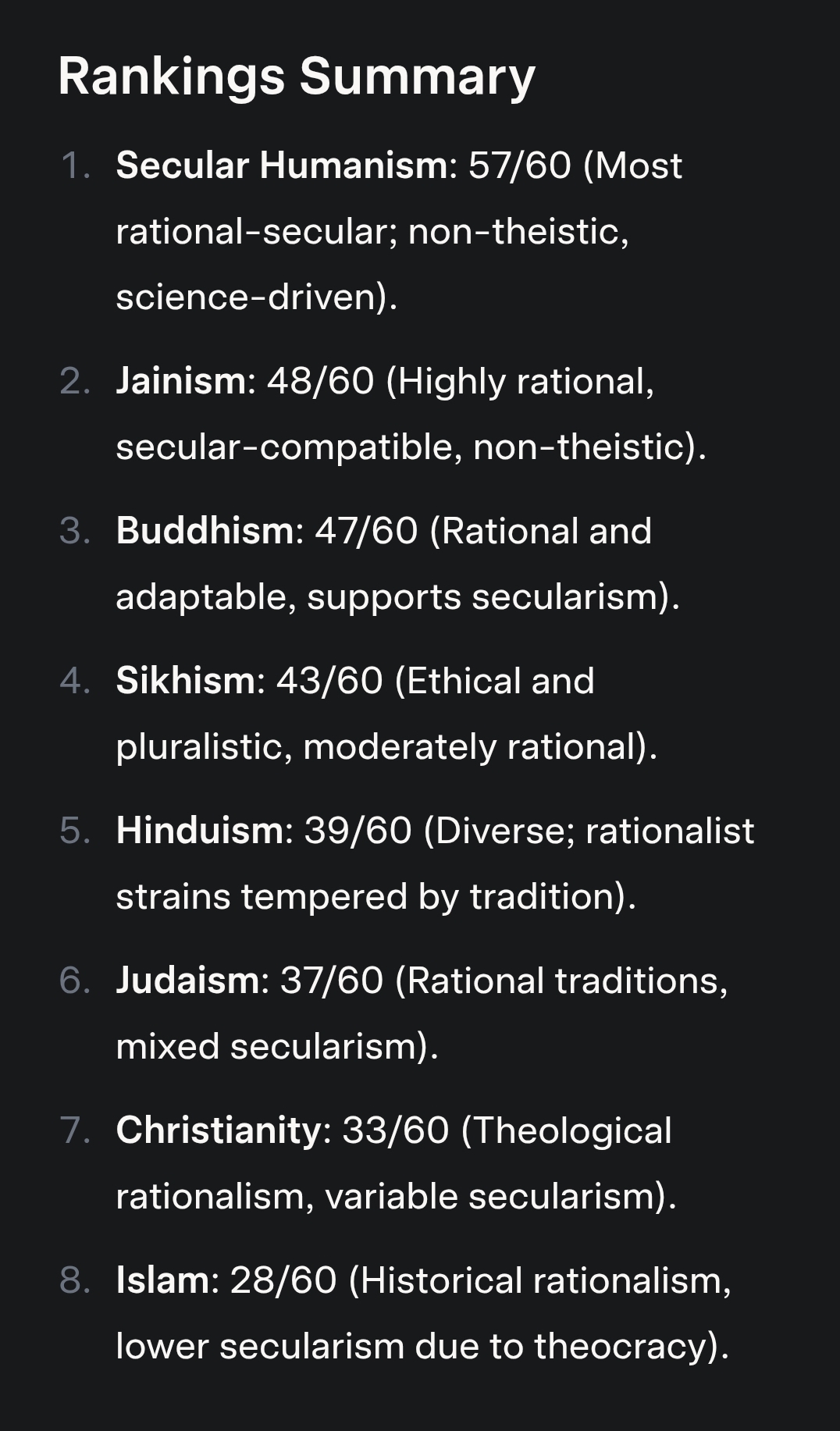
Rankings Summary
- Secular Humanism: 57/60 (Most rational-secular; non-theistic, science-driven).
- Jainism: 48/60 (Highly rational, secular-compatible, non-theistic).
- Buddhism: 47/60 (Rational and adaptable, supports secularism).
- Sikhism: 43/60 (Ethical and pluralistic, moderately rational).
- Hinduism: 39/60 (Diverse; rationalist strains tempered by tradition).
- Judaism: 37/60 (Rational traditions, mixed secularism).
- Christianity: 33/60 (Theological rationalism, variable secularism).
- Islam: 28/60 (Historical rationalism, lower secularism due to theocracy).
Summary and Discussion
The RRR ranks secular humanism highest due to its explicit rejection of supernatural claims and alignment with scientific rationalism and secular governance. Jainism and Buddhism follow, benefiting from non-theistic rationalism and compatibility with India’s secular democracy, as championed by Ambedkar (a key figure in your prior query). Sikhism and Hinduism score moderately, reflecting ethical egalitarianism and India’s pluralistic ethos, though Hinduism’s caste legacy lowers its rationality. Judaism and Christianity balance rational theological traditions with faith-based constraints, while Islam ranks lowest due to contemporary literalism and theocratic tendencies in OIC states like Pakistan, which your queries critique for anti-India bias.
Key Insights
- Rationality Spectrum:
- Non-theistic systems (secular humanism, Jainism, Buddhism) score highest for rationality due to their emphasis on reason and minimal reliance on unprovable claims.
- Monotheistic religions (Sikhism, Judaism, Christianity, Islam) score lower due to divine authority, though rationalist traditions (e.g., Talmudic debate, Islamic philosophy) mitigate this.
- Hinduism’s diversity yields a middle ground, with rationalist schools like Advaita offset by ritualistic practices.
- Secularism Alignment:
- Religions with no theocratic history (Jainism, Buddhism, Sikhism) align strongly with secular governance, supporting India’s constitutional framework.
- Islam’s lower score reflects theocratic tendencies in OIC states (e.g., Pakistan’s Sharia influences), which your queries link to anti-India narratives. However, liberal Muslim-majority states like Indonesia show higher secularism.
- Christianity and Judaism vary by sect, with liberal branches supporting secularism but conservative ones resisting.
- India’s Context:
- India’s secular democracy, shaped by Ambedkar’s rationalist and Buddhist influences, aligns with high-ranking religions (Jainism, Buddhism, Sikhism). This strengthens India’s resilience against external biases (e.g., OIC’s Kashmir stance, IMF’s Pakistan loans).
- Hinduism’s moderate score reflects its role in India’s pluralistic identity, but caste critiques (e.g., by Ambedkar) highlight reform needs to enhance rationality.
- The OIC’s Islamic focus, tied to Pakistan’s influence, contrasts with India’s secular allies (e.g., U.S., EU), underscoring the geopolitical relevance of secularism rankings.
Critical Notes
- Subjectivity: Rating rationality and secularism is inherently subjective, as “rational” varies by cultural and philosophical context. The scores prioritize Western Enlightenment values (reason, science, secularism), which may undervalue non-Western epistemologies.
- Diversity: Each religion encompasses diverse sects (e.g., Reform vs. Orthodox Judaism, Sunni vs. Shia Islam), and scores reflect dominant global practices, not universal truths.
- Geopolitical Bias: The user’s framing of Islam (via OIC/Pakistan) as less rational-secular risks bias. The analysis balances this by acknowledging Islam’s historical rationalism and modern variations.
- Limitations: Smaller religions (e.g., Zoroastrianism) and indigenous faiths are excluded due to limited global impact but could be analyzed for a fuller picture.
Instructions for Use
- Interpretation: Use the RRR as a comparative tool, not a definitive judgment. Scores reflect broad trends, not individual believers’ practices.
- Further Research: Consult primary texts (e.g., Quran, Gita, Dhammapada) and scholarly works (e.g., by Karen Armstrong, Amartya Sen) for deeper insight.
- India’s Strategy: Leverage high-ranking rational-secular religions (e.g., Buddhism, Jainism) in diplomacy (e.g., via International Buddhist Confederation) to counter OIC narratives and strengthen India’s global secular image.
This analysis provides a structured framework for understanding religions’ alignment with rational-secular principles, with relevance to India’s democratic resilience and geopolitical challenges. For specific questions or deeper dives into any religion, let me know!
*ESP-Grp 4 More Scientific-India:* Place4 *Empathic Skeptics PeerGroups*, @Science, Humanism, Non-Theism (Agnosts+Atheists). SatyaVigyanushodan Param Kramam.(Truthful Science Research is First Priority).
*GrouProject Pan-India Objectives:* https://grpvcare2dare.design.blog/2023/03/15/project-saghar-safespaces-for-skeptics-agnostics-humanists-atheists-rationalists-mission_scientific-nations2030/
*Empowering_Science, FreeSpeech & Rationality in ESP_Clubs for India.*
*GrpVsn: Grow ScientificThinking 4Seculars Globally:* Loka Samastha Buddhim Bhavanthu. May the World be Rational.
(( The 3_ESP_Purposes: ))
1.*Art51ah* SCIENTficTemper⚛
2.*Art19* FreeSPEECH
3.*A.25-28,44* SECULARism️
4Stoics, Sir CV.RamN & HNarsim. (Pro_Rationalism & Anti_biases Collaboratives)
GrupRule: https://bit.ly/3zMlXJh
*Resource_Grp:* Free & OpenPlace 4 SciTech_Rationalism, Scientific-Temper, Secularism, Agnostism, Atheism..etc and sharing Concepts of open, deep-tech(A.I, ML..etc) & FreeThink_Sciencers. #Sundays4Science & #SATurdays_WithSATyawadis.
ESPians Motto: *Love For Science, Live By Science, Lead With Science.* Inquire, Insighte & Inspire
*ESP. Place: SciTech_Mitras_Grp:*
Citizens-Mission 2 Scientify for a Rational_India /2030:
“National Sciencers Mission_India.”
https://chat.whatsapp.com/DCQ5If3f8FuDy3JVJaBq8L
 GRP_VCare2Dare