Let’s analyze the Indo-Pak conflict by expanding the scope to include China and the U.S. as key players, focusing on the “wolfing” (profiteering) dynamics at the intersection of three nations/regions (India, Pakistan, China) and their ideological/religious frameworks: Non-Abrahamic (India as a Secular-Hindu nation), Islamic (Pakistan), Communist (China, pseudo-secular), and Christian-majority nations (U.S., UK, Canada). We’ll use the “2 Dogs and a Wolf” allegory as a foundation, integrate game theory to model the interactions, and propose resolutions to mitigate the wolves’ profiteering while fostering cooperation.
Framing the Conflict: Players, Ideologies, and Wolfing
Players and Ideologies
- India (Non-Abrahamic, Secular-Hindu): A secular democracy with a Hindu majority, India seeks to maintain control over Kashmir, counter terrorism, and assert regional dominance while navigating its secular identity amidst Hindu nationalist currents.
- Pakistan (Islamic): An Islamic republic, Pakistan contests India’s control over Kashmir, often framing the conflict as a religious struggle (Muslim-majority Kashmir vs. Hindu-majority India), and relies on Islamic ideology to rally domestic and regional support.
- China (Communist, Pseudo-Secular): A communist state with a pseudo-secular stance (officially atheist but culturally influenced by Confucianism/Buddhism), China supports Pakistan via the China-Pakistan Economic Corridor (CPEC) and uses the conflict to counter India’s rise, aligning with its geopolitical goal of regional dominance.
- U.S./Western Bloc (Christian-Majority, Secular): The U.S., UK, and Canada, as Christian-majority nations with secular governance, balance relations with India (a democratic ally) and Pakistan (a partner in counterterrorism), often prioritizing strategic interests over ideological alignment.
The “Wolfing” Dynamic
The “2 Dogs and a Wolf” allegory now expands to multiple wolves: China, the U.S./Western bloc, and financial institutions like the IMF profit from the conflict between India and Pakistan (the “dogs”) by exploiting their rivalry over Kashmir (the “bone”). The intersection of ideologies/religions adds complexity, as each player leverages ideological narratives to justify actions, while the wolves benefit from the resulting instability.
Intersections of Nations/Regions and Ideologies
- Geopolitical Intersections:
- India-Pakistan-China Triangle: India and Pakistan’s conflict over Kashmir intersects with China’s involvement via its border disputes with India (e.g., Aksai Chin) and support for Pakistan (CPEC). China benefits from a distracted India, weakening its regional rival.
- U.S./Western Involvement: The U.S. engages both India (to counter China) and Pakistan (for counterterrorism), creating a quadrilateral dynamic where Western interests intersect with South Asian conflicts.
- Ideological/Religious Intersections:
- Non-Abrahamic vs. Islamic: India’s secular-Hindu identity clashes with Pakistan’s Islamic framing of the Kashmir issue, fueling religious tensions that wolves exploit (e.g., by supplying arms to both).
- Communist vs. Democratic: China’s communist system contrasts with India’s democracy, while its pseudo-secular stance avoids religious framing, focusing on strategic gains.
- Christian-Majority vs. Others: The U.S./Western bloc, while secular, is perceived as a Christian-majority entity, and its actions (e.g., IMF loans, arms sales) are often interpreted through a lens of Western dominance, adding an ideological layer to the conflict.
Game-Theoretic Payoff Matrix: Four Players
To model this complex dynamic, we’ll simplify the game by focusing on India and Pakistan as the primary players (the “dogs”), with China and the U.S./Western bloc as wolves whose payoffs increase with conflict. We’ll use a two-player matrix for India and Pakistan, with a separate column for the combined payoff of the wolves (China + U.S./Western bloc). Payoffs reflect security, economic, and ideological gains/losses, adjusted for wolfing dynamics.
Payoff Matrix
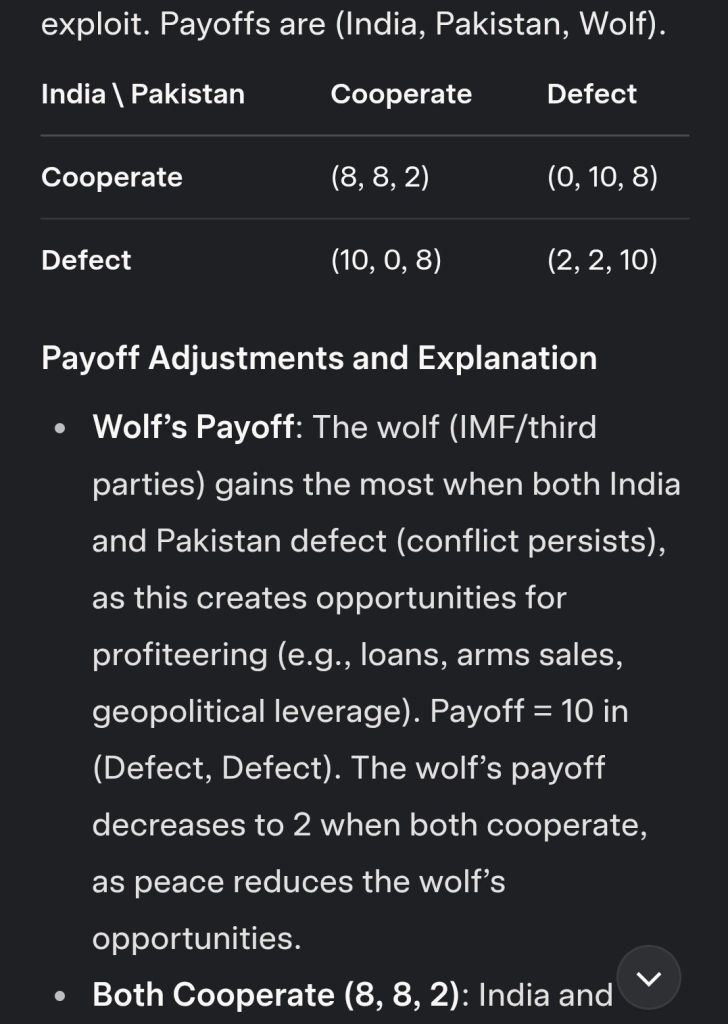
Strategies: Cooperate (pursue peace, reduce tensions) or Defect (escalate conflict, e.g., ceasefire violations, militancy). Payoffs are (India, Pakistan, Wolves).India \ PakistanCooperateDefectCooperate (8, 8, 2) (0, 10, 10) Defect (10, 0, 10) (2, 2, 15)
Payoff Breakdown
- India and Pakistan Payoffs: Same as before, reflecting security, economic costs, and domestic support. Cooperation yields mutual benefits (8, 8), while defection leads to a stalemate (2, 2) or short-term gains for one at the other’s expense (10, 0 or 0, 10).
- Wolves’ Payoff (China + U.S./Western Bloc):
- Both Cooperate (2): When India and Pakistan cooperate, the wolves’ payoff is low because peace reduces dependency on arms, loans, and geopolitical leverage.
- One Cooperates, One Defects (10): Tensions provide opportunities for wolves—e.g., China supports Pakistan (CPEC), the U.S. sells arms to India, and the IMF lends to Pakistan.
- Both Defect (15): Maximum wolf payoff occurs when conflict peaks (e.g., ceasefire violations, militancy). China gains by weakening India, the U.S./Western bloc profits from arms sales and strategic influence, and the IMF benefits from loan interest.
Nash Equilibrium
The Nash Equilibrium remains (Defect, Defect), as India and Pakistan are incentivized to defect due to distrust and short-term gains (e.g., Pakistan’s militancy boosts domestic support, India’s military presence asserts control). The wolves’ high payoff (15) in this scenario reinforces their interest in perpetuating conflict.
How Wolves Profit at Ideological/Religious Intersections
The wolves exploit the ideological and religious differences between India (Non-Abrahamic/Secular-Hindu), Pakistan (Islamic), China (Communist/Pseudo-Secular), and the U.S./Western bloc (Christian-majority/Secular) to maximize their gains:
1. China (Communist/Pseudo-Secular)
- Geopolitical Gains: China uses the Indo-Pak conflict to weaken India, its main regional rival. By supporting Pakistan through CPEC and military aid, China ensures India remains distracted, unable to challenge China’s dominance (e.g., in the South China Sea or along the LAC).
- Ideological Exploitation: China’s pseudo-secular stance avoids religious framing, but it leverages Pakistan’s Islamic identity to rally anti-India sentiment, indirectly fueling the conflict.
- Economic Profiteering: CPEC projects (e.g., infrastructure in Pakistan) secure China’s access to the Arabian Sea, while the conflict ensures Pakistan’s dependency on Chinese support, benefiting China economically and strategically.
2. U.S./Western Bloc (Christian-Majority/Secular)
- Arms Sales: The U.S. supplies arms to India (e.g., $3 billion drone deal in 2024) and Pakistan (e.g., F-16 upgrades), profiting from the arms race. The UK and Canada, as NATO allies, also benefit from defense contracts.
- Geopolitical Leverage: The U.S. uses the conflict to maintain influence—allying with India to counter China, while keeping Pakistan as a counterterrorism partner (e.g., post-9/11 cooperation). This dual engagement ensures the U.S. remains a key player in South Asia.
- Ideological Framing: The U.S./Western bloc frames its involvement as promoting democracy (India) or countering extremism (Pakistan), but its actions (e.g., IMF loans) often exacerbate tensions, aligning with the wolf’s profiteering role.
3. IMF (Western-Influenced Financial Institution)
- Loan Profiteering: The IMF, influenced by Western nations, provides loans to Pakistan (e.g., $1.3 billion under consideration in May 2025), earning interest while deepening Pakistan’s dependency. X posts suggest these funds may fuel military actions (e.g., tanks at Liaquatpur), escalating the conflict.
- Ideological Exploitation: The IMF operates under a Western secular framework but indirectly exploits the Islamic vs. Non-Abrahamic divide by funding Pakistan, knowing it will prioritize military spending over development, thus perpetuating the conflict.
4. Ideological/Religious Intersections as a Catalyst
- Non-Abrahamic vs. Islamic: Pakistan frames Kashmir as a religious struggle, rallying Islamic support (e.g., from OIC nations), while India’s secular-Hindu identity fuels domestic narratives of protecting national integrity. Wolves exploit this divide by supplying arms or funds, knowing ideological tensions will sustain conflict.
- Communist vs. Democratic: China’s support for Pakistan aligns with its goal of countering democratic India, while the U.S. backs India to contain China. This ideological clash ensures the conflict remains a proxy battleground, benefiting wolves.
- Christian-Majority vs. Others: The U.S./Western bloc’s involvement is perceived as Western dominance, adding a layer of resentment that wolves exploit to justify their actions (e.g., “countering extremism” narratives).
Wiser Resolutions: Mitigating Wolfing at Intersections
To reduce the wolves’ profiteering and improve the situation, India and Pakistan must cooperate, while addressing the ideological/religious intersections that fuel conflict. Here’s how game theory and the allegory guide resolutions:
1. Shift the Payoff Matrix: Reduce Wolves’ Incentive
- Disincentivize Conflict:
- IMF Reform: India and Pakistan should jointly demand IMF conditions that prioritize development over military spending (e.g., redirecting funds to education in Pakistan). This lowers the wolves’ payoff for (Defect, Defect) (e.g., from 15 to 5).
- Arms Control: A UN resolution limiting arms sales to conflict zones (enforced by neutral parties) reduces the U.S. and China’s payoff for perpetuating conflict.
- Incentivize Cooperation:
- Regional Blocs: India and Pakistan can form a South Asian coalition (e.g., via SAARC) to negotiate with China and the U.S., raising their payoffs for (Cooperate, Cooperate) (e.g., to 10, 10, 0) through trade benefits.
2. Bridge Ideological/Religious Divides
- Non-Abrahamic vs. Islamic:
- Interfaith Dialogue: India and Pakistan can promote interfaith initiatives in Kashmir (e.g., joint Hindu-Muslim community projects), reducing religious polarization and the wolves’ ability to exploit it.
- Secular Focus: India should emphasize its secular identity in Kashmir (e.g., by ensuring equal rights), while Pakistan reduces its Islamic framing, focusing on humanitarian issues (e.g., Kashmiri welfare).
- Communist vs. Democratic:
- Trilateral Talks: India, Pakistan, and China can hold talks to address border issues (e.g., LAC, CPEC), reducing China’s incentive to fuel Indo-Pak tensions.
- Economic Integration: A trilateral trade agreement (e.g., energy corridors) aligns China’s payoff with regional stability, not conflict.
- Christian-Majority vs. Others:
- Neutral Mediation: Involve non-Western mediators (e.g., ASEAN nations) to reduce perceptions of Western dominance, lowering ideological tensions.
- Transparency: Demand transparency in U.S./IMF actions (e.g., loan conditions), ensuring they don’t exacerbate conflict.
3. Bilateral Cooperation: Starve the Wolves
- CBMs Across Ideologies: India and Pakistan can start with small cooperative actions—e.g., cultural exchanges (Hindu-Muslim festivals), trade resumption, and joint disaster response. This raises their payoffs for cooperation, while reducing the wolves’ opportunities (e.g., arms sales decline).
- Kashmiri Empowerment: Granting Kashmiris autonomy and economic opportunities (e.g., tourism development) reduces the “bone’s” value, making ideological clashes less central and wolfing less profitable.
4. Counter Wolfing Through Regional Unity
- South Asian Solidarity: India and Pakistan can lead a unified South Asian front to negotiate with China and the U.S., reducing dependency on wolves. For example, a joint stance on IMF loans ensures funds benefit development, not conflict.
- Diversify Alliances: Both nations can engage with neutral players (e.g., Russia, Japan) to dilute China and U.S. influence, weakening the wolves’ leverage.
5. Reframe the Narrative: From Ideology to Coexistence
- Human-Centric Focus: Shift public narratives from ideological/religious divides (e.g., Hindu vs. Muslim, Communist vs. Democratic) to shared human goals—e.g., economic growth, climate action. This reduces the wolves’ ability to exploit divisions.
- Expose Wolfing: Public campaigns highlighting how wolves profit (e.g., IMF debt traps, arms sales) can rally domestic support for cooperation, making (Cooperate, Cooperate) politically viable.
Interpretation: Wolves Thrive on Ideological Divides, But Cooperation Starves Them
The Indo-Pak conflict, at the intersection of India (Non-Abrahamic/Secular-Hindu), Pakistan (Islamic), China (Communist/Pseudo-Secular), and the U.S./Western bloc (Christian-majority/Secular), creates a fertile ground for wolfing. China, the U.S., and the IMF profit by exploiting ideological/religious divides—fueling conflict through arms sales, loans, and geopolitical maneuvers. The game-theoretic matrix shows that wolves maximize their payoff (15) when India and Pakistan defect, perpetuating a stalemate that benefits the wolves at the expense of the region.
However, wiser resolutions can mitigate this:
- Few Solutions Exist: The conflict’s complexity, exacerbated by ideological intersections, makes a definitive solution unlikely, as the wolves thrive on division.
- Wiser Resolutions Bridge Divides: By addressing ideological tensions (e.g., interfaith dialogue, trilateral talks), shifting payoffs (e.g., IMF conditions, arms control), and fostering cooperation (e.g., CBMs, regional unity), India and Pakistan can reduce the wolves’ influence.
- Coexistence Over Victory: Reframing the narrative from ideological rivalry to shared goals starves the wolves, allowing the region to focus on coexistence and mutual benefit.
By uniting against the wolves and prioritizing cooperation over ideological divides, India, Pakistan, and their neighbors can weaken the profiteers, fostering a more stable and prosperous South Asia. If you’d like a more detailed matrix with all four players, let me know!
 GRP_VCare2Dare