Kashmir on Face is a Conflict of 2 Nations but in Deeper Reality its a front of 3 Civilizational-Ideologies ((Religions (Anti-Secular), Secularism & Communism (Anti-Secular)).
India, Pakistan, China & US, and seeing as conflict of Non-Abrahamic (Secular-Induus nation), Abro-Islamic Nations, Communist Nations (Psuedo-Secular as its Anti-religions) & Abro-Christian Majority nations (US,UK, Canada…Etc) & Abro-Judaic(Israel).
Let’s analyze the Indo-Pak conflict, focusing on the role of the IMF and other third parties as potential “wolves” (funding actors) in the context of the “2 Dogs and a Wolf” story from the provided link. The story serves as an allegory where two dogs (representing India and Pakistan) fight over a bone (Kashmir), while a wolf (third parties like the IMF) benefits from their conflict by taking the bone. We’ll tie this to the game-theoretic framework already established, explore how the IMF and other actors might be “profiteering” from the conflict, and propose resolutions to mitigate this dynamic.
The Allegory: “2 Dogs and a Wolf” in the Indo-Pak Context
The story “2 Dogs and a Wolf,” as referenced, illustrates two dogs fighting over a bone, too distracted to notice a wolf that ultimately benefits by taking the bone for itself. In the Indo-Pak context:
- Two Dogs: India and Pakistan, locked in a prolonged conflict over Kashmir since 1947, marked by wars, terrorism, and recent ceasefire violations.
- The Bone: The Kashmir issue, a territorial and ideological dispute fueling animosity.
- The Wolf: The IMF and other third parties (e.g., global powers like the U.S. and China, arms suppliers, or financial institutions), which may exploit the conflict for their own gain.
The allegory suggests that while India and Pakistan focus on their rivalry, third parties benefit—potentially through financial, geopolitical, or strategic gains—leaving the two nations weakened.
Game-Theoretic Payoff Matrix: Incorporating the Wolf
Let’s revisit the payoff matrix from the previous discussion, now explicitly including the “wolf” (IMF and third parties) as a player whose payoff increases when India and Pakistan remain in conflict. We’ll model this as a three-player game, but for simplicity, we’ll first adjust the two-player matrix (India vs. Pakistan) to reflect the wolf’s influence, then discuss the wolf’s role separately.
Updated Payoff Matrix (India vs. Pakistan, with Wolf’s Influence)
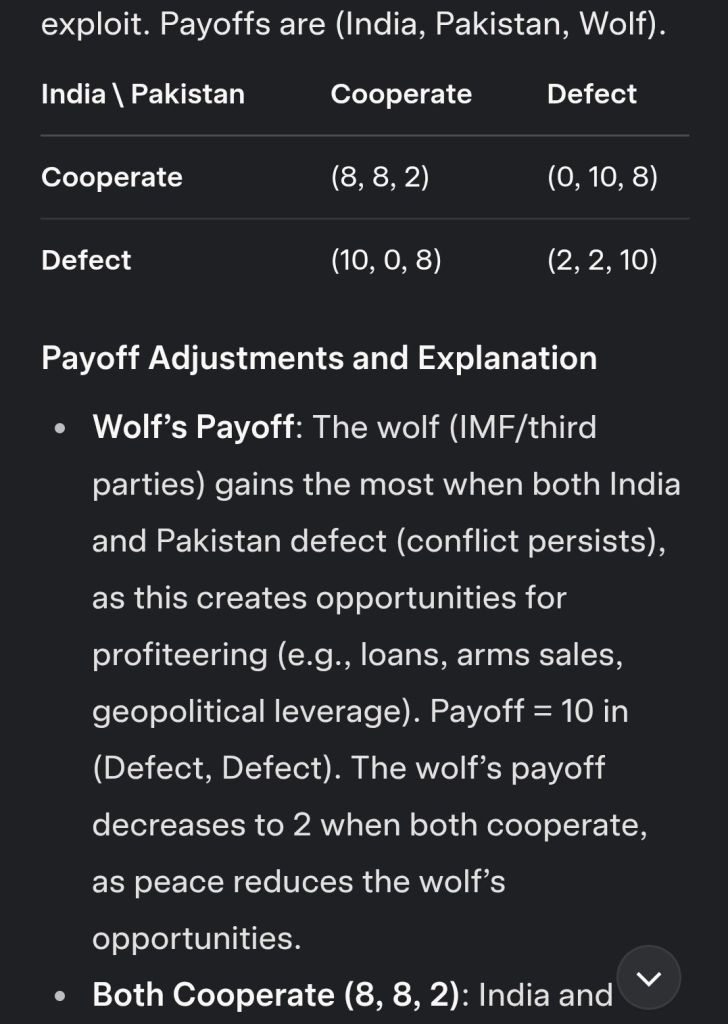
The original matrix showed India and Pakistan’s strategies (Cooperate or Defect) and their payoffs. Now, we’ll adjust the payoffs to account for the wolf’s profiteering when conflict persists. The wolf’s gain (e.g., financial or geopolitical) is higher when both defect, as their conflict creates opportunities for the wolf to exploit. Payoffs are (India, Pakistan, Wolf).India \ PakistanCooperateDefectCooperate (8, 8, 2) (0, 10, 8) Defect (10, 0, 8) (2, 2, 10)
Payoff Adjustments and Explanation
- Wolf’s Payoff: The wolf (IMF/third parties) gains the most when both India and Pakistan defect (conflict persists), as this creates opportunities for profiteering (e.g., loans, arms sales, geopolitical leverage). Payoff = 10 in (Defect, Defect). The wolf’s payoff decreases to 2 when both cooperate, as peace reduces the wolf’s opportunities.
- Both Cooperate (8, 8, 2): India and Pakistan gain from peace (security, economic savings), but the wolf’s payoff drops because a stable region reduces dependency on loans or external intervention.
- One Cooperates, One Defects (0, 10, 8) or (10, 0, 8): The defecting player gains a short-term advantage, but the wolf still benefits (payoff = 8) from the ongoing tension, as it can lend to the disadvantaged player or exploit the instability.
- Both Defect (2, 2, 10): The current stalemate—ceasefire violations, militancy, and distrust—hurts both India and Pakistan, but the wolf maximizes its payoff (10) by fueling the conflict through financial mechanisms (e.g., IMF loans to Pakistan) or geopolitical maneuvers.
Nash Equilibrium and the Wolf’s Role
The Nash Equilibrium remains (Defect, Defect) for India and Pakistan, as neither can unilaterally improve their payoff by cooperating, given the other’s defection. However, the wolf’s high payoff in this scenario (10) incentivizes it to perpetuate the conflict. For example:
- IMF Funding: Posts on X indicate Pakistan recently sought a $1.3 billion IMF loan (April 2025), with India opposing it, fearing the funds might fuel Pakistan’s military actions (e.g., tanks at Liaquatpur station, as noted in X posts). The IMF benefits by charging interest on loans, while Pakistan’s dependency on external funding deepens, keeping it in conflict with India.
- Arms Sales: Third parties (e.g., the U.S., China) supply arms to both nations—Pakistan through direct support, India through defense deals—profiting from the arms race while the conflict persists.
How the Wolf (IMF and Third Parties) Profits from the Conflict
The allegory’s wolf benefits by exploiting the dogs’ distraction. In the Indo-Pak context, the IMF and other third parties profit in several ways:
1. IMF Profiteering Through Loans
- Pakistan’s Dependency: Pakistan’s economic struggles make it reliant on IMF loans (e.g., the $1.3 billion loan under consideration on May 9, 2025). The IMF profits through interest payments, but these loans often come with conditions that limit Pakistan’s autonomy, creating a cycle of dependency.
- Conflict Fuel: X posts suggest that Pakistan uses IMF funds to sustain military activities (e.g., fueling tanks and jets), escalating tensions with India. This benefits the IMF by ensuring Pakistan remains a client, as conflict prevents economic self-sufficiency.
- India’s Response: India’s opposition to IMF loans (as seen in X posts) strains its diplomatic relations, forcing it to spend more on defense and lobbying, indirectly benefiting global financial systems that profit from such expenditures.
2. Geopolitical Leverage by Third Parties
- U.S. and China: Both nations have stakes in the region—China supports Pakistan via the CPEC (China-Pakistan Economic Corridor), while the U.S. balances relations with India and Pakistan. The conflict allows them to maintain influence, as both India and Pakistan seek their support.
- Arms Trade: The U.S. and China supply arms to India and Pakistan, respectively, profiting from the ongoing tensions. Conflict ensures a steady market for weapons, benefiting these “wolves” while draining resources from both nations.
3. Economic Exploitation
- Resource Diversion: Both India and Pakistan divert significant resources to defense—India’s military budget is among the world’s highest, while Pakistan allocates a large portion of its budget (and IMF loans) to its military. This diverts funds from development, keeping both nations economically vulnerable and reliant on external actors.
- Debt Traps: The IMF’s loans to Pakistan, while providing short-term relief, often lead to long-term debt traps, benefiting the IMF and its member countries (who hold influence over its decisions) while keeping Pakistan in a cycle of borrowing.
4. Distraction from Domestic Issues
- The conflict allows India and Pakistan to distract from domestic challenges (e.g., economic inequality, unemployment) by focusing on an external enemy. This benefits third parties indirectly, as it prevents either nation from achieving the stability needed to challenge global power structures.
Wiser Resolutions: Mitigating the Wolf’s Influence
The game-theoretic framework and the allegory both suggest that India and Pakistan’s focus on conflict allows the wolf to profit. To improve the situation, resolutions must reduce the wolf’s payoff for perpetuating conflict and encourage India and Pakistan to cooperate. Here’s how:
1. Shift the Payoff Matrix: Reduce the Wolf’s Incentive
- IMF Conditionality: The IMF should tie loans to peace-building measures (e.g., reducing military spending, halting militancy). This lowers the wolf’s payoff for (Defect, Defect) by making conflict less profitable for Pakistan. For example, if Pakistan’s loan is contingent on ceasefire adherence, its payoff for defection drops (e.g., from 10 to 5 when India cooperates).
- International Pressure: Global powers (e.g., U.S., China) should face diplomatic consequences for fueling the conflict through arms sales. A UN resolution penalizing arms supplies to conflict zones could reduce the wolf’s payoff, shifting the equilibrium toward cooperation.
2. Build Bilateral Cooperation: Starve the Wolf
- Confidence-Building Measures (CBMs): India and Pakistan can start with small cooperative actions—e.g., honoring ceasefires, resuming trade across the Line of Control, or cultural exchanges. This raises their payoffs for (Cooperate, Cooperate) to (10, 10, 0), starving the wolf of opportunities to profit (payoff drops to 0).
- Joint Economic Projects: Initiatives like a trans-Kashmir energy pipeline could create mutual economic benefits, making peace more rewarding than conflict. The wolf’s influence diminishes as both nations become less reliant on external funding or arms.
3. Empower Kashmiris: Reduce the Bone’s Value
- The “bone” (Kashmir) fuels the conflict because of its symbolic and strategic value. Including Kashmiris in the resolution process—e.g., granting them greater autonomy or economic opportunities—reduces the bone’s contentiousness. If Kashmiris benefit from peace (e.g., through development), they’re less likely to support militancy, lowering Pakistan’s payoff for defection and the wolf’s ability to exploit unrest.
4. Expose and Counter the Wolf’s Tactics
- Transparency in Funding: India and Pakistan should jointly demand transparency in IMF lending practices, ensuring funds aren’t used to fuel conflict. A unified stance reduces the wolf’s ability to play one against the other.
- Diversify Alliances: Both nations can reduce dependency on third parties by diversifying their economic and diplomatic ties—e.g., India strengthening ties with the EU, Pakistan engaging with ASEAN. This weakens the wolf’s leverage.
5. Reframe the Narrative: From Conflict to Coexistence
- The allegory warns that the dogs lose the bone by fighting. India and Pakistan should reframe their narrative from a zero-sum territorial dispute to a shared goal of regional stability. Public campaigns highlighting the costs of conflict (e.g., economic drain, human suffering) and the wolf’s profiteering can shift domestic support toward cooperation, making (Cooperate, Cooperate) politically viable.
Interpretation: The Wolf Thrives on Conflict, But Cooperation Can Starve It
The “2 Dogs and a Wolf” story aptly captures the Indo-Pak conflict: while India and Pakistan fight over Kashmir, the IMF and other third parties profit by perpetuating the conflict—through loans, arms sales, and geopolitical leverage. The game-theoretic payoff matrix shows that the wolf’s highest payoff comes when both nations defect, as conflict creates opportunities for exploitation. However, wiser resolutions can mitigate this:
- Few Solutions Exist: The conflict’s ill-posed nature (no clear, unique, stable solution) is exacerbated by the wolf’s profiteering, which incentivizes continued defection.
- Wiser Resolutions Starve the Wolf: By adjusting payoffs (e.g., IMF conditionality, international pressure), building bilateral cooperation (e.g., CBMs, joint projects), and empowering Kashmiris, India and Pakistan can reduce the wolf’s influence, shifting the equilibrium toward peace.
- Coexistence Over Victory: The allegory’s lesson is clear—stop fighting over the bone, or the wolf wins. Focusing on coexistence rather than territorial victory allows both nations to reclaim agency, improving the situation even if the dispute persists.
By recognizing the wolf’s role and strategically cooperating, India and Pakistan can weaken the third parties’ profiteering, fostering a more stable and prosperous region.
 GRP_VCare2Dare