To align the IISCh Method (Inspiration, Initiation, Struggle, Collaboration, Harmonization) with the concept of “1% Inspiration & 99% Perspiration,” we need to distribute the 99% perspiration across the Initiation, Struggle, Collaboration, and Harmonization phases while assigning 1% to Inspiration. Below, I’ll define each phase, propose a percentage distribution for the perspiration components, and explain the rationale. The percentages for Initiation (X%), Struggle (Y%), Collaboration (Z%), and Harmonization (a%) will sum to 99%, reflecting the effort-driven nature of perspiration.
IISCh Method: Inspiration (1%) & Perspiration (99%)
The IISCh Method reframes the original Initiate, Introduce, Succeed, Collective-harmony as Inspiration, Initiation, Struggle, Collaboration, and Harmonization, emphasizing the creative spark (Inspiration) and the sustained effort (Perspiration) required for success. The perspiration is distributed as follows, based on typical project dynamics:
- Inspiration: 1% (The initial spark or idea that sets the project in motion)
- Initiation: 20% (Planning and laying the groundwork)
- Struggle: 30% (Overcoming challenges during execution)
- Collaboration: 35% (Teamwork and coordination to drive progress)
- Harmonization: 14% (Reflection and integration for lasting impact)
These percentages total 100% (1% Inspiration + 99% Perspiration). Below is a detailed breakdown of each phase, including steps, principles, and how they contribute to the 1%/99% framework.
1. Inspiration (1%)
Purpose: Ignite the creative spark that motivates the project or goal, capturing the essence of the “1% Inspiration.”
Description: This phase represents the moment of insight, vision, or motivation that initiates the journey. It’s the “aha” moment that provides direction but requires minimal effort compared to the work ahead.
Steps:
- Identify the core idea or problem to solve (e.g., a new product concept Islam, 2025).
- Articulate a compelling vision statement to inspire stakeholders.
- Validate the idea’s feasibility with quick research or feedback.
Key Principles:
- Clarity: Ensure the idea is simple and compelling.
- Passion: Infuse the vision with emotional resonance.
- Focus: Keep this phase brief to maintain momentum.
Contribution to 1%/99%: Inspiration is the 1% spark that sets everything in motion. It’s the creative seed that requires minimal effort but has outsized impact, as it defines the project’s purpose.
Example: For a startup, Inspiration might be the realization that a gap exists in the market for sustainable packaging, sparking the idea for an eco-friendly product.
2. Initiation (20%)
Purpose: Establish the foundation for the project by translating inspiration into a structured plan.
Description: This phase involves setting goals, allocating resources, and defining roles. It’s the first major effort of perspiration, requiring discipline to turn an idea into a roadmap.
Steps:
- Define SMART goals (Specific, Measurable, Achievable, Relevant, Time-bound).
- Identify resources (budget, team, tools) and constraints.
- Assign roles and responsibilities to team members.
- Create a project timeline and select tools (e.g., Trello, Asana).
Key Principles:
- Structure: Build a clear, actionable plan.
- Alignment: Ensure stakeholder buy-in and shared understanding.
- Proactivity: Anticipate risks and plan contingencies.
Contribution to 1%/99%: Initiation accounts for 20% of the effort, as it requires significant work to organize and plan but is less intensive than the execution and coordination phases.
Example: For the sustainable packaging startup, Initiation involves researching materials, setting a budget, assembling a team, and creating a 6-month product development plan.
3. Struggle (30%)
Purpose: Overcome challenges and execute the plan amidst obstacles, embodying the gritty effort of perspiration.
Description: This phase is the heart of perspiration, where the team faces setbacks, iterates, and pushes through difficulties to achieve milestones.
Steps:
- Execute tasks according to the plan, tracking progress with KPIs.
- Address challenges using agile methods (e.g., sprints, retrospectives).
- Iterate based on feedback or unexpected hurdles.
- Maintain team morale through regular check-ins and encouragement.
Key Principles:
- Resilience: Persist through setbacks with problem-solving.
- Adaptability: Pivot when necessary without losing sight of goals.
- Focus: Prioritize high-impact tasks to maintain progress.
Contribution to 1%/99%: Struggle represents 30% of the effort, as it’s the most labor-intensive phase, demanding sustained focus and problem-solving to navigate execution challenges.
Example: In the startup, Struggle involves troubleshooting production issues, addressing supplier delays, and refining prototypes based on testing feedback.
4. Collaboration (35%)
Purpose: Leverage teamwork and collective effort to amplify results, reflecting the power of coordinated perspiration.
Description: This phase emphasizes the intensive coordination required to align diverse skills, perspectives, and contributions toward a shared goal.
Steps:
- Facilitate regular team meetings and communication (e.g., via Slack).
- Encourage inclusive idea-sharing and conflict resolution.
- Integrate cross-functional expertise (e.g., design, marketing, engineering).
- Use collaboration tools to streamline workflows (e.g., Google Docs, Jira).
Key Principles:
- Synergy: Achieve more together than individually.
- Trust: Build strong interpersonal relationships.
- Efficiency: Optimize coordination to reduce friction.
Contribution to 1%/99%: Collaboration is the largest share at 35%, as it requires ongoing effort to align team members, manage dependencies, and maintain momentum in a group setting.
Example: The startup team collaborates on product design, with designers, engineers, and marketers working together to finalize branding and production specs.
5. Harmonization (14%)
Purpose: Reflect on outcomes, integrate lessons, and foster unity for sustainable success, completing the perspiration cycle.
Description: This phase consolidates the project’s impact, ensuring lessons are captured and team relationships are strengthened for future work.
Steps:
- Conduct a post-project review to evaluate successes and challenges.
- Gather and share constructive feedback in a safe, open environment.
- Document insights in a knowledge base or final report.
- Celebrate achievements with team-building or recognition events.
Key Principles:
- Reflection: Learn from experience to improve future efforts.
- Unity: Strengthen team bonds for long-term collaboration.
- Closure: Ensure outcomes are sustainable and well-documented.
Contribution to 1%/99%: Harmonization accounts for 14%, as it requires effort to tie up loose ends and reflect, but is less intensive than execution or collaboration.
Example: The startup team reviews sales data, documents supply chain lessons, and hosts a celebration to mark the product launch, reinforcing team cohesion.
Rationale for Percentage Distribution
- Inspiration (1%): Aligns with the “1% Inspiration” concept, reflecting the minimal but critical creative spark.
- Initiation (20%): Planning is essential but less effort-intensive than execution, as it focuses on setup rather than overcoming dynamic challenges.
- Struggle (30%): Execution is highly effort-intensive due to unpredictable obstacles, but slightly less than Collaboration due to its individual focus.
- Collaboration (35%): Teamwork demands the most effort because it involves continuous coordination, communication, and alignment across diverse stakeholders.
- Harmonization (14%): Reflection and closure require effort but are less demanding than active execution or coordination, focusing on consolidation.
The 99% perspiration is distributed to reflect the increasing intensity of effort from planning (Initiation) to execution (Struggle) to teamwork (Collaboration), with a final reduction in effort for reflection (Harmonization).
Visual Representation
[IISCh Method: 1% Inspiration & 99% Perspiration] Inspiration (1%) → Initiation (20%) → Struggle (30%) → Collaboration (35%) → Harmonization (14%) ↑________________________________________________________________________________| (Iterate as needed)
IISCh Method: Inspiration (1%) & Pers“`markdown
Overview
The IISCh Method (Inspiration, Initiation, Struggle, Collaboration, Harmonization) is a framework for achieving success through 1% Inspiration and 99% Perspiration, with perspiration distributed as Initiation (20%), Struggle (30%), Collaboration (35%), and Harmonization (14%).
1. Inspiration (1%)
Purpose: Ignite the creative spark to motivate the project.
- Steps:
- Identify the core idea or problem.
- Articulate a compelling vision.
- Validate feasibility with quick research.
- Principles: Clarity, Passion, Focus.
- Example: Identifying a market gap for sustainable packaging.
2. Initiation (20%)
Purpose: Translate inspiration into a structured plan.
- Steps:
- Define SMART goals.
- Identify resources and constraints.
- Assign roles and create a timeline.
- Principles: Structure, Alignment, Proactivity.
- Example: Researching materials and setting a budget for a startup.
3. Struggle (30%)
Purpose: Overcome challenges during execution.
- Steps:
- Execute tasks and track KPIs.
- Address challenges with agile methods.
- Maintain morale with check-ins.
- Principles: Resilience, Adaptability, Focus.
- Example: Troubleshooting production issues and refining prototypes.
4. Collaboration (35%)
Purpose: Leverage teamwork for amplified results.
- Steps:
- Facilitate meetings and communication.
- Encourage inclusive idea-sharing.
- Integrate cross-functional expertise.
- Principles: Synergy, Trust, Efficiency.
- Example: Designers, engineers, and marketers finalizing product specs.
5. Harmonization (14%)
Purpose: Reflect, integrate lessons, and foster unity.
- Steps:
- Conduct a post-project review.
- Share constructive feedback.
- Document insights and celebrate.
- Principles: Reflection, Unity, Closure.
- Example: Reviewing sales data and hosting a team celebration.
Percentage Rationale
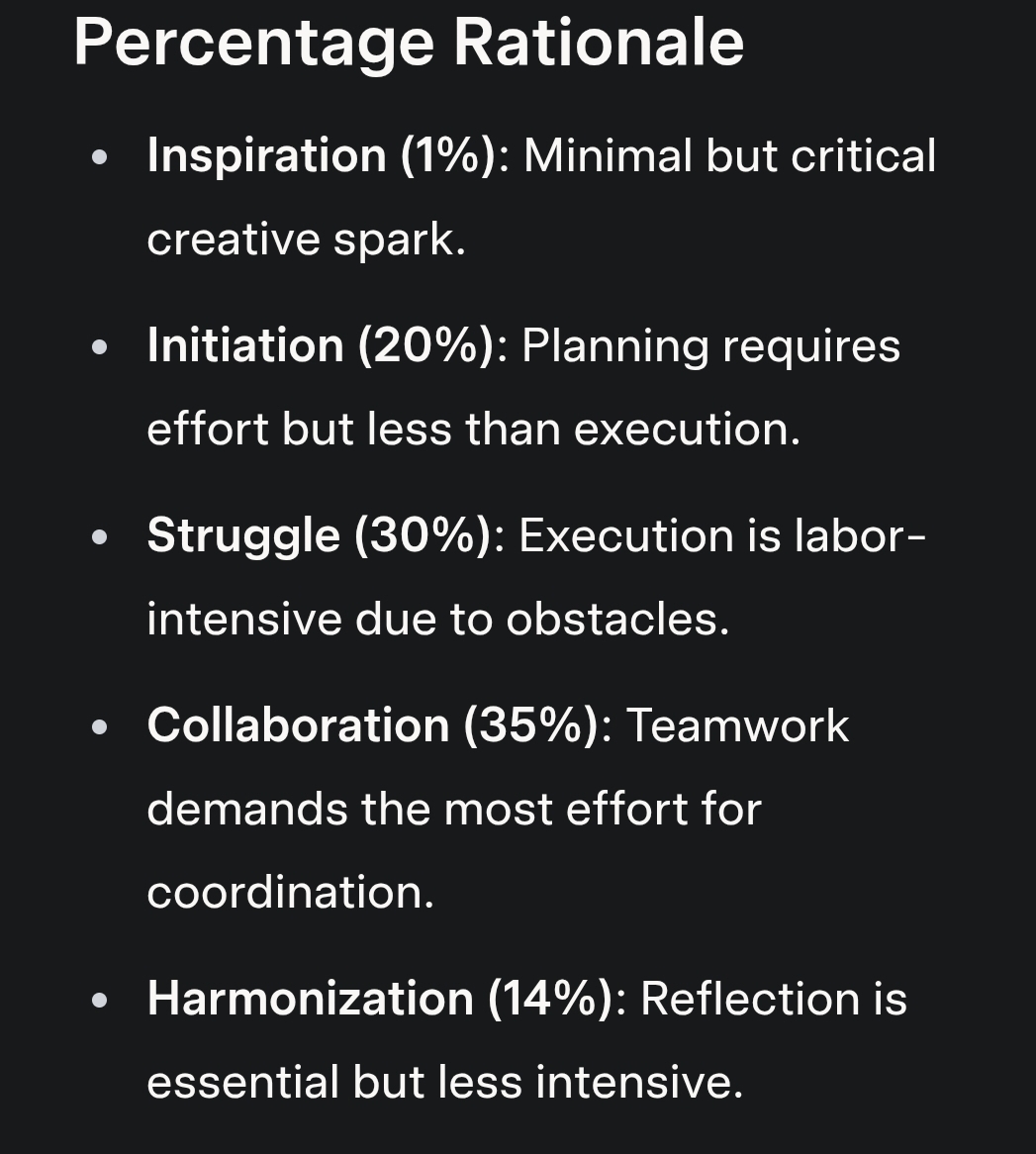
- Inspiration (1%): Minimal but critical creative spark.
- Initiation (20%): Planning requires effort but less than execution.
- Struggle (30%): Execution is labor-intensive due to obstacles.
- Collaboration (35%): Teamwork demands the most effort for coordination.
- Harmonization (14%): Reflection is essential but less intensive.
Applications
- Business: Product launches, team management.
- Education: Group projects, curriculum design.
- Community: Event planning, collaborative initiatives.
“`
This IISCh Method framework provides a clear, actionable structure for turning inspiration into reality through disciplined effort. If you’d like to apply it to a specific project, adjust the percentages, or explore a phase in more detail, let me know!
 GRP_VCare2Dare